Making every protein at all times would be wasteful, but failing to make one when needed could be lethal. Bacteria solve this by wiring gene expression to environmental signals: produce lactose-digesting enzymes only when lactose is present, produce tryptophan-synthesizing enzymes only when tryptophan is scarce. The operon is the central mechanism, and it is one of the highest-yield topics on the MCAT.
Priority labels: Must know = cold; Know the logic = mechanism not names; Passage-level = recognize, don't memorize; Optional = skippable.
The Operon Concept and the Jacob-Monod Model
What Is an Operon?
Must knowAn operon is a cluster of functionally related genes transcribed together as a single polycistronic mRNA (one mRNA encoding multiple proteins). This is unique to prokaryotes — a clear contrast with eukaryotes, where genes are transcribed individually — and it means the genes are expressed all together or not at all.
The four components:
- Promoter — RNA polymerase binding site; where transcription starts.
- Operator — binding site for a regulatory protein (repressor or activator); sits at/near the promoter.
- Structural genes — encode the pathway's enzymes/proteins.
- Regulatory gene — encodes the repressor or activator. It is NOT part of the operon and is expressed constitutively (continuously, low level) to keep regulatory protein available.
The Jacob-Monod Model
Must knowIn 1961, Jacob and Monod modeled the lac operon in E. coli (Nobel 1965): the first molecular explanation of gene regulation, showing that a small environmental molecule can control transcription by modulating protein binding to DNA.
Quick check: Why express metabolic genes as operons rather than individually?
Answer: All enzymes in a pathway are needed together and in proportional amounts, so one regulatory switch is efficient and ensures stoichiometric co-expression.
The lac Operon: Negative Control by Repression
Structure of the lac Operon
Must knowThe lac operon encodes three enzymes for importing and metabolizing lactose:
- lacZ → β-galactosidase: cleaves lactose into glucose + galactose; also converts a little lactose into allolactose, the actual inducer.
- lacY → lactose permease: imports lactose.
- lacA → transacetylase. Optional — lacA's exact role is rarely tested.
The regulatory gene lacI encodes the lac repressor, constitutively produced in small amounts.
How Negative Control Works
Must knowNegative control means a regulatory protein turns transcription off. When the lac repressor binds the operator, it blocks RNA polymerase → no transcription of lacZ, lacY, lacA.
Lactose absent: no allolactose → free repressor binds the operator tightly → transcription OFF. (Why make lactose enzymes with no lactose?)
Lactose present: β-galactosidase (trace amounts leak through) makes allolactose, the inducer. Allolactose binds the repressor, changing its shape so it falls off the operator → RNA polymerase transcribes the genes.
An operon that is normally OFF but turned ON when an inducer removes the repressor is an inducible operon.
Constitutive Mutations and Merodiploids
Passage-levelTwo mutations cause constitutive expression (always ON):
- lacI⁻ (trans-acting): non-functional repressor that can't bind the operator. Because it's a diffusible protein, a wild-type lacI⁺ copy on another DNA molecule can rescue it in trans.
- Oᶜ (operator constitutive, cis-acting): mutant operator that no repressor can bind. It affects only genes on the same DNA molecule, so a wild-type operator in trans does NOT rescue it.
A lacIˢ (super-repressor) binds the operator but not the inducer, so the operon stays OFF (uninducible) even with lactose — dominant in trans.
The cis/trans rule is tested with merodiploids (partial diploids, a second operon copy on an F′ plasmid, written as two genotypes split by a slash). The reliable method: go allele by allele — cis elements (promoter, operator) act only on their own DNA molecule; the lacI repressor is diffusible and acts on both operators.
Quick check: A mutant always makes β-galactosidase even without lactose; adding wild-type lacI on a plasmid corrects it. Is the mutation in lacI or the operator?
Answer: In lacI — a wild-type copy rescues it in trans. An operator (Oᶜ) mutant cannot be rescued in trans.
Positive Control: Catabolite Activator Protein (CAP)
The Glucose Preference Problem
Must knowRemoving the repressor is necessary but not sufficient for high lac transcription. E. coli prefers glucose, so a second layer of control enforces that preference. This layer is positive control — a protein that must actively assist RNA polymerase for high transcription.
Cyclic AMP and CAP
Must knowWhen glucose is low, cAMP is high; when glucose is high, cAMP is low.
CAP (Catabolite Activator Protein, also called CRP) binds cAMP. The CAP-cAMP complex binds upstream of the lac promoter and recruits/stabilizes RNA polymerase, boosting transcription initiation.
Know the logicYou don't need the adenylyl cyclase details — just glucose ↓ → cAMP ↑ → CAP active.
Integrating Both Signals
Must knowThe lac operon has TWO inputs; evaluate both at once:
| Glucose | Lactose | cAMP | Repressor | CAP | Transcription |
|---|---|---|---|---|---|
| Present | Absent | Low | Bound (blocking) | Inactive | ~Zero |
| Present | Present | Low | Released | Inactive | Very low (basal) |
| Absent | Absent | High | Bound (blocking) | Active | ~Zero |
| Absent | Present | High | Released | Active | High |
Only the bottom row — lactose present AND glucose absent — runs the operon at full capacity. This is combinatorial control.
Glucose suppressing the genes for alternative sugars is called catabolite repression (the glucose effect).
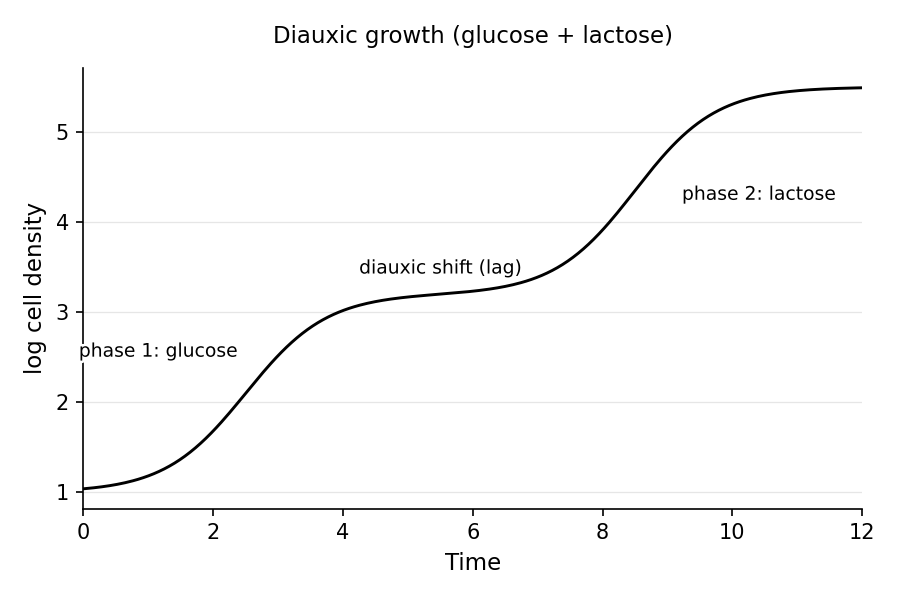
Passage-levelThe diauxic (biphasic) growth curve: in glucose + lactose, E. coli grows on glucose first (lac off), pauses (the diauxic shift/lag) as glucose runs out and cAMP rises to induce the lac operon, then grows on lactose. The common question — "what causes the lag?" — answer: the time to de-repress and induce the lac operon once glucose is depleted.
Quick check: Grown with both glucose and lactose present — is the lac operon highly expressed?
Answer: No. Allolactose releases the repressor, but glucose keeps cAMP low, so CAP is inactive and transcription stays low. High expression needs BOTH lactose present AND glucose absent.
Gene Repression: The trp Operon
A Repressible Operon
Must knowThe lac operon is inducible (normally off, turned on by substrate). The trp operon is the mirror image: a repressible operon, normally ON but turned off when the end product accumulates — keep making tryptophan until you have enough, then stop.
The trp operon encodes enzymes for tryptophan biosynthesis; the regulatory gene trpR encodes the trp repressor. Optional — the five enzyme genes (trpE, D, C, B, A) need not be memorized by name.
The key contrast with lac:
- lac repressor: active by default (binds operator); inactivated by its ligand (allolactose).
- trp repressor: inactive by default (an aporepressor); activated by its ligand. The corepressor is tryptophan itself — when Trp is high, it binds the aporepressor, which then binds the operator and blocks transcription.
Both lac and trp use negative control (a repressor blocks transcription); the difference is that lac's ligand inactivates its repressor while trp's ligand activates its repressor.
Quick check: Intracellular tryptophan rises sharply. What happens to trp transcription, and why?
Answer: It turns OFF. Tryptophan is a corepressor: it binds the inactive aporepressor, making an active repressor that binds the operator — a repressible operon shutting down when its product is abundant.
Comparing Inducible and Repressible Operons
Must know| Feature | lac (inducible) | trp (repressible) |
|---|---|---|
| Default state | OFF (repressor bound) | ON (repressor inactive) |
| Small molecule | Inducer (allolactose) inactivates repressor | Corepressor (tryptophan) activates repressor |
| Context | Catabolic (substrate → digest it) | Anabolic (product absent → synthesize it) |
| Control type | Negative (+ CAP positive) | Negative only |
The inducer turns lac ON by removing its repressor; the corepressor turns trp OFF by activating its repressor. lac additionally uses positive control via CAP-cAMP.
Common Confusions & Tricks
1. "Positive/negative control" = the regulatory protein's effect, not the outcome. Positive = an activator binds to increase transcription; negative = a repressor binds to decrease it. CAP is a positive regulator because it activates when bound.
2. Low glucose ≠ high lactose. Independent signals. Low glucose activates CAP; lactose removes the repressor. High-level expression needs both.
3. The lac inducer is allolactose, not lactose. Made by trace β-galactosidase. IPTG is a non-metabolizable synthetic inducer mimicking allolactose — recognize it in a passage.
4. trp vs. lac repressor logic — easy reversal error. lac repressor: active without ligand, INACTIVATED by allolactose (→ ON). trp repressor: inactive without ligand, ACTIVATED by tryptophan (→ OFF). Trick: Inducer and Inactivate both start with I — the inducer inactivates the repressor.
5. Cis vs. trans. The operator is just a binding site (cis): an Oᶜ mutation can't be rescued in trans. A lacI⁻ repressor is a diffusible protein (trans): a wild-type lacI on a plasmid can complement it.
6. CAP works by contacting RNA polymerase. It doesn't remove anything — it stabilizes polymerase at the promoter (unlike a repressor, which blocks access).
7. Two independent lac mechanisms (repressor + CAP). A mutant lacI with high glucose still gives low expression, because CAP is inactive — only one of two inputs is satisfied.
8. "Catabolite repression" is a misleading name. The actual mechanism is that absence of glucose activates transcription via CAP-cAMP.
Key Takeaways
- An operon = promoter + operator + co-transcribed structural genes → polycistronic mRNA; prokaryote-specific.
- Jacob-Monod model: gene expression is regulated by small-molecule-controlled protein–DNA interactions.
lac operon (inducible; negative + positive control):
- lacZ, lacY, lacA → β-galactosidase, permease, transacetylase.
- lacI repressor (active by default) blocks the operator → OFF without lactose.
- Allolactose (not lactose) inactivates the repressor → ON with lactose.
- CAP-cAMP positive control: low glucose → high cAMP → CAP binds upstream → high transcription.
- Max expression needs BOTH lactose present AND glucose absent.
- Catabolite repression: glucose keeps cAMP/CAP inactive, suppressing alternative-sugar genes.
trp operon (repressible; negative control):
- Encodes Trp-biosynthesis enzymes; normally ON.
- Aporepressor inactive until tryptophan (corepressor) binds → active repressor blocks operator → OFF when Trp is abundant.
Inducible vs. repressible (both negative control):
- Inducible: normally OFF; ligand removes repressor → ON (lac; catabolic).
- Repressible: normally ON; ligand activates repressor → OFF (trp; anabolic).
Mutations (passage-level): lacI⁻ = non-functional repressor, constitutive, rescued in trans; Oᶜ = operator can't bind repressor, constitutive, NOT rescued in trans (cis-acting).