DNA replication is how a cell copies its entire genome before dividing, so each daughter cell gets a complete, accurate copy of the genetic information. The MCAT tests this mechanistically: know why each step is necessary, which enzyme does what, and how eukaryotes solve the special problems prokaryotes don't face.
Priority labels: Must know = cold; Know the logic = mechanism not names; Passage-level = recognize, don't memorize; Optional = skippable.
The Double Helix: Setting the Stage
Must knowDNA is a double helix of two antiparallel strands: one runs 5'→3', its complement 3'→5'. The strands are held together by hydrogen bonds between complementary bases: A·T (2 H-bonds) and G·C (3 H-bonds).
The antiparallel, complementary structure is what makes accurate replication possible — each strand templates a new complementary strand. It also creates the central constraint: DNA polymerase synthesizes only 5'→3', adding nucleotides to the 3'-OH of the growing chain. Everything unusual about replication — primers, Okazaki fragments, leading/lagging asymmetry — follows from this one constraint.
Quick check: Why can't DNA polymerase start a new chain from scratch?
Answer: It requires a free 3'-OH to extend — it cannot initiate de novo. Primase must first lay down an RNA primer to provide that 3'-OH.
Semiconservative Replication
The Meselson–Stahl Experiment
Must knowThree models competed: semiconservative (each daughter duplex = one old + one new strand), conservative (old duplex preserved intact, new duplex fully new), and dispersive (old and new DNA interspersed).
Meselson and Stahl settled it (1958): grow E. coli in heavy nitrogen () until all DNA is heavy, shift to light (), and at each generation separate DNA by density-gradient centrifugation (heavy bands lower, light bands higher).
- Gen 0: one heavy band.
- Gen 1: one hybrid band () — rules out conservative (which predicts one heavy + one light).
- Gen 2: hybrid + light bands — rules out dispersive (which predicts a single progressively lighter band).
Result: semiconservative replication — each new molecule is one parental strand + one new strand.
Quick check: A student claims that after 3 generations in medium, no hybrid DNA should remain. Correct?
Answer: No. The original two strands persist as templates every round. After gen 3 you have 2 hybrid of 8 total (25% hybrid, 75% light) — hybrid DNA persists as long as the original strands exist.
Mechanism of Replication
Initiation: Origins and the Replication Fork
Must knowIn eukaryotes, replication occurs during S phase (G1 → S → G2 → M); the G1/S checkpoint licenses origins and couples replication to cell-division control — a connection the MCAT bundles with mitosis.
Replication begins at origins of replication, where the helix unwinds into a replication bubble — two replication forks moving in opposite directions (bidirectional). At each fork the core events are: unwinding → priming → elongation → primer removal/gap-filling → ligation.
Strand Separation and Primer Synthesis
Must knowHelicase breaks the base-pair hydrogen bonds and unwinds the helix at the fork, powered by ATP.
Unwinding creates positive supercoiling ahead of the fork; topoisomerases relieve this torsional stress (topoisomerase II / gyrase in prokaryotes cuts both strands and is the target of fluoroquinolone antibiotics like ciprofloxacin). Single-strand binding proteins (SSBPs) coat the separated strands to prevent re-annealing.
Primase is an RNA polymerase that synthesizes a short RNA primer complementary to the template, providing the 3'-OH that DNA polymerase needs to begin.
The Leading Strand and Lagging Strand
Must knowThe antiparallel constraint creates asymmetry:
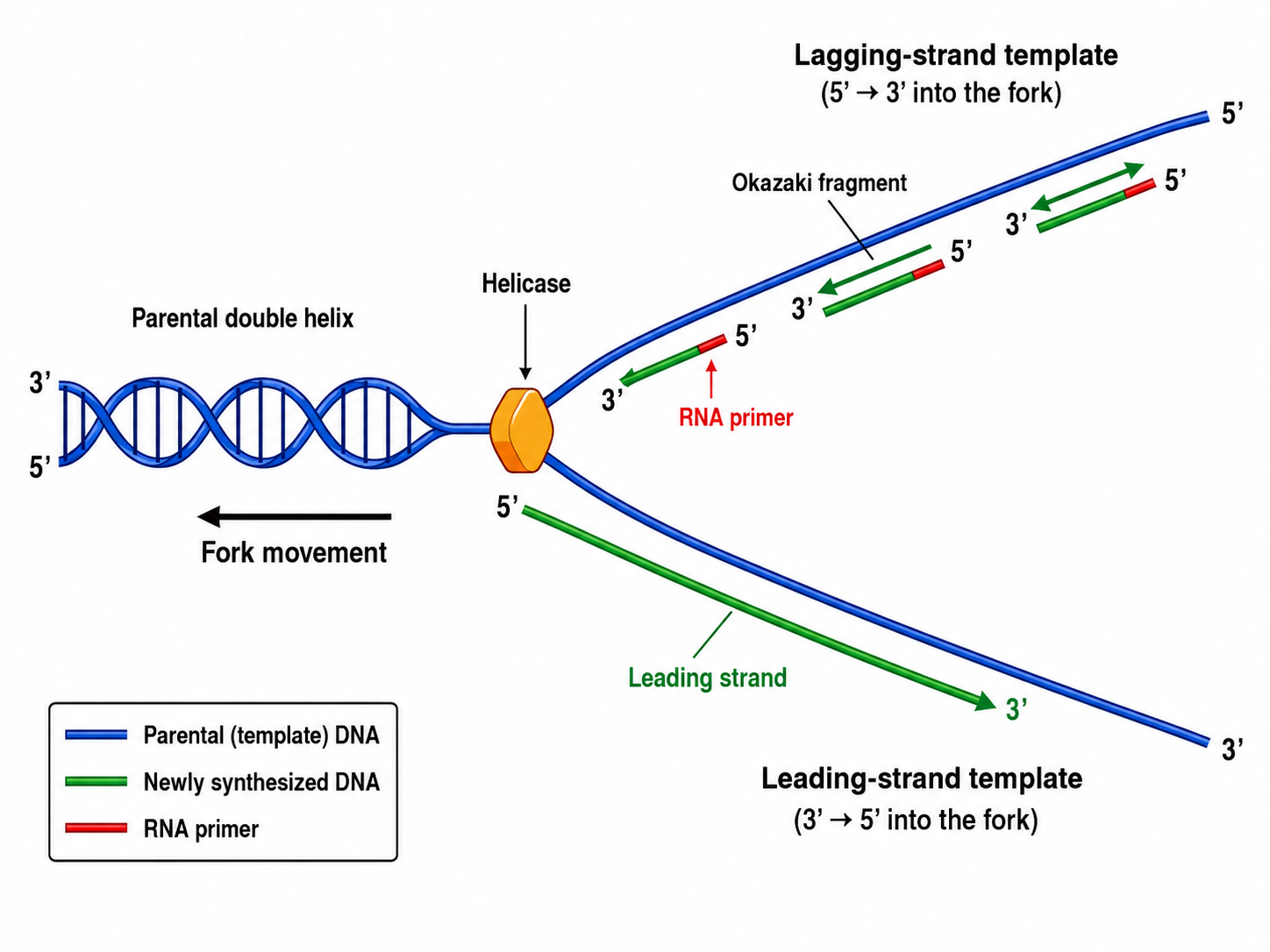
- Leading strand: its template runs 3'→5' into the moving fork, so DNA polymerase synthesizes it continuously (5'→3'), following the helicase. Needs only one primer.
- Lagging strand: its template runs the "wrong way," so synthesis is discontinuous, in short Okazaki fragments (each needs its own RNA primer). The figure below shows how antiparallel templates force one continuous and one fragmented strand.
Elongation: DNA Polymerases
Must knowIn E. coli:
| Enzyme | Role |
|---|---|
| DNA Pol III | Main replicative enzyme; elongates both strands; high processivity; 3'→5' proofreading exonuclease |
| DNA Pol I | Removes RNA primers (5'→3' exonuclease) and fills gaps with DNA |
Processivity = how many nucleotides are added before the enzyme falls off. Pol III stays on the template via a ring-shaped sliding clamp (β-clamp in prokaryotes, PCNA in eukaryotes). Its 3'→5' exonuclease (proofreading) excises a misincorporated nucleotide before extending, greatly lowering the error rate.
Know the logicWhere the energy comes from. Each nucleotide arrives as a dNTP; joining it to the 3'-OH releases pyrophosphate (), whose hydrolysis to makes the reaction strongly exergonic — this drives phosphodiester bond formation (same logic as RNA synthesis).
Primer Removal and Ligation
Must knowAfter each Okazaki fragment, the RNA primer is replaced with DNA:
- DNA Pol I uses its 5'→3' exonuclease to remove the upstream RNA primer while filling the gap with DNA.
- A nick remains, which DNA ligase seals into a phosphodiester bond (using NAD⁺ in prokaryotes, ATP in eukaryotes).
Quick check: On which strand does DNA ligase do more work, and why?
Answer: The lagging strand. Ligase must seal the nick between every Okazaki fragment; the leading strand needs essentially one ligation event.
Specific Enzymes Involved in Replication
Must knowThe MCAT loves asking which enzyme performs which function. Use this as a reference; the Pol I vs Pol III distinction is the classic trap.
| Enzyme | Function |
|---|---|
| Helicase | Unwinds the helix at the fork (uses ATP) |
| Primase | Synthesizes RNA primers (no proofreading) |
| SSBPs | Stabilize single-stranded template; prevent re-annealing |
| Topoisomerase II (gyrase) | Relieves supercoiling; target of fluoroquinolones |
| DNA Pol III | Main replicative polymerase; 3'→5' proofreading |
| DNA Pol I | Removes primers (5'→3' exonuclease), fills gaps |
| DNA Ligase | Seals nicks (NAD⁺ in prokaryotes, ATP in eukaryotes) |
| Sliding clamp | Confers processivity (β-clamp prokaryotes / PCNA eukaryotes) |
The same activities operate in eukaryotes — a helicase opens the fork, primase lays primers, a high-processivity polymerase (held by PCNA) elongates, primers are replaced, ligase seals. You do not need the individual eukaryotic polymerase names.
Quick check: A mutation eliminates the 3'→5' exonuclease activity of DNA Pol III. Predicted consequence?
Answer: Loss of proofreading — misincorporated nucleotides are no longer excised, so the mutation rate rises sharply (a "mutator" phenotype).
Origins of Replication
Must knowProkaryotes have a single circular chromosome with one origin (oriC), which is AT-rich (AT pairs have only 2 H-bonds, so they melt easily). An initiator protein binds, recruits helicase, and melts the DNA; two forks then replicate the whole chromosome until they meet at a terminus.
Eukaryotes have many origins per chromosome — the ~3 billion bp human genome could not be copied from a single origin in time, so multiple origins fire for parallel replication within one S phase.
Know the logicEach origin fires only once per cell cycle, licensed at the G1/S transition. Re-replication is blocked until the next G1, preventing extra DNA copies and preserving genomic stability.
Each fired origin makes a replication bubble with two outward-moving forks; as bubbles expand and merge, the chromosome is fully copied (the "eyes" seen on electron micrographs).
Quick check: A drug blocks licensing of replication origins at the G1/S transition. Where would the cell arrest?
Answer: At G1 / the G1/S transition. Without licensing, origins can't fire and S phase can't begin.
Replicating the Ends of DNA Molecules: The End-Replication Problem and Telomeres
The End-Replication Problem
Must knowThis arises only in linear chromosomes (eukaryotes), not circular prokaryotic ones. When the terminal RNA primer at the 5' end of a new strand is removed, there is no upstream 3'-OH to fill the gap — the polymerase cannot work backward or initiate de novo. So the lagging strand at each chromosome end is left short, producing a single-stranded 3' overhang and progressive shortening each replication cycle. Uncorrected, chromosomes shrink until essential genes are lost (replicative senescence).
Telomeres
Must knowThe solution is telomeres — repetitive non-coding end sequences (in humans, tandem TTAGGG repeats). They act as a buffer: shortening erodes the disposable telomere repeats, not coding sequence. The protected G-rich 3' overhang also keeps the chromosome end from being mistaken for a double-strand break.
Telomerase
Must knowTelomerase is a reverse transcriptase that carries its own RNA template and uses it to extend the 3' G-rich overhang with new TTAGGG repeats; normal machinery then fills in the complementary strand. The net effect is maintained (or lengthened) telomeres in cells that express it.
MCAT-Relevant Connections
Must know| Cell type | Telomerase | Implication |
|---|---|---|
| Germline / stem cells | High | Telomeres maintained; self-renewal |
| Most somatic cells | Low/absent | Telomeres shorten → senescence |
| Cancer cells | Reactivated | Replicative immortality |
Because most somatic cells lack telomerase, they divide a finite number of times before senescence (the Hayflick limit). The link between telomerase reactivation and cancer immortality is high-yield.
Quick check: A somatic fibroblast and a cancer cell line from fibroblasts are cultured. After 80 generations the fibroblast has died but the cancer cell thrives. Which enzyme explains the immortality, and what does it maintain?
Answer: Telomerase. Reactivated telomerase extends the telomeric repeats (TTAGGG) at chromosome ends each division, preventing the shortening that causes senescence.
Common Confusions & Tricks
1. DNA Pol I vs. DNA Pol III — the most-tested distinction.
- Pol III = main workhorse (synthesizes both strands, high processivity, 3'→5' proofreading).
- Pol I = clean-up crew (removes RNA primers via 5'→3' exonuclease, fills gaps).
- Trick: Pol I = prImer removal and gap-fIllIng; Pol III = the heavy lifter.
2. 5'→3' exonuclease vs. 3'→5' exonuclease.
- 3'→5' = proofreading (Pol III; removes a just-misincorporated 3'-end nucleotide).
- 5'→3' = primer removal (Pol I). A common trap is to say Pol III removes primers — it doesn't.
3. Leading vs. lagging directionality.
The lagging strand is synthesized 5'→3' (all synthesis is 5'→3') but in the opposite direction to fork movement, in Okazaki fragments. Don't confuse direction of synthesis with direction of fork movement.
4. Semiconservative ≠ semi-discontinuous.
"Semiconservative" = how parental strands distribute to daughters (one old, one new per duplex). "Semi-discontinuous" = one strand made continuously (leading), one discontinuously (lagging).
5. The end-replication problem affects only the lagging-strand terminus.
It's the newly synthesized 5' end (lagging strand) that can't be completed, leaving a recessed 5' end and a protruding 3' overhang on the parental strand — the G-overhang telomerase extends.
6. Telomerase is a reverse transcriptase — RNA → DNA.
Unusual (most replication is DNA → DNA). If a question describes "using an RNA template to extend a DNA strand," think telomerase.
7. Prokaryotes do not have the end-replication problem.
Circular chromosomes have no ends; telomeres and telomerase are eukaryote-specific.
8. PCNA = eukaryotic sliding clamp; β-clamp = prokaryotic.
Both serve the same processivity function.
9. Topoisomerase II (gyrase) and antibiotics.
Fluoroquinolones (ciprofloxacin, levofloxacin) target bacterial gyrase; eukaryotic topo II is targeted by some cancer drugs (etoposide, doxorubicin) — a classic interdisciplinary bridge.
10. Meselson–Stahl by generation.
Gen 0: heavy only. Gen 1: hybrid only (rules out conservative). Gen 2: hybrid + light (rules out dispersive). After that, hybrid fraction halves each generation but always persists.
Key Takeaways
-
Semiconservative replication was proven by Meselson–Stahl using density-gradient centrifugation. Each daughter duplex keeps one parental strand.
-
DNA synthesis is always 5'→3', requiring a free 3'-OH. Hence RNA primers (made by primase) and asymmetric synthesis: a continuous leading strand and a discontinuous lagging strand of Okazaki fragments.
-
Key prokaryotic enzymes: Helicase (unwinds), Primase (RNA primers), SSBPs (stabilize), Topoisomerase II/gyrase (relieves supercoiling; fluoroquinolone target), DNA Pol III (main; 3'→5' proofreading), DNA Pol I (removes primers via 5'→3' exonuclease, fills gaps), DNA Ligase (seals nicks; NAD⁺ in prokaryotes, ATP in eukaryotes).
-
Prokaryotes have one origin (oriC); eukaryotes have many origins per chromosome for parallel replication during S phase, each firing once per cell cycle.
-
End-replication problem: linear chromosomes can't fully replicate the 5' end of the lagging strand, so they shorten each division.
-
Telomeres (TTAGGG in humans) buffer the ends; telomerase, a reverse transcriptase carrying its own RNA template, extends the 3' G-rich overhang.
-
Telomerase is active in germline/stem cells, largely absent in somatic cells (→ Hayflick limit), and reactivated in most cancers (→ immortalization).