Molecular biology tools are the engine of modern medicine, and the MCAT tests them as an integrated story: how scientists cut, copy, sequence, and manipulate DNA, and what each step tells you. If you can follow a piece of DNA from a genome to a therapeutic protein, you can handle almost any passage here.
Priority labels: Must know = cold; Know the logic = mechanism not names; Passage-level = recognize, don't memorize; Optional = skippable.
Restriction Enzymes
Must knowThe field begins with the ability to cut DNA at predictable, specific locations. Restriction endonucleases (restriction enzymes) are bacterial proteins that recognize short, specific double-stranded sequences (typically 4–8 bp) called restriction sites and cleave both strands at or near that site.
How They Work
Must knowMost restriction sites are palindromic: the double-stranded sequence reads the same 5′→3′ on both strands. Depending on where the enzyme cuts:
- A staggered cut leaves single-stranded sticky ends (cohesive ends). Because overhangs are complementary, fragments cut with the same enzyme can base-pair and be joined by DNA ligase. This is the foundational act of making recombinant DNA.
- A cut straight across leaves flush blunt ends — ligated less efficiently because there is no overhang base-pairing.
Understand palindromes and sticky vs. blunt ends conceptually; you are not expected to memorize specific recognition sequences.
Know the logicThey are a bacterial immune defense that cuts foreign (viral) DNA; the host's own DNA is protected by methylation at the same sites (the restriction-modification system).
MCAT relevance: be able to (1) predict fragments when a DNA map is cut with one or more enzymes, and (2) recognize that the same enzyme makes compatible sticky ends in any organism's DNA, enabling cross-species recombination.
Quick check: A circular plasmid has three EcoRI sites. How many fragments are produced when cut to completion? Answer: Three — in a circular molecule, cuts yield fragments (a linear molecule yields ).
Gene Cloning
Must knowGene cloning means producing many identical copies of a DNA sequence by inserting it into a self-replicating element (a vector) and propagating it in a host cell. "Cloning" here means molecular copying, not organism cloning.
The Basic Workflow
Must knowCut target DNA and a vector (usually a plasmid) with the same enzyme → ligate the insert into the vector → transform into a host bacterium (e.g., E. coli) by heat shock or electroporation → select for cells carrying the correct insert → grow the culture, amplifying the gene with each division.
Vectors
Must knowA plasmid is a small, circular, extrachromosomal DNA that replicates independently in bacteria. A useful cloning plasmid has:
- An origin of replication (ori) — autonomous replication
- A selectable marker — usually antibiotic resistance, so only plasmid-carrying cells survive on antibiotic media
- A multiple cloning site (MCS) — region with many restriction sites for inserts
Larger inserts use phage lambda, cosmids, BACs (~100–300 kb), or YACs (up to ~1 Mb) — recognize, don't memorize.
Selecting Recombinant Colonies
Must knowBlue-white screening: the MCS sits inside lacZ (β-galactosidase). An insert disrupts lacZ → white colony (no blue color with X-gal). No insert → intact lacZ → blue colony. Grow on antibiotic (selects plasmid uptake) plus X-gal/IPTG (distinguishes insert), and pick white colonies.
Quick check: You plate transformants on ampicillin + X-gal and see blue and white colonies. Which contain your insert, and why? Answer: The white colonies — disrupted lacZ makes no β-galactosidase, so X-gal stays colorless. Blue colonies took up empty (self-ligated) vector with lacZ intact.
DNA Libraries
Must knowA DNA library is the collection of recombinant clones representing an entire genome or transcriptome.
- Genomic library: fragments representing the whole genome — exons, introns, promoters, regulatory and intergenic DNA. Use it to study gene regulation, promoters, or non-coding DNA.
- cDNA library: only the sequences being actively transcribed in a given cell type at a given time — no introns or regulatory regions. Represents the expressed genes of that tissue.
Quick check: To clone a human gene and express it in bacteria, use a genomic or cDNA library? Answer: A cDNA library — bacteria cannot splice out introns, so the intron-free cDNA gives a contiguous coding sequence bacteria can translate.
Generation of cDNA
Must knowComplementary DNA (cDNA) is double-stranded DNA synthesized from an mRNA template. Because it is copied from mature (spliced) mRNA, it contains only exons — no introns.
Know the logicIsolate mRNA (oligo-dT columns capture poly-A tails) → reverse transcriptase (an RNA-dependent DNA polymerase from retroviruses like HIV) copies mRNA into a complementary DNA strand → the RNA is degraded → DNA polymerase makes the second strand → ligate the double-stranded cDNA into a vector. You need the direction (RNA → DNA) and the enzyme, not the exact intermediates.
Because cDNA is made from mRNA, it reflects what a tissue expresses — e.g., a pancreatic β-cell cDNA library is enriched for insulin mRNA.
Quick check: Why does cDNA lack introns? Answer: It is synthesized from mature, spliced mRNA, which has already had introns removed; reverse transcriptase copies only what is in the mRNA template.
Hybridization
Must knowHybridization is the base-pairing (annealing) of two complementary single-stranded nucleic acids into a double strand — the backbone of many techniques.
Double-stranded DNA is denatured (by heat or high pH) into single strands; restoring conditions lets complementary strands re-anneal. A short, labeled probe then hybridizes only to its complementary sequence. Probes can be labeled radioactively (P), fluorescently, or enzymatically.
Stringency is how exact the probe-target match must be. High stringency (high temperature, low salt) allows only near-perfect pairing; low stringency tolerates mismatches.
Hybridization underlies Southern/Northern blotting, microarrays, FISH, and PCR primer design.
Quick check: For a 25-nt probe, which conditions give the most specific binding — high temperature/low salt, or low temperature/high salt? Answer: High temperature/low salt (high stringency) — only perfectly complementary sequences stay hybridized.
Expressing Cloned Genes
Must knowTo produce a protein or study a gene's function, the gene must be expressed (transcribed and translated) in the host.
Expression Vectors
Must knowAn expression vector is designed to drive expression. Beyond the standard features (ori, marker, MCS) it adds a strong promoter the host's RNA polymerase recognizes, a ribosome binding site (Shine-Dalgarno, for bacteria), and often a terminator. Common bacterial promoters: T7 or lac. The cDNA insert goes downstream, in frame.
Host Considerations
Know the logicThe key distinction is post-translational modification (PTM), especially glycosylation:
- E. coli: high yield, but no glycosylation/eukaryotic PTMs.
- Yeast / insect / mammalian (CHO) cells: perform eukaryotic processing; mammalian CHO cells give the most authentic human PTMs, used for complex biologics (expensive).
Proteins are often made as fusion proteins with a tag (e.g., His-tag) for affinity purification, then cleaved.
Quick check: You clone human insulin cDNA into a bacterial expression vector; the protein is the right size but inactive. One likely reason? Answer: Bacteria cannot perform eukaryotic post-translational modifications (e.g., proper disulfide bonding, glycosylation), so the protein may be misfolded or lack needed modifications.
Polymerase Chain Reaction (PCR)
Must knowIf cloning is the scissors and glue, PCR is the photocopier — it amplifies a specific sequence exponentially from tiny amounts of starting DNA.
The Three Steps (One Cycle)
Must know- Denaturation (~95°C): heat separates the double-stranded template.
- Annealing (~50–65°C): two short primers (one per strand, flanking the target) hybridize.
- Extension (~72°C): Taq polymerase (thermostable, from Thermus aquaticus) extends each primer 5′→3′.
After cycles you have copies (exponential). The figure below summarizes one cycle.
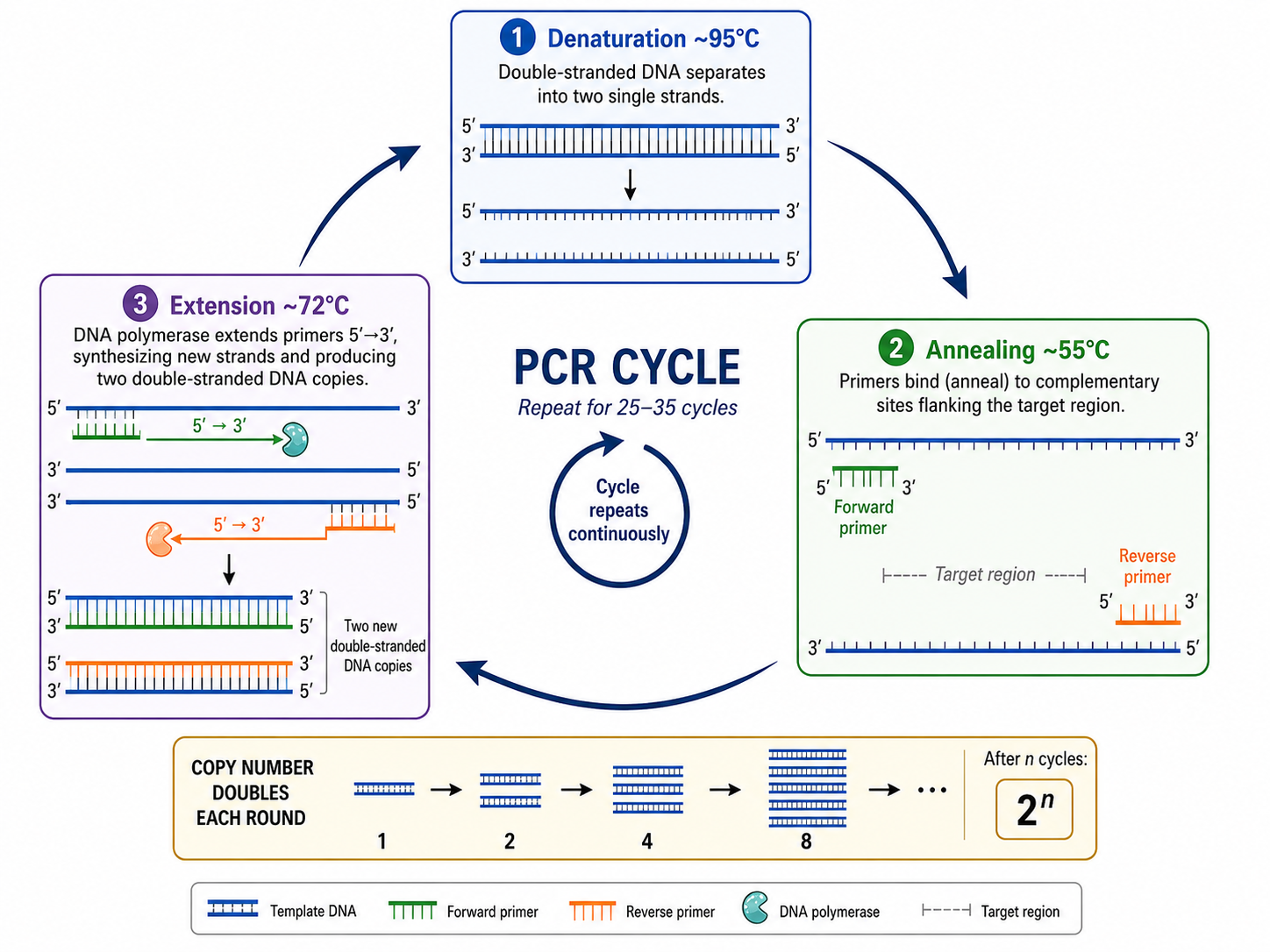
Requirements: template DNA, forward + reverse primers (~18–25 nt), Taq polymerase, dNTPs, and an buffer (Taq cofactor).
Primer design: primers are complementary to the flanking sequences and must point toward each other; if they pointed away, no amplification occurs.
Variants
Must know- RT-PCR: mRNA → cDNA (reverse transcriptase) → PCR. Detects whether a gene is expressed. Not the same as real-time PCR.
- qPCR (quantitative real-time PCR): monitors amplification in real time with fluorescence (SYBR Green, TaqMan); quantifies starting template / expression level.
- Optional PCR mutagenesis: primers with deliberate mismatches introduce mutations.
Quick check: You want to know whether a particular mRNA is expressed in liver. You have total liver RNA. Technique and key first-step enzyme? Answer: RT-PCR — reverse transcriptase makes cDNA, then PCR with gene-specific primers; a band of correct size means the mRNA is expressed. (qPCR also quantifies level.)
Gel Electrophoresis and Southern Blotting
Gel Electrophoresis
Must knowGel electrophoresis separates nucleic acids (or proteins) by size. DNA loaded into an agarose gel under current migrates toward the positive electrode (anode) because the phosphate backbone is negative; smaller fragments migrate faster (farther). A DNA ladder of known sizes is run alongside, and bands are visualized with ethidium bromide (intercalates, fluoresces under UV) or a safer dye.
For proteins, SDS-PAGE is used — SDS gives a uniform negative charge proportional to size, so migration reflects molecular weight.
Southern Blotting
Must knowSouthern blotting detects a specific DNA sequence within a mixture: digest genomic DNA and run on a gel → denature to single strands → transfer (blot) to a membrane, preserving the band pattern → hybridize a labeled probe to the target band → detect the signal. It can reveal gene presence, copy number, or RFLPs (forensics, below).
The Blotting Family
Must know| Technique | What is blotted | What is probed | Detects |
|---|---|---|---|
| Southern blot | DNA | Nucleic acid probe | Specific DNA sequence |
| Northern blot | RNA | Nucleic acid probe | Specific mRNA (expression) |
| Western blot | Protein (SDS-PAGE) | Antibody | Specific protein |
The MCAT heavily tests this distinction (see Common Confusions for the mnemonic).
Quick check: A researcher wants to know how much of a specific mRNA is produced in diseased vs. healthy tissue. Which blot? Answer: Northern blot — it detects and quantifies specific RNA transcripts. (qPCR/RT-PCR also works and is more sensitive.)
DNA Sequencing
Must knowThe MCAT focuses on Sanger sequencing (chain-termination / dideoxy method).
The Logic
Must knowSanger sequencing is a modified replication reaction. The key ingredient is dideoxynucleotides (ddNTPs), which lack the 3′-OH. When a ddNTP is incorporated, elongation terminates because there is no 3′-OH for the next bond.
A reaction contains template, primer, polymerase, all four dNTPs, and labeled ddNTPs. Synthesis terminates randomly at each ddNTP, producing a ladder of fragments of every length, each ending in a known base. Fragments are separated by size (now capillary electrophoresis) and read smallest → largest. In automated sequencing, the four ddNTPs carry different fluorescent dyes in one reaction, and a laser reads the colors into a chromatogram.
Passage-levelNext-generation sequencing (NGS): high-throughput, massively parallel sequencing of millions of fragments at once (fast, cheap whole-genome sequencing). Know the concept and applications (e.g., cancer mutation profiling); no mechanistic detail required.
Quick check: In a Sanger reaction you add labeled ddCTP with normal dNTPs. What do the resulting fragments share? Answer: Every fragment ends in cytosine (C) — synthesis terminated wherever a ddCTP was incorporated.
Analyzing Gene Expression
Must knowWhich genes are active in a cell? How does expression change in disease?
- Northern blot: detects/quantifies specific mRNA (band size = transcript size; intensity = abundance). See blotting table above.
- RT-PCR / qPCR: RT-PCR detects whether a transcript is present; qPCR quantifies expression — the gold standard for single genes.
DNA Microarrays (Gene Chips)
Must knowA microarray measures expression of thousands of genes at once. Isolate mRNA from two conditions → convert to cDNA and label with two fluorescent dyes (e.g., cancer = red, normal = green) → hybridize both to a chip of known oligonucleotide spots. Spot color shows relative expression: red = up in cancer, green = up in normal, yellow = equal in both, no signal = expressed in neither.
Passage-levelRNA-Seq: uses NGS to quantify all transcripts; more sensitive and quantitative than microarrays and needs no prior sequence knowledge.
Quick check: A microarray spot is yellow after hybridizing red-labeled cancer cDNA and green-labeled normal cDNA. What does that mean? Answer: The gene is equally expressed in both — red + green = yellow; not differentially expressed.
Determining Gene Function
Must knowFiguring out what a gene does requires perturbing its expression or sequence — loss-of-function (remove it, see what breaks) or gain-of-function (add it, see what changes).
Knockout and Knockin
Must knowA gene knockout eliminates a gene's function (often in a knockout mouse, classically via homologous recombination in embryonic stem cells); the resulting phenotype reveals the gene's role. A knockin replaces a gene with a modified version.
Conditional knockouts use the Cre-lox system: the gene is flanked by lox sites and Cre recombinase is expressed only in a specific tissue/time, deleting the gene only there — useful when whole-body loss would be lethal.
CRISPR-Cas9
Must knowCRISPR-Cas9 is the major gene-editing tool. A guide RNA (gRNA) directs the Cas9 nuclease to a specific site, where Cas9 makes a double-strand break. Repair then either introduces indels (knockout) or, with a supplied template, makes a precise edit (knockin). Faster, cheaper, and more precise than traditional knockouts. (Cas9 domain/PAM biochemistry is out of scope.)
RNA Interference (RNAi)
Must knowRNAi gives transient gene silencing without altering DNA. Double-stranded siRNA (or shRNA) is introduced; the RISC complex uses its antisense strand to find and degrade complementary mRNA, blocking translation. The knockdown is reversible and sequence-specific.
Gain-of-Function
Must knowAdding a gene (e.g., extra copies) to observe the effect is gain-of-function; transgenic organisms express foreign or additional genes. Reporter genes (GFP, lacZ) are commonly used to track expression.
Quick check: A researcher wants to eliminate Gene X only in liver cells (whole-body knockout would be lethal). Which approach? Answer: A conditional (tissue-specific) knockout via Cre-lox — Cre driven by a liver-specific promoter deletes the lox-flanked gene only in liver.
Hybridization Applications: FISH
Must knowFluorescence in situ hybridization (FISH) uses fluorescent probes to detect specific DNA/RNA sequences in intact cells or chromosomes. Clinically it detects chromosomal deletions, duplications, translocations, and aneuploidy (e.g., trisomy 21 prenatally). Know it as a hybridization-based cytogenetic technique.
Stem Cells
Must knowStem cells are undifferentiated cells capable of self-renewal and differentiation into specialized cell types — central to development, tissue repair, and regenerative medicine.
Types (Potency Hierarchy)
Must knowKnow the hierarchy and the totipotent/pluripotent line:
| Type | Source | Potential |
|---|---|---|
| Totipotent | Zygote, early blastomeres | Any cell type including placenta |
| Pluripotent | Inner cell mass / ESCs | Any body cell type, not placenta |
| Multipotent | Adult stem cells (e.g., hematopoietic) | Limited range of related cell types |
| Unipotent | Tissue-specific | One cell type |
Embryonic Stem Cells (ESCs)
Must knowESCs come from the inner cell mass of a blastocyst; they are pluripotent. Their derivation destroys an embryo, raising ethical concerns.
Induced Pluripotent Stem Cells (iPSCs)
Must knowiPSCs (Shinya Yamanaka) are adult somatic cells reprogrammed to pluripotency by four transcription factors (the Yamanaka factors: Oct4, Sox2, Klf4, c-Myc). They avoid embryo destruction and are patient-specific, reducing immune rejection — the basis of most current stem cell research.
Hematopoietic Stem Cells (HSCs)
Must knowHSCs are multipotent bone-marrow cells giving rise to all blood lineages. Bone marrow transplantation replaces a patient's HSCs with donor HSCs — used for leukemia, lymphoma, sickle cell disease, and immunodeficiencies.
Quick check: To repair heart tissue after an MI, scientists reprogram the patient's skin cells, then differentiate them into cardiomyocytes. What is the intermediate cell type, and the main advantage of using the patient's own cells? Answer: iPSCs — the main advantage is immunological compatibility (no rejection, since the cells are the patient's own).
Practical Applications of DNA Technology
Medical Diagnostics
Must know- Genetic testing: PCR + sequencing or RFLP detects disease mutations (e.g., BRCA1/2, cystic fibrosis, Huntington's).
- Prenatal diagnosis: PCR on fetal cells (amniocentesis or CVS); FISH for rapid chromosomal analysis.
- Pathogen detection: PCR detects microbial DNA/RNA with high sensitivity (HIV viral load, COVID-19, TB, hepatitis).
Human Gene Therapy
Must knowGene therapy introduces or replaces genetic material to treat disease:
- Ex vivo: cells removed, modified in the lab, reinfused (e.g., CAR-T for cancer; modifying HSCs for SCID).
- In vivo: the therapeutic gene is delivered directly, often by a viral vector (AAV, lentivirus, retrovirus).
Challenges: immune responses to vectors, insertional mutagenesis (integration disrupting a tumor suppressor or activating an oncogene), delivery, and durability. Somatic gene therapy (one patient) is accepted; germline editing (heritable) is ethically contested.
Pharmaceuticals ("Pharming")
Must knowRecombinant DNA makes therapeutic proteins — e.g., recombinant insulin (in E. coli or yeast), growth hormone, EPO (in CHO cells; needs glycosylation), clotting factors, monoclonal antibodies (mammalian cells), and recombinant/mRNA vaccines. Transgenic plants (GMOs) express Bt toxin or added nutrients (β-carotene rice).
Forensics
Must knowDNA fingerprinting exploits individual variation in Short Tandem Repeats (STRs). The modern standard is PCR-based STR analysis (tiny/degraded samples OK); RFLP + Southern blot is the older method. Across many STR loci the chance of a random match is vanishingly small, making it powerful identification evidence.
Bioremediation and Agriculture
Must know- Bioremediation: microbes degrade or detoxify contaminants (oil spills, heavy metals); phytoremediation uses plants to accumulate metals.
- Agriculture: GMO crops with herbicide resistance, insect resistance (Bt crops), or improved nutrition.
Quick check: To mass-produce human EPO (needs glycosylation for activity), express the gene in E. coli or CHO cells? Why? Answer: CHO cells — bacteria cannot glycosylate (a eukaryotic PTM in the ER/Golgi); mammalian CHO cells glycosylate properly, giving active EPO.
Safety and Ethics of DNA Technology
Passage-level- Germline vs. somatic editing: germline editing (embryos/gametes) is heritable and broadly opposed (unknown risks, no consent from future persons, eugenics concerns); somatic editing affects only the patient and is more accepted. The 2018 CRISPR-baby case (He Jiankui) is the canonical ethical-violation example.
- Genetic privacy: genetic data can reveal disease risk, ancestry, and relationships — concerns about discrimination and confidentiality.
- GMO debates: safety, ecological impact (gene flow, biodiversity), and labeling.
- Asilomar Conference (1975): scientists' voluntary moratorium on recombinant DNA research until safety guidelines existed — the canonical precedent for scientific self-governance.
- Insertional mutagenesis: early retroviral SCID gene therapy caused leukemia by activating proto-oncogenes — a real safety event that reshaped vector design.
Quick check: Why is the Asilomar Conference significant in the history of science? Answer: It was the first time scientists voluntarily halted their own research pending safety review — a precedent for self-governance in emerging biotechnology.
Common Confusions & Tricks
Southern vs. Northern vs. Western: SNoW DRoP — S = DNA, N = RNA, W = Protein. (Blots are named after directions; Eastern exists but is obscure.)
PCR vs. Cloning: PCR amplifies DNA in vitro with Taq and requires known flanking sequences for primers. Cloning amplifies DNA in vivo in a host and does not require knowing the sequence. Need a known gene fast → PCR; need to propagate/express in cells → cloning.
RT-PCR vs. qPCR: RT-PCR = reverse transcriptase + PCR (starts with RNA; detects whether expressed). qPCR = real-time fluorescence (measures how much). RT-qPCR combines both.
cDNA vs. genomic DNA: cDNA = no introns, made from mRNA, reflects expression. Genomic = has introns, present in every cell. You need cDNA to express a eukaryotic gene in bacteria.
Sticky vs. blunt ends: sticky = staggered cut, single-stranded overhangs, more efficient ligation; blunt = flush, less efficient. Both ligate with DNA ligase.
Restriction palindromes: the site reads the same 5′→3′ on both strands — don't read both strands in the same physical direction.
Probe hybridization: a probe must be complementary and antiparallel to its target — take the complement and reverse it.
Totipotent vs. pluripotent: totipotent makes every cell including placenta (zygote); pluripotent (ESCs, iPSCs) makes any body cell but not placenta (inner cell mass).
CRISPR guide RNA: the gRNA base-pairs with the target to direct Cas9 to cut; gRNA gives specificity, Cas9 makes the cut. PAM/nuclease-domain detail not required.
Gel runs toward positive: DNA is negative → migrates to the anode; smaller = farther from wells (faster).
Forensics → STR/PCR: modern DNA fingerprinting uses PCR of STR loci, not RFLP. Tiny crime-scene samples → PCR.
Reverse transcriptase and retroviruses: it goes RNA → DNA (reverse of the central dogma) and comes from retroviruses (HIV); RT inhibitors (e.g., AZT) are HIV drugs.
Key Takeaways
Core Techniques and Their Functions
| Technique | What It Does | Key Components/Enzyme |
|---|---|---|
| Restriction digestion | Cuts DNA at specific sequences | Restriction endonuclease |
| Ligation | Joins DNA fragments | DNA ligase |
| Transformation | Introduces foreign DNA into bacteria | Heat shock or electroporation |
| PCR | Amplifies specific DNA in vitro | Taq polymerase, primers, dNTPs |
| RT-PCR | Detects mRNA expression | Reverse transcriptase + PCR |
| qPCR | Quantifies mRNA/gene expression | Fluorescent dyes + real-time PCR |
| Southern blot | Detects specific DNA sequence | Probe hybridization |
| Northern blot | Detects specific mRNA | Probe hybridization |
| Western blot | Detects specific protein | Antibody |
| Sanger sequencing | Determines DNA sequence | ddNTPs, DNA polymerase |
| Microarray | Genome-wide expression profiling | cDNA hybridization to chip |
| CRISPR-Cas9 | Precise gene editing | Cas9 nuclease + guide RNA |
| RNAi/siRNA | Transient gene silencing | RISC complex |
| FISH | Chromosomal location of sequences | Fluorescent probes on chromosomes |
Cloning Concepts
- Plasmid vectors require: ori, selectable marker, MCS
- Blue-white screening: white colonies = insert present (disrupted lacZ)
- Genomic library = entire genome including introns; cDNA library = expressed sequences only (made via reverse transcriptase; no introns)
Expression in Hosts
- Bacteria: high yield, no glycosylation — use cDNA
- Mammalian cells (CHO): full PTMs including glycosylation — used for complex biologics
Stem Cells
- Totipotent (zygote) > Pluripotent (ESC, iPSC) > Multipotent (HSC) > Unipotent
- iPSCs = adult cells reprogrammed by Yamanaka factors (Oct4, Sox2, Klf4, c-Myc)
- HSC transplant = bone marrow transplant for hematological disease
Key Named People and Events
- Kary Mullis — PCR; Frederick Sanger — chain-termination sequencing; Edwin Southern — Southern blot; Shinya Yamanaka — iPSCs
- Asilomar Conference (1975) — voluntary recombinant-DNA moratorium; He Jiankui (2018) — unauthorized germline CRISPR editing
Applications Summary
- Diagnostics: PCR, FISH, sequencing — Pharmaceuticals: insulin, EPO, clotting factors, monoclonal antibodies — Gene therapy: viral vectors (somatic), ex vivo (CAR-T, SCID) — Forensics: PCR + STR — Agriculture: Bt crops — Bioremediation: engineered microbes — Ethics: germline editing, genetic privacy, GMO debate, insertional mutagenesis