Bioenergetics is how living systems acquire, convert, and use energy. Every biological reaction obeys the same thermodynamic rules as a flask in a lab; biology's trick is working cleverly within them, not breaking them. This guide focuses on biological energetics — ATP as the cell's energy currency, the coupling of unfavorable reactions, and the redox carriers of metabolism. The underlying quantitative thermodynamics and electrochemistry (the full / treatment, half-reactions, reduction potentials, and the quantitative Nernst equation) are developed in the Chem/Phys "Principles of Bioenergetics" guide; here we recap only what we need and then build the biological layer on top.
Priority labels: Must know = cold; Know the logic = mechanism not names/numbers; Passage-level = recognize, don't memorize; Optional = skippable.
Thermodynamics Recap
Must knowThis section is a brief refresher. For the full derivations, the spontaneity tables, worked calculations, and the crossover-temperature logic, see the Chem/Phys "Principles of Bioenergetics" guide.
The master spontaneity criterion is the Gibbs free energy, which combines enthalpy (, heat content) and entropy (, disorder):
A reaction is spontaneous (favorable, exergonic) when ; is endergonic (needs energy input); is equilibrium. Neither nor alone decides spontaneity — the term scales entropy with temperature, so a reaction's favorability can flip with .
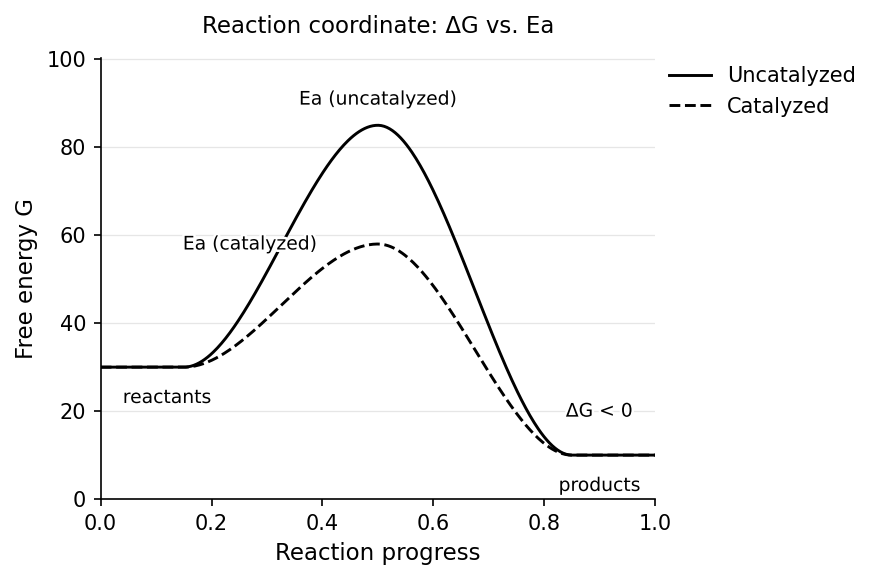
Crucial distinction: spontaneous does NOT mean fast. Thermodynamics says whether a reaction can occur; kinetics says how quickly. A catalyst lowers the activation energy but leaves unchanged — on a reaction-coordinate diagram, is the reactant-to-product gap while is the peak height above reactants.
Quick check: A reaction has and . At what approximate temperature does the reaction become spontaneous?
Answer: Set : . Above 250 K (roughly room temperature and above), this reaction is spontaneous. Note the unit conversion — must be in joules, not kilojoules, to match .
Standard Conditions, , and the Reaction Quotient
Must knowThe standard free energy change () is measured at standard conditions (1 M solutes, 1 atm gases, 298 K). Biochemistry uses — the same convention but defined at pH 7 — and in a biological context "standard free energy change" means . is a fixed property of the reaction; the actual depends on concentrations.
Two recap relationships do almost all the work in this guide (the Chem/Phys guide derives them and works full numerical examples):
- ties the equilibrium constant to standard free energy — they are two expressions of the same intrinsic preference. (products favored) corresponds to .
- gives the actual free energy, where the reaction quotient uses the concentrations present right now. At equilibrium and .
This is the key lever for biology. A cell drives a reaction forward by keeping well below — consuming products as fast as they form and maintaining high reactant levels — which keeps negative and negative. Biology does not change ; it manipulates .
Quick check: If a reaction has (unfavorable at standard conditions) but the cell maintains very small (close to zero), what is the sign of ? Is the reaction spontaneous?
Answer: is a large negative number when , so . The total can become negative, making the reaction spontaneous under those cellular conditions. This illustrates exactly how cells drive thermodynamically unfavorable reactions by controlling concentrations.
Le Châtelier and Metabolic Flux
Must knowLe Châtelier's Principle (a stressed equilibrium shifts to counteract the stress) is treated in full in the Chem/Phys guide. The biologically essential consequence: adding reactant or removing product both push a reaction toward products. This is how cells drive pathways — in a sequence, each step's product is immediately consumed by the next, pulling the preceding step forward (glycolysis is the classic example). Sustained one-directional flux through a pathway, not equilibrium, is the metabolic norm.
Quick check: In the reaction (, exothermic), what happens to if you increase temperature?
Answer: decreases. Le Châtelier: heat is a product for exothermic reactions, so adding heat (increasing ) shifts equilibrium toward reactants, meaning less product at the new equilibrium — is smaller at higher .
ATP: The Cell's Energy Currency
Why ATP Is Special
Must knowAdenosine triphosphate (ATP) is the cell's universal energy currency: adenosine (adenine + ribose) plus a chain of three phosphates. The two phosphoanhydride bonds linking the phosphates store substantial free energy.
Know the logicATP hydrolysis is highly favorable because the products are more stable than ATP — chiefly (1) relief of electrostatic repulsion between the negatively charged phosphates, (2) resonance stabilization of released inorganic phosphate (), plus entropy gain (one molecule → two) and better solvation of products.
ATP Hydrolysis:
Must knowThe hydrolysis of ATP to ADP and inorganic phosphate:
This is the standard value; under actual cellular conditions () the real is even more negative ( kJ/mol).
ATP can also be hydrolyzed to AMP + pyrophosphate (), which pyrophosphatase then cleaves (). Passage-level — this "double hydrolysis" removes a product (Le Châtelier) to make biosynthetic reactions essentially irreversible (e.g., DNA/RNA synthesis, fatty acid activation).
ATP Group Transfers: Coupling Reactions
Must knowATP's real power is group transfer — transferring a phosphoryl group from ATP to a substrate to activate it. Example, the first step of glycolysis:
Phosphorylation traps glucose in the cell (charged molecules can't cross membranes) and makes it more reactive.
Coupled reactions drive endergonic processes: two reactions are coupled when they share a common intermediate.
Coupling ATP hydrolysis to an endergonic process makes the overall reaction spontaneous. This is the thermodynamic basis for essentially all of anabolism (biosynthesis).
Quick check: A reaction has . Can one ATP hydrolysis (releasing ) drive it?
Answer: Yes — net , which is negative and therefore spontaneous under standard biological conditions.
Phosphoryl-Transfer Potential: Why ATP Sits in the Middle
Must knowATP has an intermediate phosphoryl-transfer potential — that's exactly why it works as a currency. Compounds with a more negative of hydrolysis can charge ADP → ATP, while ATP in turn can phosphorylate lower-energy acceptors. The high-yield ordering:
PEP and 1,3-BPG phosphorylate ADP in glycolysis (substrate-level phosphorylation); ATP phosphorylates glucose. Creatine phosphate is muscle's instant ATP reserve (, creatine kinase). GTP (made in the TCA cycle) is energetically equivalent to ATP. (Exact values are reference-only.)
Caloric Content of Fuel Molecules
Must knowCarbohydrates ~4 kcal/g, proteins ~4 kcal/g, fats ~9 kcal/g. Energy density tracks how reduced the carbons are (more C–H bonds → more electrons to harvest → more ATP). Fat's highly reduced hydrocarbon chains store roughly twice the energy per gram, which is why it is the body's long-term energy store.
Biological Oxidation-Reduction
Oxidation and Reduction — The Core Logic
Must knowOxidation is loss of electrons (or gain of O, loss of H); reduction is gain of electrons (or loss of O, gain of H). Mnemonic: OIL RIG (Oxidation Is Loss, Reduction Is Gain).
In metabolism, oxidizing fuel molecules releases electrons that carriers shuttle to oxygen; this electron flow down an energy gradient drives ATP synthesis in the electron transport chain.
The oxidizing agent accepts electrons and is itself reduced; the reducing agent donates electrons and is itself oxidized.
Reduction Potentials — What You Need Biologically
Must knowThe Chem/Phys guide develops the full electrochemical machinery — half-reactions written as reductions (), the spontaneous-direction rule, and worked /Nernst calculations. The two recap results that drive metabolic reasoning:
A substance's standard reduction potential (), in volts, is its tendency to accept electrons — more positive = stronger oxidizing agent. Electrons flow spontaneously from low to high , giving and therefore . ( = electrons transferred; = Faraday's constant, .)
This single ordering organizes the whole electron transport chain: electrons released from fuel are low-potential and flow "downhill" through carriers of progressively higher to oxygen (, the terminal acceptor). The large total drop from () to — V, kJ/mol — is the exergonic engine of oxidative phosphorylation, pumping protons and driving ATP synthesis.
Quick check: If for a proposed electron transfer, what does this tell you?
Answer: would be positive, meaning the transfer is non-spontaneous as written. Electrons would not flow from the proposed donor to the proposed acceptor under standard conditions.
The actual potentials inside a cell deviate from these tabulated standard values because they depend on the [ox]/[red] ratio (the Nernst equation — the redox analog of , developed quantitatively in the Chem/Phys guide). Recognize this; don't memorize the derivation.
Soluble Electron Carriers: / and /
Must knowSoluble molecules ferry electrons from catabolism to the electron transport chain. The two key carriers:
/ (nicotinamide adenine dinucleotide) — accepts a hydride ( = 2 electrons + 1 proton):
is the major electron acceptor in oxidation (glycolysis, pyruvate decarboxylation, TCA). () delivers electrons to Complex I, yielding ~2.5 ATP. Key distinction: is for catabolism/energy; (a relative) is for anabolism/biosynthetic reduction (e.g., fatty acid synthesis, pentose phosphate pathway).
/ (flavin adenine dinucleotide) — accepts two H (2 electrons + 2 protons):
has a less negative () than , so enters lower in the chain at Complex II, yielding only ~1.5 ATP. Why both? Some reactions (e.g., succinate → fumarate) release too little energy to reduce — the cell uses the carrier whose potential matches the available energy.
Quick check: Would you expect the oxidation of a fuel molecule to or to release more energy in the ETC? Why?
Answer: . Its electrons enter the chain at Complex I, earlier in the chain, spanning a larger total potential difference before reaching . This larger means more energy released and more ATP produced.
Flavoproteins
Must knowFlavoproteins use a flavin prosthetic group — FAD or FMN — as a tightly (often covalently) bound cofactor. Unlike freely diffusing , flavin cofactors stay bound to their enzyme. Know the logic — flavins can accept/donate electrons one or two at a time (via a semiquinone radical), so they bridge two-electron donors () and one-electron acceptors (iron-sulfur clusters, cytochromes) — the "traffic adapters" of electron transport.
OptionalExamples (recognize, don't memorize): succinate dehydrogenase (Complex II), NADH dehydrogenase (Complex I, FMN), fatty acyl-CoA dehydrogenase (-oxidation).
(coenzyme Q, ubiquinone) is a lipid-soluble carrier that collects electrons from Complexes I and II and shuttles them to Complex III within the inner mitochondrial membrane.
Quick check: Why does succinate dehydrogenase use FAD rather than as its electron acceptor?
Answer: The oxidation of succinate to fumarate releases relatively little free energy — not enough to reduce (). FAD has a less negative reduction potential and can accept electrons from this reaction. The enzyme uses the cofactor whose reduction potential is thermodynamically compatible with the reaction.
Common Confusions & Tricks
1. vs. — do not confuse them.
(or ) is the free energy change under standard conditions. is the actual free energy change at whatever concentrations exist. A reaction with (unfavorable at standard conditions) can still be spontaneous in a cell if concentrations make sufficiently negative. The MCAT will test this distinction.
2. Spontaneous fast.
tells you a reaction can release energy and proceed; it says nothing about rate. Enzymes lower activation energy but cannot change . A frequently tested trap is asking whether an enzyme can make a non-spontaneous reaction occur — it cannot change , but coupling to ATP can.
3. Exothermic exergonic (and endothermic endergonic).
Exothermic/endothermic refer to . Exergonic/endergonic refer to . A reaction can be exothermic but endergonic if is large and positive (e.g., very negative ). Know both terms and which quantity they describe.
4. Oxidizing agent is reduced; reducing agent is oxidized.
Students frequently reverse this. The oxidizing agent accepts electrons — it "oxidizes" the other molecule, so it must itself gain electrons and be reduced. Trick: "the oxidizing agent gets reduced" — it sounds backward, which is why it's tested.
5. sign and spontaneity.
Always subtract: . Electrons flow from lower to higher reduction potential. If you see , the reaction is spontaneous; will be negative.
6. NADH gives ~2.5 ATP; FADH₂ gives ~1.5 ATP — and why.
FADH₂ bypasses Complex I and enters at a point of lower electrochemical potential difference, so less energy is released and fewer protons are pumped. Don't memorize this as a magic fact — understand it from the reduction potentials.
7. Le Châtelier and the cell.
Many students apply Le Châtelier only to physical chemistry questions. Recognize it whenever a MCAT passage discusses how a cell manipulates pathway flux — removing products (by coupling reactions), adding reactants, or altering concentrations is always Le Châtelier.
8. Pyrophosphate release makes reactions "extra" favorable.
When ATP is hydrolyzed to AMP + PPᵢ (not ADP + Pᵢ), and pyrophosphatase cleaves PPᵢ, two high-energy bonds are broken. This is the "thermodynamic commitment" strategy cells use for irreversible activation reactions (e.g., aminoacyl-tRNA synthetases, fatty acid activation).
9. does NOT mean nothing happens — it means equilibrium lies at 50:50.
Students sometimes think means no reaction. In fact, it just means the standard equilibrium constant is 1. The reaction still proceeds; it just doesn't favor either side at standard concentrations.
Key Equations
| Equation | Variables & When to Use |
|---|---|
| = enthalpy, = entropy, = temperature (K). Use to determine spontaneity from thermodynamic components or find the crossover temperature. | |
| , in K. Converts between the equilibrium constant and standard free energy. | |
| = reaction quotient (use actual concentrations). Gives the real free energy under non-standard conditions. | |
| Equilibrium expression. At equilibrium, and . | |
| = moles of electrons, , in volts. Connects electrochemistry to free energy for redox reactions. | |
| Both potentials written as reductions. Positive → spontaneous electron transfer. | |
| Nernst equation. Gives actual reduction potential at non-standard concentrations; = [red]/[ox]. At 25°C, . | |
| , | The workhorse coupling reaction. Add this value to an endergonic reaction's to assess feasibility of coupling. |
| , | Two-electron carrier. Primary electron acceptor in catabolism; enters ETC at Complex I (~2.5 ATP/NADH). |
| , | Two-electron carrier in flavoproteins. Enters ETC at Complex II (~1.5 ATP/FADH₂). |