Priority labels: Must know = cold; Know the logic = mechanism not names; Passage-level = recognize, don't memorize; Optional = skippable.
History and Development of Cell Theory
Must knowCell theory is the foundation for all of biology, and the MCAT uses its history to test whether you can connect scientific reasoning to biological principles.
The story starts with the microscope. Robert Hooke (1665) examined cork and coined the term "cell" — but he was looking at dead plant cell walls. Soon after, Antonie van Leeuwenhoek was the first to observe living microorganisms ("animalcules"), making him the father of microbiology.
The formal theory came from three figures — Schleiden (all plants are made of cells), Schwann (all animals are made of cells), and Virchow (all cells arise from pre-existing cells, omnis cellula e cellula).
The three tenets of classical cell theory:
- All living organisms are composed of one or more cells.
- The cell is the basic structural and functional unit of life.
- All cells arise from pre-existing cells (Virchow — explicitly rejecting spontaneous generation).
A modern fourth tenet sometimes adds that cells carry hereditary information passed to daughter cells — the conceptual bridge to genetics.
Quick check: Virchow's principle that "all cells come from pre-existing cells" directly contradicts which older idea? It refutes spontaneous generation — the notion that life arises de novo from non-living matter. Pasteur's experiments supported Virchow's claim.
Impact on Cell Theory in Biology
Know the logicCell theory unified biology into a coherent framework. Once life was understood as discrete cellular units, mechanistic questions became possible: how cells divide, communicate, and cause disease. The impacts the MCAT tests:
- Disease as cellular pathology. Virchow argued diseases arise from changes in cells — the ancestor of modern oncology (cancer = uncontrolled proliferation) and germ theory.
- Evolution. Common cellular ancestry supports a universal common ancestor, consistent with the conserved genetic code and core metabolic pathways.
- Classification. Cell theory drove the prokaryote (no membrane-bound nucleus) vs. eukaryote (membrane-bound nucleus) divide.
Quick check: A researcher discovers that prions (misfolded proteins) can replicate and spread pathology. Does this violate cell theory? Yes — prions are not cells and do not reproduce from pre-existing cells; they (like viruses, which are acellular and only replicate inside hosts) are important exceptions to classical cell theory.
Prokaryotic Domains
Must knowCarl Woese (1977) used ribosomal RNA (rRNA) sequence comparisons (16S rRNA in prokaryotes) to propose the three-domain system:
- Bacteria
- Archaea
- Eukarya
The older five-kingdom system lumped all prokaryotes into "Monera." Woese's rRNA data showed that what looked like similar prokaryotes were profoundly different — Archaea are in many ways more closely related to Eukarya than to Bacteria.
Both Bacteria and Archaea are prokaryotes (no membrane-bound nucleus, no membrane-bound organelles), but they are distinct domains.
Quick check: The old five-kingdom system grouped Bacteria and Archaea together as "Monera." What key discovery prompted scientists to separate them? Carl Woese's 16S rRNA comparison revealed Archaea are molecularly distinct from Bacteria and share features with Eukarya.
Archaea
Must knowArchaea look like bacteria but differ in fundamental biochemical ways the MCAT tests.
Passage-levelArchaea were first found in extreme environments — hence extremophiles: thermophiles (hot springs), halophiles (very salty), methanogens (anaerobic; produce ), acidophiles/alkaliphiles. But they also live in ordinary environments — a common misconception. (Note: Thermus aquaticus, source of Taq polymerase, is a thermophilic bacterium, not an archaeon.)
Archaea vs. Bacteria:
| Feature | Archaea | Bacteria |
|---|---|---|
| Cell wall | NO true peptidoglycan (pseudopeptidoglycan/other) | Peptidoglycan |
| Membrane lipids | Ether-linked isoprenoids (more heat-stable) | Ester-linked fatty acids |
| RNA polymerase / histones | Resemble eukaryotes; some have histone-like proteins | Single core enzyme; no histones |
Ether bonds are more chemically stable than ester bonds, helping Archaea survive extreme temperatures. The MCAT may show a lipid structure and ask you to identify it as archaeal by the ether linkage.
Quick check
An organism from a hot spring has isoprenoid chains linked to glycerol by ether bonds and a cell wall with no peptidoglycan. Bacteria or Archaea?
Archaea. Ether-linked isoprenoid lipids and absent peptidoglycan are archaeal hallmarks; Bacteria have ester-linked membranes and peptidoglycan walls.
Bacteria
Bacteria are the "classic" prokaryotes and the most MCAT-tested group.
General Structural Features of Bacteria
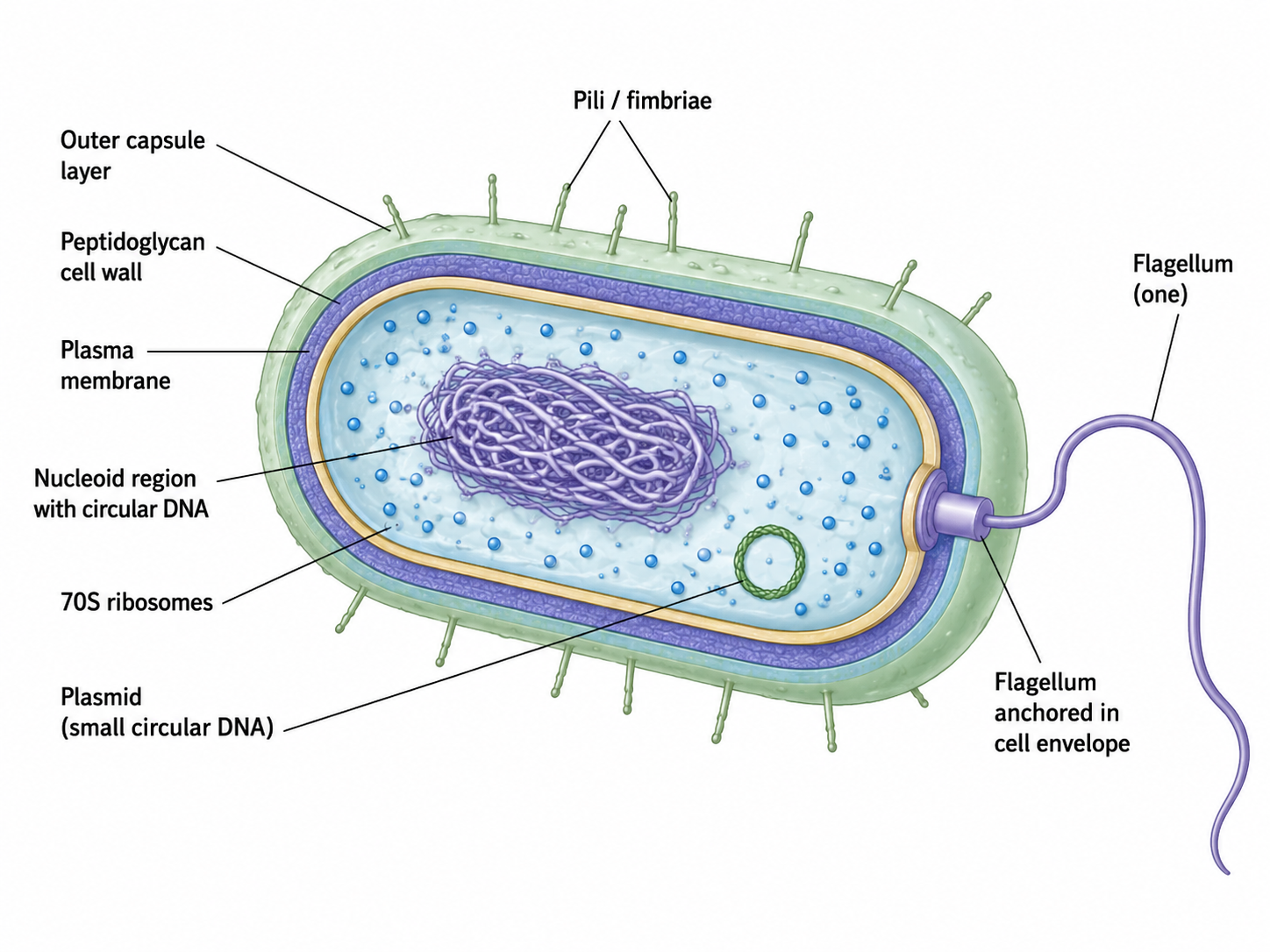
- Plasma membrane — site of the electron transport chain (bacteria have no mitochondria).
- Cell wall — peptidoglycan; a major drug target (β-lactams like penicillin block cross-linking).
- Nucleoid — single circular double-stranded DNA chromosome, not membrane-enclosed.
- Ribosomes — 70S (50S + 30S), vs. eukaryotic 80S; targeted by many antibiotics.
- Plasmids — small circular extrachromosomal DNA; can carry antibiotic resistance.
- Capsule — polysaccharide layer; resists phagocytosis (virulence). Pili/fimbriae — attachment; the sex pilus mediates conjugation.
Gram Staining
Must knowGram staining classifies bacteria by cell wall structure:
| Feature | Gram-Positive | Gram-Negative |
|---|---|---|
| Peptidoglycan | Thick | Thin |
| Outer membrane | Absent | Present (contains LPS) |
| Stain color | Purple (crystal violet) | Pink/Red (safranin) |
| Example | Staphylococcus, Streptococcus | E. coli, Salmonella |
The Gram-negative outer membrane contains lipopolysaccharide (LPS), an endotoxin that triggers a strong inflammatory response (can cause septic shock). Gram-positive bacteria instead release exotoxins (secreted proteins).
Quick check: Penicillin inhibits peptidoglycan cross-linking. More effective against Gram-positive or Gram-negative? Why?
Gram-positive, because their thick peptidoglycan is exposed. In Gram-negative bacteria, the outer membrane is a permeability barrier limiting access to the peptidoglycan beneath.
Major Classifications of Bacteria by Shape
Must knowKnow the three shapes; the species lists below are Reference / Passage-level — recognize, don't memorize.
- Bacilli — rod-shaped (E. coli, Bacillus anthracis, Mycobacterium tuberculosis).
- Cocci — spherical. Arrangement is meaningful: diplo- (pairs), strepto- (chains, e.g. Streptococcus pyogenes), staphylo- (grape-like clusters, e.g. Staphylococcus aureus).
- Spirilli — helical/corkscrew. Includes spirochetes — flexible, with internal endoflagella (axial filaments) giving corkscrew motility (Treponema pallidum — syphilis; Borrelia burgdorferi — Lyme).
Quick check: A patient has a "bulls-eye" rash after a tick bite, caused by a spiral-shaped bacterium. Name the organism and its shape category.
Borrelia burgdorferi, the cause of Lyme disease. It is a spirochete (a flexible, helical spirillum) with internal endoflagella producing corkscrew motility.
Lack of Nuclear Membrane and Mitotic Apparatus
Must knowThe defining feature of all prokaryotes (Bacteria and Archaea) is the absence of a membrane-bound nucleus. The chromosome (single, circular, double-stranded) sits in the nucleoid region.
With no nucleus to break down and reform, prokaryotes do not undergo mitosis. They also lack a mitotic spindle, centrosomes/centrioles, and condensed histone-packaged chromosomes.
Binary Fission
Know the logicProkaryotes divide by binary fission, simpler than mitosis: DNA replication starts at a single origin and proceeds bidirectionally around the circular chromosome; daughter chromosomes are segregated to opposite poles; and FtsZ (a tubulin homolog) forms a contractile Z-ring that pinches the cell in two.
Binary fission is rapid (E. coli ~every 20 min), which — with high mutation rates and horizontal gene transfer — drives rapid bacterial evolution and antibiotic resistance.
Quick check: FtsZ, the protein that forms the contractile ring in binary fission, is homologous to which eukaryotic protein?
Tubulin. FtsZ polymerizes into filaments and hydrolyzes GTP, mirroring tubulin — an example of molecular conservation supporting common ancestry.
Lack of Typical Eukaryotic Organelles
Must knowProkaryotes have no membrane-bound organelles — no mitochondria, chloroplasts, ER, Golgi, lysosomes, or peroxisomes. Processes eukaryotes compartmentalize instead occur in the cytoplasm or at the plasma membrane:
| Function | Eukaryote | Prokaryote |
|---|---|---|
| Aerobic respiration (ETC) | Inner mitochondrial membrane | Plasma membrane |
| Protein synthesis | 80S ribosomes | 70S ribosomes |
| Transcription / replication | Nucleus | Cytoplasm (nucleoid) |
Because there's no nuclear envelope, transcription and translation are coupled in bacteria — ribosomes translate mRNA while it's still being transcribed. Eukaryotes must process and export mRNA first.
Prokaryotic ribosomes are 70S (50S + 30S) vs. eukaryotic 80S (60S + 40S).
Passage-levelThis difference is the basis for antibiotics targeting the 30S (aminoglycosides, tetracyclines) or 50S (macrolides, chloramphenicol) subunit.
Quick check: If bacteria have no mitochondria, where does the electron transport chain occur?
At the plasma membrane — functionally analogous to the inner mitochondrial membrane. This parallels the endosymbiotic theory: mitochondria likely evolved from a bacterial endosymbiont, which is why they retain 70S ribosomes and circular DNA.
Presence of Cell Wall in Bacteria
Must knowThe bacterial cell wall surrounds the plasma membrane, providing rigidity, shape, and protection against osmotic lysis. Its main component is peptidoglycan.
Know the logicStructure: peptidoglycan is alternating NAM and NAG sugars cross-linked by short peptide chains. Cross-linking is done by transpeptidases (penicillin-binding proteins), the target of β-lactam antibiotics (penicillins, cephalosporins).
Osmotic protection: without a wall, bacteria in a hypotonic solution take in water and lyse; the wall resists turgor pressure. This is why lysozyme (in tears, saliva) cleaves NAM–NAG bonds to cause lysis, and why penicillin makes growing/dividing bacteria burst when they can't build intact peptidoglycan.
Reference — other walls: Archaea have a wall but no true peptidoglycan (so penicillin/lysozyme don't work); plants = cellulose; fungi = chitin; animal cells = no wall.
Quick check: A new antibiotic inhibits synthesis of N-acetylmuramic acid (NAM). Would it be effective against Archaea?
No. Archaea have no peptidoglycan and thus no NAM, so the drug selectively targets bacteria. This shows why knowing cell-wall composition is clinically important.
Flagellar Propulsion and Mechanism
Must knowMany bacteria are motile via flagella — whip-like appendages that rotate to propel the cell. Bacterial flagella are fundamentally different from eukaryotic ones.
Know the logicStructure: three parts — filament (the propeller, made of flagellin), hook (a universal joint), and basal body (the motor embedded in the cell envelope).
Mechanism: the flagellum is a rotary motor powered by the proton-motive force ( gradient across the membrane), not ATP directly.
- CCW rotation → flagella bundle → bacterium "runs" (directed swimming).
- CW rotation → flagella splay → bacterium "tumbles" (reorients).
This run/tumble switch is the basis of chemotaxis — directed movement toward attractants or away from repellents — signaled to the motor via the CheA/CheY phosphorylation cascade.
Reference — arrangements: monotrichous (one pole), amphitrichous (one at each pole), lophotrichous (tuft), peritrichous (all around, e.g. E. coli).
Bacterial vs. eukaryotic flagella:
| Feature | Bacterial | Eukaryotic |
|---|---|---|
| Protein | Flagellin | Tubulin (9+2 axoneme) |
| Energy | Proton-motive force | ATP (dynein) |
| Motion | Rotation | Whip-like bending |
| Membrane-enclosed | No | Yes |
Quick check: A mutant bacterium has a defective CheY it cannot phosphorylate. Can it swim? Can it perform chemotaxis?
It can still swim (the motor works), but cannot perform directed chemotaxis. CheY-phosphate signals the switch to CW rotation (tumbling); without it the bacterium runs continuously but can't reorient — motile but chemotactically blind.
Common Confusions & Tricks
1. Prokaryote ≠ just Bacteria. Archaea are also prokaryotes (no membrane-bound nucleus) but a separate domain. "Prokaryotic" = both domains; "bacterial" is more specific.
2. 70S vs. 80S. Prokaryotic (and mitochondrial/chloroplast) = 70S (50S + 30S); eukaryotic cytoplasmic = 80S (60S + 40S). S values don't add arithmetically. Mitochondria/chloroplasts having 70S ribosomes is evidence of their prokaryotic ancestry.
3. Gram-positive = thick peptidoglycan = purple. Gram-negative = thin peptidoglycan + outer membrane (LPS) = pink (safranin). Crystal violet washes out of Gram-negative cells during decolorization because the outer membrane is disrupted; thick peptidoglycan traps it in Gram-positive cells.
4. LPS (endotoxin) vs. exotoxins. LPS = structural Gram-negative outer-membrane component, released on death → fever/septic shock. Exotoxins = proteins actively secreted (often Gram-positive). Endo = released on death; Exo = secreted out.
5. Archaea have NO peptidoglycan. So penicillin and lysozyme have no effect. If an antibiotic "fails," check whether the organism even has the target structure.
6. Bacterial flagella use proton-motive force, NOT ATP directly. Eukaryotic flagella use ATP (dynein). Mnemonic: "Bacteria are cheap — they use the proton gradient they already have."
7. Binary fission is NOT mitosis. Mitosis uses a microtubule spindle, condensed chromosomes, and checkpoints; binary fission uses FtsZ and is simpler. Same outcome (two identical daughters), different machinery.
8. "Spirilli" is the shape; "spirochete" is a subtype. Spirochetes have endoflagella (axial filaments) inside the periplasm; spirilla have external flagella. Key spirochetes: Treponema pallidum (syphilis), Borrelia burgdorferi (Lyme).
9. "Bacillus" is both a genus and a shape. As a shape it means rod-shaped generally; capitalized Bacillus is a specific genus.
10. "Staphylo-" = clusters; "strepto-" = chains. Appears in major pathogens: Staphylococcus aureus (clusters) vs. Streptococcus pyogenes (chains).
Key Takeaways
Cell Theory
- Three tenets: all living things are made of cells; the cell is the basic unit of life; all cells come from pre-existing cells (Virchow).
- Figures: Hooke (coined "cell"), Leeuwenhoek (first observed living microorganisms), Schleiden (plants), Schwann (animals), Virchow (cell from cell).
- Viruses/prions are exceptions — acellular, can't self-replicate.
Domains of Life
- Three-domain system (Woese, 16S rRNA): Bacteria, Archaea, Eukarya.
- Both Bacteria and Archaea are prokaryotes, but distinct domains.
- Archaea: ether-linked isoprenoid lipids, no true peptidoglycan, often extremophiles, eukaryote-like RNA polymerase, some histone-like proteins.
Bacterial Structure
- Cell wall = peptidoglycan (NAM + NAG); target of β-lactams and lysozyme.
- Gram-positive: thick peptidoglycan, no outer membrane, purple, often exotoxins.
- Gram-negative: thin peptidoglycan, outer membrane with LPS (endotoxin), pink.
- Ribosomes: 70S (50S + 30S); antibiotic target.
- No nucleus → nucleoid (circular chromosome). No mitochondria → ETC at plasma membrane.
- Division by binary fission (FtsZ Z-ring, not a spindle).
Bacterial Shapes
- Bacilli (rods), cocci (spheres; diplo-/strepto-/staphylo- arrangements), spirilli (helical; spirochetes have internal endoflagella).
Flagellar Propulsion
- Flagellin filament + hook + basal-body motor; powered by proton-motive force (not ATP directly).
- CCW = run; CW = tumble; chemotaxis via CheA/CheY.
- Contrast eukaryotic flagella: tubulin 9+2 axoneme, ATP/dynein, whip-like bending, membrane-enclosed.