Bacteria lack a nucleus, but they are anything but genetically simple. They have evolved multiple mechanisms to shuffle, acquire, and share genetic material at rates that let a population adapt to antibiotics within days. Understanding how bacteria exchange genes — and how that information moves even without sexual reproduction — is central to both the MCAT and to medicine.
Priority labels: Must know = cold; Know the logic = mechanism not names; Passage-level = recognize, don't memorize; Optional = skippable.
The Prokaryotic Genome: Setting the Stage
Must knowThe main chromosome of a bacterium is a single, circular, double-stranded DNA molecule in the nucleoid region (not membrane-bound). Bacteria are essentially haploid — one copy of each gene — so a mutation is immediately expressed phenotypically, with no second allele to mask it. This is why bacteria evolve so rapidly.
Bacterial DNA is compacted by nucleoid-associated proteins, which are functionally analogous (but not homologous) to eukaryotic histones — bacteria lack true histones and have no nuclear envelope. Passage-level that prokaryote-vs-eukaryote chromosome contrast is occasionally tested; the protein names (HU, H-NS) are not.
Beyond the main chromosome, many bacteria carry extragenomic DNA as plasmids (next), and mobile elements like transposons can insert into the chromosome or plasmids — making the bacterial "genome" more dynamic than a single fixed sequence.
Quick check: A mutation in a bacterial gene almost always produces a visible phenotype. Why? Because bacteria are haploid — there is no second copy to provide a functional backup.
Plasmids and Extragenomic DNA
What Plasmids Are
Must knowA plasmid is a small, usually circular, double-stranded DNA molecule that replicates independently of the main chromosome. It contains its own origin of replication (ori), so it can be duplicated and passed to daughter cells during binary fission. Plasmids carry genes that are not essential under normal conditions but confer advantages in specific environments (antibiotics, novel nutrients, hostile hosts).
Types of Plasmids
Must knowThe two the MCAT names: the F (fertility) plasmid, which carries transfer genes and mediates conjugation (produces the sex pilus), and R (resistance) plasmids, which carry antibiotic-resistance genes. Optional other classes exist (virulence, metabolic, Col) but are not high-yield by name.
R plasmids are emphasized because the MCAT loves the link between antibiotic resistance and horizontal gene transfer (HGT): when an R plasmid transfers from a resistant to a sensitive bacterium via conjugation, resistance spreads with no mutation needing to occur.
Episomes
Know the logicA plasmid that can integrate into the host chromosome is an episome. The F plasmid is the canonical example — free circular (F⁺ state) or integrated (Hfr state, see conjugation). This integration/excision behavior underlies the different conjugation outcomes.
Passage-levelPlasmids also vary in copy number (a regulated property); high-copy plasmids are useful for biotech amplification. No numbers to memorize.
Quick check: A hospital strain of S. aureus becomes resistant to multiple antibiotics seemingly overnight. Mutation or plasmid transfer? Plasmid (R plasmid) transfer via conjugation — a single R plasmid can carry resistance genes for many drugs at once, producing multi-drug resistance simultaneously.
The Three Mechanisms of Horizontal Gene Transfer
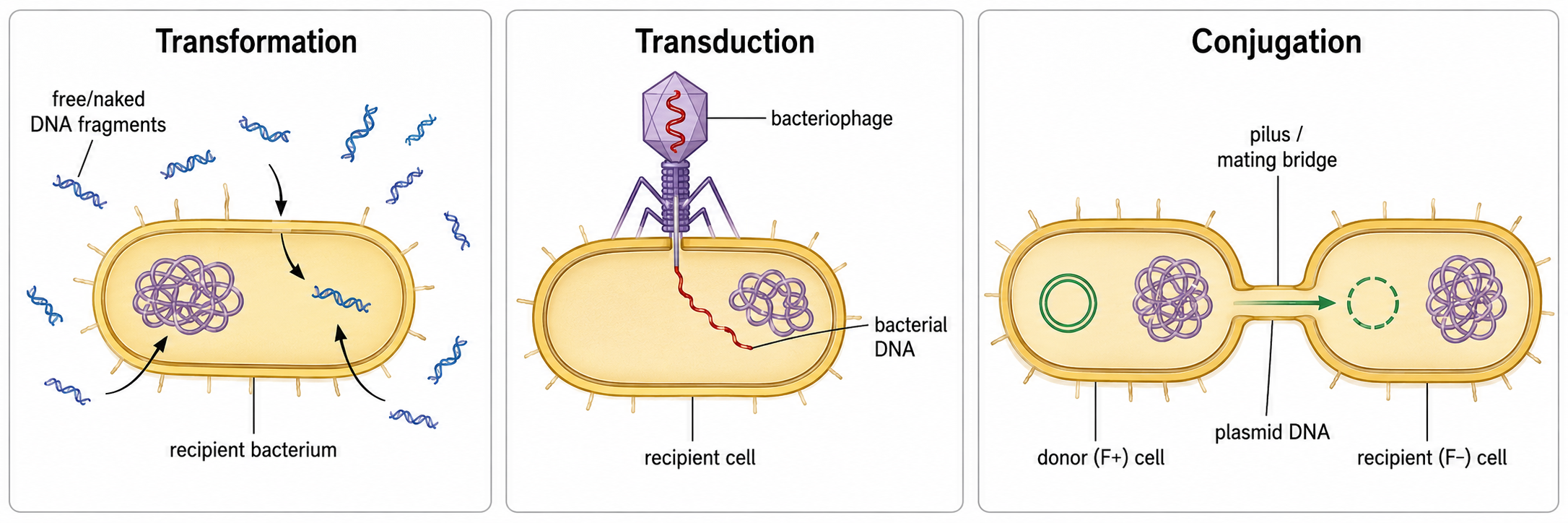
Bacteria acquire new DNA without reproducing through three distinct routes, contrasted below before we examine each.
Transformation
Must knowTransformation is the uptake of naked (free) DNA fragments from the external environment and their incorporation into the cell. No living donor is required — the DNA could come from a lysed dead bacterium, a lab experiment, or the medium.
Competence. Only competent cells take up DNA. Natural competence is a regulated state (some species only, e.g., S. pneumoniae) in which the cell expresses a DNA-binding/import apparatus. In the lab, artificial competence is induced in E. coli by chemical treatment (CaCl₂ + heat shock) or electroporation — a common biotechnology context.
Griffith (1928). Using S. pneumoniae, the smooth (S) strain (capsule → virulent) and rough (R) strain (no capsule → harmless). Mice injected with heat-killed S + live R died, and live S bacteria were recovered — something from the dead S cells had "transformed" the live R cells. Griffith called this the "transforming principle" without knowing what it was.
Avery, MacLeod, McCarty (1944). Selectively destroying candidate molecules: proteases and RNases left transformation intact, but DNase abolished it — proving DNA is the genetic material.
Integration. Imported DNA is stably inherited via homologous recombination, so it must share sequence similarity with the chromosome; non-homologous DNA is typically degraded.
Worked example: DNA from an ampicillin-resistant E. coli is added to a competent ampicillin-sensitive strain. Cells that take up and recombine the resistance gene grow on ampicillin plates while others don't — which is exactly how transformation is detected (selection on antibiotic plates).
Conjugation
Must knowConjugation is direct cell-to-cell DNA transfer requiring physical contact, mediated by a sex pilus encoded by the F (fertility) plasmid. It is the closest thing bacteria have to "sex," but it is not sexual reproduction — it is one-directional and transfers only part of the genome.
The F Plasmid and Mating Types
Must know- F⁺ cell: carries the F plasmid as a free element; produces the pilus; acts as donor.
- F⁻ cell: no F plasmid; acts as recipient.
When F⁺ contacts F⁻, a mating bridge forms and one strand of the F plasmid is transferred (rolling-circle replication) while complementary strands are synthesized in both cells. Result: both cells become F⁺, and the chromosome is not normally transferred.
Hfr Cells: High-Frequency Recombination
Must knowWhen the F plasmid integrates into the chromosome, the cell becomes an Hfr (high-frequency recombination) cell. In an Hfr × F⁻ cross, transfer begins at the integration point and leads with chromosomal genes. Because cells usually separate before the whole chromosome transfers, genes near the start transfer most often and the F sequences (at the very end) almost never make it across. So the recipient receives chromosomal genes at high frequency (incorporated by homologous recombination) but rarely becomes F⁺.
| Cross Type | Chromosome Transfer? | Recipient Becomes F⁺? |
|---|---|---|
| F⁺ × F⁻ | Rarely (almost never) | Yes |
| Hfr × F⁻ | Yes (partial) | Rarely (F sequences last) |
Quick check: In an Hfr × F⁻ cross, genes near the origin of transfer go at high frequency. What about genes far from it? They transfer rarely — conjugation usually ends before the pair separates, so distal genes (and the trailing F sequences) seldom arrive, which is why recipients stay F⁻.
Transduction (Virus-Mediated Gene Transfer)
Must knowTransduction is the transfer of bacterial DNA from one cell to another via a bacteriophage (bacterial virus) as the vector. During infection, a phage occasionally packages a fragment of bacterial DNA into a capsid; infecting a new cell, it delivers that DNA, which can recombine into the new host's chromosome. It is the third route of HGT and is reliably tested even though it isn't in this subtopic's outline.
OptionalThe generalized (random packaging of any gene) vs. specialized (only genes flanking a phage's integration site) distinction is developed in the Viral Life Cycle guide; here, just know a phage can ferry bacterial genes between cells.
Quick check: A phage-mediated transfer can move any gene at roughly equal frequency — generalized or specialized? Generalized (random packaging). Specialized is limited to genes near the phage's integration site.
Transposons
Must knowTransposons ("jumping genes," transposable elements) are DNA sequences that move from one genome location to another — within a chromosome, between chromosomes, or onto/off a plasmid. They occur in both prokaryotes and eukaryotes (a high-yield AAMC distinction; in humans, ~45% of the genome is transposon-derived). Passage-level discovered by Barbara McClintock in maize.
Prokaryotic Transposon Structure
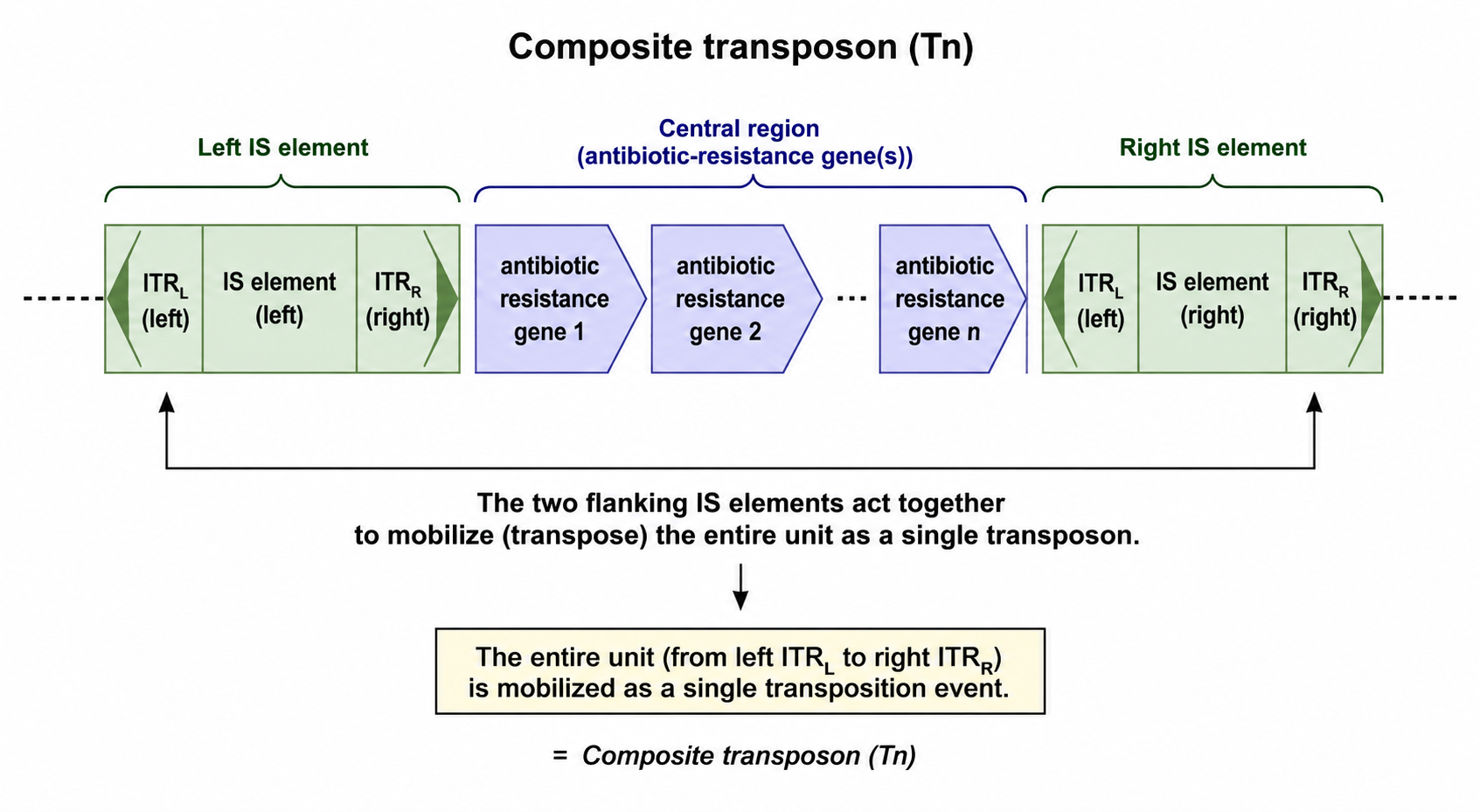
Know the logicThe simplest elements are insertion sequences (IS elements), which encode only transposase (the enzyme that moves the element) and are flanked by inverted terminal repeats that transposase recognizes. Composite transposons (Tn elements) are two IS elements flanking a central region carrying extra genes — most importantly antibiotic-resistance genes — that move as a unit. (Detailed transposase enzymology is out of scope.)
Mechanism and Consequences
Know the logicTwo strategies: cut-and-paste (conservative) — excised and reinserted, no duplication; and replicative — copied, so one copy stays and a new copy inserts elsewhere.
Transposons are mutagens: their insertion can inactivate a gene (insertion into coding sequence) or alter expression (insertion into a promoter/regulatory region). Clinically, they can spread antibiotic resistance by jumping from the chromosome onto a plasmid that then conjugates into new hosts, and can drive chromosomal rearrangements via recombination between two copies.
Quick check: A transposon carrying kanamycin resistance jumps from the chromosome into the F plasmid, which then conjugates with a sensitive strain. Outcome? The sensitive strain becomes F⁺ and kanamycin-resistant — with no mutation in the new host. This is the clinical danger of transposons plus conjugation.
A Note on Operons and Gene Regulation
Bacteria also cluster functionally related genes into operons (e.g., lac, trp), regulating them at transcription. That topic is developed fully in the Control of Gene Expression in Prokaryotes guide. For prokaryotic genetics, focus on how DNA moves (plasmids, the three HGT mechanisms, transposons), not how genes are switched on and off.
Common Confusions & Tricks
Transformation vs. Transduction vs. Conjugation — the classic mix-up:
- Transformation = naked DNA from the environment (no live donor, no virus)
- Transduction = bacteriophage carries the DNA (a virus is the vector)
- Conjugation = direct cell-to-cell contact (pilus + mating bridge)
Mnemonic: Transformation = Tube (DNA in solution); Transduction = Transported by phage; Conjugation = Contact required.
Hfr crosses rarely produce F⁺ recipients — students get this backwards. The F sequences are at the trailing end of the transferred DNA, and most matings are disrupted before the chromosome fully transfers, so F sequences almost never arrive. Recipients stay F⁻. Only in F⁺ × F⁻ matings does the recipient routinely become F⁺.
Generalized vs. specialized transduction: "any gene" → generalized; only genes near an integration site → specialized ("specialized neighborhood").
Transposons are NOT viruses. No protein coat, not infectious, can't exist outside a cell. They move within and between DNA molecules, not between organisms directly (though they hitchhike on conjugating plasmids).
Competence ≠ every bacterium. Only naturally competent (or artificially treated) species undergo transformation.
McClintock ≠ prokaryote. She found transposons in maize (a eukaryote), but transposons exist in prokaryotes too — the bidirectional relevance is the testable point.
IS elements vs. composite transposons: IS = only transposase (the "engine"); composite transposon = IS elements plus cargo like resistance genes (the "truck").
"Transformation" has two uses: (1) natural uptake of environmental DNA (Griffith/Avery), or (2) lab introduction of recombinant plasmids into bacteria (biotech). Context clarifies which.
Key Takeaways
Prokaryotic Genome
- Single circular chromosome, haploid, in the nucleoid (no nuclear envelope); compacted by nucleoid-associated proteins (not true histones)
- Mutations expressed immediately (no second allele)
Plasmids
- Small, circular, autonomously replicating extragenomic DNA
- F (fertility) and R (resistance) are the named types; episomes can integrate (e.g., F plasmid)
- R plasmids are the primary vehicle for multi-drug resistance spread via conjugation
Transformation
- Uptake of naked DNA by competent bacteria; integrated via homologous recombination
- Griffith (1928): "transforming principle" in S. pneumoniae; Avery/MacLeod/McCarty (1944): it is DNA
Conjugation
- Direct cell-to-cell contact via sex pilus (F plasmid-encoded)
- F⁺ × F⁻: F plasmid transfers, recipient becomes F⁺, chromosome rarely transferred
- Hfr × F⁻: chromosomal genes transferred at high frequency; recipient stays F⁻ (F sequences last)
Transduction
- Gene transfer via bacteriophage (generalized = any gene; specialized = genes flanking the integration site — see Viral Life Cycle guide)
Transposons
- "Jumping genes," present in prokaryotes AND eukaryotes (McClintock, maize)
- IS elements (only transposase) vs. composite transposons (IS + cargo like resistance genes)
- Move by cut-and-paste or replicative; cause insertional mutagenesis, resistance spread, chromosomal rearrangements
| Mechanism | DNA Source | Vector/Contact | Any Gene? |
|---|---|---|---|
| Transformation | Environmental (naked DNA) | None (direct uptake) | Any (if homology exists) |
| Conjugation | Donor cell | Sex pilus / direct contact | F plasmid or chromosome (partial) |
| Transduction | Donor cell (via phage) | Bacteriophage | Any (generalized) / specific (specialized) |
| Transposition | Self (within genome) | None (intracellular) | No — only the transposon itself moves |