Prokaryotes are abundant and metabolically versatile, and the MCAT tests them by applying their physiology to antibiotic resistance, infectious disease, and human physiology. This guide keeps the concepts and just enough mechanism to reason through passages.
Priority labels: Must know = cold; Know the logic = mechanism not names; Passage-level = recognize, don't memorize; Optional = skippable.
Reproduction by Binary Fission
Must knowProkaryotes reproduce asexually by binary fission: a single parent grows, duplicates its single circular chromosome, and divides into two genetically identical daughter cells. There is no mitotic spindle and no mitosis.
Know the logicThe sequence: chromosome replication begins at the origin of replication (oriC) and proceeds bidirectionally while the cell elongates; daughter chromosomes are pulled toward opposite poles (actin homolog MreB, tubulin homolog FtsZ — functional analogues of the spindle, not the real thing); FtsZ polymerizes into a Z-ring at midcell and constricts; new peptidoglycan builds the septum and the cells separate, each with one chromosome.
Because there's no recombination, daughters are clones — mutation is the main source of new heritable variation within a lineage (horizontal gene transfer changes this, below).
Binary fission is fast (E. coli ~20 min). Combined with exponential growth, even rare mutations appear frequently in absolute numbers — the engine of antibiotic-resistance evolution.
Quick check: A student claims binary fission is "like mitosis but simpler." What is the most important structural difference?
Answer: No true microtubule spindle. Segregation uses FtsZ (tubulin homolog) and MreB (actin homolog) — functional analogues, not eukaryotic spindle machinery. There's also no nuclear envelope breakdown, since prokaryotes have no membrane-bound nucleus.
Exponential Growth and the Bacterial Growth Curve
Must knowWhen each cell divides into two, the population doubles every generation — exponential (logarithmic) growth, not linear. The rate (doublings per unit time) is constant, but the absolute number added each generation keeps rising.
The growth equation. Starting with cells after doublings:
With generation (doubling) time and elapsed time , , so:
On a log scale ( vs. time), exponential growth is a straight line — hence "log phase."
The four phases (transferred to a new environment):
| Phase | What is happening | Key feature |
|---|---|---|
| Lag | Synthesizing enzymes, ribosomes, cofactors | No net increase; metabolically very active |
| Log (exponential) | Dividing at max rate; nutrients plentiful | Constant doubling; most antibiotic-sensitive here |
| Stationary | Growth rate = death rate (nutrient depletion, waste) | Number plateaus; stress responses/sporulation |
| Death (decline) | Death rate > growth rate | Exponential decline in viable count |
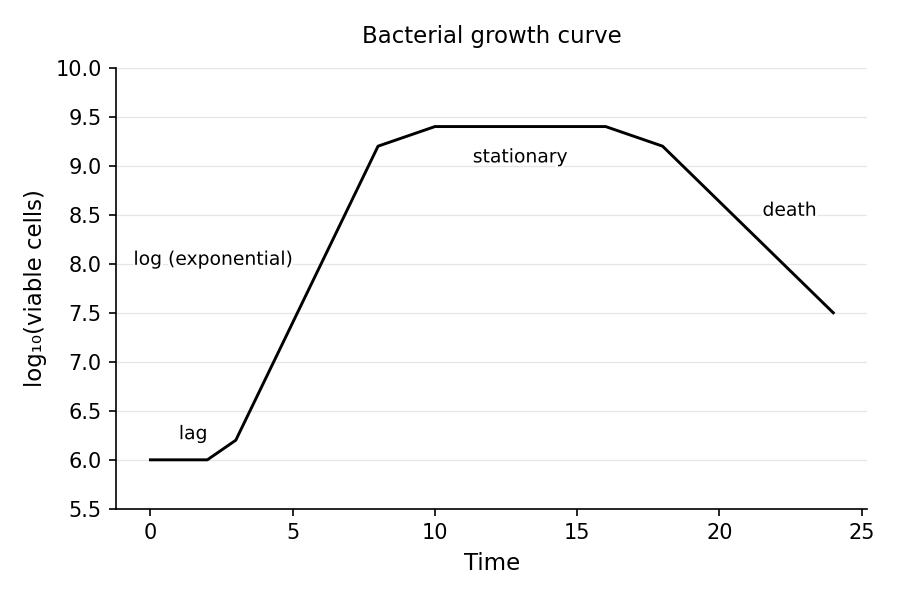
The lag phase is frequently tested: cells aren't dormant, they're building the machinery for rapid growth.
Worked example: Start with bacteria, min. After 3 hr?
min, so doublings. .
Quick check: A culture is in stationary phase. Are the bacteria dead?
Answer: No. The net population is stable because new-cell production equals cell death. Individual cells are often very much alive and metabolically active, upregulating stress-response and sporulation pathways.
Genetic Adaptability and Acquisition of Antibiotic Resistance
Must knowProkaryotes adapt fast via two routes: spontaneous mutation (amplified by huge populations and short generation times) and horizontal gene transfer (HGT), which spreads resistance genes between unrelated cells. HGT is the more dangerous clinically.
Three mechanisms of HGT:
| Mechanism | DNA source | Vector/Conduit | Cell contact? |
|---|---|---|---|
| Transformation | Environmental free (naked) DNA | None | No |
| Transduction | Donor bacterium | Bacteriophage | No |
| Conjugation | Donor bacterium | Pilus | Yes |
- Transformation: a competent cell takes up naked DNA released by lysed cells and recombines it in.
- Transduction: a bacteriophage accidentally packages host DNA and injects it into a new host. Optional generalized vs. specialized transduction distinguishes lytic random packaging from lysogenic imprecise excision.
- Conjugation: direct transfer through a pilus. The donor carries a plasmid (classically the F factor in E. coli); a copy of the plasmid — or chromosomal DNA in Hfr strains — is transferred. Most clinically important, because R plasmids carry multiple resistance genes and spread across species.
Plasmids are small circular extrachromosomal DNA that replicate independently and often carry resistance genes; conjugation makes them the main vehicle for spreading resistance. Transposons ("jumping genes") move between chromosome and plasmid, further scrambling resistance determinants.
Know the logicResistance mechanisms (not drug classes):
- Enzymatic inactivation (e.g., β-lactamase cleaves the β-lactam ring).
- Target modification so the drug can't bind.
- Efflux pumps that export the drug.
- Reduced permeability that keeps the drug out.
Crucially, the antibiotic does not create resistance. Resistance mutations/genes already exist or arise by chance; the antibiotic is selective pressure that kills sensitive cells and lets resistant ones proliferate — Darwinian selection in real time.
Quick check: A hospital introduces a new antibiotic. Within months, a resistant strain emerges. Did the antibiotic cause the mutation conferring resistance?
Answer: No. The antibiotic selects, it doesn't mutate. Resistance arose spontaneously before/during exposure; the drug kills sensitive cells, leaving resistant ones to reproduce — selection, not directed mutation.
Aerobic and Anaerobic Variants
Must knowOxygen is a double-edged sword: an excellent terminal electron acceptor (large ATP yield via oxidative phosphorylation), but a source of toxic reactive oxygen species — superoxide (), , hydroxyl radical — for cells lacking protective enzymes (superoxide dismutase, catalase). So prokaryotes span a spectrum of oxygen tolerance.
Oxygen categories:
| Category | Relationship to O₂ | Example |
|---|---|---|
| Obligate aerobe | Requires O₂ (aerobic respiration only) | M. tuberculosis |
| Obligate anaerobe | Cannot use O₂; O₂ is toxic | Clostridium |
| Facultative anaerobe | Prefers O₂ but ferments/anaerobically respires without it | E. coli |
| Aerotolerant anaerobe | Doesn't use O₂ but isn't harmed by it | Streptococcus |
| Microaerophile | Needs low O₂; harmed by atmospheric levels | H. pylori |
Nutritional classification: by carbon source — autotrophs fix , heterotrophs use organic carbon; by energy source — phototrophs use light, chemotrophs use chemical bonds. The two common combos are photoautotrophs (cyanobacteria) and chemoheterotrophs (most bacteria, all animals).
Anaerobic respiration vs. fermentation:
- Anaerobic respiration still uses an ETC, but with a terminal acceptor other than (e.g., , , ). It yields more ATP than fermentation but less than aerobic respiration.
- Fermentation uses no ETC; an organic molecule (e.g., pyruvate) accepts electrons purely to regenerate , yielding no ATP beyond glycolysis (2 net ATP).
The two canonical fermentations: lactic acid (pyruvate → lactate; Lactobacillus, exercising muscle) and alcohol (pyruvate → ethanol + ; yeast). The point of both is regenerating so glycolysis continues.
Quick check: A wound infected with Clostridium perfringens produces gas (bubbles under the skin). Why is this consistent with the organism's physiology?
Answer: Clostridium are obligate anaerobes generating ATP by fermentation/anaerobic metabolism and producing gas (, ) as byproducts. Gas in tissue (gas gangrene) is a hallmark of obligate anaerobic metabolism.
Parasitic and Symbiotic Relationships
Must knowBacteria occupy every niche, from free-living decomposers to obligate intracellular parasites. The MCAT uses precise ecological terms. Symbiosis broadly = any long-term interspecies interaction:
| Relationship | Host | Bacterium | Example |
|---|---|---|---|
| Mutualism | + | + | Rhizobium (N fixation); gut microbiome |
| Commensalism | 0 | + | Many skin bacteria |
| Parasitism | − | + | M. tuberculosis |
(In loose MCAT usage "symbiotic" sometimes means "mutualistic" — be precise when you can.)
Obligate intracellular parasites live exclusively inside host cells, relying on host machinery — e.g., Chlamydia (cannot make its own ATP) and Rickettsia. They occupy a conceptual space near viruses but are still true cells with their own ribosomes and metabolism.
Passage-levelMutualism examples: the gut microbiome digests complex polysaccharides we can't, makes short-chain fatty acids and some vitamins (K, B), and trains immunity. Nitrogen fixation: Rhizobium in legume root nodules fixes → for the plant in exchange for carbon.
Quick check: Chlamydia trachomatis is called an "obligate intracellular parasite." What specific metabolic dependency explains this?
Answer: Chlamydia cannot synthesize ATP, so it must parasitize host ATP ("energy thief"), forcing intracellular life. It does have its own ribosomes and DNA replication, unlike viruses.
Chemotaxis
Must knowChemotaxis is directed movement along a chemical gradient — toward nutrients/oxygen, away from toxins.
Flagellar mechanics: bacterial flagella (made of flagellin) are spun by a proton-motive-force-driven rotary motor — distinct from the eukaryotic "9+2" microtubule flagellum powered by dynein/ATP.
- Run: flagella rotate counterclockwise (CCW); in E. coli they bundle and propel the cell smoothly forward.
- Tumble: flagella rotate clockwise (CW); the bundle flies apart and the cell randomly reorients.
With no gradient, runs and tumbles alternate randomly (a random walk).
Know the logicBiased random walk: bacteria don't sense direction; they compare recent past to present. Moving up an attractant gradient → suppress tumbling, extend the run. Conditions worsening → tumble more, reorient. Statistically the cell drifts toward attractants and away from repellents.
Know the logicThe pathway (not the names): membrane receptors (MCPs) signal through the kinase CheA, which phosphorylates CheY; CheY-P binds the motor switch to promote CW rotation → tumbling. Detecting attractant suppresses CheA → less CheY-P → CCW → run. Optional CheZ dephosphorylates CheY-P; CheR/CheB methylate/demethylate MCPs for adaptation to constant background.
Passage-levelEndospores: when nutrients run low (stationary phase), Bacillus and Clostridium form endospores — dormant, highly resistant structures surviving boiling, desiccation, UV, and most disinfectants. They are a survival, not reproductive, strategy: one cell → one endospore → one bacterium on germination. (Sporulation molecular detail is beyond MCAT scope.)
Quick check: A bacterium is swimming up a glucose gradient. What is happening at the level of its flagellar motor?
Answer: Increasing attractant suppresses CheA, so less CheY-P reaches the motor switch. The flagella default to CCW rotation, the bundle forms, and the cell runs smoothly up the gradient.
Common Confusions & Tricks
Binary fission vs. mitosis: Bacteria don't "undergo mitosis." Binary fission uses FtsZ and MreB, not a true spindle; there's no nuclear envelope breakdown and no spindle checkpoint.
Transformation ≠ transformation (cancer): Microbiology = uptake of naked exogenous DNA; cell biology = a normal cell becoming cancerous. Don't mix them.
The antibiotic does not create resistance: Resistance arises via mutation/HGT regardless of exposure; the drug selects for pre-existing resistant cells. Bacteria don't "learn" resistance.
Conjugation requires a pilus but DNA travels through a channel: The pilus makes initial contact and retracts to pull cells together; DNA passes through a direct cell–cell mating junction, not the hollow pilus.
Facultative anaerobe vs. aerotolerant anaerobe: Both survive in oxygen; the difference is whether they use it. Facultative anaerobes switch to aerobic respiration (preferred); aerotolerant anaerobes always ferment and merely tolerate O₂.
Fermentation regenerates NAD⁺, not ATP: Yield equals glycolysis alone (2 net ATP). Fermentation steps make zero ATP. Don't say fermentation "produces more ATP."
CCW = run, CW = tumble: Frequently tested directionally. Attractant → CCW → run; repellent → CW → tumble. Mnemonic: "Counterclockwise = Correct direction (toward food)."
Obligate intracellular parasites are not viruses: Chlamydia and Rickettsia are true cells (ribosomes, membranes, own DNA replication) that require the intracellular environment. Viruses are not cells.
Endospores are not reproductive: One cell → one endospore → one bacterium. MCAT passages may imply endospores are a growth mechanism — they are not.
Key Takeaways
-
Binary fission: chromosome replication at oriC, FtsZ Z-ring constriction, septum, separation. No spindle; no nucleus.
-
Growth curve: Lag (ramp-up, no net growth) → Log (exponential, ) → Stationary (growth = death) → Death. Most antibiotic-sensitive in log phase.
-
HGT: Transformation (naked DNA), transduction (phage), conjugation (pilus/plasmid — most important for resistance).
-
Antibiotic resistance: enzymatic inactivation (β-lactamase), target modification, efflux pumps, reduced permeability. Selected, not induced.
-
Oxygen categories: obligate aerobe, obligate anaerobe, facultative anaerobe, aerotolerant anaerobe, microaerophile — know each definition and an example.
-
Fermentation: regenerates NAD⁺ (not ATP) so glycolysis continues. Lactic acid and alcohol fermentation are the canonical types.
-
Ecological relationships: mutualism (+/+), commensalism (0/+), parasitism (−/+). Obligate intracellular parasites (Chlamydia, Rickettsia) are true bacteria, not viruses.
-
Chemotaxis: biased random walk. Attractant → CCW → run; repellent → CW → tumble. MCPs → CheA → CheY-P → motor switch.
-
Endospores (Bacillus, Clostridium): dormant survival structures (not reproductive), extremely resistant.