Viruses sit at one of biology's most fascinating borders: they carry genetic information and evolve, yet they cannot reproduce on their own. Understanding this dependency — and how viruses exploit host machinery — is the foundation for antivirals, vaccines, transduction, and the central-dogma exceptions the MCAT loves to test.
Priority labels: Must know = cold; Know the logic = mechanism not names; Passage-level = recognize, don't memorize; Optional = skippable.
What Is a Virus? The Logic of Obligate Intracellular Parasitism
Must knowViruses are obligate intracellular parasites. They lack ribosomes, cannot generate ATP, and have no metabolic machinery. Everything a virus needs to replicate — ribosomes, energy, often polymerases, lipid membranes — must come from the host. This single fact explains every step of the life cycle below.
Virus Structure
Must knowA minimal virus is genetic material (DNA or RNA, single- or double-stranded) wrapped in a protein shell called a capsid; nucleic acid + capsid = nucleocapsid. Many animal viruses are additionally surrounded by a viral envelope — a lipid bilayer taken from the host membrane during budding, studded with virus-encoded spike glycoproteins.
The naked vs. enveloped distinction drives entry and exit:
| Naked (non-enveloped) | Enveloped | |
|---|---|---|
| Outer layer | Capsid only | Lipid bilayer + glycoproteins |
| Stability | More resistant (drying, detergent) | Sensitive to drying/detergents/heat |
| Exit | Often lysis | Often budding (host survives longer) |
| Examples | Adenovirus, poliovirus | HIV, influenza, herpes |
You don't need Baltimore classification — just how a genome reaches mRNA. Positive-sense (+) RNA can be translated directly; negative-sense (−) RNA must first be copied to a + strand by an RNA-dependent RNA polymerase; retroviruses go RNA → DNA → RNA → protein (backward from the central dogma, hence "retro").
Quick check: A virus has an ssRNA genome that host ribosomes can translate directly on entry. Is it + or − sense? Answer: Positive sense (+ssRNA) — it functions directly as mRNA, no intermediate synthesis step.
Bacteriophage Life Cycles: The MCAT's Model System
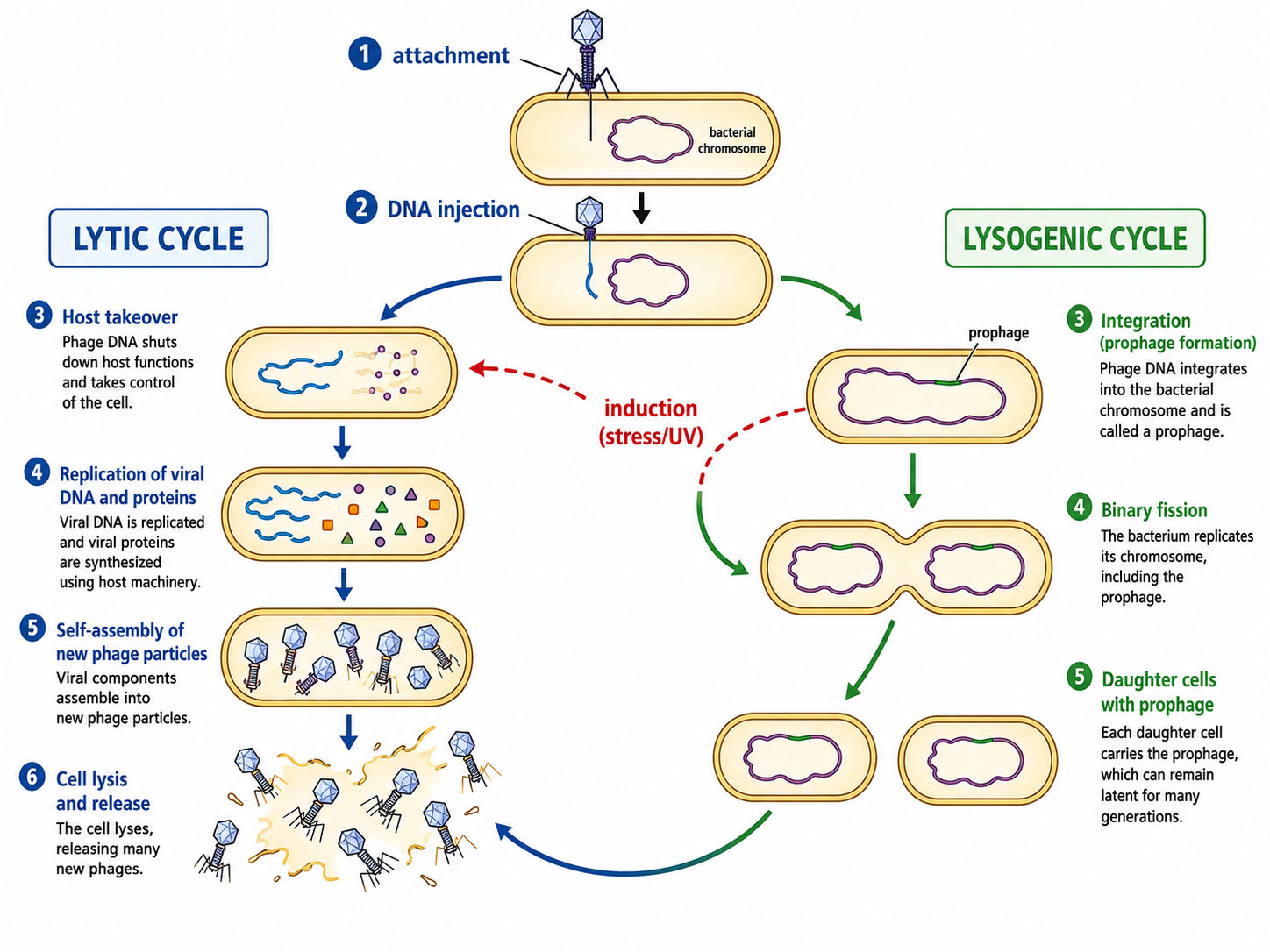
Bacteriophages ("phages") infect bacteria and are the canonical teaching model. They come in two strategies, shown below.
The Lytic Cycle
Must knowKnow the logic and order. In the lytic cycle the virus commandeers the host, replicates massively, and lyses the cell to release progeny — "infect, exploit, destroy." The stages:
- Attachment (adsorption): Tail fibers bind specific surface receptors. Receptor specificity defines host range — no receptor, no infection.
- Penetration: The phage injects its genome through its tail like a syringe; the capsid stays outside. (Contrast: animal viruses usually enter whole.)
- Host takeover: Viral early genes (transcribed by the host's RNA polymerase) shut down host replication and degrade the bacterial chromosome.
- Replication: Viral genome and structural proteins are made using host machinery.
- Self-assembly: Capsid proteins and genome assemble spontaneously, driven by favorable protein–protein interactions (no extra energy needed).
- Lysis and release: Phage-encoded lysozyme degrades the peptidoglycan wall, bursting the cell and releasing ~100–200 phage (the burst size).
The Lysogenic Cycle
Must knowTemperate phages can instead integrate their genome into the bacterial chromosome as a prophage; the cell keeps dividing and passes the prophage to every daughter cell (lysogeny; the carrier is a lysogen).
Key features:
- The prophage replicates passively with the host chromosome — no virions are made.
- A phage-encoded repressor keeps lytic genes off.
- Stress (UV, DNA damage) triggers induction: the prophage excises and enters the lytic cycle.
- Lysogenic conversion: prophage genes can give the host new traits (classic: Corynebacterium diphtheriae makes diphtheria toxin only when carrying its prophage).
Quick check: A bacterium repeatedly treated with UV suddenly produces many phage. What was its prior state? Answer: A lysogen harboring a prophage; UV triggered induction, switching it to the lytic cycle.
Animal Virus Life Cycles
Must knowAnimal viruses infect eukaryotic cells but follow the same logic (attach → enter → replicate → assemble → release); the molecular details differ.
Stage 1 — Attachment: Surface proteins bind host receptors with high specificity, setting tissue tropism (e.g., HIV gp120 binds CD4; influenza hemagglutinin binds sialic acid).
Stage 2 — Penetration and uncoating: Animal viruses enter as whole virions, by receptor-mediated endocytosis (endosome acidification triggers escape) or, for enveloped viruses, direct membrane fusion. The capsid is then dismantled (uncoating), releasing the genome.
Stage 3 — Use of host machinery (most important): The virus always depends on host ribosomes — no virus encodes its own. DNA viruses use host nuclear RNA polymerase II; RNA viruses usually carry/encode their own RNA-dependent RNA polymerase (RdRp) because eukaryotes can't replicate RNA from an RNA template.
Passage-levelReplication site — DNA viruses replicate in the nucleus (exception: poxviruses, cytoplasm); RNA viruses replicate in the cytoplasm (exception: influenza, nucleus).
Stage 4 — Self-assembly: Proteins and genomes assemble into new virions; envelope glycoproteins are inserted into host membranes.
Stage 5 — Release: Non-enveloped viruses typically lyse the cell; enveloped viruses typically bud — the nucleocapsid pushes through a glycoprotein-studded patch of host membrane, taking it as its envelope, often without immediately killing the cell (allowing chronic infection).
Quick check: An enveloped virus buds. Which envelope components come from the host vs. the virus? Answer: The lipid bilayer is host-derived; the embedded spike glycoproteins are virus-encoded (made by host ribosomes).
Transduction: Viruses as Gene Ferries
Must knowTransduction is phage-mediated transfer of bacterial DNA from one cell to another — one of three mechanisms of horizontal gene transfer (with transformation and conjugation).
- Generalized transduction: During the lytic cycle, phage packaging machinery occasionally packages a random fragment of degraded host DNA instead of phage DNA, then injects it into a new cell. Any gene can transfer (random packaging).
- Specialized transduction: With temperate phages, imprecise prophage excision drags adjacent host genes along, so only genes flanking the integration site transfer.
| Type | Mechanism | Which genes? |
|---|---|---|
| Generalized | Random packaging of host DNA during lysis | Any gene |
| Specialized | Imprecise prophage excision | Only genes flanking integration site |
Quick check: A phage transfers an antibiotic-resistance gene, and across transductants any gene transfers at roughly equal frequency. Generalized or specialized? Answer: Generalized — equal-frequency transfer of any gene indicates random packaging of host DNA.
The Retrovirus Life Cycle: HIV as the Canonical Example
Must knowRetroviruses violate the classical central dogma with a reverse step (RNA → DNA). HIV is the prototype: an enveloped virus with a +ssRNA genome carrying three key enzymes:
- Reverse transcriptase (RT): RNA-dependent DNA polymerase (makes DNA from RNA). No proofreading → high mutation rate and rapid drug resistance.
- Integrase: integrates viral dsDNA into the host chromosome.
- Protease: cleaves polyprotein precursors into functional proteins (virion maturation).
HIV Life Cycle (high-yield order)
Must know- Attachment: gp120 binds CD4 (on helper T cells, macrophages, dendritic cells) plus a co-receptor (CCR5 or CXCR4).
- Fusion/entry: gp41 fuses the envelope with the cell membrane; nucleocapsid enters.
- Reverse transcription: RT converts +ssRNA → dsDNA (proviral DNA).
- Integration: integrase inserts the proviral DNA into the host chromosome (provirus) — permanent; the basis of HIV latency in long-lived memory T cells.
- Transcription: host RNA polymerase II makes both mRNA and genomic RNA.
- Translation and processing: host ribosomes translate the mRNAs; protease cleaves proteins into functional forms.
- Assembly and budding: virions assemble at the membrane, bud, and mature.
Quick check: A patient's HIV is undetectable on antiretroviral therapy but not cured. Why? Answer: HIV integrates as a provirus in long-lived memory CD4+ T cells. Antiretrovirals block new replication but can't remove integrated proviruses, which replicate with the cell.
Prions and Viroids: Subviral Particles
The minimalist extremes — simpler than viruses, and both challenge "nucleic acid = heritable information."
Prions
Must knowPrions are infectious proteins — no nucleic acid. A single protein has two conformations: normal soluble PrP and misfolded pathological PrP. PrP acts as a template, inducing PrP to refold into the pathological shape. The amino acid sequence is unchanged — only the fold. Because the "information" is shape, not nucleic acid, prions are resistant to UV and nucleases. They cause fatal neurodegenerative disease (e.g., Creutzfeldt-Jakob disease, "mad cow disease").
Viroids
Must knowViroids are small, naked, circular ssRNA — no protein coat. They encode no proteins and replicate using host RNA polymerase. They infect plants only.
| Property | Virus | Viroid | Prion |
|---|---|---|---|
| Nucleic acid | DNA or RNA | RNA only | None |
| Protein coat | Yes (capsid) | No | Protein only |
| Encodes proteins | Yes | No | N/A |
| Host range | Bacteria, plants, animals | Plants only | Mammals |
| Replication via | Host machinery | Host RNA pol | Conformational conversion |
Quick check: A sample is UV-irradiated to destroy nucleic acid but still causes neurodegeneration in mice. What agent? Answer: A prion — it has no nucleic acid, so UV doesn't inactivate it; the agent is a misfolded protein.
Common Confusions & Tricks
1. Lytic vs. lysogenic — which is "dormant"?
Lysogenic = phage lying low ("ly" = lying dormant); lytic = cell lysed. The prophage makes no virions; lysis only happens in the lytic cycle.
2. Transduction vs. transformation vs. conjugation
All three are horizontal gene transfer, but transduction uniquely uses a phage. Transformation = naked DNA uptake; conjugation = cell-to-cell via pilus. "Phage" + "DNA transfer between bacteria" → transduction.
3. Reverse transcriptase: RNA → DNA, not DNA → RNA
Transcription (DNA→RNA) is forward; RT does the reverse (RNA→DNA). Its lack of proofreading explains HIV's high mutation rate.
4. Retroviruses vs. phages integrating
A prophage integrates via integrase at specific recombination sites; a retroviral provirus also uses integrase but inserts roughly randomly. Don't conflate them.
5. Prions: conformational change, NOT mutation
No nucleic acid mutation — the heritable "information" is the 3D fold. PrP and PrP share the same sequence; only the conformation differs.
6. HIV infects CD4+ cells — not all immune cells
HIV requires CD4 as its primary receptor; CD8+ T cells, B cells, and NK cells aren't primary targets. It depletes CD4+ helper T cells, collapsing immune function.
7. Ribosomes ALWAYS come from the host
No virus encodes its own ribosomes. If asked what the virus must take from the host, translation machinery (ribosomes, tRNAs, amino acids, ATP) is always included.
8. + sense vs. − sense RNA — which is "ready to use"?
Positive sense = same polarity as mRNA = translated directly. Negative sense = complementary = must be copied to + strand by RdRp first. Cue: positive = productive immediately.
9. Viroids vs. prions
Viroids have RNA (no protein), infect plants. Prions have protein (no RNA), infect mammals.
10. Budding ≠ cell death (usually)
Enveloped viruses can bud without immediately lysing the cell — why HIV causes chronic infection rather than the acute burst-and-die of T4 phage.
Key Takeaways
- Viruses are obligate intracellular parasites — always use host ribosomes, ATP, and often host polymerases.
- Phage lytic cycle: attach → inject genome → host takeover → replicate → self-assemble → lyse/release.
- Phage lysogenic cycle: integrate as prophage → dormancy → induction (stress/UV) → lytic cycle. Can confer new traits (lysogenic conversion).
- Animal virus entry: receptor-determined tropism; enveloped enter by fusion, non-enveloped by endocytosis; all uncoat.
- Genome type sets strategy: +ssRNA translated directly; −ssRNA needs RdRp first; retroviruses reverse-transcribe (RNA→DNA→provirus).
- DNA viruses replicate in the nucleus (poxvirus exception); RNA viruses in the cytoplasm (influenza exception).
- Transduction: phage-mediated gene transfer. Generalized = any gene, random packaging; specialized = only flanking genes, imprecise excision.
- HIV: CD4/co-receptor binding → fusion → reverse transcription → integration (provirus) → transcription → translation → budding/maturation.
- HIV enzymes: reverse transcriptase (no proofreading), integrase, protease.
- Prions: misfolded PrP templates PrP. No nucleic acid; resistant to UV/nucleases; fatal neurodegeneration.
- Viroids: circular ssRNA, no protein coat, no encoded proteins; infect plants; replicate via host RNA polymerase.
| Agent | Nucleic Acid | Protein Coat | Replicates Via |
|---|---|---|---|
| Bacteriophage | DNA or RNA | Yes | Host + viral enzymes |
| Animal virus | DNA or RNA | Yes (± envelope) | Host machinery |
| Viroid | Circular ssRNA | No | Host RNA polymerase |
| Prion | None | Protein only | Conformational conversion |