Priority labels: Must know = cold; Know the logic = mechanism not names; Passage-level = recognize, don't memorize; Optional = skippable.
What Is a Virus, Really?
Must knowA virus is not a cell. It is a nucleic acid genome packaged inside a protein shell (capsid), sometimes wrapped in a lipid membrane stolen from a host cell. Viruses carry just enough information to hijack a host cell's machinery and replicate — they bring the blueprint, but none of the construction equipment.
This obligate intracellular parasite status is the single most important concept here: every structural feature flows from total dependence on the host. No ribosomes, no mitochondria — the virus borrows the host's.
General Structural Characteristics
The Capsid and Nucleocapsid
Must knowThe core of every virus is its genome (DNA or RNA) surrounded by a protein coat, the capsid, built from repeating subunits called capsomeres that self-assemble around the nucleic acid. Genome + capsid = nucleocapsid.
Must know the two main capsid symmetries:
- Icosahedral — roughly spherical, 20 triangular faces; encloses maximum volume with minimum protein (e.g., adenovirus, poliovirus).
- Helical — capsomeres wrap the genome in a spiral, producing a rod/filament (classic: tobacco mosaic virus).
A complex category (neither purely icosahedral nor helical) covers bacteriophages and poxviruses.
Enveloped vs. Non-Enveloped Viruses
Must knowSome viruses acquire a viral envelope — a lipid bilayer taken from the host's membranes during budding out of the cell. Embedded in it are viral glycoproteins (spike proteins) used to recognize and bind new host cells. (HIV and influenza spikes are recognizable examples; specific spike subtypes are not tested.)
Non-enveloped (naked) viruses have only their capsid as the outer layer. They are generally more stable in the environment — resistant to drying and detergents — because they lack a fragile lipid membrane.
Enveloped viruses are disrupted by lipid solvents (alcohol), which is why alcohol-based sanitizers work on them; naked viruses are more resistant.
Quick check: A researcher exposes two viruses to a lipid-dissolving detergent. Virus A loses infectivity; Virus B does not. What structural feature does Virus A have that Virus B lacks?
Answer: Virus A is enveloped — its lipid bilayer is disrupted by the detergent, destroying its ability to bind host cells. Virus B is non-enveloped (naked), so removing a lipid membrane has no effect.
Lack of Organelles and Nucleus
Must knowA virus has no nucleus, no ribosomes, no mitochondria, no ER, no Golgi. Consequences:
- Cannot generate its own energy (no independent ATP synthesis).
- Cannot synthesize proteins (no ribosomes — it commandeers the host's).
- Cannot replicate outside a living host cell — viruses carry out no independent metabolism, so they are not "alive" in the conventional sense.
This is the basis for obligate intracellular parasite status. Know the logic the defining absence is all organelles — that distinguishes viruses from obligate intracellular bacteria (e.g., Chlamydia, Rickettsia), which still possess ribosomes and metabolic machinery. From the host a virus borrows ribosomes, tRNAs, amino acids, nucleotides, ATP, and (if enveloped) membrane lipids.
Quick check: A newly discovered pathogen requires a living host cell to replicate and contains no ribosomes or mitochondria. Is it necessarily a virus?
Answer: Not necessarily — some obligate intracellular bacteria (like Chlamydia) also cannot replicate outside a host, but they do have ribosomes. The complete absence of ribosomes strongly supports a virus; the defining structural absence is all cellular organelles.
Structural Aspects of a Typical Bacteriophage
Must knowThe bacteriophage — a virus that infects bacteria — is the structural example to know cold. The T-even (T4) phage is the model complex structure.
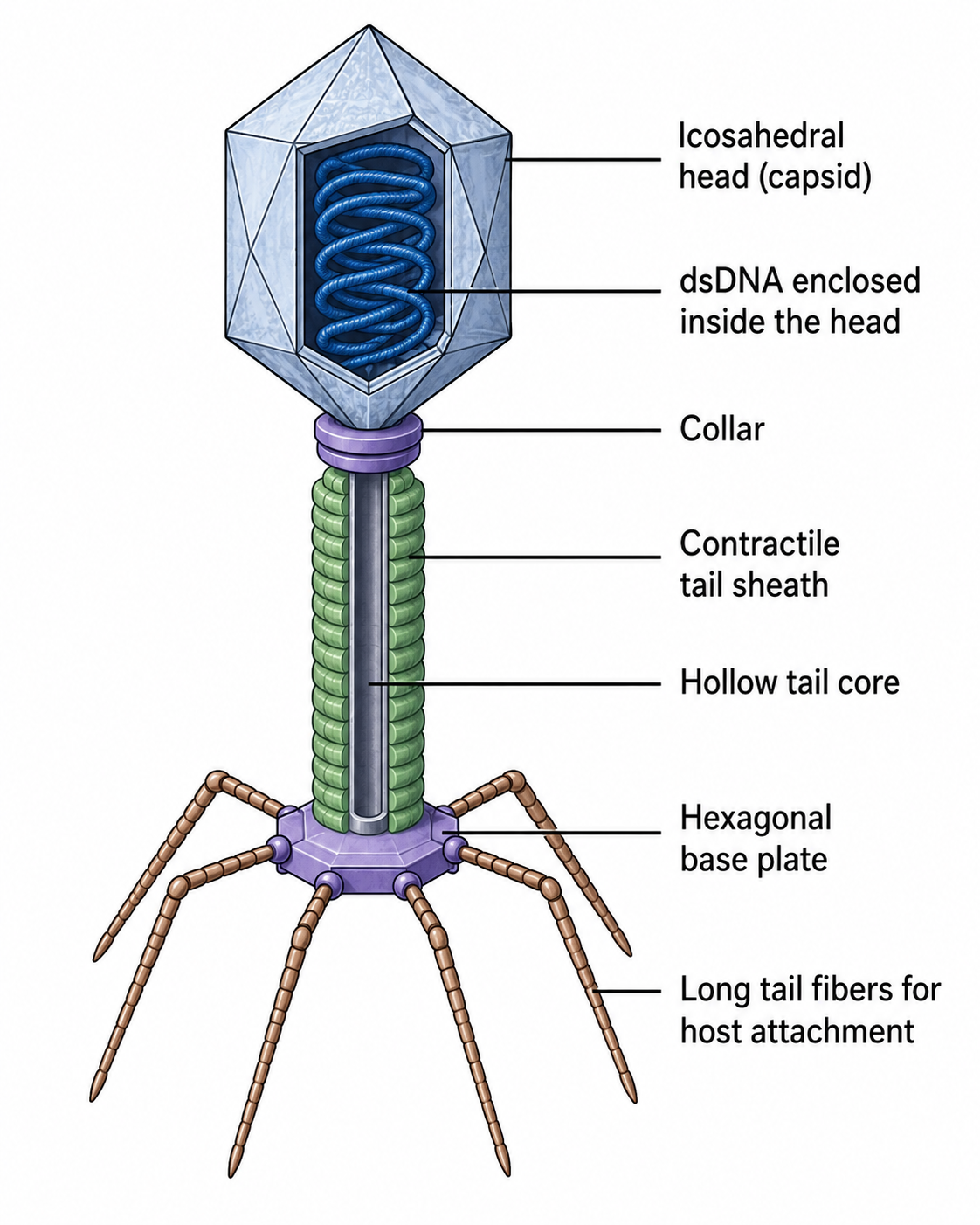
Must know the head–tail–tail-fiber layout and what each key part does; the full parts list is reference-level:
- Head (capsid): icosahedral shell housing the dsDNA genome.
- Tail sheath: contractile cylinder that contracts like a syringe to inject DNA.
- Tail fibers + base plate: recognize and bind specific bacterial surface receptors (host specificity); base plate triggers contraction.
A collar connects head to tail, the hollow tail core is the channel DNA passes through, and tail pins help anchor attachment.
Know the logicTail fibers bind the bacterial surface, the base plate locks down, the sheath contracts, and the tail core acts as a needle injecting the DNA genome into the cytoplasm. Only the nucleic acid enters; the capsid stays outside. This injection is unique to phages — animal viruses instead internalize the whole virion (endocytosis or membrane fusion).
Quick check: During T4 bacteriophage infection, which part of the virus enters the bacterial cell?
Answer: Only the DNA genome enters; the capsid, sheath, base plate, and tail fibers stay outside. This was shown by the Hershey-Chase experiment, which used (DNA label) and (protein label) to prove DNA is the genetic material injected.
Genomic Content — DNA or RNA
Must knowUnlike cells (always dsDNA), viral genomes vary: the genome is either DNA or RNA, never both, and may be single- or double-stranded, linear or circular, segmented or not.
The +/− RNA distinction:
- Positive-sense ssRNA (+ssRNA): the genome is mRNA — host ribosomes translate it immediately. (e.g., poliovirus, coronavirus.) "Positive = ready-to-go."
- Negative-sense ssRNA (−ssRNA): the genome is the complement of mRNA, so it must first be transcribed by a viral RNA-dependent RNA polymerase (RdRP) packaged in the virion (host cells lack this enzyme). (e.g., influenza, rabies.)
- dsRNA: also requires a viral RdRP (e.g., rotavirus).
- DNA viruses (ds or ss): use host DNA polymerase; dsDNA examples include herpesviruses, adenovirus, and phage T4.
Retroviruses (e.g., HIV): carry a +ssRNA genome but replicate through a DNA intermediate. The virion carries reverse transcriptase, which makes dsDNA from the RNA; this dsDNA integrates into the host chromosome as a provirus. The RNA → DNA direction is the "retro" reversal.
Know the logicThe takeaway is who must bring a polymerase. −ssRNA and dsRNA viruses must package their own RdRP; +ssRNA viruses do not; retroviruses bring reverse transcriptase.
Quick check: A newly isolated virus carries only RNA and packages no polymerase in the virion. What type of RNA genome does it most likely have, and why?
Answer: Most likely +ssRNA. Because +ssRNA functions directly as mRNA, host ribosomes can translate it immediately — no viral polymerase needed. A −ssRNA or dsRNA virus would have to bring its own RdRP, and a retrovirus would bring reverse transcriptase.
Size Relative to Bacteria and Eukaryotic Cells
Must knowThe size hierarchy:
| Entity | Approximate Size |
|---|---|
| Eukaryotic cell | 10–100 µm |
| Prokaryotic cell (bacterium) | 1–10 µm |
| Virus (typical) | 20–300 nm |
The key relationship: viruses are ~10–100× smaller than bacteria, which are ~10–100× smaller than eukaryotic cells. In practice:
- Viruses pass through filters that trap bacteria (historically, how "filterable viruses" were discovered).
- Viruses are too small for light microscopy (resolution limit ~200 nm); most require an electron microscope. Bacteria are visible by light microscopy.
Quick check: A 19th-century scientist filters a diseased plant extract through a filter fine enough to remove all bacteria, then uses the filtrate to infect a healthy plant — successfully causing disease. What does this suggest about the causative agent?
Answer: The agent is smaller than bacteria — it passes through a bacterium-retaining filter. This is the signature of a virus (the original "filterable virus" observation, made with tobacco mosaic virus).
Common Confusions & Tricks
1. Envelope = lipid bilayer from the HOST, not made by the virus.
The lipid bilayer is derived from the host membrane; the virus only contributes its own glycoproteins into it. If asked where an enveloped virus gets its envelope, the answer is the host cell membrane.
2. Only the DNA (or RNA) enters during phage infection — not the capsid.
For bacteriophages, only the genome is injected; the coat stays outside. For animal viruses, the whole virion is internalized, then uncoated.
3. −ssRNA viruses MUST package their own RdRP; +ssRNA viruses do not.
Repeatedly tested. Mnemonic: Negative = Needs its own polymerase.
4. Retroviruses have an RNA genome that becomes DNA — not the other way around.
HIV carries RNA in the virion; reverse transcriptase makes DNA from it inside the host. The provirus is the integrated DNA copy — the original virion is RNA.
5. Bacteriophage tail fibers determine host specificity — not the head.
Tail fibers recognize specific surface receptors; the head just stores DNA.
6. "Virus-sized" ≠ visible by light microscope.
Bacteria CAN be seen by light microscopy; most viruses CANNOT. Standard light-microscope visualization means bacteria or larger, not typical viruses.
7. Prions and viroids are even simpler than viruses.
A viroid is naked RNA (no capsid); a prion is a misfolded protein (no nucleic acid). Neither is a virus, but the MCAT may place them below viruses on the complexity spectrum.
Key Takeaways
- Virus = nucleic acid + protein capsid ± lipid envelope. No organelles, no ribosomes, no nucleus — obligate intracellular parasites.
- Capsid symmetries: icosahedral and helical (complex = phages/poxviruses).
- Enveloped viruses have a host-derived lipid bilayer with viral glycoproteins; disrupted by detergents/lipid solvents. Naked viruses are more environmentally stable.
- Bacteriophage T4: icosahedral head (dsDNA) → contractile tail sheath → base plate/tail fibers (host specificity). Only the DNA genome enters the bacterium.
- Genomes: DNA or RNA (never both); +ssRNA translates directly, −ssRNA and dsRNA need a viral RdRP in the virion, retroviruses use reverse transcriptase (ssRNA → dsDNA provirus).
- Size hierarchy: eukaryotic cells (10–100 µm) > bacteria (1–10 µm) > viruses (20–300 nm); viruses need EM, bacteria are visible by light microscopy.
- Hershey-Chase proved DNA (not protein) is the injected genetic material, using and .
- Viroids (naked RNA) and prions (misfolded protein) are simpler than viruses.