Why This Topic Belongs in Neuroscience
A chemistry topic appears in the nervous-system section because every action potential is driven by electrochemical gradients — ion concentration differences across a membrane that create an electrical potential. The math governing a zinc electrode in zinc sulfate is the same math governing a sodium channel in a neuron. The Nernst equation is the bridge between electrochemistry and physiology, and the MCAT tests both sides.
Priority labels: Must know = cold; Know the logic = mechanism not names; Passage-level = recognize, don't memorize; Optional = skippable.
Electrochemical Cells: A Quick Foundation
Must knowFor the full treatment of general electrochemistry — galvanic vs. electrolytic cells, electrode potentials, thermodynamics (), Faraday's laws, and batteries — see the 4C Electrochemistry guide. Here we need only the minimum to reach the biological payoff.
In a galvanic (voltaic) cell, two half-cells are connected by a wire (electron flow) and a salt bridge (ion flow to maintain neutrality). Oxidation happens at the anode (electrons leave); reduction at the cathode (electrons arrive) — mnemonic AN OX, RED CAT. The driving force is the cell potential : positive means spontaneous. The one fact we carry forward is that potential depends on concentration — which is exactly what the Nernst equation captures.
Quick check: If , what can you say about and ?
Answer: means (spontaneous) and (products favored).
The Nernst Equation
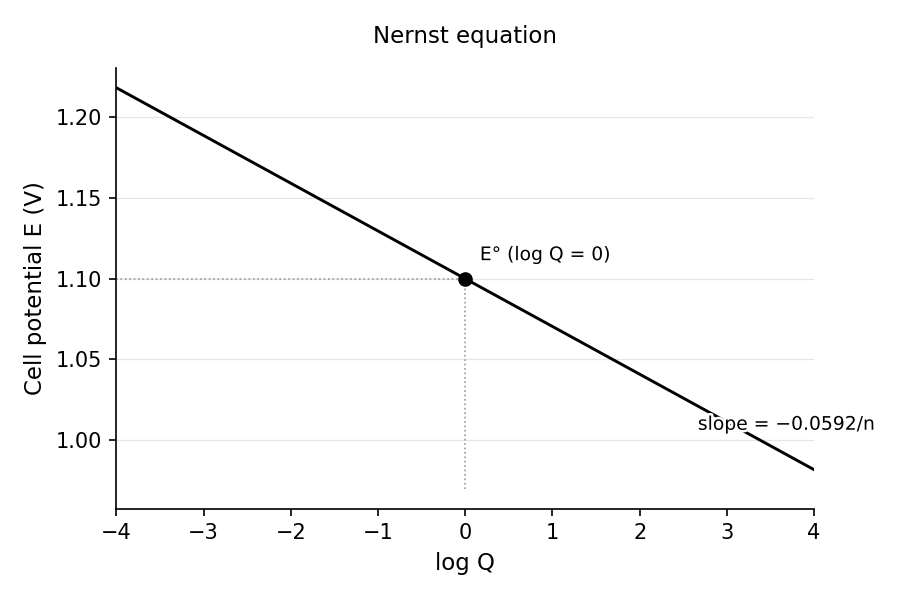
Must knowStandard potential assumes 1 M, 1 atm, 25 °C — conditions real cells never hold. As a reaction proceeds, concentrations change and the actual driving force drifts from . The Nernst equation corrects for this via the reaction quotient :
At 25 °C this simplifies (converting to ) to:
The constant 0.0592 V (≈ 59.2 mV). Variables: = actual potential, = standard potential, = electrons transferred, , , (K), as above.
Know the logicSign intuition: If , the reaction is more spontaneous than standard, so (the Nernst term subtracts a negative). As the reaction proceeds, and — the cell is dead (at equilibrium).
Quick check: A cell has V, , . Is larger or smaller than ? Estimate .
Answer: , so .
V. Still spontaneous, but weaker.
Concentration Cells
The Core Concept
Must knowA concentration cell is a galvanic cell where both electrodes are the same material and both half-cells contain the same ion — only the concentration differs. There is no chemical driving force: because identical half-reactions cancel. The entire driving force is the concentration gradient.
The system spontaneously works to equalize concentrations. The lower-concentration side is the anode (metal dissolves, raising its ion concentration); the higher-concentration side is the cathode (ions plate out, lowering concentration). Electrons flow from low- to high-concentration half-cell — analogous to an ion flowing down its concentration gradient.
The Nernst Equation for a Concentration Cell
Must knowWith , for a metal cell the overall reaction is , so:
Since , (spontaneous). The bigger the concentration ratio, the larger .
Worked Example
Must knowA copper concentration cell at 25 °C. Here , (Cu²⁺), and :
Check: ✓; electrons flow from the dilute (0.010 M) anode to the concentrated (1.0 M) cathode ✓.
The Biological Nernst Equation: Membrane Potentials
Must knowThis is the payoff. The Nernst (equilibrium) potential for a single ion is the membrane voltage that exactly balances that ion's chemical gradient — the voltage at which there is no net driving force.
At physiological temperature (37 °C), the constant shifts so:
where is the ion charge with sign. Convention: membrane potential = inside minus outside; a resting neuron is ≈ mV.
Passage-levelTypical equilibrium potentials: mV, mV, mV, mV. Don't memorize the underlying concentration tables; recognize the values and know that 's near mV is why leak channels set the resting potential.
Know the logicDirection: is more concentrated inside, so chemically it leaks outward, making the inside more negative; is the negative voltage that opposes this efflux. (Plugging , into the equation gives mV.)
Quick check: mV. What does this mean for at rest ( mV)?
Answer: At mV both the electrical gradient (inside negative, attracting in) and the chemical gradient (low inside) favor entry. The cell is far from mV, so there's a large inward driving force — why opening channels causes rapid influx during depolarization.
Direction of Electron Flow: Summary Rules
Must knowFor a concentration cell:
- The lower-concentration half-cell is the anode.
- Electrons flow anode → cathode (low → high concentration) through the external wire.
- In the salt bridge, cations migrate toward the cathode, anions toward the anode.
Quick check: In , which electrode is the anode and which way do electrons flow externally?
Answer: The 0.001 M side is the anode (oxidation: ). Electrons flow from the 0.001 M electrode to the 0.1 M cathode — low to high concentration.
Common Confusions & Tricks
1. Concentration cell anode = LOW concentration (not high). The dilute side wants to raise its ion concentration, so its metal dissolves (oxidation = anode).
2. Writing . Use from the overall reaction; for a concentration cell , giving .
3. Get right. for , for , for . A wrong scales your answer.
4. 0.0592 V at 25 °C vs. 61.5 mV at 37 °C. Use the physiological constant when the passage specifies body temperature.
5. Nernst potential convention. times (with the sign of ). Don't flip the ratio or drop the sign for anions.
6. does NOT mean . A cell is dead () when . A concentration cell has but until the concentrations equalize.
7. Fast shortcut: same metal, same ion, different concentration → → Nernst simplifies immediately.
Key Equations
| Equation | Variables & When to Use |
|---|---|
| Full Nernst; in K. Use when °C. | |
| Nernst at 25 °C; default for most MCAT problems. | |
| From standard reduction potentials; positive = spontaneous. | |
| , | Links cell potential, free energy, and ; C/mol. |
| Single-ion Nernst (equilibrium) potential at 37 °C; = charge with sign. | |
| Concentration cell at 25 °C (); electrons flow low → high. |