Lipids are a chemically diverse class of biomolecules unified not by a shared functional group, but by a shared physical property: they are hydrophobic or amphipathic (largely insoluble in water, soluble in nonpolar environments). This drives their main biological roles: energy storage, membrane architecture, signaling, and insulation. For the MCAT, understand lipids at two levels: structural chemistry (what dictates behavior) and biological function (how the body uses these structures).
Priority labels: Must know = cold; Know the logic = mechanism not names; Passage-level = recognize, don't memorize; Optional = skippable.
Description and Structure of Lipids
Fatty Acids: The Core Building Block
Must knowA fatty acid is a long, unbranched hydrocarbon chain with a terminal carboxylic acid () group. The chain is almost always an even number of carbons (biosynthesized two at a time from acetyl-CoA). The hydrophobic tail interacts with nonpolar molecules; the carboxylate head ionizes at physiological pH, making the molecule amphipathic.
Saturated vs. unsaturated:
- Saturated: no double bonds; straight chains pack tightly → high melting point → solid at room temp (butter, animal fats).
- Unsaturated: one or more . Naturally cis, which kinks the chain, prevents tight packing, lowers melting point → liquid at room temp (olive oil). Monounsaturated = one double bond; polyunsaturated = two or more.
Trans fatty acids have trans double bonds; they pack like saturated fats and are strongly associated with cardiovascular disease.
Nomenclature (brief recap — see the 5D chemistry guide for Δ/ω detail): chains are described by the omega (ω) system, counting from the methyl end. The biologically important point is dietary: omega-3 fatty acids (EPA, DHA) are cardioprotective, and the essential fatty acids (linoleic, ω-6; α-linolenic, ω-3) cannot be synthesized by humans and must come from the diet.
Know the logicEicosanoid signaling: the 20-carbon arachidonic acid is the precursor for prostaglandins (inflammation, pain, fever), thromboxanes (platelet aggregation), and leukotrienes (allergic/asthmatic responses). NSAIDs (aspirin, ibuprofen) inhibit cyclooxygenase (COX) to block prostaglandin synthesis — the basis of their anti-inflammatory action. (Eicosanoid chemistry is detailed in the 5D guide.)
Quick check: Why do unsaturated fatty acids have lower melting points than saturated fatty acids of the same chain length?
Answer: The cis double bonds introduce kinks, preventing the tight Van der Waals packing that is the main source of intermolecular attraction. Less packing = weaker forces = less energy to melt = lower melting point.
Glycerides: Energy Storage Lipids
Must knowTriacylglycerols (triglycerides, TAGs) are a glycerol backbone esterified with three fatty acids. They are completely nonpolar, the primary form of long-term energy storage in adipose tissue, and yield ~9 kcal/g on oxidation (more than twice carbs or protein) because their carbons are highly reduced. They are also anhydrous, so the body stores far more energy per gram as fat than as hydrated glycogen — the reason adipose is the body's main fuel reserve.
In digestion, dietary TAGs are hydrolyzed by lipases back to fatty acids and glycerol; the related base-catalyzed cleavage (saponification, yielding soaps) and the structure of waxes are covered as chemistry in the 5D guide.
Quick check: Why does the body store long-term energy as triacylglycerol rather than as glycogen?
Answer: TAG carbons are highly reduced (more energy per gram on oxidation) and fat is anhydrous, whereas glycogen is heavily hydrated — so fat is far more compact per kcal stored.
Phospholipids and Membrane Structure
Must knowPhospholipids (glycerophospholipids) replace one fatty acid on glycerol with a phosphate group bearing a polar head (choline, serine, ethanolamine, inositol). This gives a hydrophilic head and two hydrophobic tails — the classic amphipathic geometry. In water they self-assemble:
- Micelles — spherical, single-layer, tails inward; typical of single-tailed molecules (detergents).
- Lipid bilayers — two-layer sheets, tails sandwiched between heads; the basis of all cell membranes.
Fluid mosaic model: the membrane is a dynamic bilayer in which proteins "float." Fluidity increases with unsaturated tails (kinks), shorter chains, and higher temperature. Cholesterol is a fluidity buffer: it increases fluidity at low temperature (prevents crystallization) and decreases it at high temperature (restrains motion).
Passage-levelSphingolipids in the nervous system: sphingomyelin is a major lipid of the myelin sheath that insulates axons, and glycolipids (sugar head groups) mediate cell–cell recognition in neural tissue. (Their structural chemistry — sphingosine backbone, amide bond, ceramide — is in the 5D guide.)
Quick check: Why do phospholipids spontaneously form bilayers rather than micelles?
Answer: Two tails make them roughly cylindrical, and cylinders tile into a flat bilayer. Single-tailed molecules are cone-shaped and pack into curved micelles; two bulky tails can't fit a micelle interior.
Lipid Digestion and Transport (Physiological Context)
Passage-level- Dietary TAGs are emulsified by bile salts (cholesterol derivatives) and hydrolyzed by pancreatic lipase into 2-monoacylglycerol + free fatty acids.
- Long-chain fatty acids are re-esterified into TAGs in enterocytes, packaged into chylomicrons, and carried via lymph to blood.
- Lipoproteins (VLDL, LDL, HDL) transport lipids through aqueous blood. LDL delivers cholesterol to tissues; HDL returns it to the liver. High LDL is associated with atherosclerosis.
Steroids
The Steroid Skeleton
Must knowAll steroids share a four-ring carbon skeleton (three fused six-membered rings + one five-membered ring); the attached functional groups distinguish one steroid from another. (Ring nomenclature and isoprene/terpene biosynthesis are detailed in the 5D chemistry guide.)
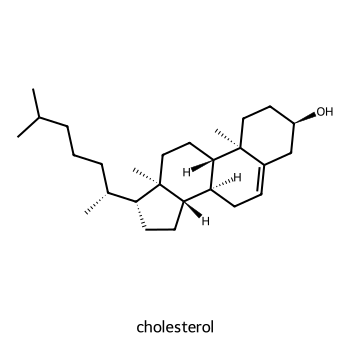
Cholesterol is the most abundant animal steroid. Its single C-3 hydroxyl is the only hydrophilic handle; the rest is nonpolar, so in membranes the hydroxyl sits near the phospholipid heads while the rigid rings intercalate among the tails — making cholesterol the membrane fluidity buffer described above. Biologically, cholesterol is the precursor for all steroid hormones, bile acids/salts, and vitamin D — the roles that matter in the endocrine and digestive systems.
Steroid Hormones
Must knowDerived from cholesterol. Know the logic for the classes, not every example:
| Class | Example | Key Action |
|---|---|---|
| Glucocorticoids | Cortisol | Gluconeogenesis; anti-inflammatory |
| Mineralocorticoids | Aldosterone | Na⁺ reabsorption, K⁺ excretion (kidney) |
| Androgens | Testosterone | Male sex characteristics |
| Estrogens | Estradiol | Female sex characteristics; bone density |
| Progestins | Progesterone | Maintains pregnancy |
Mechanism: Because steroid hormones are lipophilic, they diffuse across the plasma membrane, bind intracellular receptors, and the complex acts as a transcription factor at hormone response elements to regulate gene expression. This is slower (hours) but longer-lasting than peptide-hormone signaling.
Key MCAT contrast: steroid hormones → lipophilic → intracellular receptors → altered transcription; peptide/amino-acid hormones → hydrophilic → membrane receptors → second messengers (cAMP, IP₃/DAG).
Exception to remember: Thyroid hormones (, ) are iodinated tyrosine derivatives but are lipophilic, so they need carrier proteins in blood and use intracellular nuclear receptors like steroids. Classic MCAT trick.
Bile Acids, Vitamin D, Fat-Soluble Vitamins
Know the logicBile acids (cholesterol derivatives from the liver) have polar and nonpolar regions; conjugated and ionized as bile salts, they emulsify dietary lipids into mixed micelles, increasing surface area for lipase.
Vitamin D₃ is activated to calcitriol (the skin→liver→kidney activation sequence is detailed in the 5D guide), which raises intestinal calcium/phosphate absorption for bone mineralization — its key role in endocrine calcium regulation.
Vitamins A, D, E, K are fat-soluble — absorbed with dietary fat, stored in fat/liver, so deficiency follows fat malabsorption and toxicity is possible.
- A – vision (retinal = rhodopsin chromophore), cell differentiation; deficiency → night blindness.
- D – calcitriol; intestinal /phosphate absorption.
- E – membrane antioxidant protecting PUFAs from peroxidation.
- K – cofactor for γ-carboxylation of clotting factors; warfarin antagonizes it.
Quick check: A patient is prescribed a synthetic glucocorticoid (prednisone). By what mechanism does it enter cells, and over what time course does it act?
Answer: Being a steroid (lipophilic), it diffuses across the membrane, binds intracellular glucocorticoid receptors, and the complex regulates transcription. Effects emerge over hours, reflecting time for mRNA/protein synthesis.
Terpene Origin of Steroids and Vitamin A
Must knowFor biology, the link to remember is that several key lipids are terpene-derived: cholesterol (and therefore every steroid hormone, bile acid, and vitamin D) is built from isoprene units via the triterpene squalene, and vitamin A (retinol) derives from the tetraterpene pigment β-carotene. This explains why these structurally unrelated molecules all count as lipids. (The isoprene rule, terpene classification by carbon count, and the squalene→cholesterol numerical logic are covered as chemistry in the 5D guide.)
Common Confusions & Tricks
1. "Unsaturated fat = unhealthy" is backwards. Saturated fats are associated with elevated LDL and cardiovascular risk; unsaturated (especially omega-3) fats are generally cardioprotective.
2. Steroids ≠ just anabolic steroids. Cortisol, aldosterone, estradiol, and cholesterol itself are all steroids. A four-ring figure → "steroid family," then identify by substituents.
3. Steroid vs. peptide hormone mechanism. Steroid → lipophilic → crosses membrane → intracellular receptor → gene expression (hours). Peptide/catecholamine → hydrophilic → membrane receptor → second messenger → rapid (seconds–minutes). Heavily tested.
4. Thyroid hormone is the exception. / are tyrosine-derived but iodination makes them lipophilic — carrier proteins, nuclear receptors like steroids.
5. Terpene counting: divide by 5. Mono = 10C, sesqui = 15C, di = 20C, tri = 30C, tetra = 40C. Cholesterol (27C) doesn't divide neatly (3 carbons lost from squalene) — don't apply the isoprene rule to it directly.
6. Squalene (C30) → Cholesterol (C27). Three carbons are lost; cholesterol is derived from a triterpene, not itself a triterpene.
7. Phospholipid vs. triglyceride at C-3 of glycerol. TAGs: all three carbons esterified to fatty acids. Phospholipids: C-1 and C-2 to fatty acids, C-3 to a phosphate head. Passage questions go straight to C-3.
8. Saponification = base-catalyzed ester hydrolysis. Products: glycerol + carboxylate salts (soaps). Acid hydrolysis gives the protonated fatty acids. Ester bonds cleaved = number of fatty acids.
9. Cis vs. trans double bonds. Natural unsaturated fatty acids are almost always cis. "Partially hydrogenated vegetable oil" → trans fats.
Key Equations and Relationships
| Concept | Expression | Notes |
|---|---|---|
| Isoprene rule | = isoprene units; identifies terpene class | |
| Saponification | Base-catalyzed; 3 mol NaOH per TAG | |
| TAG hydrolysis | Enzymatic in digestion | |
| Degree of unsaturation | Each ring or double bond = 1 DoU | |
| Squalene → cholesterol | Triterpene precursor → steroid nucleus; loses 3 C (pathway out of scope) |