Energy is a unifying idea across physics and biology — falling objects, springs, muscle contraction, cellular respiration. The central insight: energy is a scalar that can change form but is never created or destroyed.
Priority labels: Must know = cold; Know the logic = mechanism not names; Passage-level = recognize, don't memorize; Optional = skippable.
Kinetic Energy
The Concept
Must knowA moving object carries kinetic energy (KE), which depends on mass and velocity — but not equally. Doubling mass doubles KE; doubling speed quadruples it (the dependence). That asymmetry is why a car at 60 mph needs four times the stopping distance of the same car at 30 mph.
- = mass (kg), = speed (m/s)
- KE is always non-negative
The SI unit of energy is the joule (J), . Passage-level in biochem you'll see kJ and kcal; .
The Work-Energy Theorem
Must knowKE connects directly to work. The work-energy theorem states the net work on an object equals its change in kinetic energy:
This is one of the most tested relationships in MCAT mechanics. Recall work by a constant force is , where is the angle between force and displacement. Forces perpendicular to motion (normal force, centripetal force) do zero work and don't change KE.
Worked Example
Must knowA 2 kg ball is thrown horizontally from rest and reaches 6 m/s just before landing (ignore air resistance). How much net work was done?
The ball sped up, so positive net work makes sense. ✓
Quick check: If the ball's mass were doubled to 4 kg but it reached the same final speed of 6 m/s, what would be?
Answer: — exactly double, because KE scales linearly with mass.
Potential Energy
The Concept
Must knowPotential energy (PE) is stored energy associated with an object's position or configuration in a force field. It's always defined relative to a reference point — what matters is the change, , not the absolute value.
Gravitational Potential Energy:
Must knowNear Earth's surface, gravity is essentially constant (). The gravitational PE of mass at height above a reference level is:
- (MCAT approximation)
- = height above your chosen reference point (you pick it)
Lifting an object by stores joules; when it falls, that PE converts to KE. Passage-level physiologically, standing up raises your center of mass (gains PE); sitting releases it (mostly to heat).
Quick check: A 70 kg person climbs stairs 3 m tall. How much gravitational PE do they gain? (Use .)
Answer: — about half a kilocalorie.
Spring (Elastic) Potential Energy:
Must knowA compressed or stretched spring stores elastic PE. From Hooke's Law, the restoring force is , where is the spring constant (N/m) and is displacement from equilibrium; the negative sign means the force points back toward equilibrium. Integrating gives:
- is displacement from the equilibrium length, not the spring's total length
- Always non-negative (the ); a stiffer spring (larger ) stores more energy for the same
Tendons and cartilage act as biological springs, storing elastic PE during loading (e.g., the Achilles tendon) and releasing it during propulsion.
Worked Example
Must knowA spring with is compressed . How much elastic PE is stored?
Doubling the compression to 0.20 m gives — four times as much, consistent with the dependence. ✓
Quick check: Two springs have and , both compressed by the same . Which stores more elastic PE, and by what factor?
Answer: Spring B, by times (since at fixed ).
Conservation of Energy
The Core Principle
Must knowThe total energy of an isolated system is constant. In mechanical systems, mechanical energy is:
When only conservative forces act (gravity, spring force — work is path-independent), mechanical energy is conserved:
Conservative vs. Non-Conservative Forces
Must knowConservative forces (gravity, springs) convert PE ↔ KE and preserve . Non-conservative forces (friction, air resistance) drain mechanical energy to heat; applied forces like muscles can add energy. When non-conservative forces do work:
where is negative for friction, positive for muscles doing useful work.
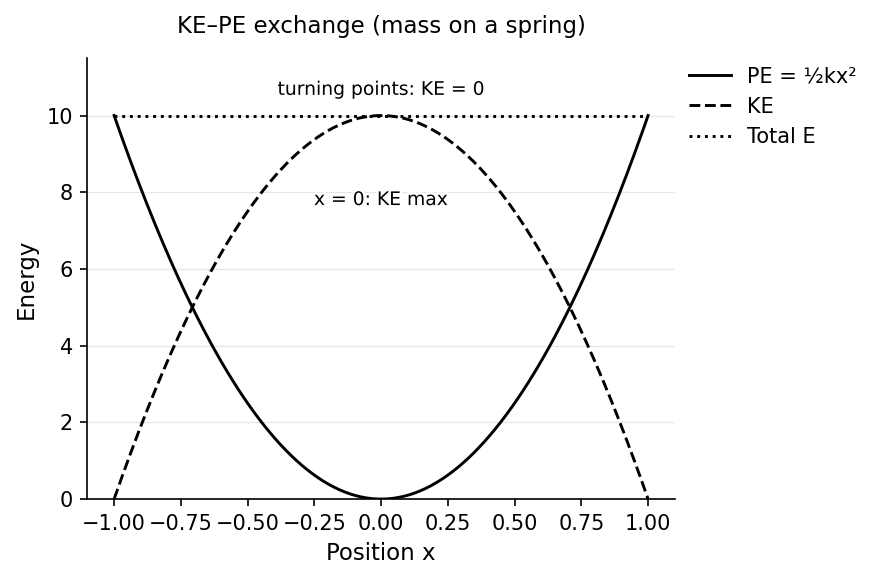
Energy diagrams: On a PE-vs-position graph, total mechanical energy is a horizontal line; the gap above the PE curve is KE. The object can't enter regions where PE > total energy — those KE = 0 points are the turning points. Tracking the gap as the object moves shows KE and PE trading off, the hallmark of an oscillator (pendulum, mass on a spring).
Fully Worked Example: Ball Dropped from a Height
Must knowA 0.5 kg ball is dropped from 5 m. Find its speed just before it hits the ground. (Use .)
Take the ground as reference (), starting from rest ():
The mass canceled (it always does in free-fall energy problems). Kinematics confirms: , m/s ✓.
Quick check: What is the ball's speed when it has fallen 3 m (2 m above the ground)?
Answer: .
Power
The Concept
Must knowEnergy is how much work; power is how fast it's transferred. Two engines may do the same work, but the one that does it in half the time has twice the power. Rates matter in physiology — cardiac output, athletic performance.
The SI unit is the watt (W), . Optional horsepower (1 hp ≈ 746 W) is a non-SI unit.
Alternative Form:
Must knowFor a constant force on an object moving at velocity in the force's direction:
Useful for motors, the heart, or athletes at steady speed.
Efficiency
Passage-levelReal systems aren't 100% efficient. Efficiency () is useful output over total input:
Human muscles are ~25% efficient — about 75% of metabolic energy becomes heat. The MCAT may ask for total power input given a mechanical output and efficiency.
Quick check: A cyclist generates 200 W of mechanical power at 25% efficiency. What total metabolic power is required?
Answer: . The remaining 600 W is released as heat.
Common Confusions & Tricks
1. Speed vs. velocity in KE: KE uses , so it's always positive — an object moving left at 5 m/s has the same KE as one moving right at 5 m/s.
2. The reference point for gravitational PE: Only matters; the absolute value is meaningless. Use the same reference throughout. A negative (object below the reference) is perfectly fine.
3. The trap for springs: Don't confuse the force (, linear) with the PE (, quadratic). Triple the compression → PE multiplies by 9, not 3.
4. Friction always reduces mechanical energy: It's non-conservative and always converts to heat — never an exception. Account for .
5. Work done by gravity vs. change in gravitational PE: Gravity's work on a falling object is positive (); the change in PE is negative (). They're related by .
6. Power vs. energy: Same energy released faster = more power. Fast-twitch fibers hydrolyze ATP at a higher rate, generating more power for sprinting even though energy per mole of ATP is fixed.
7. "Conservation of energy" ≠ "conservation of mechanical energy": Total energy is always conserved, but mechanical energy is conserved only when non-conservative forces do no net work. With friction, drag, or an engine, use .
8. Units trap — watts vs. joules: Watts are joules per second. Given power (W) and time (s), multiply to get energy (J). Don't confuse the unit of power (W) with the symbol for work (also ).
Key Equations
| Equation | Variables & When to Use |
|---|---|
| = mass (kg), = speed (m/s); kinetic energy of any moving object | |
| Work-energy theorem; net work equals change in KE | |
| = force, = displacement, = angle between them; work by a constant force | |
| , = height above reference; gravitational PE near Earth | |
| = spring constant (N/m), = displacement from equilibrium; elastic PE | |
| Hooke's Law; restoring force of a spring | |
| Conservation of mechanical energy; only conservative forces act | |
| Modified conservation; = work by non-conservative forces | |
| Power (W = J/s); rate of energy transfer or work | |
| Power by force at speed ; motors, cardiac output, athletes at steady pace | |
| Efficiency (0 to 1); useful output over total input |