Mechanical equilibrium is physiologically rich: every time your bicep holds a textbook steady or your jaw closes on food, your body solves an equilibrium problem. An object is in equilibrium when nothing about its motion is changing — neither linear nor rotational velocity.
Priority labels: Must know = cold; Know the logic = mechanism not names; Passage-level = recognize, don't memorize; Optional = skippable.
What Is Mechanical Equilibrium?
Must knowAn object is in mechanical equilibrium when two conditions hold simultaneously:
- Translational equilibrium — net force is zero, so no linear acceleration.
- Rotational equilibrium — net torque is zero, so no angular acceleration.
If both hold, the object is either perfectly still (static equilibrium) or moving at constant velocity (dynamic equilibrium). The MCAT almost always tests static equilibrium — a joint at rest, a beam on a fulcrum, a sign on two cables.
These two equations are your entire toolkit; everything else is applying them carefully.
Vector Analysis of Forces Acting on a Point Object
Forces as Vectors
Must knowA force is a vector (magnitude + direction). The common MCAT forces: gravity/weight (, down), normal (, perpendicular to and away from a surface), tension (, along the rope away from the object), static friction (, parallel to surface opposing slide), and applied force. The essential skill is decomposing each force into components: for a force at angle above the horizontal,
Free Body Diagrams
Must knowA free body diagram (FBD) sketches the object as a dot with all forces acting on it drawn as labeled arrows (ignore forces it exerts on others). Pick a coordinate system (usually x = horizontal, y = vertical). Drawing one is the first step of every problem and keeps you from missing a force.
Applying Translational Equilibrium
Must knowSum components and set each to zero:
Sign convention: right/up positive, left/down negative. This gives a system you solve for unknowns.
Know the logicClosed-polygon shortcut. When forces all act through one point (concurrent forces), equilibrium means their vectors drawn tip-to-tail form a closed polygon. For exactly three concurrent forces, they form a closed triangle — if you know all three directions and one magnitude, you can solve the others by triangle geometry (law of sines / right-triangle trig) without writing component equations.
Worked Example: Sign Hanging from Two Cables
Must knowA 60 N sign hangs from two cables; the left makes 30° with the ceiling, the right 60°. Find each tension. (Angle with vertical = 90° − angle with ceiling, so left = 60° from vertical, right = 30° from vertical.) Vertical components support the weight; horizontal components cancel.
Substituting gives N and N. The cable closer to vertical (right) carries more load — a good sanity check.
Quick check: In a symmetric setup where both cables make equal angles, what can you immediately say about their tensions?
Answer: By symmetry they are equal, each carrying half the weight vertically — no algebra needed. Symmetry is a powerful MCAT shortcut.
Torques and Lever Arms
Building Intuition for Torque
Must knowPush a door near the hinge and it barely moves; push far from the hinge and it swings easily. Torque () captures this rotational effectiveness of a force:
where = distance from the pivot to where the force is applied, = force magnitude, = angle between and . The lever arm (moment arm) is , the perpendicular distance from the pivot to the force's line of action, so equivalently:
Unit: — dimensionally a joule, but torque is not energy.
Sign Convention
Must knowCounterclockwise (CCW) torque = positive; clockwise (CW) = negative. Either convention works if you stay consistent.
Rotational Equilibrium
Must knowKnow the logic
You can choose the pivot anywhere. Choosing it at the location of an unknown force gives that force a zero lever arm, dropping it from the torque equation and simplifying the algebra.
Worked Example: Horizontal Beam (Classic MCAT Problem)
Must knowA uniform 4 m beam (200 N) is hinged at the left wall. A 500 N person stands 3 m from the left. A cable at the right end pulls at 37° above the beam, holding it horizontal. Find the cable tension .
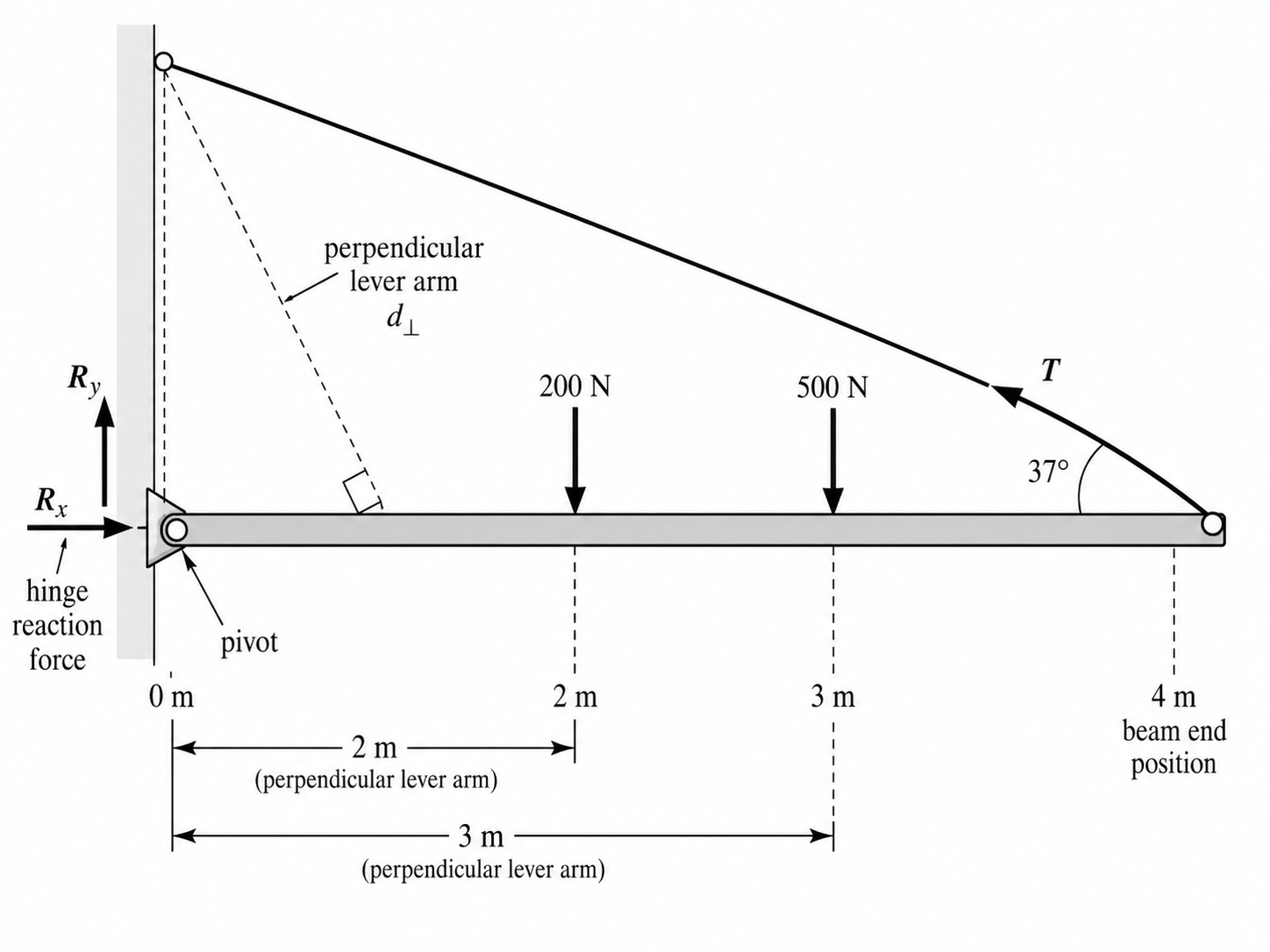
Pivot at the hinge (eliminates the unknown hinge force). Beam weight (200 N at 2 m) and person (500 N at 3 m) give CW torques; the cable's vertical component gives CCW torque:
Quick check: Why did we choose the hinge as the pivot?
Answer: The hinge force (both components) is unknown. Pivoting at the hinge gives it a zero lever arm, so it contributes zero torque and drops out — leaving only the single unknown .
Levers: A Biological Application of Torques
Must knowThe body is a collection of levers — bones are rigid beams, joints are fulcrums, muscles supply the effort. Lever classes are set by the relative positions of the fulcrum (F), effort (E), and load (L).
The Three Classes of Levers
Must knowKnow the middle element of each class and the body's two exceptions:
| Class | Middle element | MA | Body example |
|---|---|---|---|
| First | Fulcrum in middle | varies | Neck (skull on atlas) |
| Second | Load in middle | always >1 (force) | Calf raise / Achilles |
| Third | Effort in middle | always <1 (speed/range) | Bicep curl |
Mnemonic: classes 1-2-3 → F, L, E in the middle. Most muscles are Class 3; the tested exceptions are the calf/Achilles (Class 2) and the neck (Class 1).
Mechanical Advantage
Must know
MA > 1 amplifies force (Class 2); MA < 1 trades force for speed/range (Class 3); MA = 1 only changes direction.
Know the logicWhy muscles insert near the joint. The bicep inserts ~5 cm from the elbow while the load sits ~35 cm out, so MA ≈ 5/35 < 1: the muscle must exert much more force than the load. The payoff is large, fast hand movement from a small contraction — biology trades force economy for mobility.
Quick check: Lever Classification
The jaw biting: the TMJ is the fulcrum, the masseter (near the joint) is the effort, the food at the molars is the load. What class?
Answer: Effort (masseter) is between fulcrum (TMJ) and load (molars), so Class 3, MA < 1 — the masseter exerts more than the bite force. Molars (closer to the fulcrum) grind better than incisors because they have more mechanical advantage.
Center of Gravity and Stability
Must knowThe center of gravity (CG) (treat as synonymous with center of mass) is the single point where an object's whole weight acts for torque purposes; for a uniform object it's the geometric center. This is why a beam's weight is drawn as one downward force at its midpoint. An object is stable as long as its CG stays above its base of support; once the CG falls outside the base, it tips over.
Quick check: A uniform 10 m plank (300 N) rests on two end supports. A 600 N box sits 2 m from the left end. Find each support force.
Answer: N. Pivot at left: N, so N. The support nearer the box carries more.
Common Confusions & Tricks
1. The angle in the torque formula. The in is the angle between and . Force perpendicular to the beam () gives maximum torque; force along the beam () gives zero torque.
2. Lever arm is the perpendicular distance. Use , not alone, when the force is angled.
3. Class 2 vs. Class 3 levers. Class 2 = Load in middle (calf raise/wheelbarrow); Class 3 = Effort in middle (most muscles). If you blank, draw out the three elements.
4. Forgetting the beam's own weight. A uniform beam's weight acts down at its midpoint — a separate torque-producing force students often omit.
5. Choosing a poor pivot. Pivot at an unknown force you don't want to solve for, so it drops out. An arbitrary pivot leaves extra unknowns.
6. Torque ≠ Work. Both are N·m, but torque is rotational, not energy — never plug it into energy equations.
7. Muscle insertion → think Class 3. Almost every muscle is Class 3; memorize the two MCAT exceptions: calf/Achilles (Class 2) and neck (Class 1).
Key Equations
| Equation | Variables & When to Use |
|---|---|
| Translational equilibrium; apply separately as , | |
| Decompose a force at angle from horizontal | |
| Torque; = pivot-to-force distance, = angle between and | |
| Equivalent form; is the lever arm | |
| Rotational equilibrium; CCW positive, CW negative, about any pivot | |
| Lever mechanical advantage | |
| Weight; on MCAT; acts down at the CG |