Periodic motion bridges mechanics, waves, sound, and physiology: your heart beats rhythmically, sound waves carry information to your cochlea, and ultrasound imaging relies on wave reflection. The MCAT tests it heavily because it ties these together.
Priority labels: Must know = cold; Know the logic = mechanism not names; Passage-level = recognize, don't memorize; Optional = skippable.
Simple Harmonic Motion: The Foundation
Must knowAmplitude, frequency, and phase are all properties of simple harmonic motion (SHM), so build that model first.
Picture a mass on a spring on a frictionless surface. Pull it right and release: it accelerates back toward the equilibrium position, overshoots left, turns around, and repeats. Whenever a restoring force always points back toward equilibrium, you get SHM.
Hooke's Law and the Restoring Force
Must knowThe restoring force follows Hooke's Law:
where is the spring constant (stiffness, N/m) and is displacement from equilibrium. The minus sign means force opposes displacement; larger = stiffer spring = stronger snap-back. Any system whose net force is proportional to displacement and opposes it executes SHM — the spring-mass system and, for small angles, the simple pendulum.
Period and Frequency of Common SHM Systems
Must knowThe period is the time for one complete oscillation.
For a spring-mass system:
For a simple pendulum (small angle, ):
where is pendulum length and .
The spring period depends on mass and stiffness but not amplitude; the pendulum period depends on length and gravity but not mass or amplitude. These independence relationships are favorite MCAT traps.
Energy in SHM
Must knowKE and PE trade off continuously, but their sum—total mechanical energy—stays constant (no friction):
where is amplitude, so total energy is set by amplitude. At equilibrium, all energy is kinetic (maximum speed); at the turning points (), all energy is potential and the mass is momentarily at rest.
Velocity and Acceleration in SHM
Must knowFor , the maxima are and . The phase relationships the MCAT tests:
- Velocity is maximum at equilibrium () and zero at the turning points.
- Acceleration is maximum at the turning points and zero at equilibrium — since , is largest where is largest.
So velocity and acceleration are exactly out of step: where one peaks, the other vanishes.
Quick check: A spring-mass system oscillates with amplitude 0.2 m and spring constant 50 N/m. What is its total mechanical energy?
Note: If amplitude doubles, energy quadruples—a quadratic relationship to remember.
Amplitude, Frequency, and Phase
Amplitude
Must knowAmplitude () is the maximum displacement from equilibrium (always positive). It does not affect period or frequency in ideal SHM, but it does set total energy ().
Passage-levelFor a sound wave, amplitude sets loudness (pressure variation); for light, it sets intensity (brightness).
Frequency and Period
Must knowFrequency () is oscillations per second, in hertz (). Period and frequency are reciprocals:
Frequency is set by the source and does not change when a wave moves into a new medium—only wavelength and speed change.
Angular frequency (rad/s) is how fast the phase rotates around a circle:
Phase
Must knowAt a mass on a spring could start at the turning point, or at equilibrium moving rightward, or leftward—same oscillation, just shifted in time. Phase quantifies that starting offset:
where is the initial phase. If , the oscillator starts at ; if , it starts at moving positive.
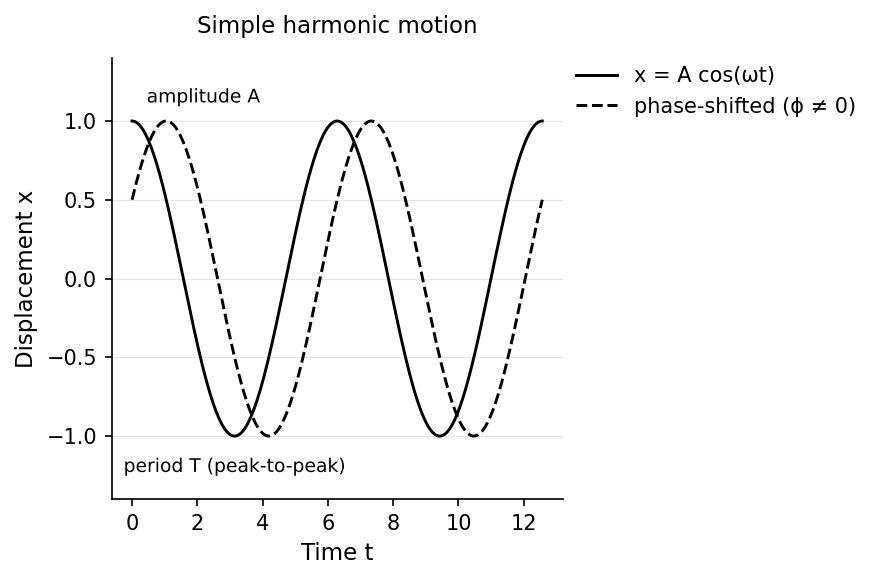
Phase difference drives interference: waves in phase ( or ) add constructively; out of phase (, i.e. 180°) they cancel destructively.
Quick check: A mass on a spring has period s. What is its frequency? Its angular frequency?
Hz. rad/s.
Biological relevance: A resting heart rate of 75 bpm ≈ 1.25 Hz.
Transverse and Longitudinal Waves
Must knowA wave transfers energy through a medium (or vacuum, for EM waves) without permanently transporting matter. The key question: in what direction does the medium oscillate relative to the wave's travel?
Transverse Waves
Must knowIn a transverse wave, the medium oscillates perpendicular to propagation (shake a rope up and down while the wave travels horizontally). Examples: light and all EM waves, waves on a string. Because displacement is perpendicular to travel, transverse waves can show polarization—EM waves are polarizable, sound is not.
Longitudinal Waves
Must knowIn a longitudinal wave, the medium oscillates parallel to propagation (a pushed-and-pulled Slinky). The key example is sound (including ultrasound), where compressions (higher pressure) and rarefactions (lower pressure) alternate. The eardrum and cochlear hair cells respond to these pressure oscillations.
Quick check: Is an ultrasound pulse used in echocardiography a transverse or longitudinal wave?
Longitudinal. Sound is always longitudinal—tissue oscillates parallel to the travel direction. Light (used in ophthalmoscopy) would be transverse.
Wavelength
Must knowWavelength () is the distance between two consecutive in-phase points—crest to crest, or compression to compression (units: meters).
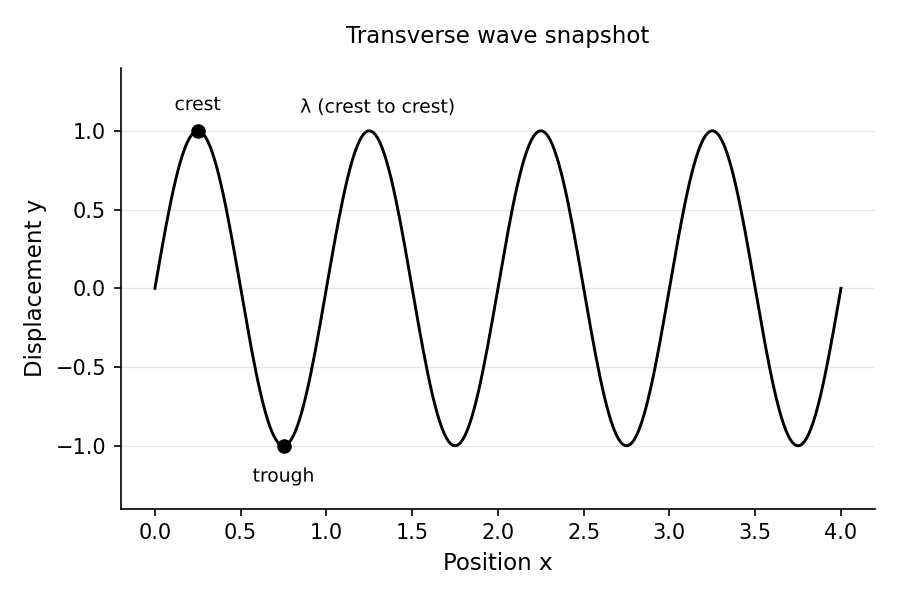
Shorter wavelength → more cycles per unit length → higher frequency (at fixed speed), and vice versa.
Wave Speed and the Fundamental Wave Equation
Must knowThe speed at which the wave pattern travels is the propagation speed ():
This is the single most tested wave equation—know it cold ( in m/s, in Hz, in m).
Wave speed depends on the medium, not the source. When a wave enters a new medium (different ), its frequency stays constant and its wavelength changes:
This is why light refracts entering glass: and decrease, stays the same.
Know the logicStiffer/more elastic media transmit mechanical waves faster (sound: solids > liquids > gases). Quantitative speed-vs-medium and for light are developed in the Sound and Light guides; here the takeaway is that crossing media changes speed, fixes frequency, and adjusts wavelength via .
Quick check: A 440 Hz sound (speed in air 343 m/s) has m. Entering water ( m/s), frequency is unchanged (set by the source), so m—scaled up by the same ratio as the speed. ✓
Quick check: If you double the frequency of a sound wave at constant wave speed, what happens to wavelength?
Since with constant, doubling halves —inversely proportional at fixed speed.
Damping and Resonance
Must knowA real oscillator loses energy to friction or drag, so its amplitude decays over time—damped harmonic motion (a pendulum coming to rest, a car's shock absorbers).
Every system has a natural (resonant) frequency at which it "wants" to oscillate ( for a spring-mass system). Driving it with a periodic force produces a small response unless the driving frequency matches —then energy transfers most efficiently and amplitude peaks. This is resonance.
Know the logicResonance is high-yield and biological—the cochlea's basilar membrane resonates at different positions to sort sound by frequency; MRI is nuclear magnetic resonance; a singer can shatter a glass at its natural frequency. Damping sets the peak: heavy damping gives a broad, low resonance; light damping a sharp, tall one.
Passage-levelStanding waves (nodes, antinodes, harmonics), beats, superposition/interference, sound properties (pitch, intensity, decibels, Doppler), and the EM spectrum are developed in the Sound and Light guides. This unit's job is the underlying periodic-motion and general-wave framework.
Common Confusions & Tricks
1. Period of a pendulum depends on , not mass. A heavier pendulum does not swing faster— has no mass term. Likewise the spring-mass period depends on , not amplitude.
2. Frequency does not change when a wave changes medium. Only and change. If sound enters bone from tissue, frequency stays the same and wavelength shortens because speed drops.
3. Energy and amplitude. Total energy scales as , not : double the amplitude → four times the energy ().
4. Longitudinal waves DO have a wavelength. It's the distance between successive compressions—wavelength isn't exclusive to the peak-to-trough transverse picture.
Key Equations
| Equation | Variables & When to Use |
|---|---|
| Hooke's Law: = spring constant (N/m), = displacement. Restoring force in SHM. | |
| Period (, s) and frequency (, Hz) are reciprocals. | |
| Angular frequency (, rad/s). Used when SHM is written . | |
| Period of spring-mass; independent of amplitude. | |
| Period of simple pendulum (small angles); independent of mass and amplitude. | |
| Total mechanical energy in SHM; scales as amplitude squared. | |
| The fundamental wave equation. = speed (m/s), = frequency (Hz), = wavelength (m). | |
| Rearranged wave equation; wavelength changes when a wave enters a new medium while stays fixed. |