Translational motion is the study of objects moving through space — how fast, in what direction, and how that motion changes over time. The MCAT tests these ideas in biological contexts: blood flow, nerve impulse timing, or a projectile modeled after a thrown ball. Solid intuition here makes every later mechanics topic easier.
Priority labels: Must know = cold; Know the logic = mechanism not names; Passage-level = recognize, don't memorize; Optional = skippable.
Units and Dimensions
The SI System and Why It Matters
Must knowThe MCAT uses SI units almost exclusively. The three base units for mechanics are meter (m, length), kilogram (kg, mass), and second (s, time). Every other mechanical quantity — velocity, acceleration, force, energy — is a derived unit built from these (e.g. velocity = m/s, force = ).
Dimensional Analysis
Must knowDimensional analysis tracks units through a calculation like algebra. If the units on both sides of an equation don't match, the equation is wrong — a reliable error-check. You can only add or subtract quantities with the same dimensions, but can multiply or divide different dimensions to create new ones (e.g. velocity , acceleration , force ).
Common Prefixes
Must knowMemorize these prefixes cold.
| Prefix | Symbol | Factor |
|---|---|---|
| nano- | n | |
| micro- | μ | |
| milli- | m | |
| centi- | c | |
| kilo- | k |
In biology, distances are often given in cm or mm — convert to meters before plugging into kinematic equations. Forgetting this is a common arithmetic mistake.
Quick check: A nerve impulse travels at 70 m/s. How fast is this in km/s?
Answer: . ✓
Vectors and Components
Scalars vs. Vectors — The Core Distinction
Must know- Scalars: magnitude alone — speed, distance, mass, temperature, time, energy.
- Vectors: magnitude and direction — velocity, displacement, acceleration, force, momentum.
Vectors are written with an arrow (); the magnitude is or .
Resolving a Vector into Components
Must knowAny 2D vector breaks into a horizontal and vertical component — this converts a 2D problem into two independent 1D problems, the single most useful skill in MCAT mechanics. For a vector at angle from the positive x-axis:
By convention is measured counterclockwise from the +x-axis. Assign the correct sign to (positive up, negative down).
Worked Example: Decomposing a Velocity Vector
Must knowA soccer ball is kicked at at above the horizontal.
Sanity check: makes sense — is shallow, so most velocity is horizontal. ✓
Must know these exact trig values:
| Angle | ||
|---|---|---|
| 1 | 0 | |
| 0 | 1 |
Quick check: A force vector has components and . What is its magnitude?
Answer: . (The 3-4-5 triangle.) ✓
Vector Addition and Subtraction
Graphical: Head-to-Tail
Must knowPlace the tail of the second vector at the head of the first; the resultant runs from the tail of to the head of . Addition is commutative: .
By Components — The Reliable Method
Must know- Resolve each vector into and components.
- Add components separately: , .
- Magnitude ; direction .
Vector Subtraction
Must knowSubtracting = adding the negative: , where has the same magnitude but opposite direction. This is key for change in velocity (). Do not subtract magnitudes if the directions differ — use components.
Worked Example: Adding Displacement Vectors
Must knowA red blood cell travels east, then north.
Sanity check: displacement (5 cm) < total distance (7 cm). Displacement is always ≤ distance. ✓
Quick check: A swimmer swims east, then west. What is her displacement? What distance did she travel?
Answer: Displacement = (back to start). Distance = .
Speed, Velocity (Average and Instantaneous)
Distance vs. Displacement
Must know- Distance (): total path length — always positive, scalar.
- Displacement (): straight-line change in position, with direction — vector.
These are equal only for straight-line motion with no backtracking.
Average Speed vs. Average Velocity
Must know
The MCAT loves scenarios where these differ: running a full 400 m lap in 80 s gives average speed but average velocity (zero displacement).
Instantaneous Velocity
Know the logicInstantaneous velocity is the velocity at one moment — formally the derivative of position, . You don't take derivatives on the MCAT; instead, on a position-vs-time graph the instantaneous velocity is the slope of the tangent line. Steeper slope = greater speed; negative slope = motion in the −direction; horizontal line = at rest.
Worked Example: Average Speed vs. Average Velocity
Must knowA red blood cell travels 12 cm through a looping capillary in 0.60 s, ending 5 cm (straight-line) from start.
Sanity check: average speed > average velocity magnitude, as expected for a curved path. ✓
Quick check: On a position-vs-time graph, the slope from to is ; from to the graph is horizontal. What is the average velocity over the full 8 s?
Answer: Displacement (then 0). Average velocity .
Acceleration
Building the Concept
Must knowAcceleration is how velocity changes over time. Because velocity is a vector, acceleration is nonzero whenever the magnitude or direction of velocity changes. A car at constant speed around a curve is accelerating because its direction changes — important for circular motion later.
Average and Instantaneous Acceleration
Must know
Instantaneous acceleration is the slope of the tangent on a velocity-vs-time graph.
Reading Kinematic Graphs
Must knowThese graph relationships:
| Graph | Slope | Area |
|---|---|---|
| Position vs. time | velocity | — |
| Velocity vs. time | acceleration | displacement |
| Acceleration vs. time | — | change in velocity |
A curved -vs- graph means changing velocity (nonzero acceleration). A straight -vs- graph means constant acceleration.
Uniformly Accelerated Motion and the Kinematic Equations
Must knowWhen acceleration is constant, four kinematic equations describe 1D motion:
v_f = v_i + at \tag{1}
\Delta x = v_i t + \frac{1}{2}at^2 \tag{2}
v_f^2 = v_i^2 + 2a\Delta x \tag{3}
\Delta x = \frac{v_i + v_f}{2} \cdot t \tag{4}
Strategy: list the five variables (, , , , ), identify the three you know plus your unknown, and pick the equation missing the unused variable. Equation (3) is useful when time is neither given nor asked.
Free Fall and Gravitational Acceleration
Must knowFree fall is motion under gravity alone (no air resistance), with downward. The MCAT almost always uses for cleaner arithmetic. Pick a sign convention and be consistent.
- Dropped from rest: , .
- Thrown upward: at the peak instantaneously, but throughout — a key conceptual point.
Worked Example: Kinematics of a Falling Object
Must knowA package drops from rest off a cliff and hits the ground 3.0 s later. How far does it fall? (.)
Using eq. (2) with :
The cliff is 45 m tall. Check with eq. (1): ; eq. (3): , . ✓
Quick check: During free fall from rest, speed increases by each second. After 4 s, what is the speed?
Answer: .
Terminal Velocity (one line)
Passage-levelWith air resistance, drag grows with speed until it balances gravity; then and , and the object falls at constant terminal velocity (not maximum acceleration). The MCAT treats projectiles as ideal otherwise.
Two-Dimensional Projectile Motion
Must knowThe horizontal and vertical motions are independent. Gravity acts only vertically, so (constant horizontal velocity) while . Solve each direction with the 1D equations, linked only by shared time . The path is a symmetric parabola: launch and landing speeds are equal, and rise time equals fall time.
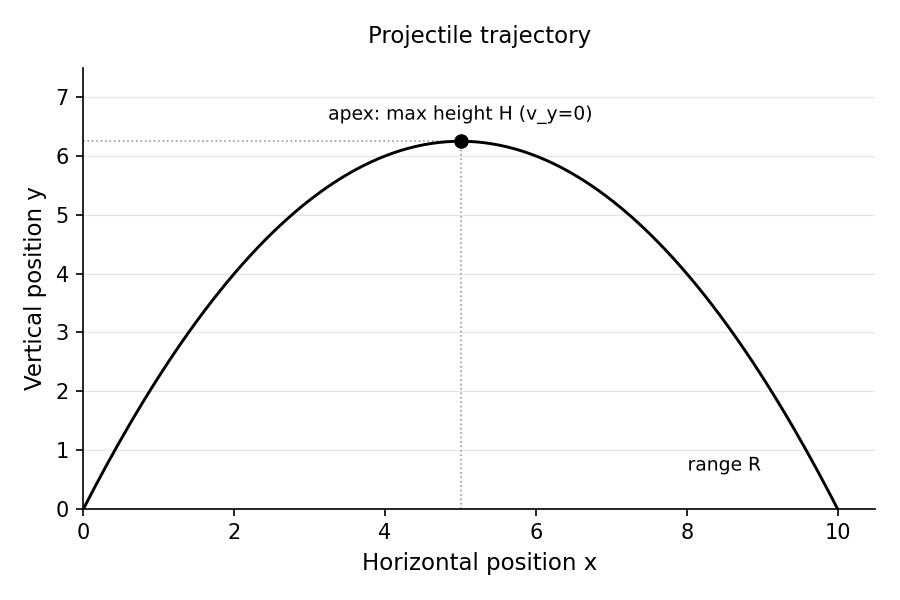
Worked example: Launch at , from ground level (). Decompose: , .
- Time of flight ():
- Range:
- Max height ():
Sanity check: at the peak only the vertical velocity is zero; horizontal velocity stays . ✓
Common Confusions & Tricks
1. Displacement ≠ Distance (velocity ≠ speed). Round trips, curved paths, and direction changes make these differ. "Average velocity = 0" means the object returned to its start — though it may have traveled far.
2. "Deceleration" ≠ negative acceleration. If an object moves in the −direction and slows, its acceleration is positive (opposing motion). Deceleration just means opposes ; determine the sign from the direction of .
3. At the peak of projectile motion, but . Gravity is at every point, including the top. Only the vertical velocity is zero there.
4. When subtracting vectors, flip the arrow. adds (opposite to ). Don't subtract magnitudes unless both vectors point the same way.
5. Slope is the derivative — use it. Instantaneous velocity = slope of vs. ; instantaneous acceleration = slope of vs. ; displacement = area under vs. .
6. on the MCAT. The real value is , but use unless a passage specifies otherwise.
7. Round trips at different speeds — don't average the speeds. For equal-distance legs, average speed is the harmonic mean:
The arithmetic average overestimates because you spend more time at the slower speed.
8. Choosing a kinematic equation. Identify which variable is absent from the problem; pick the equation that does not contain it. Equation (3) has no ; equation (4) has no .
9. Keep signs consistent. Pick a positive direction at the start and stick with it.
Key Equations
| Equation | Variables & Notes |
|---|---|
| Decompose vector at angle from +x-axis | |
| Magnitude from components | |
| Average speed; scalar; total path length | |
| Average velocity; vector; net displacement | |
| Average acceleration; units | |
| Eq. 1; use when is absent | |
| Eq. 2; use when is absent | |
| Eq. 3; use when is absent (most common!) | |
| Eq. 4; use when is absent | |
| Free-fall acceleration; use only if specified |