Work is one of the most fundamental ideas in mechanics, and the MCAT tests it both in isolation and as the bridge between forces and energy. The unifying question through every subtopic: how much energy is transferred by a force acting over a displacement? Keep that in mind and the equations become intuitive.
Priority labels: Must know = cold; Know the logic = mechanism not names; Passage-level = recognize, don't memorize; Optional = skippable.
Work Done by a Constant Force
The Core Idea
Must knowPushing a gurney down a corridor: you apply a force, it moves, and energy is transferred — that transfer of energy by a force over a displacement is work. What matters is not force alone or displacement alone, but how much the force lines up with the direction of motion.
The Equation
Must know
- = work, in joules (J = N·m = kg·m²/s²)
- = force magnitude (N), = displacement magnitude (m)
- = angle between the force and displacement vectors
This is the dot product ; extracts only the component of force parallel to displacement — the only part doing work.
Sign Convention
Must knowThe sign of work gives the direction of energy transfer:
- (): max positive work; energy added to object.
- (): zero work (e.g., normal force, centripetal force).
- (): negative work; energy removed.
A normal force does zero work on a horizontally sliding box because it points up while displacement is horizontal (). This trips students up constantly.
Work on an Inclined Plane (Worked Example)
Must knowA nurse pushes a wheelchair up a 30° ramp, applying 200 N along the ramp over 5.0 m along the ramp.
Force is parallel to displacement, so :
The 30° ramp angle does NOT appear: is the angle between and , not between and horizontal.
Work from an F-d Graph
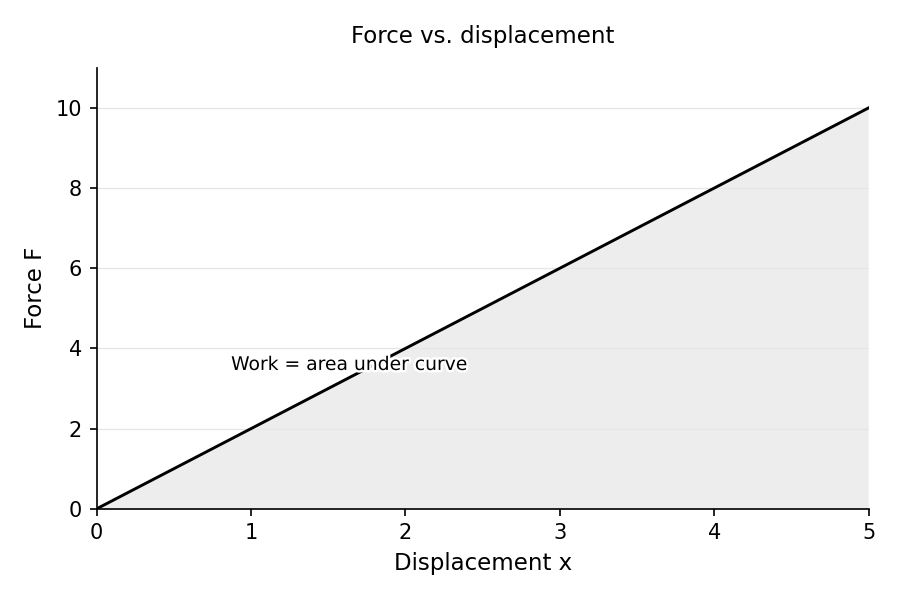
Must knowFor a variable force, work = area under the Force-vs-displacement graph (triangles, rectangles, trapezoids). This is the graphical version of — you only need the area intuition, not the integral.
Quick check: A weightlifter holds a barbell still overhead for 10 seconds. How much work do the arms do on the barbell?
Answer: Zero. Displacement , so regardless of . Effort/fatigue is real physiologically, but mechanical work is zero.
Mechanical Advantage
The Intuition
Know the logicSimple machines (levers, ramps, pulleys) let a smaller input force do the same work as a larger force would. The trade-off is always the same: you sacrifice distance to gain force (or vice versa), because work (energy) cannot be created for free.
Defining Mechanical Advantage
Must knowMA is the ratio of output force (load) to input force (effort):
For an ideal (frictionless) machine, work in = work out, so , giving:
A machine that triples force requires you to move the input three times farther.
Common Simple Machines
Know the logicUnderstand each principle; the lever-class table is for reference — recognize the principle, don't memorize examples.
- Lever: . Three classes by fulcrum/load/effort placement (1st = fulcrum in middle, can be >1 or <1; 2nd = load in middle, always >1, e.g. wheelbarrow; 3rd = effort in middle, always <1, e.g. tweezers, bicep-forearm).
- Inclined plane: (ramp length over height); longer, shallower ramp = higher MA.
- Pulley: single fixed pulley has MA = 1 (changes direction only); MA = number of rope segments supporting the load.
- Wheel and axle: .
The bicep-forearm is a classic MCAT example: the bicep inserts close to the elbow (short effort arm), the load is far (long load arm), so MA < 1 — the bicep exerts force much greater than the weight, but gains speed and range of motion.
Efficiency
Must knowReal machines lose energy to friction/heat:
Ideal machines = 100%. The MCAT may give efficiency and ask for actual output work.
Quick check: A 2nd-class lever has effort arm 1.2 m and load arm 0.4 m. Ideal MA, and what does it tell you?
Answer: . Input force is multiplied by 3 — you apply one-third the force but push through three times the distance.
The Work-Kinetic Energy Theorem
Building the Connection
Must knowWork is the mechanism by which kinetic energy changes — net force does work that transfers energy into (or out of) an object's motion:
is the work of the net (total) force. With multiple forces, find net force first, or sum the work of each.
Why This Is Powerful
Know the logicThe theorem finds final speeds without acceleration or kinematics — just forces and displacement. When you see a force applied over a distance and are asked about speed, this is the most direct path.
Worked Example
Must knowA 2.0 kg ball falls 5.0 m from rest (). Speed just before impact (vertical only)?
Gravity does work . Apply W-KE with :
Check with kinematics: , . ✓
Extending to All Forces
Must knowIf friction also acts over the displacement, its negative work reduces final KE:
The theorem always holds — it accommodates every force through the net work.
Quick check: A car brakes to a stop. Net work on the car: positive, negative, or zero?
Answer: Negative. KE dropped from to 0, so and . Braking friction opposes displacement.
Conservative Forces
The Conceptual Distinction
Must knowA force is conservative if the work it does between two points is independent of the path (equivalently, work around any closed loop is zero). Gravity gives back the energy it took when a boulder rolls back down; non-conservative friction converts kinetic energy to heat permanently.
Conservative: gravity (work depends only on ), spring force (), electrostatic force.
Non-conservative: kinetic friction and air resistance (longer path = more negative work), general applied forces.
Potential Energy: "Stored Work" of Conservative Forces
Must knowBecause conservative forces are path-independent, each has a potential energy ():
Positive work by the force → PE decreases (cashed in as KE); negative work → PE increases.
| Conservative force | Potential energy |
|---|---|
| Gravity (near Earth) | |
| Spring | |
| Electrostatic (point charges) |
Conservation of Mechanical Energy
Must knowWhen only conservative forces do work:
When non-conservative forces also act, mechanical energy is not conserved — some becomes thermal energy:
where is the non-conservative work (negative for friction).
Path Independence (Conceptual)
Must knowA 1.0 kg object rises 10 m via a straight 10 m lift vs. a winding 50 m ramp. Either way — path length is irrelevant. Gravity did negative work because the object moved up, against gravity (energy went into PE).
Quick check: A roller coaster starts from rest atop a 20 m hill (, no friction). Speed at the bottom?
Answer: .
Power: The Rate of Doing Work
Know the logicPower appears in nearly every work passage and follows directly from work:
For force parallel to velocity, . SI unit: watt (W) = J/s. (1 hp ≈ 746 W — context only.)
The MCAT often frames muscle power or cardiac output as a rate of doing work (e.g., work per beat times heart rate). The pressure–volume form of cardiac work belongs to thermodynamics.
Quick check: A motor does 6000 J in 2 minutes. Power output?
Answer: .
Common Confusions & Tricks
1. "Work" in physics ≠ effort. Holding a barbell overhead, pushing an immovable wall, or carrying a tray horizontally involve effort but zero mechanical work. Zero displacement = zero work.
2. Perpendicular forces do zero work. Normal force, centripetal force, and the magnetic force on a moving charge act perpendicular to velocity, so they do zero work and change only direction, not speed.
3. The angle is between and , not between and horizontal. On inclines, don't substitute the ramp angle for unless the force is horizontal. Always ask: angle between this force and the direction of motion?
4. W-KE Theorem uses , not one force. If friction is acting, using only gravity's work gives the wrong answer. Sum all work, or find net force first.
5. Conservative ≠ "things we like." Conservative means path-independent — a mathematical property. Friction is non-conservative because it produces heat and its work grows with path length.
6. Mechanical advantage > 1 does NOT mean less work. The machine redistributes force and distance; total work in = out (ideal). You apply less force over greater distance.
7. Negative work does NOT mean the object moves backward. It means the force opposes displacement. Friction on a forward-sliding box does negative work even though the box moves forward.
8. : is measured from a reference you choose. Only matters, so the reference cancels. Pick the convenient point (usually the lowest).
9. "If you see centripetal force, work = 0." It's always perpendicular to velocity, so it does zero work and cannot change kinetic energy.
Key Equations
| Equation | Variables & When to Use |
|---|---|
| Work by a constant force; = angle between and | |
| Work-KE theorem; net work = change in KE | |
| Mechanical advantage (ideal); force amplified at cost of distance | |
| Work by a conservative force = negative change in PE | |
| Gravitational PE near Earth; = height above reference | |
| Spring PE; = spring constant, = displacement from equilibrium | |
| Conservation of mechanical energy (conservative forces only) | |
| Energy equation with non-conservative forces ( for friction) | |
| Power = rate of work; when force ∥ velocity | |
| Real machine efficiency; always |