Fluids — liquids and gases — sit at the intersection of physics and physiology on the MCAT. Every heartbeat drives blood through vessels and every breath moves air down a pressure gradient. Build the physics intuition here and the biology follows.
Priority labels: Must know = cold; Know the logic = mechanism not names; Passage-level = recognize, don't memorize; Optional = skippable.
Density and Specific Gravity
Must knowDensity () is mass per volume:
SI unit is , but () is more convenient. Memorize water: .
Specific gravity (SG) is the dimensionless ratio of a substance's density to water's:
Because water is , SG and density in are numerically identical (SG > 1 sinks, < 1 floats). This is why urine SG (normally ~1.001–1.030) tells you directly how concentrated the urine is. Passage-level warmer fluids are generally less dense (water between 0–4°C is the exception).
Quick check: A patient's urine sample has a specific gravity of 1.025. Is the patient well-hydrated or dehydrated?
Answer: Dehydrated. High SG means concentrated urine — the kidneys are conserving water because the body is short on it.
Buoyancy and Archimedes' Principle
Must knowWhen you submerge an object, the surrounding fluid still exerts the same upward force it exerted on the fluid that used to occupy that space. That upward force is the buoyant force.
Archimedes' Principle: the buoyant force equals the weight of the fluid displaced.
= the object's total volume if fully submerged, or just the submerged portion if floating.
Float vs. sink depends on average density vs. fluid density: floats, is neutral buoyancy, sinks. For a floating object, weight, which gives the fraction submerged:
E.g., ice () floats with ~92% submerged, ~8% above water.
Passage-levelFish adjust average density with a swim bladder for neutral buoyancy; the human body (~) is near-neutral in water.
Quick check: A 50 g object has a volume of 40 mL. Will it float or sink in water? What is the minimum fluid density in which it would float?
Answer: , so it sinks in water. It floats only if the fluid density .
Hydrostatic Pressure
Must knowPressure in a static fluid comes from the weight of the fluid column above. Deeper → more fluid above → greater pressure. (This is why leg-vein pressure in a standing person far exceeds pressure at heart level.)
= surface pressure (often atmospheric, ); ; = depth. Gauge pressure (above atmospheric) is .
- Pressure depends only on depth and fluid density — not container shape or total volume (the hydrostatic paradox).
- Pressure acts equally in all directions at a given depth.
Capillary hydrostatic pressure (~35 mmHg arteriolar, ~15 mmHg venular) drives fluid out of capillaries — one of the Starling forces, and why edema collects in dependent body parts.
Quick check: A diver descends 10 m in seawater (). Estimate the gauge pressure increase.
Answer: . Rule of thumb: pressure rises ~1 atm per 10 m of water.
Pascal's Law
Must knowPascal's Law: a pressure change applied to an enclosed, incompressible fluid is transmitted undiminished throughout the fluid and to its container walls.
The key application is the hydraulic lift. The applied pressure acts equally on the large piston:
A large area ratio amplifies force — but conservation of energy means the small piston moves proportionally farther (). No free lunch.
Quick check: A hydraulic system has a small piston of area and a large piston of area . A force of 50 N is applied to the small piston. What force does the large piston exert?
Answer: . Force amplified 10×.
Viscosity and Poiseuille Flow
Must knowViscosity () is a fluid's internal resistance to flow ("stickiness"); honey is high, water is low. Unit: pascal-second (Pa·s). Know the logic higher temperature decreases liquid viscosity (warm oil flows freely).
Poiseuille's Law
Must knowFor laminar flow of a viscous fluid through a cylindrical tube, the volumetric flow rate is:
The dependence. Doubling the radius increases flow 16-fold. This is why a small drop in vessel radius (plaque, vasospasm) drastically cuts blood flow, and why vasodilation is so powerful.
Poiseuille's Law mirrors Ohm's Law:
Fluidic resistances add in series and combine reciprocally in parallel, like resistors.
Know the logicVelocity profile: the no-slip condition (zero velocity at the wall) gives a parabolic profile; centerline fastest, average velocity = half the maximum.
Passage-levelArterioles are the main site of vascular resistance — small (large ) plus active radius control by smooth muscle. Cardiac output .
Quick check: If a patient's blood viscosity increases (e.g., polycythemia), what happens to vascular resistance and cardiac workload?
Answer: . Higher → higher resistance → the heart needs greater for the same flow → increased cardiac workload (a cardiovascular risk factor).
The Continuity Equation
Must knowFor an incompressible fluid, mass can't pile up, so where a pipe narrows the fluid must speed up. The continuity equation is conservation of mass:
The product is the volumetric flow rate , constant along the path. Narrow → faster; wide → slower.
Passage-levelCardiovascular application: the aorta has high velocity (~0.3–0.5 m/s), but the combined cross-sectional area of all capillaries is far larger, so blood slows dramatically in capillaries — giving time for exchange. The same logic explains why air velocity drops in the branching airways, favoring alveolar gas diffusion.
Quick check: Blood flows at 40 cm/s through a vessel of radius 1 cm. The vessel narrows to radius 0.5 cm. What is the new velocity?
Answer: Radius halved → area decreased 4× → velocity increased 4× → .
Turbulence
Must knowLaminar (smooth, layered) flow becomes chaotic and turbulent at high velocities. Turbulence dissipates much more energy and produces the sounds (bruits, murmurs) clinicians listen for.
The Reynolds number predicts the transition:
Low Re → viscous forces dominate → laminar; high Re → inertial forces dominate → turbulent. The MCAT wants qualitative reasoning, not numerical thresholds. Turbulence is promoted by high velocity, large diameter, high density, and low viscosity — so it appears at bifurcations, in large vessels, and at high flow (exercise, fever).
Passage-levelClinical: heart murmurs (turbulent flow through abnormal valves), Korotkoff sounds (turbulent flow under a deflating BP cuff), and turbulence-driven endothelial damage at bifurcations in atherosclerosis.
Quick check: A patient develops anemia (lower blood viscosity). How does this affect the likelihood of turbulence?
Answer: Lower → higher Re → more turbulence. Anemia is associated with flow murmurs even without structural heart disease.
Surface Tension
Must knowBulk molecules are pulled equally in all directions; surface molecules have no neighbors above, so they feel a net inward pull. The liquid acts as if it has a "skin" resisting expansion — surface tension (), in .
Water has high surface tension from hydrogen bonding. Surfactants are amphiphilic molecules that insert into the surface and lower .
Know the logicCapillary action: in a narrow tube, adhesion (liquid-wall) vs. cohesion (liquid-liquid) determines behavior. Adhesion > cohesion (water in glass) → liquid rises, concave meniscus ("wetting"); cohesion > adhesion (mercury) → liquid depressed, convex meniscus. Smaller radius → taller rise (drives water up plant xylem). Optional quantitative form: .
Laplace's Law
Must knowFor a sphere/alveolus with one interface, internal pressure exceeds external by:
(For a two-interface soap bubble, .)
Pulmonary surfactant: smaller alveoli would have higher internal pressure () and tend to collapse into larger ones. Surfactant lines the alveolar surface and lowers (more so in small alveoli), keeping them open. Premature infants lacking surfactant develop neonatal respiratory distress syndrome.
Quick check: Two connected alveoli have radii and with equal surface tension. Which way does air flow, and why?
Answer: , so the smaller alveolus has higher internal pressure. Air flows from small into large — the small one collapses. This is why surfactant is essential.
Bernoulli's Equation
Must knowBernoulli's equation is conservation of energy per unit volume along a streamline, for an ideal fluid (incompressible, nonviscous, steady, laminar):
The three terms are pressure (flow) energy, kinetic energy, and gravitational PE per unit volume (each in ).
At constant height, faster flow → lower pressure. For horizontal flow:
Know the logic
When it applies: Bernoulli assumes ideal (inviscid) flow. Real blood is viscous, and viscous losses drop pressure along a vessel even at constant velocity — that's Poiseuille's domain. Use Bernoulli for velocity-pressure tradeoffs (Venturi, pitot); use Poiseuille for viscosity-driven flow.
Worked Example: Pressure Drop in a Constriction
Must knowWater flows horizontally. At point 1 (radius 2 cm), ; at point 2 (radius 1 cm):
Continuity: .
Bernoulli: .
Velocity rose → pressure dropped, as expected.
Quick check: An airplane wing makes air flow faster over the top. Using Bernoulli, explain the lift.
Answer: Faster flow on top → lower pressure on top; higher pressure below pushes up → net upward lift.
Venturi Effect and Pitot Tube
The Venturi Effect
Must knowThe Venturi effect is Bernoulli + continuity: fluid through a constriction speeds up (continuity) and its pressure drops (Bernoulli). The pressure difference between wide and narrow sections is used to measure flow rate (Venturi meter). Know the qualitative relationship — faster flow in the constriction means lower pressure there; the formula is Optional.
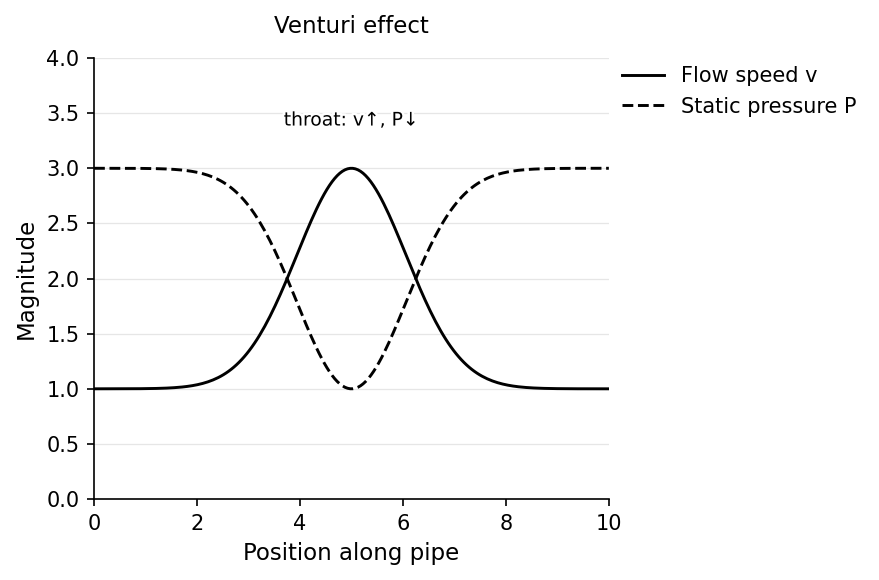
Applications: Venturi masks (entrain room air for predictable ), nebulizers/atomizers (fast gas draws up liquid), and atherosclerotic stenosis (blood speeds up through the narrowing, pressure drops, walls may collapse further).
The Pitot Tube
Passage-levelA pitot tube measures fluid velocity by converting kinetic energy to a pressure difference. A stagnation port faces the flow (fluid brought to rest), a static port is perpendicular; their difference is the dynamic pressure:
The MCAT just wants you to recognize that a pitot tube gets speed from the stagnation-vs-static pressure difference via Bernoulli.
Quick check: A pitot tube in water measures a stagnation pressure 800 Pa above static. What is the velocity? ()
Answer: .
Common Confusions & Tricks
1. Buoyancy depends on displaced volume, not object mass. A lead ball and a hollow steel ball of the same outer volume feel the same buoyant force when fully submerged (same ).
2. Pressure at depth depends only on , not container shape. The hydrostatic paradox: a thin tube and a wide lake at the same depth have the same pressure. Don't confuse total force with pressure.
3. Pascal vs. Bernoulli. Pascal applies to static fluids; Bernoulli to moving fluids (pressure changes with velocity). Don't use Pascal to explain pressure drop in a constriction.
4. Poiseuille's — never write . Flow scales with , not the of area. "Radius doubles → flow ×16" signals Poiseuille.
5. Bernoulli + Continuity together. Use continuity first to find , then Bernoulli for pressures.
6. Smaller bubble = higher pressure. means small → large . This is why small alveoli collapse and surfactant is life-saving.
7. Viscosity decreases with temperature for liquids (opposite for gases). Blood and water thin when warmed; the MCAT almost always asks about liquids.
8. Turbulence is favored by low viscosity. Viscosity damps fluctuations, so high → low Re → laminar. Honey never goes turbulent.
9. SG and density are numerically equal only in g/mL. If density is in , divide by 1000 to get SG ().
Key Equations
| Equation | Variables & Use |
|---|---|
| Density: mass per unit volume () | |
| Specific gravity: dimensionless ratio relative to water | |
| Buoyant force = weight of displaced fluid (Archimedes) | |
| Floating fraction submerged | |
| Absolute pressure at depth | |
| Gauge pressure (above atmospheric) at depth | |
| Pascal's Law for hydraulic systems | |
| Poiseuille's Law: viscous laminar flow (!) | |
| Fluidic resistance; analogous to electrical resistance | |
| Continuity equation for incompressible flow | |
| Reynolds number; low → laminar, high → turbulent | |
| Laplace's Law for a spherical bubble/alveolus | |
| Bernoulli's equation along a streamline | |
| Pitot tube: dynamic pressure → |