Gases are the simplest state of matter to model mathematically, and the MCAT rewards understanding why the laws work. Gas behavior shows up in lung physiology, blood-gas exchange, and atmospheric-pressure passages.
Priority labels: Must know = cold; Know the logic = mechanism not names; Passage-level = recognize, don't memorize; Optional = skippable.
The Kelvin Scale and Absolute Temperature
Must knowTemperature measures the average kinetic energy of particles. The Celsius scale allows negative values, which break gas calculations (negative volume/KE is nonsensical).
The Kelvin scale sets its zero at absolute zero (where molecular motion ceases): 0 K = −273.15 °C (use −273 on the MCAT). The conversion:
Because Kelvin is directly proportional to average KE, it is the only scale you may plug into gas laws. Forgetting to convert is the most common gas-law error. Useful anchors: 0 °C = 273 K, 25 °C ≈ 298 K, 37 °C ≈ 310 K.
Quick check: A gas at 27 °C is heated until its absolute temperature doubles. What is the new Celsius temperature?
Answer: 27 °C = 300 K. Doubling → 600 K. Converting back: 600 − 273 = 327 °C. Notice that doubling K does not double the Celsius value—another reason to always work in Kelvin.
Pressure and the Mercury Barometer
Must knowPressure is force per unit area (). For a gas it arises from molecules bombarding the container walls—more collisions per area → higher pressure.
Units of Pressure
Must knowKnow these equivalences:
The SI unit is the Pascal (Pa = N/m²), but atm and mmHg dominate MCAT physiology passages (partial pressures of /). (1 bar ≈ 1 atm; 1 atm ≈ 14.7 psi — Optional.)
The Simple Mercury Barometer
Must knowA mercury barometer measures atmospheric pressure: an evacuated tube inverted in a dish of mercury, with atmospheric pressure supporting a mercury column whose height measures the pressure:
( = mercury density 13,600 kg/m³, = 9.8 m/s², = column height.) At sea level the column stands at 760 mm — hence 760 mmHg = 1 atm. Mercury's high density keeps the instrument compact (water would need a ~10 m column).
Quick check: At high altitude, would the mercury column be taller or shorter than at sea level?
Answer: Shorter. Atmospheric pressure is lower at altitude, so it supports a shorter column.
The Manometer
Passage-levelA manometer measures a trapped gas's pressure via the height difference between two mercury levels. Open-end → (add if gas is above atmospheric, i.e. mercury higher on the open side; subtract if below). Closed-end (reference evacuated) → , reading absolute pressure like a barometer.
Molar Volume and Standard Conditions
Must knowAt STP (0 °C = 273 K, 1 atm), 1 mole of any ideal gas occupies 22.4 L — the molar volume. It applies to all gases equally because ideal molecules have negligible volume and no interactions. (Some sources use 25 °C/1 bar → ~24.5 L/mol; the MCAT uses the traditional 22.4 L/mol.)
Quick check: How many moles of gas are present in 5.6 L at STP?
Answer: . (5.6 L is exactly one-quarter of 22.4 L.)
The Ideal Gas and the Ideal Gas Law
What Makes a Gas "Ideal"?
Must knowAn ideal gas is a model with two assumptions: (1) molecules have negligible volume (point masses), and (2) no intermolecular forces. Collisions are perfectly elastic. Real gases approach ideal behavior when molecules are far apart (low pressure) and fast (high temperature).
PV = nRT
Must know
= pressure, = volume, = moles, = temperature (K always). Use L·atm/(mol·K) with atm and L; use J/(mol·K) for energy work (KMT, thermo).
Worked example: 2.00 mol of ideal gas at 27 °C and 2.00 atm — what volume?
K, so L. (Sanity check: at STP 2 mol = 44.8 L; here doubled P roughly halves it. ✓)
The simple gas laws below all fall out of by holding variables fixed. Know the inverse/direct relationships and the combined form.
Boyle's Law (P–V, constant n, T)
Must know
Pressure and volume are inversely proportional at constant ; vs. is a hyperbola. Physiology: breathing is Boyle's Law — the diaphragm contracts → lung volume rises → lung pressure drops below atmospheric → air rushes in.
Quick check: A gas occupies 4 L at 3 atm. If pressure drops to 1 atm (T unchanged), what is the new volume?
Answer: L.
Charles' Law (V–T, constant n, P)
Must know
Volume and absolute temperature are directly proportional; vs. (K) is a straight line through the origin.
Quick check: A balloon is 3.0 L at 300 K. Cooled to 150 K at constant pressure, what is the new volume?
Answer: L.
Gay-Lussac's Law (P–T, constant n, V)
Must know
Pressure and temperature are directly proportional at constant volume (why aerosol cans warn against heat).
Avogadro's Law (V–n, constant P, T)
Must know
Equal volumes of gases at the same , contain equal numbers of molecules — this gives the 22.4 L/mol molar volume.
The Combined Gas Law (constant n)
Must know
Use when a fixed amount of gas changes two or three state variables at once.
Quick check: A gas at 2.0 atm, 3.0 L, and 300 K is compressed to 1.5 L and cooled to 200 K. What is the new pressure?
Answer:
Kinetic Molecular Theory of Gases
Must knowThe Kinetic Molecular Theory (KMT) explains why the ideal gas laws hold. Its postulates: many tiny particles of negligible volume, in constant random motion, with perfectly elastic collisions and no intermolecular forces, and whose average kinetic energy is proportional to absolute temperature:
where = Boltzmann constant ( J/K). Critically, average KE depends ONLY on , not on gas identity.
The Maxwell-Boltzmann Distribution
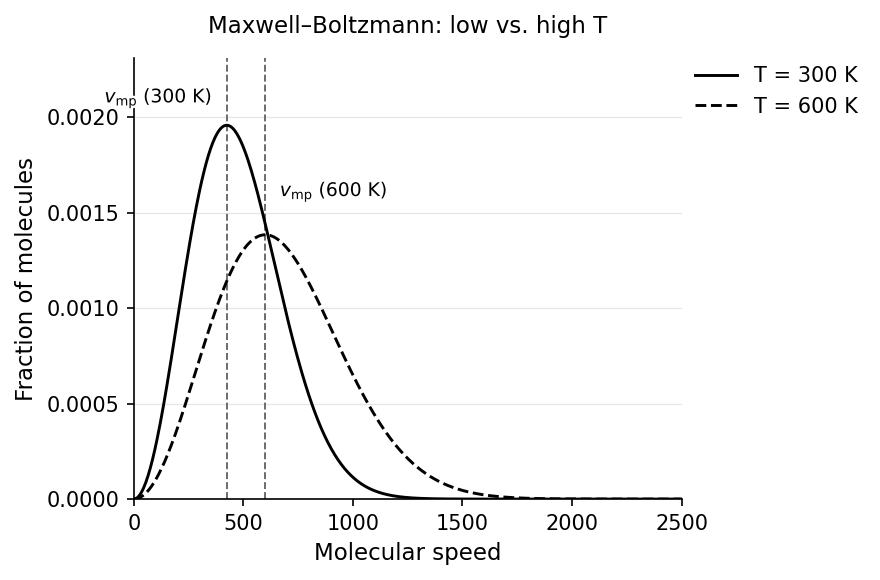
Must knowNot all molecules move at the same speed; the Maxwell-Boltzmann distribution is a right-skewed curve of speeds. Three speeds, ordered (most probable = peak; rms = highest):
where is molar mass (kg/mol). Effect of temperature: raising shifts the curve to higher speeds and broadens it (peak drops and moves right).
Effect of molar mass: heavier molecules move slower at a given — the basis of Graham's Law of Effusion/Diffusion:
Lighter gases effuse/diffuse faster — e.g. (2 g/mol) effuses 4× faster than (32 g/mol).
Quick check: At the same temperature, which has a higher : (28 g/mol) or (44 g/mol)?
Answer: — lighter molecules move faster (smaller → larger ).
Boltzmann's Constant and Its Relationship to R
Must knowThe Boltzmann constant is the per-molecule version of :
So (moles) is equivalent to (molecules), and per-molecule KE becomes per mole.
Quick check: At 300 K, what is the average translational KE of a single gas molecule?
Answer: J.
Heat Capacity at Constant Volume vs. Constant Pressure
Know the logicAt constant volume () all heat raises molecular KE (no expansion work): for a monatomic gas, for diatomic. At constant pressure the gas also does expansion work, so it needs more heat for the same :
The extra is the work . The key takeaway: always. (The ratio is Optional.)
Quick check: Why does it take more heat to raise a gas's temperature by 1 K at constant pressure than at constant volume?
Answer: At constant pressure, the gas expands and does positive work on the surroundings. That work comes from the energy you supply, so some of your heat goes to work rather than raising temperature. You must supply extra energy equal to to achieve the same .
Partial Pressure and Dalton's Law
Mole Fraction and Dalton's Law
Must knowThe mole fraction is the fraction of molecules that are species (dimensionless, sum to 1). Dalton's Law: each gas in an ideal mixture exerts a partial pressure as if alone, and total pressure is their sum:
This works because ideal molecules don't interact — each species fills the whole container independently.
Physiology hook: in dry air (), mmHg. In the alveoli, water vapor and lower alveolar to ~100 mmHg; venous blood arrives at ~40 mmHg, so diffuses down its gradient into blood. Gas exchange is Dalton's Law + diffusion.
Quick check: A container holds only and at 760 mmHg total; = 200 mmHg. What is ?
Answer: mmHg.
Collecting a Gas Over Water
Must knowWhen a gas is collected over water, it is saturated with water vapor, which adds its own partial pressure. To get the dry gas pressure, subtract the water vapor pressure:
Henry's Law: Gas Solubility in Liquids
Passage-levelHenry's Law governs how much gas dissolves in a contacting liquid (e.g. blood plasma): at equilibrium, dissolved concentration is proportional to partial pressure above the liquid:
is temperature-dependent (solubility rises as falls). Hook: Henry's Law explains decompression sickness ("the bends") — at depth, high pressure dissolves extra in blood; surfacing too fast drops and the gas bubbles out of solution.
Quick check: A diver breathes air at 4 atm total pressure. How does the amount of dissolved in blood compare to the surface value?
Answer: is ~4× higher, so by Henry's Law ~4× as much dissolves — the reservoir that causes the bends on rapid ascent.
Fick's Law of Diffusion
Passage-levelFick's Law sets the rate a gas diffuses across a membrane (e.g. the alveolar wall):
= surface area, = partial-pressure gradient, = membrane thickness, = diffusion coefficient. Faster with larger area/gradient, slower across a thicker membrane. Hook: emphysema shrinks and pulmonary fibrosis raises — both impair gas exchange.
Quick check: Why does pulmonary edema (fluid filling the alveolar space) reduce oxygenation?
Answer: The fluid layer increases the effective diffusion distance , so by Fick's Law the rate of diffusion into the blood falls.
Deviation from Ideal Gas Behavior
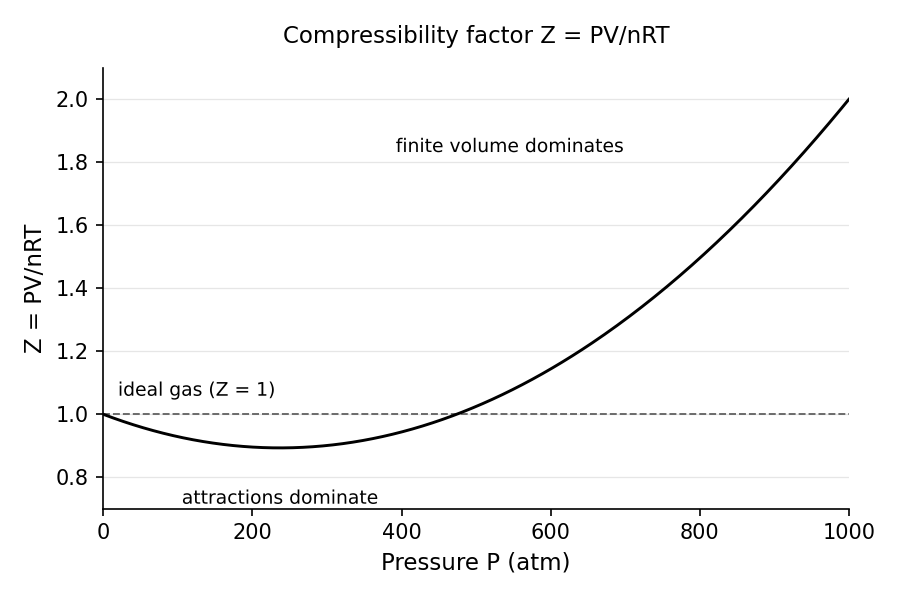
Must knowReal gases deviate because two ideal assumptions break down: (1) molecules have finite volume — at high pressure the free volume is less than the container; (2) attractive forces exist — at low temperature, attractions reduce the force of wall collisions, lowering real pressure below ideal.
Qualitative Rules
Must knowReal gases deviate most at high pressure and low temperature, and more for gases with strong intermolecular forces or large molecules. and behave most ideally (small, nonpolar).
The compressibility factor visualizes this: for an ideal gas; a real gas dips below 1 at moderate (attractions dominate) and rises above 1 at high (finite volume dominates).
The Van der Waals Equation
Know the logicThe van der Waals equation corrects for both effects:
The term is added to pressure to correct for attractions (larger = stronger attractions); the term is subtracted from volume to correct for excluded volume (larger = bigger molecules). For an ideal gas and it reduces to . Know the logic, not the numbers.
Quick check: Between (small, nonpolar) and (polar, hydrogen-bonding), which deviates more from ideal behavior at low T and high P?
Answer: — its large (strong attractions) causes big deviations when molecules are close (high ) and slow (low ).
Common Confusions & Tricks
1. Celsius vs. Kelvin in gas laws. Always convert to Kelvin before plugging into any gas law equation. If you use Celsius, your ratio of temperatures is wrong—often by a huge factor. Tattoo "T(K) = T(°C) + 273" into your memory.
2. Which to use? Use L·atm/(mol·K) for problems (standard MCAT calculation). Use J/(mol·K) for energy calculations (kinetic energy, thermodynamics). Never mix units within the same equation.
3. Molar volume at STP vs. room temperature. 22.4 L/mol is only at 0 °C and 1 atm. At room temperature (25 °C, 1 atm), the molar volume is about 24.5 L/mol. Don't apply 22.4 blindly without checking conditions.
4. The van der Waals correction increases pressure, decreases effective volume. Students often get these backwards. Think: attractions pull molecules toward each other, so they hit the wall with less force → real < ideal → we must add to reconcile. And real molecules take up space, so the free-roaming volume is less than total volume → subtract .
5. Higher temperature → real gas behaves more ideally. At high , kinetic energy overwhelms intermolecular attractions (the correction becomes negligible). High also means low density (for fixed ), reducing the importance of molecular volume.
6. . The most probable speed is the lowest of the three; rms speed is the highest. The distribution is right-skewed, so the average and rms are pulled higher by the long tail of fast molecules.
7. Graham's Law—flip the molar masses! The heavier gas is in the numerator under the radical when you want the ratio of the lighter gas's rate. . A heavier gas efuses slower, so if , Rate₁ > Rate₂—they are inversely related.
8. Partial pressure and mole fraction are in the same ratio. . This equivalence is handy—if you know mole percentages, you immediately know pressure percentages.
9. always for gases. At constant pressure, some heat does work expanding the gas. At constant volume, all heat goes to raising temperature. If a passage asks why you need more heat at constant pressure—it's the expansion work.
10. Dalton's Law applies to ideal (non-reacting) gas mixtures only. If gases react with each other (e.g., and ), Dalton's Law does not apply because the gases are no longer independent.
Key Equations
| Equation | Variables & When to Use |
|---|---|
| Convert Celsius to Kelvin before any gas law calculation | |
| Pressure from a fluid column; = density, = 9.8 m/s², = height | |
| Ideal Gas Law; use L·atm/(mol·K) with atm and L | |
| Boyle's Law; constant , | |
| Charles' Law; constant , ; in Kelvin | |
| Gay-Lussac's Law; constant , ; in Kelvin | |
| Combined Gas Law; constant | |
| Average translational KE per molecule; J/K | |
| RMS speed; in kg/mol; J/(mol·K) | |
| Graham's Law of Effusion; heavier gas efuses slower | |
| Relates molar gas constant to Boltzmann constant; mol⁻¹ | |
| Heat capacity at constant P vs. constant V; for ideal gases | |
| Van der Waals equation; corrects for attractions, for molecular volume | |
| Dalton's Law; total pressure = sum of partial pressures | |
| Partial pressure from mole fraction | |
| Open-end manometer; closed-end drops | |
| Henry's Law; dissolved-gas concentration ∝ partial pressure | |
| Fick's Law of diffusion across a membrane (area, gradient, thickness) |