Electrochemistry is the interplay between redox chemistry and electrical energy. Every electrochemical system does one of two things: a galvanic cell harvests electrical energy from a spontaneous redox reaction, or an electrolytic cell drives a non-spontaneous reaction by pumping energy in. The MCAT tests electron-flow direction, cell potentials, the link between thermodynamics and electrochemistry, the Nernst equation for non-standard conditions, and practical batteries. Build the conceptual model first; the math follows.
Priority labels: Must know = cold; Know the logic = mechanism not names; Passage-level = recognize, don't memorize; Optional = skippable.
Oxidation, Reduction, and Half-Reactions
The Core Idea
Must knowEvery electrochemical process is a redox reaction — one species loses electrons (oxidation), another gains them (reduction). Mnemonic: OIL RIG (Oxidation Is Loss, Reduction Is Gain). Because electrons can't float free, oxidation and reduction always occur together. Splitting the overall reaction into two half-reactions lets you track electron bookkeeping, calculate potentials, and predict spontaneity.
Writing and Balancing Half-Reactions
Know the logicTo balance a half-reaction in acidic solution: (1) balance the main element, (2) balance O with , (3) balance H with , (4) balance charge with . In basic solution, do the same, then add to both sides to neutralize the .
Example — permanganate reduction in acid:
Mn goes from +7 to +2 (gain of 5 = reduction). Charge balances: left , right . ✓
Quick check: In , is zinc oxidized or reduced? Its change in oxidation state?
Answer: Oxidized (loses 2 ); oxidation state goes 0 → +2.
Galvanic (Voltaic) Cells
Building the Mental Picture
Must knowTake a spontaneous redox reaction (e.g., Zn dissolving in solution). Separate the two half-reactions into different half-cells and connect them with a wire: electrons must travel through the wire from Zn to Cu, and that flow is usable current. This is a galvanic (voltaic) cell — chemical energy → electrical energy, spontaneously ().
Anatomy of a Galvanic Cell
Must knowThe four parts and their roles:
- Anode — site of oxidation; this electrode dissolves ("eats away").
- Cathode — site of reduction; metal plates onto it.
- Salt bridge — allows ion flow to keep each half-cell electrically neutral (e.g., in agar); without it the reaction stops.
- External circuit — wire carrying electrons from anode → cathode.
Memory anchor: AN OX / RED CAT — ANode = OXidation; CAThode = REDuction. In a galvanic cell the anode is the negative terminal and the cathode is positive (electrons leave the negative anode toward the positive cathode).
Cell Diagram (Line Notation)
Must knowHow to read line notation:
- Anode (oxidation) on the left, cathode (reduction) on the right.
- Single bar = phase boundary; double bar = salt bridge.
- So electrons flow left → right through the external wire.
Standard Reduction Potentials and Cell Potential
Must knowEach half-reaction has a standard reduction potential (volts, at 25 °C, 1 atm, 1 M), tabulated relative to the standard hydrogen electrode (SHE), defined as . A more positive = stronger tendency to be reduced (better oxidizing agent); a more negative value = prefers oxidation (better reducing agent).
Passage-levelActivity series: this same ranking is the activity series. The most negative metals (Li, K, Na, Mg, Zn) are most "active" and give up electrons easily; a more active metal displaces a less active metal ion from solution (e.g., goes; the reverse does not).
The standard cell potential:
with both values as reduction potentials. A positive means spontaneous as written.
Worked Example: Zn/Cu Galvanic Cell
Must knowGiven: , ; , .
Cu²⁺ has the higher → Cu is reduced (cathode); Zn is oxidized (anode).
Overall: . Since , spontaneous. ✓
Quick check: If zinc were forced to be the cathode, what would be, and is it spontaneous?
Answer: . Negative → non-spontaneous (an electrolytic scenario).
Thermodynamics of Electrochemistry
Connecting , , and
Must knowThe central link:
where = moles of electrons transferred and = Faraday's constant (). Combining with :
| Sign of | Sign of | Spontaneity |
|---|---|---|
| Positive | Negative | Spontaneous |
| Negative | Positive | Non-spontaneous |
| Zero | Zero | At equilibrium |
Quick check: For the Zn/Cu cell, , . What is ?
Answer: . Strongly spontaneous. ✓
The Nernst Equation
Must knowStandard conditions are rare, so the Nernst equation corrects for actual concentrations. The MCAT form (25 °C, base-10 log):
where is the reaction quotient.
Intuition: as the reaction proceeds, products build and rises → falls. When , and the cell is "dead" (equilibrium). This is why batteries run down.
Worked Example: Nernst Calculation
Must knowFor the Zn/Cu cell with , :
The potential drops slightly because product () is built up and reactant () depleted. (When , and .)
Quick check: At what condition does for any galvanic cell?
Answer: When — equilibrium; the cell can no longer do work.
Concentration Cells
Must knowA concentration cell is a galvanic cell with the same electrode and redox couple on both sides at different concentrations. There's no chemical difference, so ; the concentration gradient alone drives it.
Example: two Cu half-cells, (cathode) and (anode). With :
Cu dissolves from the dilute side and plates onto the concentrated side, equalizing concentrations.
Passage-levelBiology hook: concentration cells model how membrane potentials arise from ion gradients; the Nernst equation is used in physiology to find equilibrium potentials for individual ions. (For this physiological application — resting/equilibrium potentials — see the 3A Electrochemistry guide.)
Quick check: In a concentration cell, which side is the anode — more or less concentrated?
Answer: The less concentrated half-cell (oxidation there adds ions to the dilute side, raising its concentration toward equilibrium).
Electrolytic Cells
Must knowAn electrolytic cell consumes electricity to drive a non-spontaneous reaction (, ). An external power source pumps electrons in, forcing the reaction backward.
Polarity flips, chemistry doesn't. Oxidation is still at the anode and reduction still at the cathode, but the power source makes the anode positive and the cathode negative — opposite of a galvanic cell.
| Galvanic | Electrolytic | |
|---|---|---|
| Spontaneity | ||
| Anode charge | Negative | Positive |
| Cathode charge | Positive | Negative |
| Energy | Chemical → electrical | Electrical → chemical |
Electrolysis uses current to drive chemical change. Classic examples:
- Water: — at the cathode, at the anode.
- Electroplating: object to be plated is the cathode; metal source is the anode.
- Molten : Na at the cathode, at the anode (Downs process).
Quick check: In electrolysis of water, does oxygen form at the anode or cathode?
Answer: The anode (oxidation): .
Faraday's Laws of Electrolysis
Must knowThe amount of substance deposited at an electrode is proportional to charge passed:
where = mass (g), = molar mass, = current (A), = time (s), = electrons per ion, . Note (charge in coulombs); 1 ampere = 1 coulomb/second.
Worked Example: Electroplating
Must knowA silver bath runs at 2.00 A for 1.50 h. Grams of Ag (, half-reaction , )?
Quick check: With instead of at the same current/time, more or fewer grams? (, )
Answer: — far fewer, both from lower molar mass and 2 per ion (half the moles for the same charge).
Electromotive Force (EMF) and Voltage
Must knowElectromotive force (EMF) (, used interchangeably with ) is the maximum voltage a cell can produce under reversible (zero-current) conditions, in volts (). "Force" is a misnomer — it's energy per charge, the "push" on electrons. Under load, terminal voltage drops below EMF due to internal resistance; the MCAT treats EMF ≈ cell potential for ideal cells. The maximum electrical work is .
Quick check: A cell has and transfers 1 mole of electrons. What is ?
Answer: . Spontaneous.
Batteries
Must knowA battery is one or more galvanic cells (in series voltages add; in parallel capacities add); the chemistry sets the voltage.
The distinction:
- Primary cells — non-rechargeable; reaction not practically reversible (e.g., alkaline dry cell).
- Secondary cells — rechargeable; on discharge they run as a galvanic cell (chemical → electrical), on charging an external source drives them as an electrolytic cell (electrical → chemical), regenerating the reactants.
Lead-Storage (Lead-Acid) Battery
Must knowHigh-yield (the car battery). Pb anode, cathode, electrolyte; per cell (six cells = 12 V). Overall discharge:
Key points:
- Both electrodes form lead sulfate () on discharge.
- Acid concentration decreases during discharge (sulfate consumed, water made) — low electrolyte density ⇒ discharged.
- Reversible: charging regenerates Pb, , and . Optional overcharging electrolyzes water → explosive .
Quick check: During charging, what happens at the lead-sulfate electrode that was originally the cathode?
Answer: It is oxidized back to (), so it acts as the anode of the electrolytic cell during charging.
Nickel-Cadmium (Ni-Cd) Battery
Passage-levelCd anode, cathode, alkaline electrolyte; rechargeable; per cell. Its hallmark: it delivers a nearly constant (flat) voltage through most of discharge, unlike cells whose voltage sags steadily. Optional "memory effect" from partial cycling; Cd is toxic, largely replaced by NiMH/Li-ion.
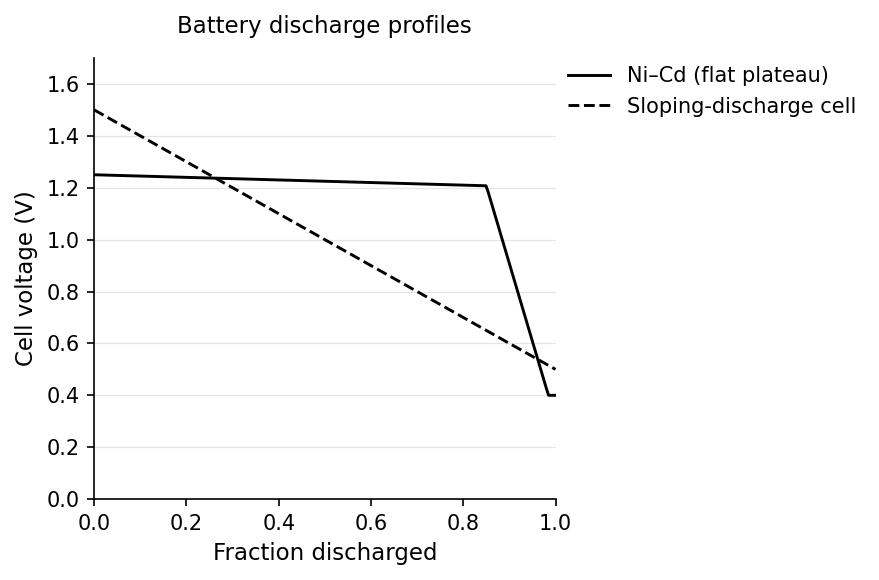
Quick check: Compared to a lead-storage battery, is Ni-Cd acidic or alkaline? Approximate voltage per cell?
Answer: Alkaline (); approximately 1.2 V per cell.
Electrolytes
Must knowAn electrolyte produces mobile ions when dissolved or melted, carrying current by ion migration (distinct from electron flow in a wire). Strong electrolytes fully dissociate (strong acids/bases, most ionic salts); weak electrolytes partially dissociate (weak acids/bases); non-electrolytes produce no ions (glucose, ethanol).
MCAT context: the salt bridge holds an electrolyte to maintain neutrality; biological fluids (, , ) are electrolyte solutions, linking electrochemistry to physiology.
Quick check: Would a glucose solution conduct? A solution?
Answer: Glucose — no (non-electrolyte, no ions). — yes (strong electrolyte, fully dissociated).
Common Confusions & Tricks
1. Polarity flips, chemistry doesn't. Galvanic anode = negative; electrolytic anode = positive. But anode = oxidation in both.
2. Never flip the sign of when scaling a half-reaction. is intensive — doubling coefficients doesn't change it. Only (via ) scales with stoichiometry.
3. uses both as reduction potentials. Don't flip the anode's sign and subtract (double-counting). Pick one convention and stick with it.
4. Positive = spontaneous = . Always consistent; no need to compute separately.
5. Nernst log base. The MCAT version uses : at 25 °C. Don't mix with .
6. Higher in the reduction table = better oxidizing agent. Most positive = strongest oxidizing agent and is always the cathode; most negative = strongest reducing agent.
7. Lead-acid: both electrodes become lead sulfate on discharge. Not just one — which is why density drops.
8. Concentration cell direction: dilute side = anode, concentrated side = cathode; electrons flow from the low- to the high-concentration side, equalizing them.
9. Sign in . and for spontaneous galvanic cells; the negative sign keeps them consistent.
10. Faraday's law units. Current in amperes, time in seconds → coulombs; convert hours first, then divide by 96,500 C/mol for moles of .
Key Equations
| Equation | Variables & Notes |
|---|---|
| Both as reductions; positive result = spontaneous | |
| = mol ; ; links thermo to electrochem | |
| Combine with above: | |
| 25 °C only; standard potential → | |
| Nernst at 25 °C; = reaction quotient | |
| Faraday's law; in coulombs | |
| Max electrical work = | |
| Lead-acid discharge; , 6 cells = 12 V |