Overview: Why This Topic Matters for the MCAT
Electrostatics underlies circuits, membrane potentials, nerve conduction, and the behavior of charged biomolecules. The MCAT tests forces, fields, and potentials both quantitatively and conceptually, often embedded in biology (e.g., potential across a lipid bilayer). Build intuition, not just formula recall.
Priority labels: Must know = cold; Know the logic = mechanism not names; Passage-level = recognize, don't memorize; Optional = skippable.
Charge, Conductors, and Charge Conservation
Electric Charge
Must knowElectric charge is a property of matter that produces electromagnetic forces. Two types — positive and negative; like charges repel, opposites attract. Charge is a scalar in coulombs (C).
Charge is quantized: every free charge is an integer multiple of the elementary charge C. The proton carries , the electron , so any transferred charge is for integer .
Conservation of charge: the net charge of an isolated system never changes — charge is transferred or separated, never created or destroyed. Rub a glass rod with silk and the glass gains while the silk gains exactly .
Conductors
Must knowA conductor has charges (metals' delocalized valence electrons) free to move throughout its bulk; they redistribute until any internal field cancels.
For a conductor in electrostatic equilibrium:
- Field inside is exactly zero (otherwise free electrons would keep moving).
- Net charge resides entirely on the outer surface.
- Field just outside points perpendicular to the surface.
- The whole conductor is one potential — an equipotential body.
Biological hook: a cell membrane is an insulator between two conductive aqueous compartments, each at a roughly uniform potential; the potential difference across it (~–70 mV at rest) drives ion flow. A Faraday cage is a hollow conductor whose interior is shielded from external fields because charge sits on the outer surface.
Insulators
Must knowAn insulator (dielectric) has charges bound to atoms; placed charge stays put. Lipid bilayers, glass, rubber, and polymers are insulators. They can't conduct but can be polarized — molecules stretch so one face is slightly negative, the other positive (relevant to dielectrics in capacitors).
Charging Mechanisms and Grounding
Know the logicThree ways a neutral object gains net charge:
- Friction: rubbing two insulators transfers electrons; they end up equal and opposite.
- Conduction (contact): touching a charged object to a neutral conductor shares charge; the neutral object ends with the same sign.
- Induction: a charged object brought near (no contact) redistributes a conductor's free charges; grounding while it's nearby lets charge flow to/from Earth, leaving the conductor with the opposite sign after the ground and object are removed.
Grounding provides a path for charge to an effectively infinite reservoir. Polarization also lets a charged object attract neutral objects (charged comb attracting paper) with no net charge transfer.
Quick check: A metal sphere carries . A second identical metal sphere (neutral) is briefly brought into contact, then separated. What is the final charge on each sphere?
Answer: Charge is conserved and the spheres are identical, so each gets half: . This is charge sharing through a conductor.
Coulomb's Law
The Force Between Two Point Charges
Must knowLike gravity, the electrostatic force falls off as — but it can attract or repel depending on the charges' signs.
Coulomb's Law gives the force magnitude between point charges and at separation :
Direction is along the line joining them: repulsive for like signs, attractive for opposite. (You may see with permittivity ; just know .)
Passage-levelStructurally identical to gravity () but vastly stronger and able to repel — at the atomic scale the Coulomb force dwarfs gravity (~ for proton–electron), so gravity is negligible there.
Superposition
Must knowWhen more than two charges are present, the net force on a charge is the vector sum of the Coulomb forces from every other charge — add as vectors, not magnitudes. MCAT setups are usually symmetric so components cancel cleanly.
Worked Example
Must knowProblem: and separated by . Find the force magnitude and direction.
Opposite signs, so the force is attractive. (Sanity check: microcoulombs are tiny but , so tenths of a newton is reasonable.)
Quick check: If the distance between the two charges in the example above is doubled to m, what happens to the force?
Answer: , so doubling decreases by a factor of . New force N.
Electric Field E
The Concept of Field
Must knowRather than the force between two specific charges, think about the electric field a source charge creates in space — it exists whether or not a test charge is present. is the force per unit positive test charge :
Units: (= ). By convention points along the force on a positive charge; a negative charge feels force opposite to .
Field of a Point Charge
Must knowFor a point charge at distance (Coulomb's law divided by , same ):
Direction: radially outward if , inward if .
Using the Field to Find Force
Must knowOnce you know , the force on a charge there is — same direction as if , opposite if . (Source creates the field; the field acts on the test charge.)
Quick check: A charge is placed where the electric field is pointing east. What is the force on the charge?
Answer: N mN, directed west (opposite to because is negative).
Electric Field Lines
Visualizing the Field
Must knowRules for electric field lines:
- Direction: point along — leave positive charges, terminate on negative.
- Density: closer lines = stronger field.
- Tangent: is tangent to the line at each point.
- No crossing: the field has one direction at each point.
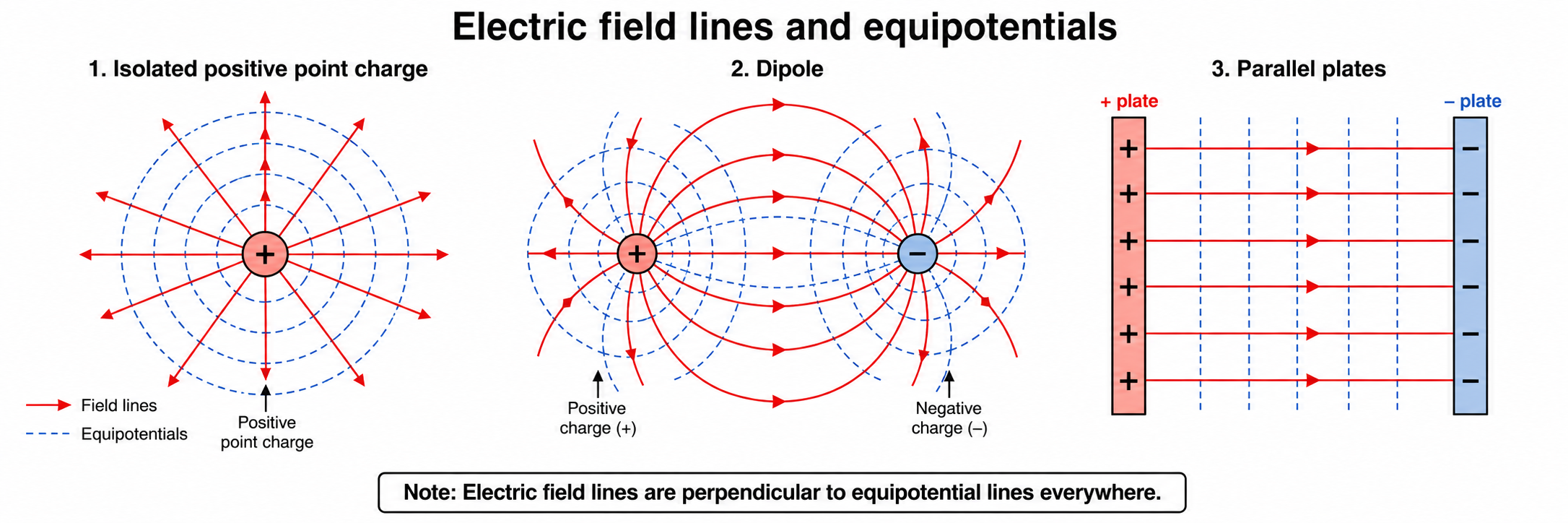
- Meet conductor surfaces and equipotentials at right angles.
Classic Field Line Diagrams
Must know- Single charge: radial lines, outward (+) or inward (−).
- Dipole (+ and −): lines arch from + to −, dense near the charges.
- Two equal + charges: lines repel outward; a neutral point lies between them.
- Parallel plates: uniform, straight, parallel lines from + to − plate (fringing at edges).
The parallel-plate case is MCAT-important because it gives a uniform field. The diagram shows the three canonical patterns with equipotentials crossing field lines at right angles.
Quick check: Two field lines appear to converge toward the same point on a conductor's surface. What can you conclude?
Answer: This is impossible — field lines cannot cross. Either only one line arrives there, or you must re-examine the diagram. The field at any point has only one direction.
Field Due to Charge Distributions
Parallel Plate Capacitor (Uniform Field)
Must knowThe key distribution: two large, oppositely charged parallel plates create a uniform field (constant magnitude/direction) pointing from + to − plate, the same everywhere between them — distance doesn't matter (ideal plates). A particle between the plates feels constant force , hence constant acceleration — exactly like a projectile in gravity. (Magnitude , = surface charge density; the relation you actually use is , below.)
Spherical Shell of Charge
Know the logic(Qualitative Gauss's Law, no derivation): outside a uniformly charged shell () the field equals a point charge at the center, ; inside (), . This is why conductor charge sits on the outer surface — the interior feels no net field.
The Electric Dipole
Know the logicAn electric dipole is and separated by small ; its dipole moment points from − to + with magnitude . Dipoles are everywhere in biology (water, peptide bonds, lipids). Two high-yield facts:
- Falls off faster than a point charge: and at large (vs. and for a single charge), because + and − nearly cancel.
- Torque in a uniform field: no net force (equal/opposite forces) but a torque that aligns with :
= angle between and ; torque is max at , zero when aligned (, stable). This is why polar molecules orient in a field.
Quick check: A proton is placed between two parallel plates with N/C directed downward (from + plate above to − plate below). What is the magnitude and direction of the electric force on the proton? (Use C.)
Answer: N, directed downward (same as , since the proton is positive).
Electrostatic Energy and Electric Potential
Electric Potential Energy
Must knowTwo charges at separation have electrostatic potential energy:
Sign matters (use actual signs):
- Like charges (): . Work needed to push together; they fly apart if released.
- Opposite charges (): . Bound — work needed to pull apart.
By convention as (the reference point).
Electric Potential (Voltage)
Must knowThe electric potential is potential energy per unit positive test charge:
Units: volts, . Key points:
- is a scalar — sum contributions algebraically: (no vectors).
- at by convention.
- A charge at potential has .
Work, Potential Difference, and the Electron-Volt
Must knowWork done by the field moving from A to B:
The electron-volt (eV) is the energy of one elementary charge moved through 1 V:
It appears constantly in atomic/nuclear problems — it's an energy unit, not a voltage.
Relationship Between E and V
Must knowand carry the same information. The field points from high to low potential (decreasing ), with magnitude . For a uniform field (parallel plates, separation ):
(hence V/m = N/C). For a point charge, both fall off with distance but drops faster than . The plot shows both curves.
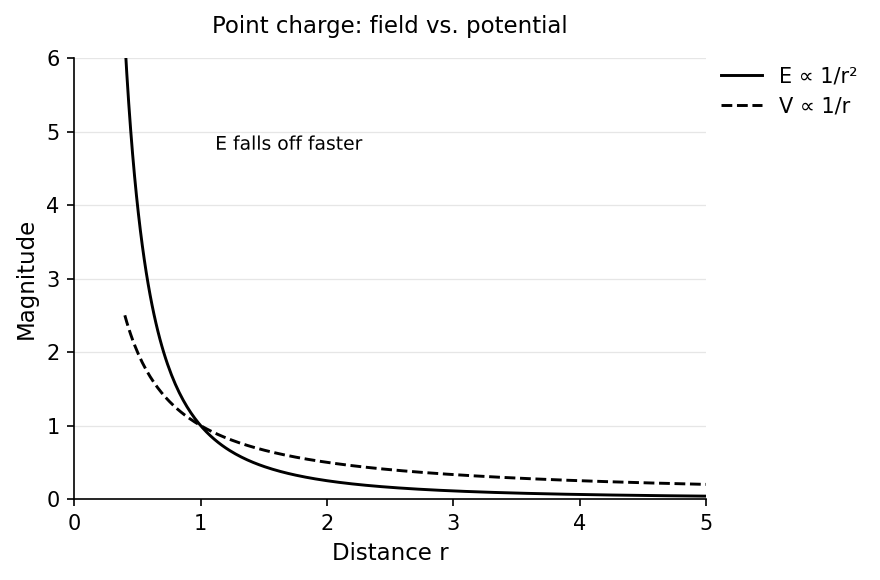
Crucially: positive charges move from high to low potential (ball rolling downhill); negative charges move toward higher potential (opposite to ). In nerve conduction, ions flowing "downhill" through channels release stored electrical energy.
Accelerating a Charge Through a Potential Difference
Must knowA charge released from rest through converts PE to KE:
This is the canonical electrostatics–kinematics link (e.g., accelerating an ion before a mass spectrometer). Between parallel plates a charge feels constant , so and it deflects like a projectile in gravity (parabolic path), the field playing the role of .
Equipotential Surfaces
Must knowAn equipotential surface has the same potential everywhere; no work is done moving a charge along it. They are always perpendicular to field lines: concentric spheres around a point charge, planes parallel to parallel plates, and the surface of a conductor in equilibrium.
Worked Example: Energy of Two Charges
Must knowProblem: A proton () and electron () at m (Bohr radius). Find (a) the potential at the electron due to the proton and (b) the system's PE.
(a)
(b)
Negative because it's a bound (attractive) system; magnitude ~27 eV is in the range of atomic binding energies.
Quick check: A charge of is moved from a point at potential V to a point at V. How much work does the electric field do, and does the charge move spontaneously?
Answer: J mJ. The work is positive (field does positive work on the charge), and positive charges naturally move from high to low potential, so yes, this motion is spontaneous.
Common Confusions & Tricks
1. is a vector; is a scalar. Add fields from multiple charges as vectors (decompose into components); add potentials algebraically (much simpler).
2. Zero field ≠ zero potential. Midpoint between two equal + charges: (fields cancel) but (potentials add). Equidistant from and : but . Independent quantities.
3. The sign in . Use the charges' actual signs. The magnitude-only form is for force , not .
4. "Positive charges move to lower potential." Potential is like altitude: a + charge rolls downhill (toward lower ), a − charge "rises" (toward higher ). The + plate is high potential, the − plate low.
5. requires a uniform field. Works only for parallel plates. For a point charge, , , related by (a derivative, not a ratio).
6. Inside a conductor: but . The conductor is an equipotential — is constant throughout, not necessarily zero.
7. Negative charge in a field. , so feels force antiparallel to . Electrons accelerate toward the + plate (higher potential).
8. Coulomb is the separation, not a radius. For a charged sphere, is the distance from its center to the external charge (shell theorem — sphere acts as a point charge at its center).
9. "If you see eV, think energy." It's an energy unit ( J), not a voltage. Convert early.
Key Equations
| Equation | Variables & When to Use |
|---|---|
| = integer, C; quantization of charge | |
| Coulomb force magnitude; N·m²/C²; = separation | |
| Force on charge in field ; includes sign/direction | |
| Field magnitude from point charge at distance | |
| Uniform field between parallel plates; = plate separation | |
| Electric potential from point charge at distance ; scalar | |
| Superposition of potential from multiple charges; scalar sum | |
| Electrostatic potential energy; use actual signs of | |
| PE of charge at a location with potential | |
| Electric dipole moment; = charge, = separation | |
| Torque on a dipole in uniform field ; = angle between and | |
| Work done by electric field moving from A to B | |
| J | Conversion; energy of charge moved through 1 V |