Magnetism governs some of the most clinically relevant physics on the MCAT — the mass spectrometer, MRI, and the deflection of charged particles all trace back to a single force law. Build the intuition first, then let the math follow.
Priority labels: Must know = cold; Know the logic = mechanism not names; Passage-level = recognize, don't memorize; Optional = skippable.
The Magnetic Field B
What Is a Magnetic Field?
Must knowA moving charge (or current) creates a magnetic field that exerts a force on other moving charges. The key word is moving: a stationary charge feels no magnetic force and creates no magnetic field.
Field Lines and Direction
Must knowMagnetic field lines form closed loops — they never begin or end on a source (no magnetic monopoles). Outside a bar magnet they run from north to south pole; inside, from south to north. Around a straight current-carrying wire they are concentric circles.
Right-hand rule for a straight wire: point your right thumb in the direction of conventional current; your curling fingers show the direction of the circular field lines.
Units and Magnitude
Must knowThe SI unit is the Tesla (T). A smaller unit is the Gauss (G), where . Passage-level Earth's field is roughly (); clinical MRI runs at –.
Common Sources of Magnetic Fields
Know the logicRecognize these, but the MCAT tests proportionality, not derivation.
| Source | Field Magnitude | Notes |
|---|---|---|
| Long straight wire | = distance from wire | |
| Solenoid (inside) | = turns per unit length |
Here is the permeability of free space. Conceptual takeaway: doubling the current doubles the field; doubling the distance from a wire halves the field.
Quick check: A straight wire carries a current directed into the page. At a point directly above the wire, what is the direction of ?
Answer: By the right-hand rule, thumb into the page means the fingers curl clockwise as seen by the reader. Directly above the wire, the clockwise tangent points to the right. So points to the right.
Magnetic Properties of Materials
Know the logicThe deciding factor is unpaired electrons. Distinguish the three types (MRI passages expect this); don't memorize the example lists.
| Type | Behavior in a field |
|---|---|
| Diamagnetic | Weakly repelled; all electrons paired, induced moment opposes the field; effect vanishes when field is removed (e.g. water, Cu). |
| Paramagnetic | Weakly attracted; unpaired electrons partially align; no permanent magnetization (e.g. , transition-metal ions). |
| Ferromagnetic | Strongly attracted; domains align and the material retains magnetization (Fe, Co, Ni). |
This connects to electron configuration — molecular has two unpaired electrons, so it is paramagnetic.
The Lorentz Force
The Core Force Law
Must knowA particle with charge moving with velocity through a magnetic field feels the Lorentz force:
with magnitude
where is the angle between and . Three consequences:
- Stationary (): .
- Parallel/antiparallel ( or ): , so , no deflection.
- Maximum force at (): .
The Right-Hand Rule for Force Direction
Must knowFor : point right-hand fingers along , curl toward , and your thumb gives the force direction for a positive charge. For a negative charge, flip the result. Practice until automatic — RHR appears in 2D and 3D ( = out of page, = into page) versions.
The Full Lorentz Force (Electric + Magnetic)
Must knowWith both fields present:
This is the basis of the velocity selector below.
Magnetic Force on a Current-Carrying Wire
Must knowCurrent is moving charge, so a straight wire of length at angle to feels:
Direction: RHR with current in place of . This is how MCAT passages test electric motors.
Force Between Two Parallel Wires
Know the logicEach wire sits in the other's field. The frequently tested rule:
- Parallel currents (same direction) attract.
- Antiparallel currents repel.
(Opposite of the "like repels" intuition from electric charges.) Optional the force per unit length is , but the MCAT usually asks only for the direction.
Torque on a Current Loop (Motor Principle)
Know the logicA current loop in a field feels no net force but a net torque that rotates it — the principle of the electric motor (a commutator reverses current each half-turn to keep rotation going one way). Recognizing this qualitatively is enough; you need not compute the loop's magnetic moment.
Quick check: An electron moves to the right in a region where points out of the page. Which direction is the magnetic force on the electron?
Answer: By RHR, (right) (out) points downward for a positive charge. The electron is negative, so the force is upward.
Motion of Charged Particles in Magnetic Fields
Why Magnetic Forces Curve (Not Speed Up) Particles
Must knowThe magnetic force is always perpendicular to the velocity, so it does zero work (). Therefore:
- Magnetic forces never change speed (kinetic energy).
- They change only the direction of motion.
Circular Motion in a Uniform Magnetic Field
Must knowWhen in a uniform field, the particle circles with the magnetic force as centripetal force:
This is high-yield. Larger mass or speed → larger radius; larger charge or stronger field → smaller (tighter) radius.
The period is
which is independent of speed — the operating principle of the cyclotron. The cyclotron frequency is .
Helical Motion (Oblique Entry)
Passage-levelIf a particle enters at an oblique angle, decompose its velocity — the component parallel to is unaffected, the perpendicular component circles, giving helical (spiral) motion along the field lines (how charged particles spiral along Earth's field lines to produce the aurora).
Worked Example: Proton Deflected in a Magnetic Field
Must knowA proton (, ) moves at perpendicular to . Find the radius.
A few centimeters is reasonable for a proton in a half-Tesla field.
Key Applications (High-Yield MCAT Devices)
The Velocity Selector
Must knowIn crossed and fields, a charge passes undeflected only when the electric and magnetic forces balance:
Only particles with exactly this speed pass straight through — the inlet stage of a mass spectrometer.
The Mass Spectrometer
Must knowAfter velocity selection, ions enter a uniform and curve in semicircles, landing on a detector at distance . Since , measuring gives the mass-to-charge ratio .
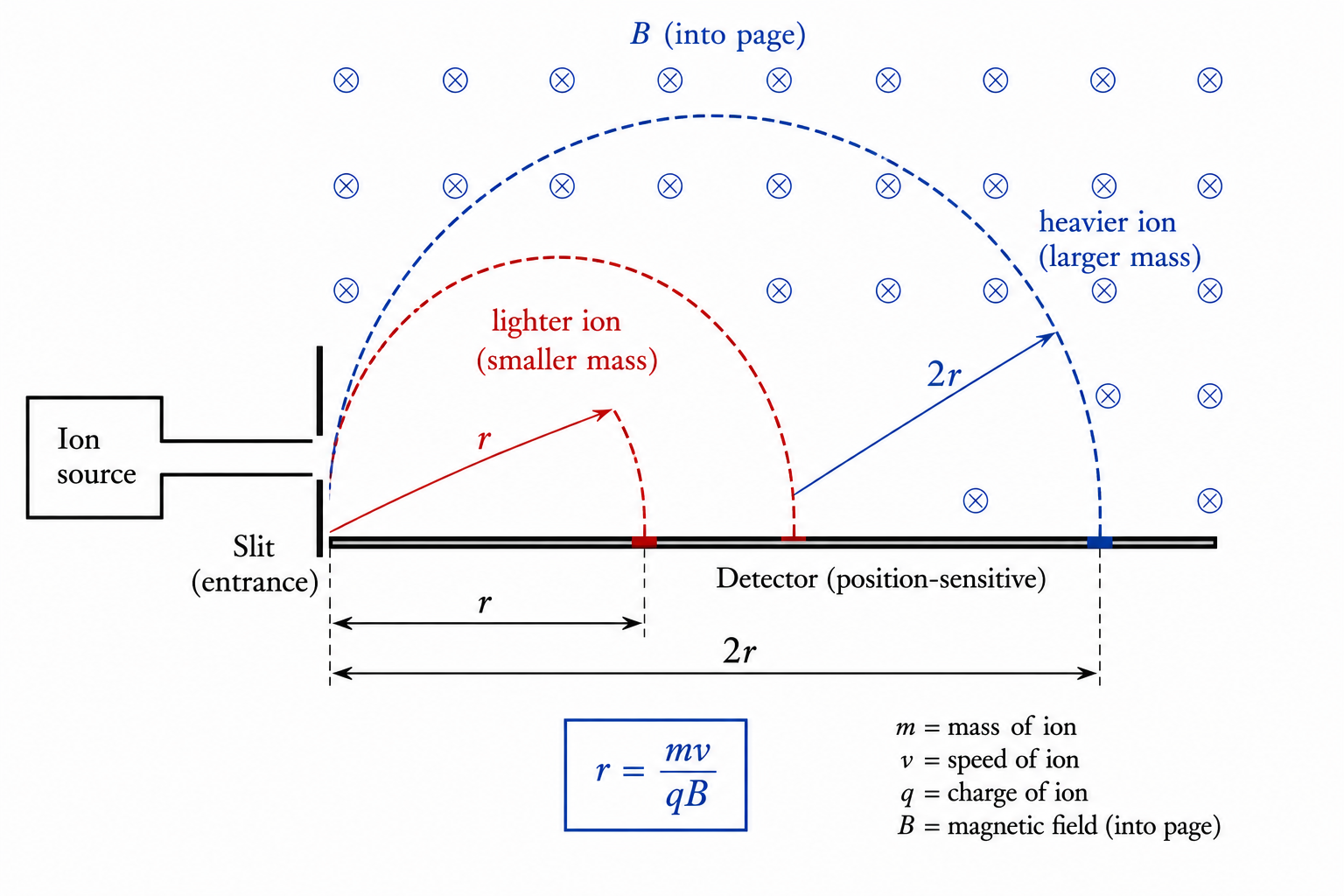
Different isotopes have the same charge but different mass, so they curve to different radii and separate — how isotope ratios are measured (e.g. -labeling).
The Cyclotron
Know the logicTwo D-shaped electrodes ("dees") in a uniform field; an alternating electric field at the gap adds kinetic energy each pass, and particles spiral outward. Because is independent of speed, the alternating frequency stays constant and in sync. Medical cyclotrons make short-lived PET isotopes (, ).
Quick check: In a mass spectrometer, a singly charged ion of mass and one of mass enter the same field with the same speed. What is the ratio of their orbital radii?
Answer: Since with the same , , , radius is proportional to mass: . The heavier ion curves twice as widely.
Common Confusions & Tricks
1. Magnetic vs. electric force on a stationary charge. A stationary charge feels no magnetic force but does feel an electric force. If a passage describes a particle that isn't moving, the electric force is responsible.
2. RHR for negative charges — always flip at the end. Do the RHR as if positive, then reverse for electrons/anions. Forgetting to flip is the most common error.
3. Magnetic force does no work. It cannot change kinetic energy. If a particle speeds up, an electric field is responsible.
4. The factor. Parallel motion = zero force; perpendicular = maximum force.
5. Radius direction of dependence. From , a stronger field gives a smaller radius (stronger = more force = tighter bend).
6. "Into the page" () vs. "Out of the page" (). = into the page (arrow feathers), = out of the page (arrow tip). Confusing these flips every force direction.
7. Cyclotron period is independent of speed. has no — this is why a cyclotron works.
8. Mass spectrometer measures , not alone. For singly ionized atoms , but for multiply charged ions compare .
Key Equations
| Equation | Variables & Use |
|---|---|
| Magnetic force magnitude; = angle between and | |
| Full Lorentz force; direction from RHR; flip for negative charges | |
| Force on current-carrying wire; = current, = length in field | |
| Cyclotron/Larmor radius; circular path in uniform | |
| Cyclotron period; independent of speed | |
| Cyclotron frequency; | |
| Velocity selector condition | |
| Field at distance from a long straight wire | |
| Field inside a solenoid; = turns per unit length, |