Priority labels: Must know = cold; Know the logic = mechanism not names; Passage-level = recognize, don't memorize; Optional = skippable.
Overview: The Neuron as an Electrical Device
Must knowThe MCAT frames the neuron as a biological electrical circuit: the membrane separates charge (a capacitor), ion channels allow selective current flow (resistors/switches), and the -ATPase acts as a voltage source by maintaining ion gradients. Structural features — myelin, nodes, axon diameter — exist to propagate signals rapidly and efficiently over distance.
This guide owns the electrophysics: resting potential, the action potential, cable properties, and conduction. The synaptic biology that begins where the AP ends — neurotransmitter release and receptor types, postsynaptic summation, and glial cell biology — is covered in the Bio/Biochem 3A Nerve Cell guide; see it for that detail.
Neuron Anatomy (Essential Roadmap)
Must know- Dendrites — receive incoming signals
- Cell body (soma) — contains the nucleus; integrates signals
- Axon hillock — trigger zone where APs initiate (highest density of voltage-gated channels)
- Axon — conducts the signal away from the soma (the structure that benefits from myelination)
- Axon terminals (boutons) — where the AP arrives and opens voltage-gated channels, triggering vesicle exocytosis (the electrical-to-chemical handoff; synaptic detail in 3A)
Resting Membrane Potential and Ion Equilibrium
Must knowAt rest, a neuron holds a stable voltage across its membrane — the resting membrane potential (RMP), about (inside negative). Two causes:
- The -ATPase pumps 3 out and 2 in per ATP, building the gradients and making the inside slightly negative.
- The membrane is far more permeable to than at rest (leak channels), so diffuses outward, leaving negative charge behind.
Each ion has an equilibrium potential — the voltage at which the electrical gradient exactly opposes the concentration gradient (no net flow). Reason from the gradient:
- is concentrated inside, so it leaks out; a negative interior is needed to hold it ().
- is concentrated outside, so it rushes in; a positive interior is needed to hold it ().
Because the resting membrane is much more permeable to , the RMP sits close to , pulled only slightly positive by the small leak. The quantitative Nernst equation lives in the Electrochemistry guide; here the directional reasoning is what is tested.
Quick check: If extracellular is 145 mM and intracellular is 12 mM, is the equilibrium potential for positive or negative?
Answer: Positive. is more concentrated outside, so it "wants" to rush in; you need a positive interior to stop it (). This is why influx drives depolarization toward .
The Action Potential
Mechanism Step by Step
Must knowAn action potential (AP) is the neuron's all-or-nothing signal — a self-amplifying wave of voltage change.
- Resting (): voltage-gated channels closed; leak channels hold RMP.
- Threshold (): depolarization to threshold triggers massive opening of voltage-gated channels.
- Depolarization: rushes in; potential spikes toward .
- Repolarization: channels inactivate (inactivated ≠ closed — they can't reopen immediately); voltage-gated channels open with a delay, flows out, voltage drops.
- Hyperpolarization: channels close slowly; membrane briefly overshoots to .
- Return to RMP: channels close; the -ATPase restores gradients over time.
Refractory Periods
Must know- Absolute: during depolarization/early repolarization. channels are inactivated — no new AP regardless of stimulus. This enforces unidirectional propagation.
- Relative: during hyperpolarization. A new AP is possible but needs a stronger stimulus.
Quick check: Why can't an action potential travel backward along an axon?
Answer: The membrane just behind the advancing AP is in its absolute refractory period — Na⁺ channels are inactivated and can't reopen yet. Only the membrane ahead (still at RMP) can fire next.
Where the Electrical Signal Becomes Chemical
Know the logicWhen the AP reaches the axon terminal, the depolarization opens voltage-gated channels; influx triggers neurotransmitter-vesicle exocytosis. This is the only synaptic step that belongs here, because it is gated by membrane voltage. Everything downstream — neurotransmitter identities, receptor types, EPSP/IPSP summation, and glial cells — lives in the 3A Nerve Cell guide.
Myelin Sheath and Schwann Cells
The Core Problem: The Leaky Cable
Know the logicIn unmyelinated axons, depolarization spreads passively (electrotonically) and decays with distance. The neuron must continuously regenerate the AP at every point along the membrane — slow and energetically expensive.
Myelin as Electrical Insulation
Must knowMyelin is a lipid-rich membrane wrapping that insulates the axon, like insulation on a wire:
- It increases membrane resistance — less current leaks out through wrapped segments.
- It decreases membrane capacitance — less charge stored per unit voltage, so the membrane charges and discharges faster.
A passive depolarization decays over a characteristic length constant — larger when membrane resistance is high (less leak) and internal axial resistance is low (current flows easily down the axon). Myelin raises membrane resistance enormously, so the signal reaches the next node before fading. Only the qualitative reasoning is tested — not the cable-theory formula.
Axon Diameter and Conduction Velocity
Must knowThe same logic explains why larger-diameter axons conduct faster: a wider axon has lower internal axial resistance (like a thicker wire), so the signal spreads farther and faster. This is why the unmyelinated but enormously thick giant squid axon still conducts rapidly; vertebrate myelination achieves the same speed more efficiently by raising membrane resistance instead.
Schwann Cells vs. Oligodendrocytes
Must knowThe PNS/CNS split and one-vs-many distinction.
| Feature | Schwann Cells | Oligodendrocytes |
|---|---|---|
| Location | PNS | CNS |
| Axons myelinated | One segment per cell | Many axons per cell |
| Regeneration | Supports regrowth | Poor (CNS regenerates poorly) |
| Disease | Guillain-Barré | Multiple sclerosis (MS) |
Quick check: A demyelinating attack destroys oligodendrocytes in the spinal cord. Why are symptoms harder to reverse than peripheral nerve damage?
Answer: In the CNS, oligodendrocytes regenerate poorly (and inhibitory signals block regrowth). In the PNS, Schwann cells support axon regrowth. This is why MS causes persistent deficits while many peripheral neuropathies partially recover.
Nodes of Ranvier: Saltatory Conduction
Why Gaps in the Myelin Exist
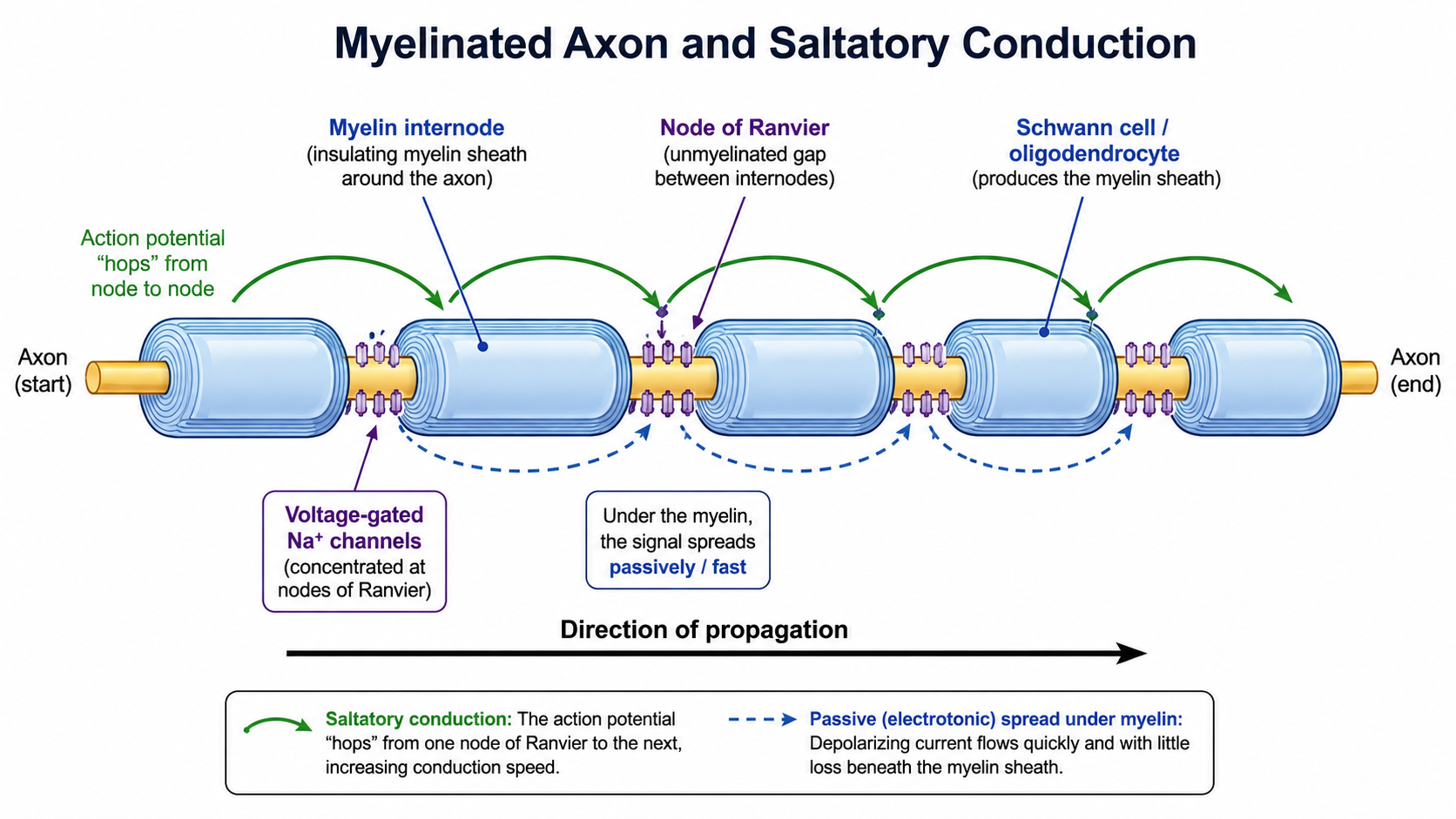
Must knowIf myelin covered the axon continuously, no ion exchange could regenerate the signal. Myelin is interrupted at Nodes of Ranvier, gaps densely packed with voltage-gated channels, where the AP is actively regenerated.
Saltatory Conduction
Must knowBetween nodes, the signal travels passively and nearly instantaneously through the insulated internode — the depolarization "leaps" node to node (saltatory conduction, from Latin saltare, to leap). It is fast because reduced capacitance lets the next node's membrane build voltage quickly. At each node the passive depolarization exceeds threshold, fires a fresh AP, and spreads to the next node — so amplitude is preserved over distance.
Comparison of conduction:
| Property | Unmyelinated | Myelinated |
|---|---|---|
| Mechanism | Continuous regeneration | Saltatory (node-to-node) |
| Velocity | ||
| Energy use | High (pumps along whole length) | Low (pumps only at nodes) |
Circuit framing: the myelinated axon = a cable with insulating sleeves (high-resistance, low-capacitance internodes) and periodic amplifiers (nodes as active current sources).
Quick check: A toxin blocks voltage-gated channels only at Nodes of Ranvier. What happens to saltatory conduction?
Answer: It fails. The passive depolarization arrives at the next node but can't regenerate (no Na⁺ influx), so the signal decays and the AP is extinguished — the mechanism of local anesthetics like lidocaine.
Clinical and MCAT-Relevant Applications
Multiple Sclerosis (MS)
Must knowMultiple sclerosis is an autoimmune demyelinating disease of the CNS (destroys oligodendrocytes/myelin). Loss of myelin raises capacitance and lets current leak, so APs slow, fail to propagate between nodes, or fail entirely. Symptoms are heterogeneous (vision loss, weakness, sensory changes) because plaques form anywhere in CNS white matter, with relapse and remission as partial remyelination is attempted.
Guillain-Barré Syndrome
Passage-levelAutoimmune demyelination of the PNS (Schwann cell myelin), causing ascending paralysis; recovery is more complete than MS because Schwann cells support regeneration.
Conduction Velocity and Fiber Types
Passage-levelVelocity tracks myelination and diameter — thick myelinated motor/proprioception fibers are fastest; thin unmyelinated C fibers (slow pain, autonomic) are slowest. This is why the sharp immediate pain of a pinprick arrives before the slow burning ache.
Quick check: Why might MS symptoms worsen when body temperature rises (Uhthoff's phenomenon)?
Answer: In partially demyelinated axons the AP is barely sustained. Higher temperature speeds Na⁺ channel inactivation and shortens the window for inward current, tipping a marginal AP into conduction failure. Cooling can temporarily restore conduction.
Common Confusions & Tricks
Schwann cells vs. oligodendrocytes — which is which?
Schwann → Single axon → peripheral (PNS). Oligodendrocytes myelinate many axons in the CNS. Most reliably: Schwann = PNS, Oligo = CNS.
Inactivated vs. closed Na⁺ channels:
A closed channel (at rest) can open on depolarization. An inactivated channel (during/after AP) cannot open again until the membrane repolarizes. This is why the absolute refractory period exists.
Myelin increases resistance AND decreases capacitance — remember both:
More resistance → less current leak. Less capacitance → faster charging. Both accelerate the signal.
Getting the sign of an equilibrium potential right:
Reason from the gradient. Ion concentrated inside (like ) leaks out → negative interior holds it → negative equilibrium potential. Ion concentrated outside (like ) flows in → positive interior holds it → positive equilibrium potential.
All-or-nothing ≠ "all APs are the same size everywhere":
A single AP on a single cell fires fully or not at all. But different neurons can have different AP amplitudes. Don't over-generalize.
Saltatory conduction is faster AND uses less energy — both testable:
The energy savings (fewer nodes needing pumping) is a separate point from the speed advantage.
Nodes of Ranvier = where the action is:
A toxin or disease affecting AP propagation on a myelinated axon acts at the nodes — not the internode, which has no voltage-gated channels.
Key Relationships
This page is qualitative — no equation block is required (the Nernst equation and cable-theory constants are out of scope here). The relationships worth holding onto:
| Relationship | Usage |
|---|---|
| (qualitatively) | Membrane capacitance. Myelin adds effective thickness , lowering — faster charging, faster conduction. Directional, not a calculation. |
| -ATPase: 3 out, 2 in, 1 ATP | Electrogenic pump. Net outward positive charge; maintains the gradients that power all electrical signaling. |