Geometrical optics treats light as rays that travel in straight lines until they hit a boundary or curved surface. This holds whenever objects and apertures are much larger than the wavelength — true for essentially all lenses, mirrors, and eyes on the MCAT. The payoff: with one equation and a consistent sign convention you can predict where any image forms and whether it is real or virtual, upright or inverted.
Priority labels: Must know = cold; Know the logic = mechanism not names; Passage-level = recognize, don't memorize; Optional = skippable.
Reflection from Plane Surfaces
The Law of Reflection
Must knowThe normal is the line perpendicular to the surface at the point of contact. The angle of incidence and angle of reflection are both measured from the normal (not the surface — a common error). The law of reflection:
For a plane mirror, the image is: as far behind the mirror as the object is in front; virtual; upright and same size; laterally inverted (left-right reversed).
Quick check: You stand 2 m in front of a plane mirror. How far is your image from you?
Answer: The image is 2 m behind the mirror, so you-to-image is m.
Refraction and Snell's Law
Why Refraction Happens
Must knowLight slows in a medium. The index of refraction quantifies this:
where is the speed in the medium ( m/s in vacuum). Since , . Vacuum (and air, on the MCAT) ; water , glass , diamond .
Across an interface, frequency stays the same; speed and wavelength change, with (shorter wavelength in a denser medium). A ray bends because one side of the wavefront slows before the other:
- Low → high (air → glass): bends toward the normal
- High → low (glass → air): bends away from the normal
Snell's Law
Must know
with both angles measured from the normal.
Worked example: A ray in air () hits glass () at . Find the angle of refraction.
Low → high , so it bends toward the normal: . ✓
Quick check: A ray travels from glass () into water (). Does it bend toward or away from the normal?
Answer: Higher to lower , so it bends away from the normal ().
Dispersion
Must knowThe index of refraction depends slightly on wavelength — this is dispersion. Shorter wavelengths (violet, blue) have a slightly higher than longer ones (red), so they refract more. A prism therefore spreads white light into a spectrum (violet bends most, red least); the same effect makes rainbows. Dispersion is also the cause of chromatic aberration in lenses.
Quick check: Which color is at the outer (top) arc of a rainbow?
Answer: Red. Red bends the least inside the droplet, exiting at a steeper angle that places it at the top of the arc.
Total Internal Reflection
Must knowGoing from higher to lower , light bends away from the normal. As grows, the refracted ray reaches at the critical angle . Beyond there is no refracted ray — all the light reflects back. This is total internal reflection (TIR).
Conditions: (1) (denser → less dense), and (2) .
Setting in Snell's law:
(e.g., glass→air: ).
Passage-levelTIR underlies fiber optics (endoscopes) and the sparkle of diamond (small traps light).
Quick check: Can TIR occur when a ray goes from water () into glass ()?
Answer: No. TIR needs (denser to less dense); water to glass is the wrong direction.
Spherical Mirrors
Concave vs. Convex
Must knowA spherical mirror is a section of a sphere whose center is the center of curvature , a distance (radius of curvature) from the surface.
- Concave (converging): reflective inner surface; parallel rays converge.
- Convex (diverging): reflective outer surface; parallel rays diverge, appearing to come from behind the mirror.
Focal Length and the Mirror Equation
Must knowParallel rays converge at (or appear to diverge from) the focal point , halfway to :
The image location comes from the mirror equation (same form as the thin-lens equation):
( = object distance, = image distance, = focal length.)
Sign conventions (real-is-positive): = real image in front of the mirror; = virtual image behind. = concave (converging); = convex (diverging). Object in front: .
Magnification:
magnified, diminished; upright, inverted.
Real vs. Virtual Images
Must knowA real image forms where rays actually intersect (projectable onto a screen); a virtual image forms where rays only appear to diverge from (not projectable). For mirrors: real is in front (), virtual is behind ().
Ray Diagrams for Concave Mirrors
Must knowThree canonical rays (any two suffice): (1) parallel ray reflects through ; (2) ray through reflects parallel; (3) ray through reflects back on itself.
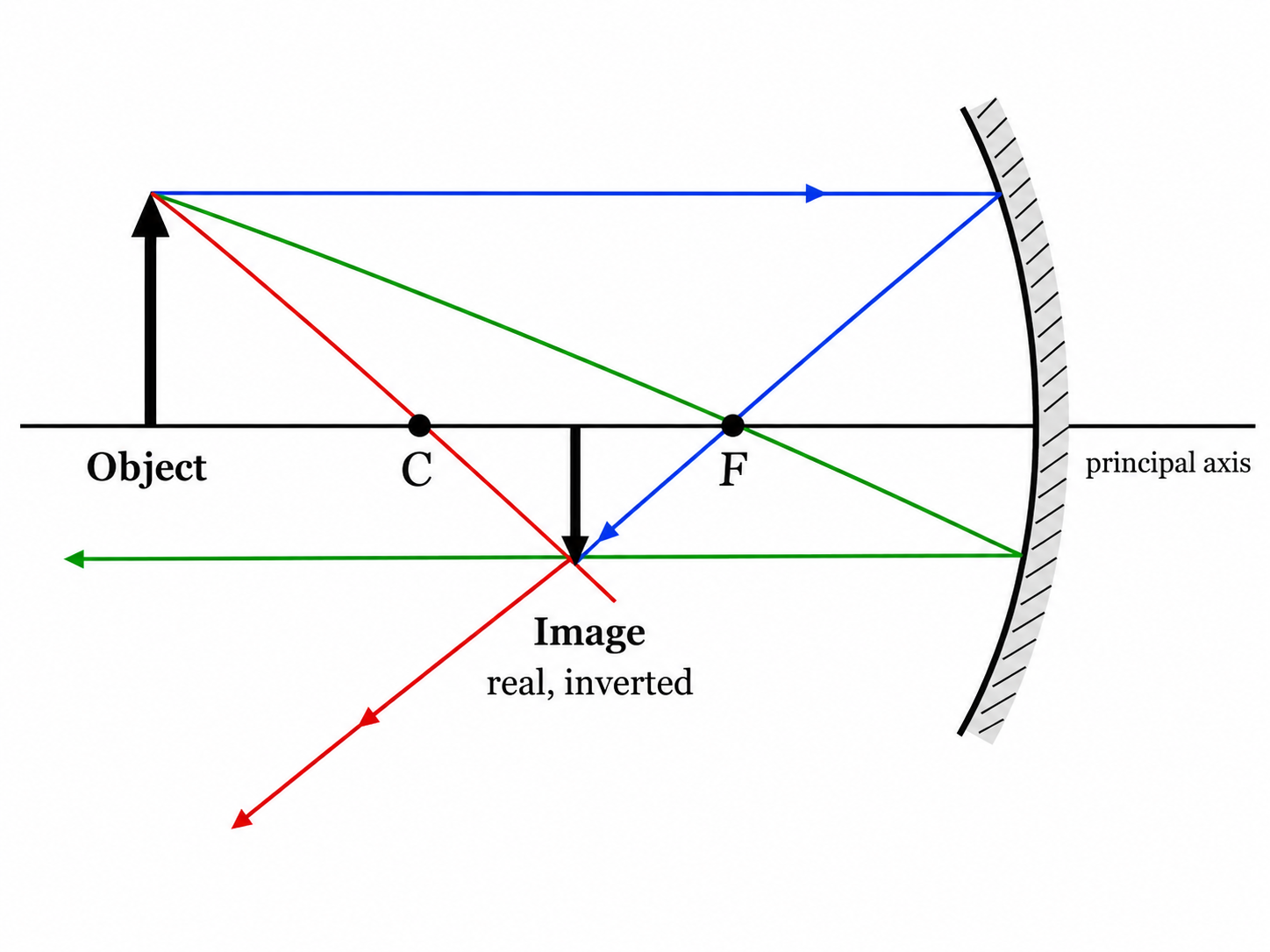
Worked example: Object 30 cm in front of a concave mirror, cm. Find , , and describe the image.
→ real, in front; → inverted; → diminished. Consistent with an object beyond . ✓
Quick check: Where do you place an object to get a virtual, upright, magnified image in a concave mirror?
Answer: Between and the mirror (). This is how a makeup/shaving mirror works.
Thin Lenses
Converging and Diverging Lenses
Must knowA thin lens refracts entering and exiting, but we treat refraction as happening at one plane.
- Converging (convex) lens: thicker at center; parallel rays converge to a real focal point on the far side. .
- Diverging (concave) lens: thinner at center; parallel rays appear to diverge from a virtual focal point on the near side. .
Memory aid: convex = converging = ; concave = diverging = .
The Thin-Lens Equation and Sign Conventions
Must know
Sign conventions (real-is-positive): real object on incoming side ; real image on outgoing (far) side , virtual image on incoming side ; converging lens , diverging . Magnification is again .
Ray Diagrams for Thin Lenses
Must knowConverging lens, three canonical rays: (1) parallel ray refracts through far focal point ; (2) ray through near focal point refracts parallel; (3) ray through the optical center passes straight through. (For a diverging lens, ray 1 refracts as if from the near focal point.)
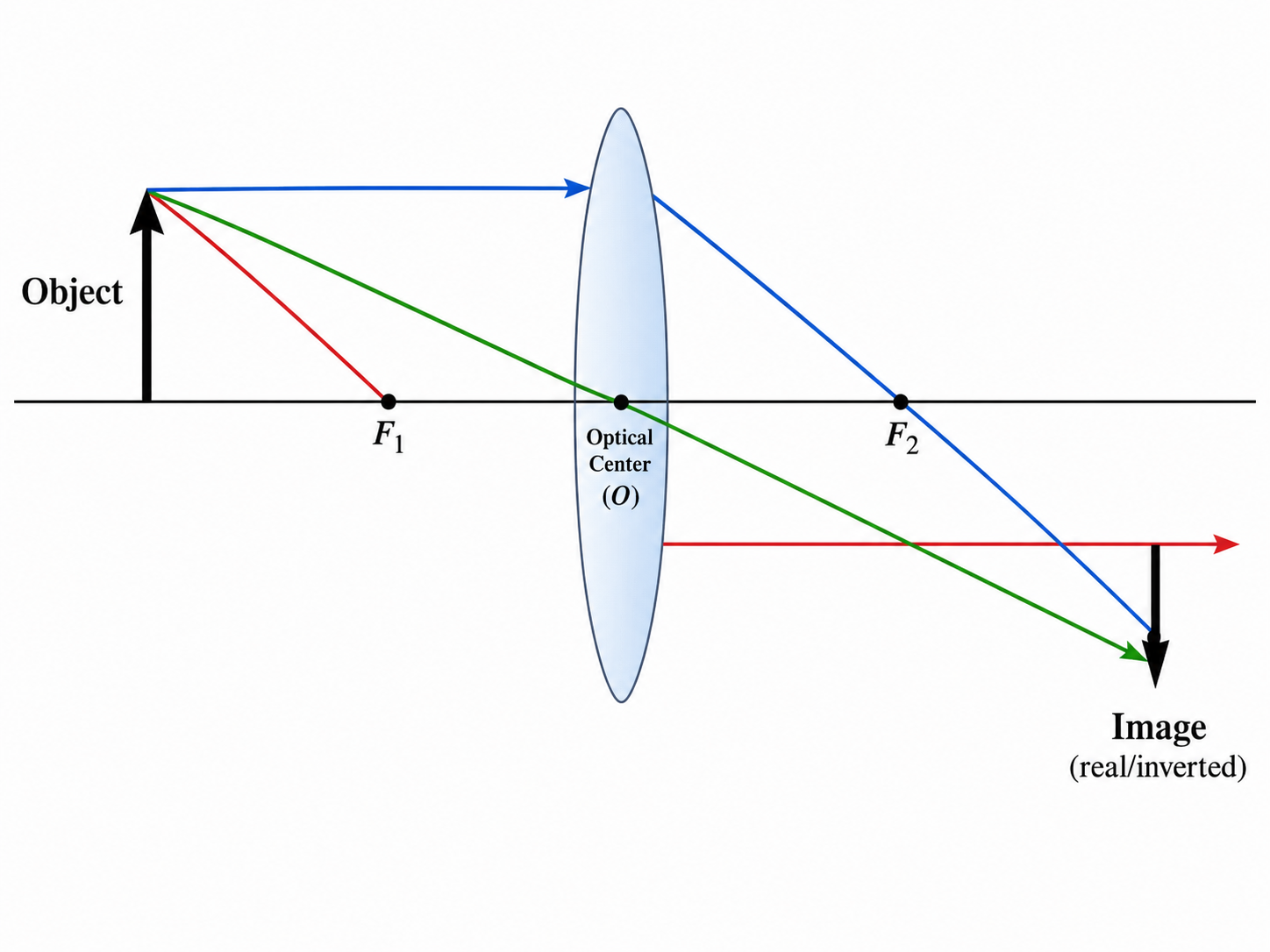
Worked example: Object 20 cm from a converging lens, cm (object inside ). Find .
→ virtual, same side as object; → upright, magnified 3×. This is exactly how a magnifying glass works. ✓
Quick check: A diverging lens always produces what type of image for a real object?
Answer: Always virtual, upright, diminished — regardless of object position. (, always give , .)
Lens Strength and Diopters
Must knowLens power is measured in diopters (D):
with in meters. Converging ; diverging . (E.g., D → m.)
Quick check: A lens has cm. What is its power in diopters?
Answer: m, so D.
Combination of Lenses
Must knowFor thin lenses in contact, powers add:
Optional
If lenses are separated, treat them sequentially — the image from lens 1 is the object for lens 2 (the separated-system formula is not required).
Quick check: A D lens is placed in contact with a D lens. What is the combined focal length?
Answer: D, so m = 50 cm.
Lens Aberration
Know the logicSpherical aberration: rays through the edges of a spherical lens/mirror focus at a slightly different point than rays through the center, blurring the image. Corrected with parabolic shapes, a smaller aperture, or compound designs.
Chromatic aberration: because depends on wavelength (dispersion), colors focus at slightly different distances, giving colored fringes. Corrected with an achromatic doublet.
Key MCAT point: Mirrors do not show chromatic aberration (reflection doesn't depend on ) — hence large telescopes use mirrors.
Quick check: Why don't mirrors suffer from chromatic aberration?
Answer: The law of reflection doesn't involve , so all wavelengths reflect identically and focus at the same point.
Optical Instruments, Including the Human Eye
The Human Eye
Must knowThe eye is a converging lens system projecting a real, inverted image on the retina. The cornea provides most of the fixed converging power; the crystalline lens provides variable power. Accommodation is the ciliary muscles changing the lens curvature (more power) to focus on near objects. Near point ≈ 25 cm (young adult); far point = infinity (normal eye).
Myopia, Hyperopia, Presbyopia, Astigmatism
Must knowThe corrections:
- Myopia (nearsighted): eye too long/strong; image forms in front of retina; distance blurry; far point < ∞. Corrected with a diverging (–) lens.
- Hyperopia (farsighted): eye too short/weak; near objects blurry; near point farther than normal. Corrected with a converging (+) lens.
- Presbyopia: lens stiffens with age, reducing accommodation; near vision worsens. Corrected with converging (+) reading glasses.
- Astigmatism: irregular corneal curvature blurs at all distances. Corrected with cylindrical lenses.
For a myopic far point of 0.50 m, the corrective power is D (negative of the far-point distance).
| Condition | Problem | Blurry at | Corrective Lens |
|---|---|---|---|
| Myopia | Eye too long / strong | Distance | Diverging (–) |
| Hyperopia | Eye too short / weak | Near | Converging (+) |
| Presbyopia | Lens stiffens with age | Near | Converging (+) |
| Astigmatism | Irregular cornea | All | Cylindrical |
Other Optical Instruments
Passage-level- Magnifying glass: single converging lens, object inside → virtual, upright, magnified image.
- Compound microscope: two converging lenses; the objective forms a real, magnified intermediate image that the eyepiece magnifies again. Total = (objective)(eyepiece).
- Refracting telescope: large objective + eyepiece; . Large telescopes use mirrors to avoid chromatic aberration.
- Camera: single converging lens forms a real, inverted, reduced image; focus by changing lens-to-sensor distance.
Quick check: The objective produces a 40× intermediate image; the eyepiece acts as a 10× magnifier. What is the total magnification?
Answer: (the "40× objective + 10× eyepiece" labeling).
Common Confusions & Tricks
1. Always measure angles from the normal, not the surface — otherwise you get the complement of the right angle.
2. The sign of is everything. Converging lenses and concave mirrors → ; diverging lenses and convex mirrors → .
3. "Concave/convex" flips meaning for mirrors vs. lenses. Mirror: concave = converging, convex = diverging. Lens: convex = converging, concave = diverging.
4. Real image is in front of a mirror but behind a lens — wherever the rays actually converge. The sign conventions encode this ( = real on both, but "real side" differs).
5. A virtual image is always upright; a real image is always inverted (single lens/mirror, real object). Reliable answer check.
6. Myopia = minus; hyperopia = plus. Myopic eyes over-converge, so diverge first.
7. Diopters require in meters. cm = 0.25 m → D.
8. TIR requires the right direction — only high → low ; no critical angle the other way.
9. is for spherical mirrors only, not lenses. (The lensmaker's equation is not tested.)
10. A convex mirror or diverging lens → always virtual, upright, diminished. Guaranteed shortcut.
Key Equations
| Equation | Variables & When to Use |
|---|---|
| Reflection; both angles measured from the normal | |
| Index of refraction: = speed in medium | |
| Snell's law for refraction at a flat interface | |
| Critical angle for TIR; requires | |
| Focal length of a spherical mirror | |
| Mirror/lens equation; = object dist, = image dist | |
| Magnification; upright, inverted, $ | |
| Lens power in diopters; converging , diverging | |
| Powers add for thin lenses in contact | |
| Angular magnification of a refracting telescope |