Priority labels: Must know = cold; Know the logic = mechanism not names; Passage-level = recognize, don't memorize; Optional = skippable.
What Light Actually Is
Must knowLight is a self-sustaining wave of oscillating electric () and magnetic () fields, each generating the other. Unlike sound, EM radiation needs no medium — it crosses the vacuum of space.
Propagation is perpendicular to both and , and . (Wave along → along , along .) This mutual perpendicularity is directly tested.
Speed, Frequency, and Wavelength
Must knowIn a vacuum, all EM radiation travels at the same speed:
where is frequency (Hz) and is wavelength (m). Since is constant, frequency and wavelength are inversely related.
When light enters a medium, its speed decreases and wavelength shrinks, but its frequency stays the same (frequency is the invariant property of the photon). The index of refraction quantifies the slowdown:
Quick check: A yellow photon is 580 nm in vacuum. Its wavelength in glass ()?
Answer: . Frequency is unchanged; only wavelength and speed shrink.
The Electromagnetic Spectrum and Photon Energy
The Spectrum
Must knowThe ordering from lowest to highest energy/frequency (longest to shortest wavelength):
| Region | Approx. Wavelength | Context |
|---|---|---|
| Radio | MRI (NMR) | |
| Microwave | Heating | |
| Infrared (IR) | Molecular vibration, heat | |
| Visible | Vision | |
| Ultraviolet (UV) | DNA damage | |
| X-rays | Imaging, crystallography | |
| Gamma | Nuclear decay, highest energy |
Mnemonic: Radio, Microwave, IR, Visible, UV, X-ray, Gamma.
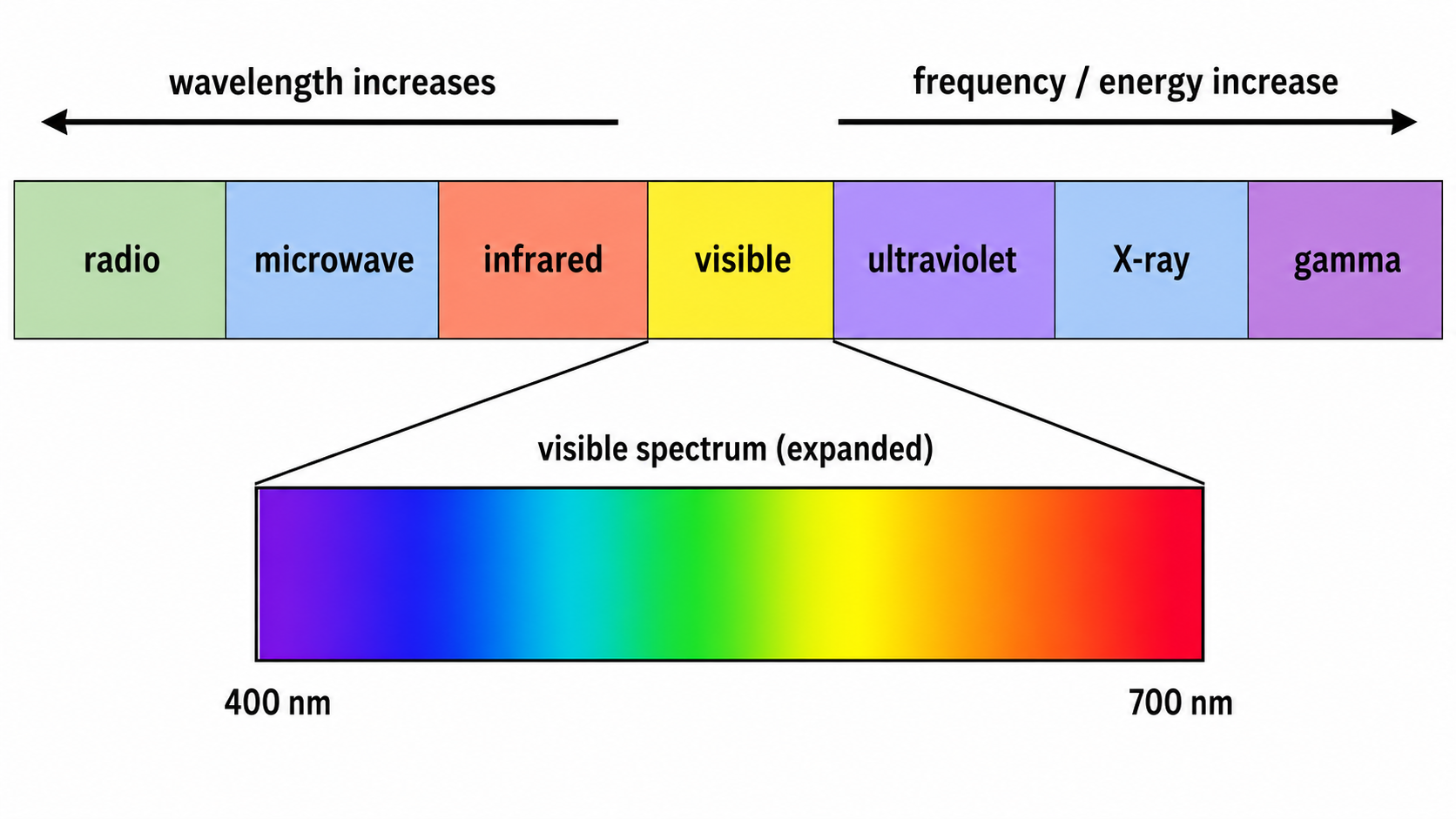
Photon Energy:
Must knowLight comes in discrete photons, each carrying:
where (Planck's constant). Higher frequency = shorter wavelength = higher energy. This is why UV (not visible) light damages DNA — each photon has enough energy to break bonds.
Passage-levelA convenient unit is the electron-volt, ; visible photons carry ~1.8–3.1 eV.
Quick check: Energy of a 400 nm violet photon, in J and eV?
Answer: — right at the violet end of the visible range. A 700 nm red photon is less energetic (~1.8 eV).
How Light Interacts With Matter
The Photoelectric Effect
Must knowWhen light of high enough frequency strikes a metal, it ejects photoelectrons — the canonical proof that light behaves as particles. Each photon delivers all its energy to one electron. To escape, an electron must overcome the work function ; leftover energy becomes kinetic:
- Threshold frequency : below it, no electrons eject no matter how intense the light.
- More intensity (above threshold) → more electrons, but same max KE.
- Higher frequency → higher KE per electron.
The stopping potential just halts the fastest electrons: .
Quick check: Metal with eV, hit by 2.0 eV photons. Electrons ejected? Answer: Just barely — . At threshold; any lower frequency ejects none.
Atomic Line Spectra: Emission and Absorption
Must knowElectrons occupy discrete (quantized) energy levels. A photon interacts only when its energy exactly matches a level gap:
- Absorption: cool gas removes matching wavelengths from white light → dark lines.
- Emission: excited atoms drop and emit those same wavelengths → bright lines on dark.
Each element's line spectrum is a unique fingerprint — the basis of flame tests and absorption spectroscopy.
Quick check: A hydrogen electron falls from eV to eV. Photon energy? Answer: eV — the red Balmer line.
Fluorescence and Phosphorescence
Know the logicIn fluorescence, a molecule absorbs a high-energy (often UV) photon, loses some energy as heat, then re-emits a lower-energy / longer-wavelength photon — the Stokes shift. Emission is essentially immediate, so it stops the instant the source is removed (underlies fluorescence microscopy, GFP assays). Phosphorescence is the same process but via a long-lived excited state, so emission is delayed (glow-in-the-dark, seconds to minutes).
The Doppler Effect for Light
Know the logicRelative motion shifts observed frequency:
- Approaching → higher frequency, shorter wavelength → blue shift.
- Receding → lower frequency, longer wavelength → red shift.
The red shift of distant galaxies is the primary evidence the universe is expanding. Only relative velocity matters (no medium).
Quick check: A star's absorption lines appear at longer wavelengths than in the lab. Approaching or receding? Answer: Receding — red shift indicates motion away.
The Visual Spectrum and Color
Colors of Visible Light
Must knowWithin ~400–700 nm, the brain reads wavelength as color, longest to shortest (lowest to highest energy):
Mnemonic: ROY G BIV. Red is lowest energy; violet is highest.
Perceived Color vs. Absorbed Color
Must knowAn object appears the color it reflects/transmits and absorbs the complementary color. Complementary pairs sit opposite on the color wheel — e.g., Red ↔ Cyan, Green ↔ Magenta, Blue ↔ Yellow.
Example: a solution looks blue because it absorbs orange/red and transmits blue — the principle behind colorimetric assays.
Dispersion
Know the logicWhite light is all visible wavelengths mixed. In a prism, depends slightly on (higher for shorter ), so violet bends most, red bends least. This spreading is dispersion; water droplets cause rainbows the same way.
Quick check: Why does red bend less than violet in glass?
Answer: Glass has a slightly lower for red (longer ), so red slows and bends less (Snell's law: ).
Wave Nature of Light: Interference
The Core Idea
Must knowWaves superpose: crest + crest → constructive interference (bigger amplitude); crest + trough → destructive (cancels). This is the foundation of all interference and diffraction.
Young's Double-Slit Experiment
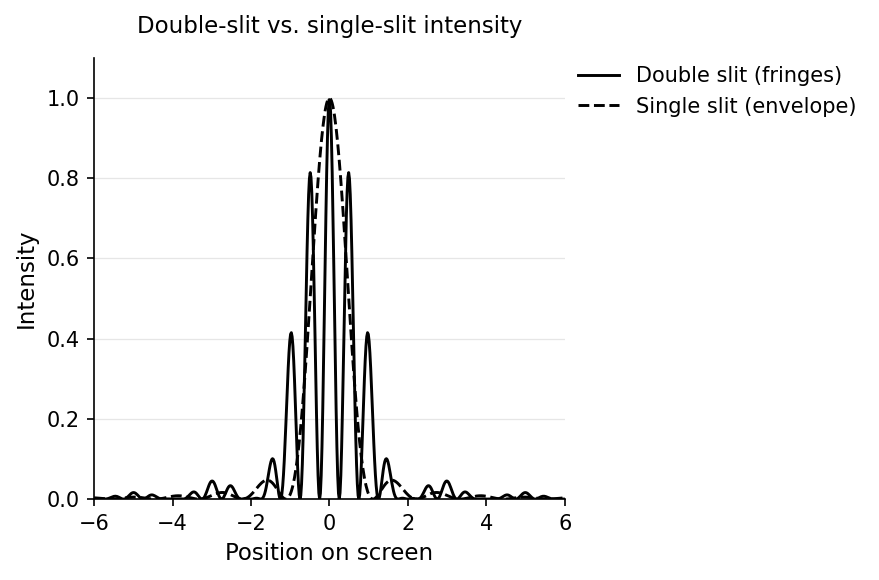
Must knowMonochromatic light through two slits separated by produces alternating bright/dark fringes on a screen distance away. The path difference between the two rays sets constructive vs. destructive:
For small angles, , so the -th bright fringe sits at:
Larger → wider spacing; larger → narrower spacing. Optional the same wave behavior applies to electrons (matter waves), linking to de Broglie wavelength.
Quick check: Replace red light (700 nm) with blue (400 nm). Fringe spacing wider or narrower? Answer: Narrower — .
Diffraction
Must knowDiffraction is the bending of waves around edges or through openings, most pronounced when the opening is comparable to the wavelength.
Single-Slit Diffraction
Must knowA single slit of width gives a broad central maximum with dimmer side maxima. Minima (dark fringes) occur at:
For single-slit, gives dark fringes; for double-slit, gives bright fringes. A narrower slit → wider central maximum (constraining a wave in space spreads it in angle).
Diffraction Grating
Must knowA diffraction grating has many equally spaced slits (spacing ), giving the same condition:
Because is tiny, the bright orders are far apart and sharp. Gratings are used in spectroscopy to separate wavelengths — relevant to atomic-structure passages.
Quick check: A grating with 500 lines/mm (): first-order () angle for red (700 nm)? Answer: , so .
Thin-Film Interference
Know the logicLight hitting a thin film (soap bubble, oil slick, anti-reflective coating) partially reflects off the top and bottom surfaces; the two reflected rays interfere. Two factors set the phase difference:
- Path length: the bottom ray travels an extra ; in terms of film wavelength (), that's cycles.
- Reflection phase shift: reflecting off a higher- medium adds a (180°) shift; off a lower- medium, none.
For a film of index in air, only the top reflection (air → film) gets a shift, so there is one net shift, which flips the conditions:
Key logic: 0 or 2 phase flips → constructive when ; 1 flip → constructive when .
Anti-reflective coatings exploit thin-film destructive interference to cancel reflected glare.
Worked example: Oil film () on water (); minimum thickness for destructive interference (zero reflection) at nm? Top (air→oil): phase shift. Bottom (oil→water, high→low ): no shift → one net flip → destructive when . Minimum at : . ✓ (right range for thin-film effects.)
X-Ray Diffraction and Bragg's Law
Must knowX-ray diffraction (XRD) works because crystal plane spacings (~ångströms) match X-ray wavelengths. Constructive interference off parallel atomic planes obeys Bragg's Law:
where is plane spacing and is the glancing angle (measured from the plane, not the normal).
Passage-levelX-ray diffraction produced the key images of DNA and is standard for protein structures — it can appear in biochem passages.
Quick check: For fixed and , increasing does what to order ? Answer: ; larger → higher orders at larger angles.
Polarization of Light
The Concept
Must knowUnpolarized light has oscillating in all transverse directions. Polarization restricts to one orientation.
Linear Polarization
Know the logicIn linearly polarized light, oscillates in a single plane. A polarizer transmits only the component along its axis. Unpolarized light through one polarizer loses half its intensity. When already-polarized light hits a second polarizer (analyzer) at angle :
- Aligned (): full transmission.
- Crossed (): zero transmission.
- Intermediate: partial.
This qualitative behavior is what matters — no intensity calculation required.
Circular Polarization
Passage-levelIn circularly polarized light, rotates as the wave propagates (arising from two perpendicular components with equal amplitude and a 90° phase difference).
MCAT relevance: chiral molecules (amino acids, sugars) rotate the plane of polarized light — optical rotation, measured by a polarimeter.
Brewster's Angle
Know the logicAt Brewster's angle , reflected light is completely linearly polarized:
( = index of the second medium). This is why polarized sunglasses (vertical axis) block horizontally polarized glare from roads and water.
Quick check: Why do polarized sunglasses have vertical transmission axes? Answer: Glare reflected off horizontal surfaces is horizontally polarized (Brewster reflection); a vertical polarizer blocks it.
Common Confusions & Tricks
1. Single-slit minima vs. double-slit maxima — same equation, opposite meaning. (single) gives dark; (double) gives bright. Note to self: "single slit: m → dark."
2. Thin film: count the phase flips. A shift happens only at a low- → high- boundary. Label values, count flips: 0 or 2 → for constructive; 1 → for constructive.
3. Bragg's Law: is the glancing angle, not from the normal. Opposite to Snell's convention. If given the angle from the perpendicular, subtract from 90°.
4. Frequency is invariant when light changes medium; wavelength and speed change. doesn't change — it's the same photon. Wavelength () shrinks.
5. Absorbed color ≠ observed color. A blue solution absorbs orange. Mix-ups are common in spectroscopy passages.
6. Polarizer vs. analyzer. Unpolarized light on the first polarizer always loses half, regardless of orientation. Only already-polarized light on a second polarizer has angle-dependent transmission.
7. Energy increases toward gamma, not radio. — radio lowest, gamma highest. Don't confuse wavelength ordering with energy ordering.
8. Soap bubbles / oil slicks → thin-film interference. Different thicknesses destructively remove different wavelengths from reflected light.
Key Equations
| Equation | Variables & Use |
|---|---|
| = speed of light in vacuum, = frequency, = wavelength | |
| index of refraction; higher → slower speed, shorter | |
| photon energy; J·s | |
| photoelectric effect; threshold | |
| atomic line spectra; photon energy = level gap | |
| double-slit / grating bright fringes | |
| -th bright fringe position (small-angle) | |
| single-slit dark minima () | |
| thin film, 0 or 2 flips: constructive | |
| thin film, 1 flip: constructive (min at ) | |
| Bragg's Law; = lattice plane spacing, = glancing angle | |
| Brewster's angle; = index of second medium |