Sound is one of the most clinically relevant physics topics on the MCAT — the stethoscope and the ultrasound probe are sound physics in action. This guide builds from what sound is through how it travels, shifts, resonates, and goes supersonic. The topic rewards understanding over memorization.
Priority labels: Must know = cold; Know the logic = mechanism not names; Passage-level = recognize, don't memorize; Optional = skippable.
Production of Sound
Sound as a Longitudinal Mechanical Wave
Must knowSound is a disturbance of matter, not space. A vibrating object pushes neighboring molecules, which collide with their neighbors, propagating the disturbance outward. The molecules themselves do not travel — they oscillate about equilibrium. What propagates is the pattern of compression (high-pressure regions) and rarefaction (low-pressure regions).
This makes sound a longitudinal wave: particle displacement is parallel to propagation (contrast a transverse wave on a string, where displacement is perpendicular). For the MCAT: sound is a longitudinal, mechanical, pressure wave. Because it needs molecular collisions, sound cannot travel through a vacuum — no sound in space.
The universal wave relationship applies:
where is wave speed (m/s), is frequency (Hz), and is wavelength (m). At fixed speed, higher frequency means shorter wavelength — used repeatedly in the resonance section.
Quick check: A sound wave travels through air at 340 m/s with a frequency of 680 Hz. What is its wavelength?
Answer: .
Relative Speed of Sound in Solids, Liquids, and Gases
Why Medium Matters
Must knowTwo competing factors set the speed:
- Elasticity (stiffness) — how strongly molecules push back. Stiffer → faster.
- Density (inertia) — how hard molecules are to accelerate. Denser → slower.
So sound travels faster in a stiffer medium and slower in a denser one. (Qualitative only; the bulk-modulus formula is out of scope.)
The Solid > Liquid > Gas Hierarchy
Must knowSound is fastest in solids, slower in liquids, slowest in gases (air ~343 m/s, water ~1480 m/s, steel ~5960 m/s). The counterintuitive part: gases are less dense than solids, yet slower — because gases are also far less stiff, and stiffness dominates. Steel is denser than air but vastly stiffer, so the stiffness advantage wins.
Know the logicTemperature dependence: warmer air → higher molecular kinetic energy → faster propagation. Approximation: (m/s), giving ~343 m/s at 20 °C — the standard value.
Passage-levelUltrasound assumes a known tissue speed (~1540 m/s) to convert echo timing into depth.
Quick check: Would sound travel faster in warm air or cold air? What about comparing bone and soft tissue?
Answer: Warm air — higher temperature increases speed. Bone (denser but far stiffer) transmits sound faster than soft tissue.
Intensity of Sound, Decibel Units, and the Log Scale
Intensity: Power per Unit Area
Must knowIntensity () is power per unit area:
For a point source radiating uniformly (a spherical wave), power spreads over :
This is the inverse square law: double the distance, and intensity drops by a factor of four. The MCAT loves this.
The Decibel Scale
Must knowHuman hearing spans ~12 orders of magnitude, so we use a logarithmic decibel (dB) scale:
where is the threshold of hearing. The threshold of pain (~) is 120 dB.
Key log facts:
- ×10 intensity = +10 dB
- ×2 intensity ≈ +3 dB
- ×4 intensity ≈ +6 dB
Worked Example: Decibel Calculation
Must knowA speaker produces at a point. The sound level is:
(60 dB = normal conversation.) Move twice as far away and intensity drops ×4, so .
Quick check: If two identical uncorrelated sound sources each produce 70 dB at a point, what is the combined level?
Answer: Two sources double the intensity. , so ~73 dB. (Add intensities, not decibels.)
Attenuation (Damping)
Energy Loss During Propagation
Must knowAttenuation is the loss of amplitude/intensity as a wave travels, beyond geometric spreading. Know the logic of the causes:
- Absorption: sound energy converts to heat via molecular friction. Higher frequencies are absorbed more (you hear distant bass before treble).
- Scattering: inhomogeneities (bubbles, grain boundaries) redirect sound off the original path.
- Reflection at boundaries: at an interface between media, some energy reflects rather than transmits.
Acoustic impedance (set by density and sound speed) governs how much reflects. A large impedance mismatch reflects most of the energy — why ultrasound gel is used to remove the air-skin gap. Qualitative only; no impedance calculation required.
Frequency trade-off: higher-frequency ultrasound gives better resolution but penetrates less; lower frequency penetrates deeper but with worse resolution.
Quick check: Why does a doctor use lower-frequency ultrasound to image deep abdominal structures compared with superficial tendons?
Answer: Lower-frequency ultrasound is attenuated less per distance, so it penetrates deeper. The trade-off is reduced resolution, acceptable for large deep structures.
Doppler Effect
The Intuition
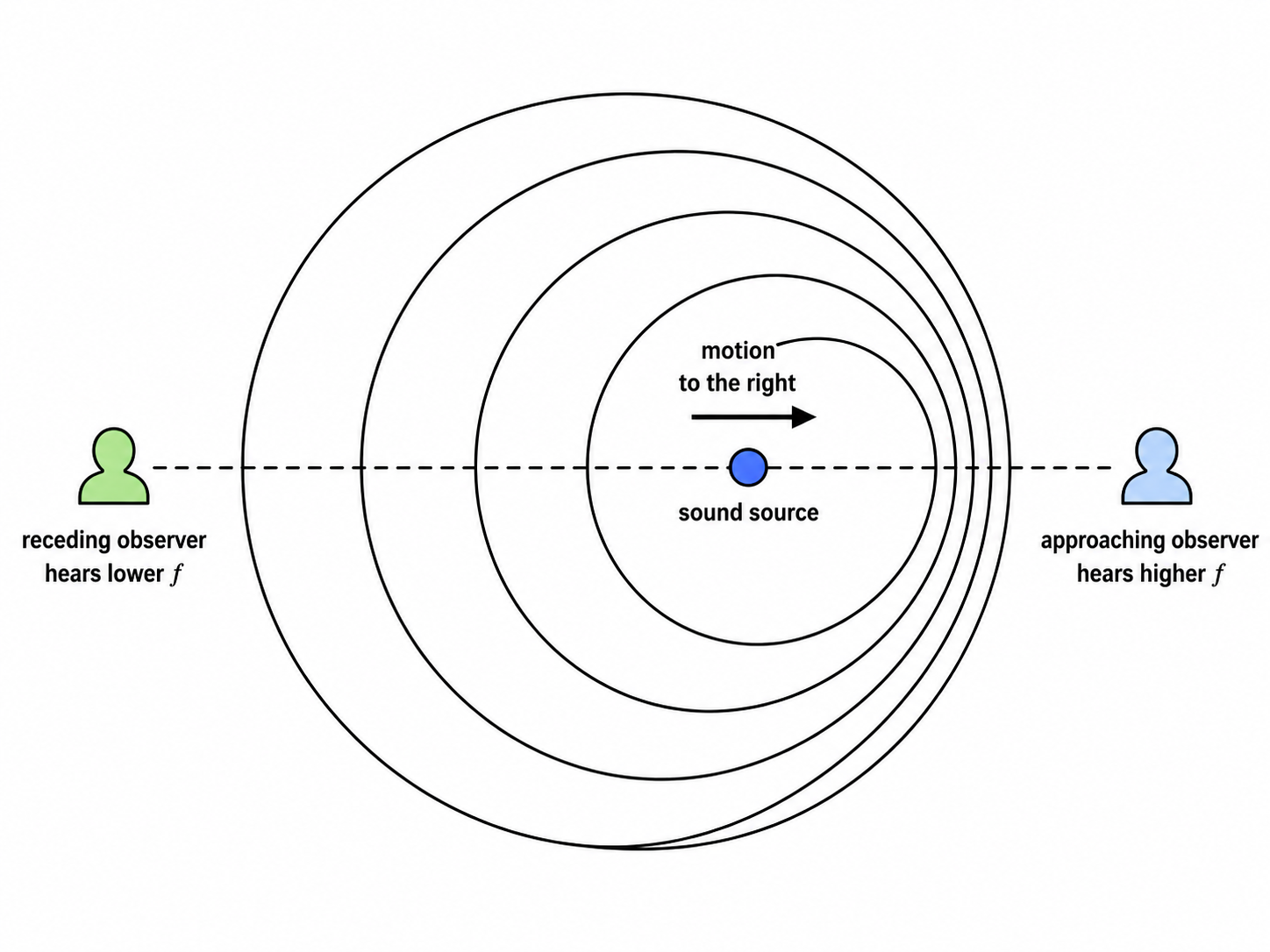
Must knowA source moving toward you emits each wavefront from a closer position, so wavefronts bunch up: shorter wavelength → higher frequency → higher pitch. Moving away spreads them out: lower frequency, lower pitch. The same logic holds if you move: toward a source = intercept wavefronts more often (higher ); away = less often (lower ).
The Doppler Effect: observed frequency differs from emitted frequency whenever source and observer have relative motion along their connecting line.
The Doppler Equation
Must know
where = observed frequency, = source frequency, = speed of sound, = observer speed, = source speed.
Sign convention: any motion that increases (approaching) adds in the numerator / subtracts in the denominator; receding does the reverse. Sanity check: if the source approaches, , so the fraction must exceed 1.
Reflection from a Moving Object
Know the logicSound reflecting off a moving object (a blood cell in Doppler ultrasound) shifts twice: the reflector first receives a shifted frequency (moving observer), then re-emits it (moving source). The net double shift of the echo encodes blood-flow velocity — the basis of Doppler ultrasound.
Worked Example: Doppler Effect
Must knowAn ambulance emitting a 500 Hz siren moves toward a stationary observer at 30 m/s; m/s. Source approaching → denominator ; observer stationary → numerator :
Approaching → higher pitch (548 > 500). ✓ As it recedes, the frequency drops below 500 Hz.
Quick check: If the observer moves toward a stationary source at 17 m/s (with m/s, Hz), what is ?
Answer: .
Pitch and Frequency of Sound Waves
Frequency, Pitch, and the Audible Range
Must knowFrequency is the objective number of cycles per second (Hz); pitch is its subjective perceptual correlate. Treat them as directly related (higher frequency → higher pitch).
The audible range is ~20 Hz to 20,000 Hz. Below 20 Hz is infrasound; above 20 kHz is ultrasound. The high end narrows with age.
Passage-levelHarmonics and timbre: instruments produce a fundamental plus harmonics (); their relative intensities give an instrument its timbre, why a flute and trumpet on the same note sound different.
Beat Frequency
Must knowWhen two waves of slightly different frequencies superimpose, the loudness pulses at the beat frequency:
Used to tune instruments (adjust until beats vanish).
Quick check: Two tuning forks vibrate at 442 Hz and 438 Hz. How many beats per second are heard?
Answer: .
Resonance in Pipes and Strings
Standing Waves: The Core Concept
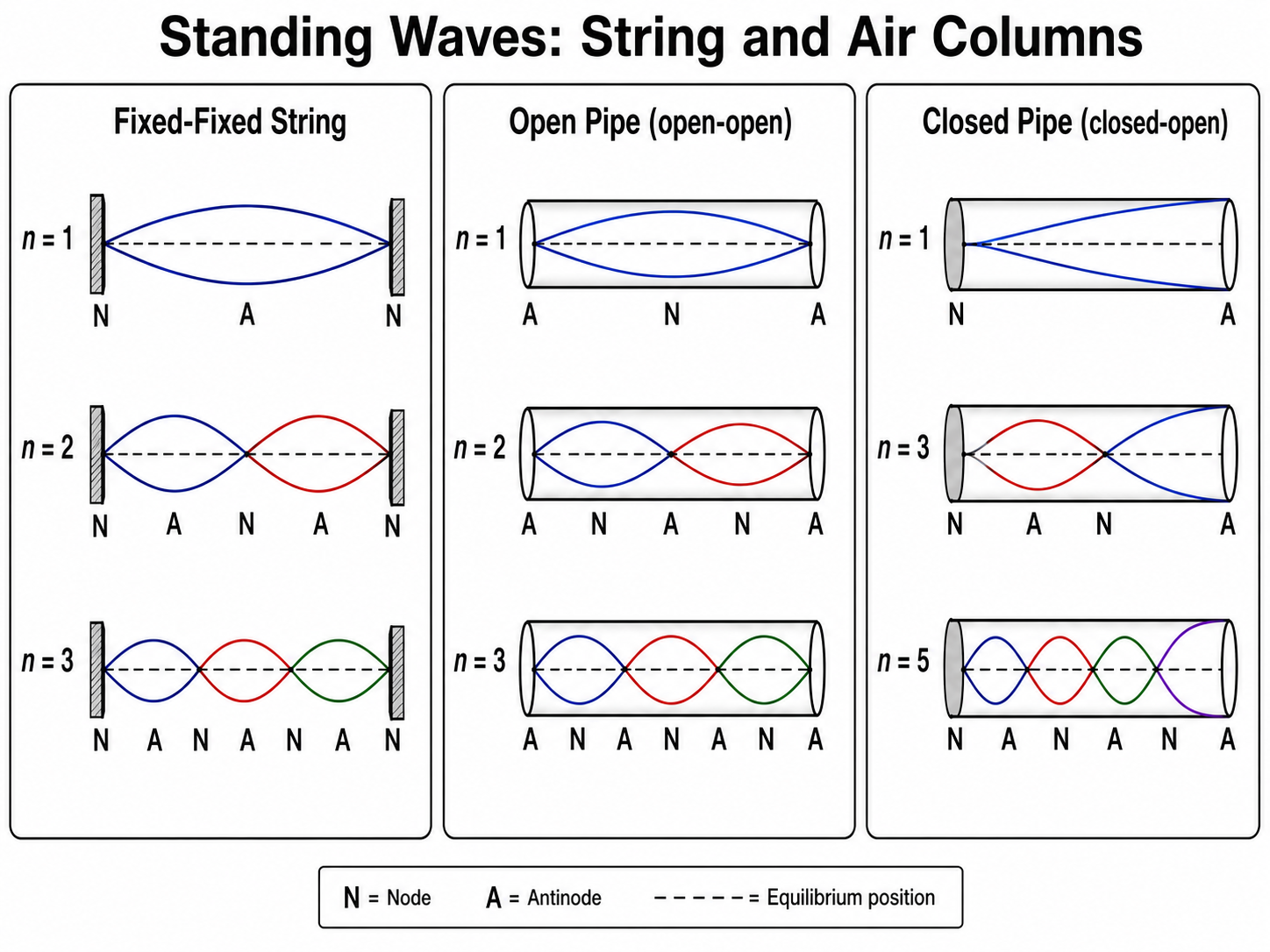
Must knowA wave reflecting in a confined medium interferes with itself. At special resonant frequencies the interference is constructive, forming a standing wave of stationary nodes (zero displacement, max pressure variation) and antinodes (max displacement, zero pressure variation).
Nodes occur where motion is constrained: a fixed string end or a closed pipe end (zero displacement). Antinodes occur at free ends: an open pipe end (air free to move).
Strings and Open Pipes
Must knowA string fixed at both ends (node–node) and an open pipe (antinode–antinode) both fit an integer number of half-wavelengths, giving the same condition:
- : fundamental (first harmonic); : second harmonic; etc.
- All harmonics present.
For a string, the wave speed is ( = tension, = linear mass density). Higher tension → faster wave → higher pitch (why tightening a guitar string raises its note).
Closed Pipes (Closed at One End)
Must knowA closed pipe has a node at the closed end and an antinode at the open end, fitting odd quarter-wavelengths:
Only odd harmonics are present (fundamental, 3rd, 5th, …). The clarinet behaves this way.
Summary Table
Must know| System | Boundaries | Harmonics | Resonant frequencies |
|---|---|---|---|
| String, both ends fixed | Node–Node | All | |
| Open pipe | Antinode–Antinode | All | |
| Closed pipe | Node–Antinode | Odd only |
Worked example: A closed organ pipe is 0.85 m long, m/s.
300 Hz is exactly 3× the fundamental — only odd harmonics exist for a closed pipe. ✓
Quick check: If the pipe above were open at both ends instead, what would its fundamental frequency be?
Answer: — twice the closed-pipe fundamental. Their harmonic series never coincide: open gives 200, 400, 600…; closed gives 100, 300, 500…
Ultrasound
Definition and Production
Must knowUltrasound is sound above ~20 kHz; medical imaging uses 1–20 MHz.
Passage-levelIt is generated by piezoelectric transducers — crystals that deform under voltage and generate voltage when deformed, so one transducer both emits and detects pulses.
Imaging Principle: Pulse-Echo
Must knowThe transducer emits a pulse; at each tissue interface (impedance change) some energy reflects as an echo. Depth comes from round-trip time:
with m/s in soft tissue; the factor of 2 is the round trip.
Key Trade-offs
Must know- Higher frequency → better resolution, but more attenuation (less penetration).
- Lower frequency → worse resolution, but deeper penetration.
- Ultrasound cannot penetrate bone or air (large impedance mismatch → near-total reflection) — why lungs/skull are hard to image and why gel displaces air at the skin.
- Doppler ultrasound measures blood velocity from the echo's frequency shift (cardiac valves, stenosis, fetal monitoring).
Quick check: An ultrasound pulse takes 130 µs to return after emission. With m/s, how deep is the reflecting structure?
Answer: .
Shock Waves
Supersonic Sources and the Mach Number
Must knowDoppler assumes the source moves slower than sound. At or above sound speed, something new happens. The Mach number is:
subsonic, sonic, supersonic.
Know the logicAs , the Doppler denominator → 0 and wavefronts pile up faster than they propagate. At the source outruns its own wavefronts, which stack into a Mach cone trailing the source.
The Sonic Boom
Must knowThe pressure discontinuity along the cone is heard as a sonic boom. The cone half-angle satisfies:
Higher Mach → narrower cone → more concentrated energy.
Passage-levelShock waves are used therapeutically — lithotripsy (ESWL) focuses them on kidney stones to fragment them.
Quick check: An aircraft flies at 680 m/s when the speed of sound is 340 m/s. What is its Mach number and the half-angle of its Mach cone?
Answer: . , so .
Common Confusions & Tricks
1. Nodes vs. antinodes at pipe ends.
Open end = antinode (air free to move, max displacement); closed end = node (wall blocks displacement). Remember "open = free = antinode."
2. Decibels are not intensities — never add them directly.
Two 60 dB sources is NOT 120 dB. Convert to intensity, add intensities ( W/m²), convert back: dB.
3. The Doppler sign trap.
The variable causing a frequency increase gets added (observer toward: ; source away: ). Sanity check: source toward observer → , so the fraction must exceed 1.
4. Closed vs. open pipe fundamental.
Open pipe: . Closed pipe of the same length: — half the open-pipe fundamental, not double. Watch for answer choices differing by a factor of 2.
5. Denser does NOT always mean slower.
Across phases, stiffness changes more than density. Steel is denser than water but much stiffer, so faster. "Solids are stiff, gases are squishy; stiffness wins."
6. Ultrasound resolution vs. penetration.
Surface structures → higher frequency (better resolution); deep structures → lower frequency (more penetration). "Frequency up = resolution up, penetration down."
7. Shock waves only when .
Below sound speed, Doppler applies. At the denominator hits zero and Doppler breaks down. Don't plug into the Doppler formula.
8. Beat frequency is always positive.
. Take the absolute value.
Key Equations
| Equation | Variables and When to Use |
|---|---|
| Wave speed (), frequency (), wavelength (). Universal for any wave. | |
| Speed of sound in air at (°C). Standard: 343 m/s at 20 °C. | |
| Intensity (W/m²) of a point source; gives inverse square law. | |
| Sound level in dB; is the hearing threshold. | |
| Doppler effect; and when approaching. | |
| Beat frequency for two nearby frequencies. | |
| Resonant frequencies for strings (both ends fixed) and open pipes; | |
| Resonant frequencies for closed pipes; odd harmonics only. | |
| Wave speed on a string; = tension, = linear mass density. | |
| Depth of reflector in ultrasound pulse-echo; = round-trip time. | |
| Mach cone half-angle; = Mach number. |