Introduction: Why the Nucleus Matters
The nucleus is a tiny, dense core that governs processes from the sun's energy to medical imaging. The MCAT tests nuclear structure, the forces holding nuclei together, how unstable nuclei decay, and how mass spectrometers measure atomic masses. Build your model inside-out: what is in the nucleus, what holds it together, what happens when it falls apart, and how we measure it.
Priority labels: Must know = cold; Know the logic = mechanism not names; Passage-level = recognize, don't memorize; Optional = skippable.
Atomic Number, Atomic Weight, and Nuclide Notation
The Language of the Nucleus
Must knowEvery nucleus has two defining integers. The atomic number () is the number of protons — it defines the element. The mass number () is the total count of protons plus neutrons (nucleons):
where is the number of neutrons. The standard nuclide notation packages this:
For example, is carbon (, 6 protons) with , so neutrons. The MCAT often writes just since is implicit in the symbol.
Atomic Weight vs. Mass Number
Must knowMass number () is always a whole integer (it counts nucleons). Atomic weight is the weighted average mass of an element's naturally occurring isotopes, in atomic mass units (amu or u) — this is why carbon is 12.011 amu, reflecting the / mixture. Use mass number in nuclear equations; use atomic weight (from the periodic table) in stoichiometry.
One amu is the mass of a atom kg, and amu MeV/ — the conversion needed for binding energy.
Quick check: An atom of has how many protons, neutrons, and electrons (if neutral)?
Answer: protons, neutrons, and 15 electrons (equal to protons in a neutral atom).
Neutrons, Protons, and Isotopes
Inside the Nucleus
Must knowProtons carry charge ( C), mass amu. Neutrons are neutral, slightly heavier at amu. Electrons (mass amu, negligible for nuclear mass) sit outside the nucleus.
Isotopes and the Band of Stability
Must knowIsotopes are atoms of the same element (same ) with different , hence different — e.g., , (deuterium), (tritium).
Know the logicStable nuclei cluster in the band of stability (a plot of vs. ):
- Light nuclei (): stable near (1:1).
- Heavier nuclei: need more neutrons to dilute proton–proton repulsion, up to .
- Above (bismuth): no stable isotopes — all radioactive.
Nuclei above the band (too many neutrons) undergo beta-minus decay; below the band (too many protons) undergo beta-plus decay or electron capture; very heavy nuclei undergo alpha decay.
Quick check: has 6 protons and 8 neutrons (). Is this above, within, or below the band for a light nucleus?
Answer: Above the band (too many neutrons for , which ideally sits near ). This is why undergoes beta-minus decay — the basis of radiocarbon dating.
Nuclear Forces and Binding Energy
The Problem and the Strong Force
Know the logicProtons are packed into a femtometer-scale volume ( m), where Coulomb repulsion is enormous. The strong nuclear force holds the nucleus together. It acts between all nucleons, is attractive at 1–3 fm, extremely short-range (falls off beyond 3 fm), and is much stronger than electromagnetism at short range. Neutrons add strong-force attraction without adding charge repulsion — why heavier stable nuclei need extra neutrons.
Mass Defect and Binding Energy
Must knowA bound nucleus is less massive than the sum of its free nucleons. This missing mass is the mass defect ():
The missing mass was converted to binding energy () via mass–energy equivalence:
Using :
Binding energy is the energy needed to disassemble a nucleus into free nucleons. Higher binding energy = more stable.
Binding Energy per Nucleon
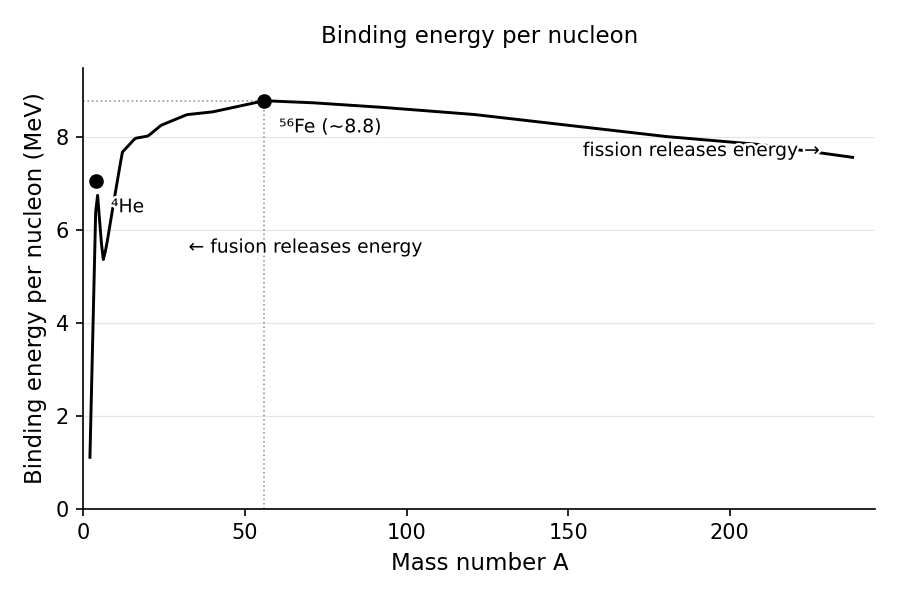
Know the logicTo compare nuclei, use binding energy per nucleon (). The vs. curve:
- Peaks near iron () (~8.8 MeV/nucleon) — the most stable nucleus.
- Fusion (combining light nuclei) releases energy — powers stars.
- Fission (splitting heavy nuclei) releases energy — powers reactors.
The MCAT won't ask for fusion/fission calculations, but expects you to know which direction toward the peak releases energy and why.
Worked Example: Binding Energy of
Must knowHelium-4 (2 protons, 2 neutrons) has measured atomic mass 4.002602 amu. Using atomic masses (the hydrogen-atom mass cancels electron masses on both sides):
This sits below iron's 8.8 MeV/nucleon, consistent with helium-4's position on the left of the curve.
Radioactive Decay
Why Nuclei Decay
Must knowRadioactive decay is a spontaneous nuclear process in which an unstable nucleus emits radiation to reach a more stable state. It is driven by the quest for stability — independent of temperature, pressure, or chemical environment. This distinguishes nuclear from chemical reactions.
Conservation Laws
Must knowEvery decay conserves mass number (), atomic number/charge (), energy (including mass-energy), and momentum. Conserving and is your main tool for balancing nuclear equations.
Alpha, Beta, and Gamma Decay
Alpha (α) Decay
Must knowAn alpha particle is a nucleus, emitted from heavy nuclides () to move toward the band of stability:
Example: (: ; : ).
Alpha: charge , lowest penetrating power (stopped by paper/few cm air), highest ionizing power.
Beta-Minus (β⁻) Decay
Must knowA neutron converts to a proton, emitting an electron () and an antineutrino (). increases by 1, unchanged. Occurs above the band (too many neutrons).
Example: (radiocarbon dating).
Beta-Plus (β⁺) Decay and Electron Capture
Must knowA proton converts to a neutron, emitting a positron () and a neutrino (). decreases by 1, unchanged. Occurs below the band (too many protons).
Passage-level
Electron capture is a competing proton-rich process: the nucleus captures an inner-shell electron, converting a proton to a neutron ( down 1, unchanged):
Must know
Beta particles: charge , moderate penetrating and ionizing power (stopped by a few mm aluminum).
Gamma (γ) Decay
Must knowGamma decay emits a high-energy photon (); it does not change or — the nucleus drops from an excited state () to a lower one. It usually accompanies other decays.
Gamma: no charge, highest penetrating power (needs cm of lead), lowest ionizing power per path length. Used clinically in PET scans and radiotherapy.
Comparison Table
Must know| Property | Alpha (α) | Beta-Minus (β⁻) | Beta-Plus (β⁺) | Gamma (γ) |
|---|---|---|---|---|
| Identity | nucleus | electron | positron | photon |
| Change in | 0 | 0 | 0 | |
| Change in | 0 | |||
| Charge | 0 | |||
| Penetrating power | Lowest | Moderate | Moderate | Highest |
| Ionizing power | Highest | Moderate | Moderate | Lowest |
Quick check: After two alpha decays and one beta-minus decay starting from , what is the resulting nuclide?
Answer: Two alphas: , . One beta-minus: , unchanged. Final: .
Half-Life, Exponential Decay, and Semi-Log Plots
The Intuition Behind Half-Life
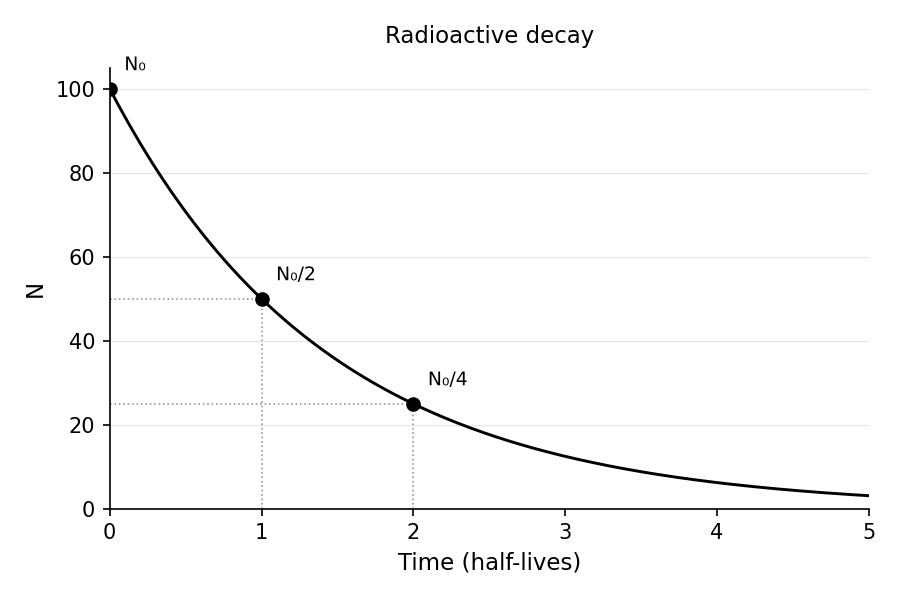
Must knowDecay is random and probabilistic: you can't predict a single nucleus, but in each half-life () exactly half the remaining nuclei decay. This gives exponential decay — the key pattern for nuclear MCAT problems.
The Exponential Decay Equation
Must know
where = nuclei remaining, = initial nuclei, = half-life, = decay constant (reciprocal time). The two are linked by:
Activity (, in Becquerels = decays/s) is the decay rate, , and halves every just like .
Worked Example: Half-Life
Must know( days) starts at activity 800 Bq. After 24 days: half-lives, so Bq (400 → 200 → 100 confirms).
Semi-Log Plots
Know the logicvs. is a curving exponential, but vs. (a semi-log plot) is linear:
This is with slope and y-intercept . A straight semi-log line confirms first-order exponential decay; a curved one means it isn't. The MCAT may ask you to extract or from the slope.
Quick check: On a semi-log plot of activity vs. time, the slope is . What is the half-life?
Answer: , so .
Radiocarbon Dating (Applied Context)
Passage-levelstays at a roughly constant ratio to in living organisms; at death, intake stops and decays unreplenished. Measuring the ratio with years gives time since death — a classic exponential-decay application.
The Mass Spectrometer
How It Works: Four Stages
Know the logicA mass spectrometer separates ions by mass-to-charge ratio () using electric and magnetic fields:
- Ionization — the sample is vaporized and ionized (e.g., electrons knock electrons off molecules to make positive molecular ions, ).
- Acceleration — ions accelerate through a potential difference : . Lighter ions go faster.
- Deflection — a perpendicular magnetic field bends the ions, the magnetic force supplying centripetal force:
Heavier ions (larger ) curve less (larger radius); lighter ions curve more.
- Detection — ion landing position (radius) gives ; intensity vs. is the mass spectrum.
The Key Equation
Know the logic
The conceptual takeaway matters most: larger → larger radius → hits detector farther along.
Quick check: Two ions have identical charges; ion A has twice the mass of ion B. Which has the larger radius of curvature?
Answer: Ion A, because . With equal and , larger → larger (curves less).
Mass Spectroscopy: Reading the Spectrum
The Mass Spectrum
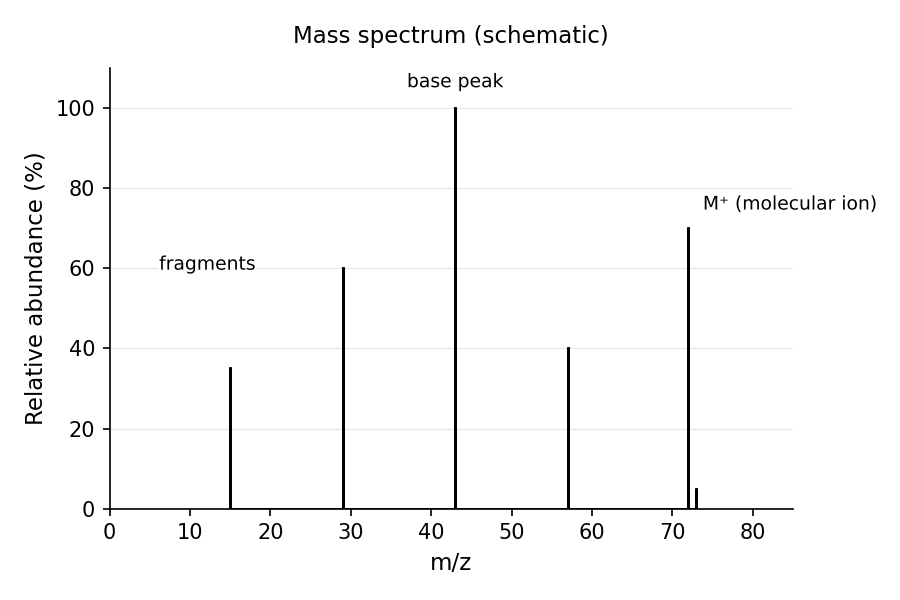
Know the logicThe output is a plot of relative abundance (y) vs. (x). Key features:
- Molecular ion peak (): rightmost major peak; its gives the molecular weight.
- Base peak: tallest peak (100% abundance), the most stable fragment.
- Fragmentation peaks: lower- pieces; give structural information.
- Isotope peaks: small , peaks from heavy isotopes (, ).
Isotope Identification
Passage-levelEach isotope appears as its own peak at its mass number. Chlorine (/, ~3:1) and bromine (/, ~1:1) give diagnostic doublets — handy when scanning a spectrum.
Calculating Atomic Weight from a Mass Spectrum
Must knowAtomic weight is the weighted average of isotope masses:
Example: Boron is (19.9%, 10.013 amu) and (80.1%, 11.009 amu): amu, closer to 11 as expected.
Quick check: A spectrum shows peaks at (69%) and (31%). Identify the element and its atomic weight.
Answer: and — copper. amu, matching the periodic table (~63.55).
Common Confusions & Tricks
1. Mass number vs. atomic weight. is a whole number (nucleon count); atomic weight is a decimal (isotope average). Use mass numbers in nuclear equations, atomic weights in stoichiometry.
2. Beta-minus emits an electron from the nucleus, not a shell. A neutron → proton + electron + antineutrino; the electron is created in the process, not pre-existing.
3. increases in β⁻, decreases in β⁺. β⁻: too many neutrons → raise . β⁺: too many protons → lower . Tie it to moving toward the band.
4. Gamma decay changes neither nor . It just releases excess nuclear energy; the element does not change.
5. Penetrating power is INVERSE to ionizing power. Alpha: most ionizing, least penetrating. Gamma: least ionizing per path, most penetrating.
6. Binding energy is released when the nucleus forms, not when it decays. Breaking the nucleus requires adding that energy; higher /nucleon = more stable.
7. On a semi-log plot, slope , not . Get .
8. Heavier ions curve LESS (larger radius) — counterintuitive, but from .
9. A doublet separated by 2 mass units → think Cl or Br. / (3:1), / (1:1).
10. Nuclear reactions are NOT affected by chemical state or temperature. Decay rate is independent of bonding, ionization, or heat.
Key Equations
| Equation | Variables & When to Use |
|---|---|
| = mass number, = protons, = neutrons. Fundamental for any nuclide. | |
| = mass defect; with gives binding energy in MeV. | |
| Mass defect. Use hydrogen-atom mass (1.007825 amu) to cancel electron masses. | |
| Exponential decay law. Also applies to activity . | |
| Half-life form. Easiest when is a whole multiple of . | |
| Connects decay constant and half-life. | |
| Semi-log (linearized) form; slope of vs. equals . | |
| Mass spec deflection. Larger → larger . | |
| Derived mass spec relation; = accelerating voltage. | |
| = fractional abundance, = isotope mass. From mass-spectrum data. |