Electronic structure explains why elements behave as they do — why bonds form, why ionization energies trend the way they do, and why atoms emit light at specific wavelengths. This guide builds from the Bohr model up through the quantum description the MCAT tests.
Priority labels: Must know = cold; Know the logic = mechanism not names; Passage-level = recognize, don't memorize; Optional = skippable.
The Bohr Model of the Atom
Must knowBohr's key insight: electrons occupy discrete, quantized energy levels indexed by the principal quantum number They cannot exist between levels. He pictured electrons in circular orbits with quantized angular momentum ().
The energy of an electron in hydrogen at level is:
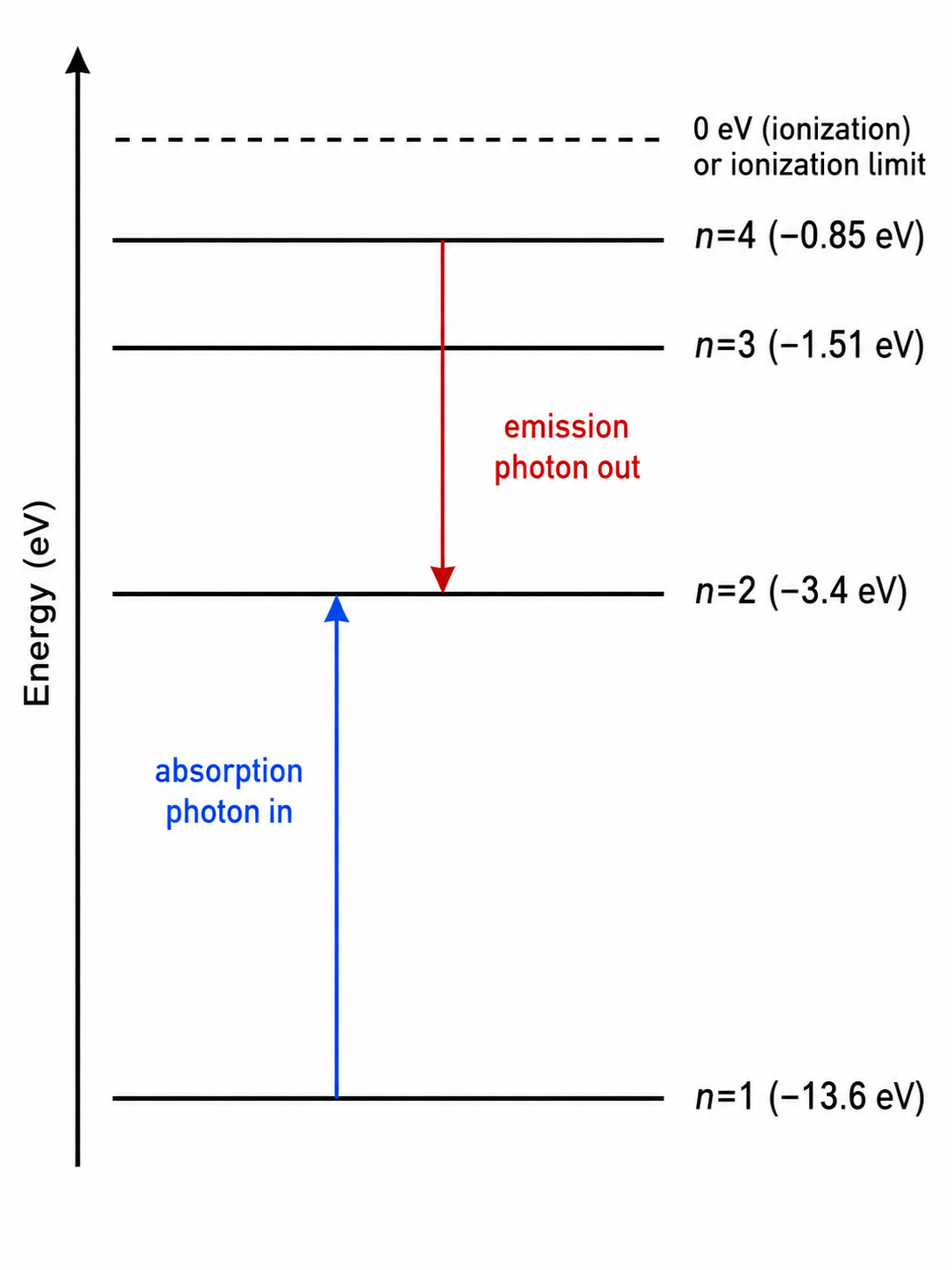
The negative sign means the electron is bound (zero energy = a free electron infinitely far away). As increases, rises toward zero — less tightly bound. The ground state () sits at eV, so eV is hydrogen's ionization energy. Orbit radius grows as ( nm).
Know the logicDe Broglie proposed every particle has a wavelength . A stable orbit fits a whole number of these wavelengths around its circumference (), which reproduces Bohr's angular-momentum rule. This wave nature of matter (confirmed by electron diffraction) bridges Bohr to full quantum mechanics. Detailed de Broglie wavelength calculations are out of scope — the qualitative duality is enough.
What it gets right/wrong: Bohr nails hydrogen's spectrum and introduces quantized energy. It fails for multi-electron atoms and contradicts the uncertainty principle (no real circular paths). Treat it as a scaffold, not a literal picture.
Quick check:
An electron in hydrogen absorbs a photon and jumps from to . How much energy did the photon carry?
The photon carried eV (positive confirms absorption). ✓
Ground State and Excited States
Must knowIn its ground state, an atom has all electrons in the lowest available levels — the most stable arrangement. Absorbing energy (photon, heat, collision) promotes an electron to a higher level, giving an excited state. Excited states are unstable: within nanoseconds the electron falls back down, emitting the energy as a photon. This is the basis of emission spectra.
The emitted or absorbed photon's energy exactly equals the gap between levels:
Quick check:
If a photon causes a transition between and in hydrogen, is this absorption or emission?
eV eV, so requires gaining energy — absorption. The reverse () releases energy — emission.
Absorption and Emission Line Spectra
Must knowLine spectra are key evidence for quantized levels: atoms absorb or emit light only at specific, discrete wavelengths, not a continuous rainbow.
- Emission spectrum: excited electrons fall and emit photons → bright colored lines on a dark background. Each element has a unique fingerprint (how we identify elements in stars).
- Absorption spectrum: white light through a cool gas → continuous spectrum with dark lines at exactly the same wavelengths the element would emit. The two are complementary.
Transitions are grouped by their final (lower) level: Lyman (, UV), Balmer (, visible), Paschen (, IR). The MCAT usually means Balmer (visible). The qualitative takeaway is all you need: larger energy gap → shorter wavelength (higher frequency, higher-energy photon). The transition is the smallest Balmer gap, so it gives the longest-wavelength (red, 656 nm) visible line.
OptionalThe Rydberg formula gives exact wavelengths, but quantitative Rydberg computation is out of scope.
The Photoelectric Effect
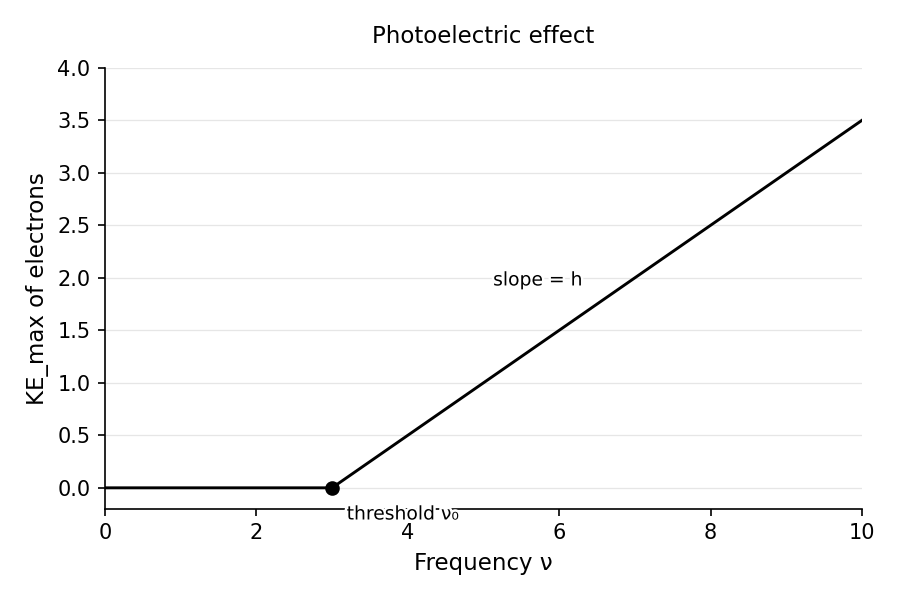
Must knowLight on a metal ejects electrons — but only if the light's frequency exceeds a threshold, regardless of intensity. This is evidence that light comes in discrete photons (). An electron absorbs one photon at a time; if its energy exceeds the metal's work function , the electron is ejected with the excess as kinetic energy:
Consequences (classic MCAT traps):
- Below threshold frequency: no electrons ejected, no matter how bright.
- Above threshold: more intensity → more electrons, but not more KE per electron.
- Higher frequency above threshold → higher (linear).
- Stopping potential halts ejected electrons: .
Quick check:
Two frequencies, both above threshold, on the same metal, with . How do the ejected electrons' kinetic energies compare?
. Higher frequency → higher .
The Heisenberg Uncertainty Principle
Must knowYou cannot simultaneously know both the exact position and momentum of a particle:
(There is an analogous energy–time form, .) This is fundamental, not a measurement flaw: pin down position precisely and momentum becomes wildly uncertain, and vice versa. Conceptual upshot: an electron confined near the nucleus would need enormous momentum/KE, so it cannot simply sit on the nucleus. Quantum mechanics replaces definite orbits with probability distributions (orbitals).
Quick check:
If you measure an electron's position to within nm, what can you say about its momentum?
. Since is tiny, must be very large — its momentum is highly uncertain.
Orbital Structure and Quantum Numbers
Must knowFour quantum numbers specify an electron's "address."
| Quantum number | Values | Describes |
|---|---|---|
| Principal, | Energy level / shell, orbital size (max electrons) | |
| Azimuthal, | to | Subshell / shape: 0 = s (spherical), 1 = p (dumbbell), 2 = d, 3 = f |
| Magnetic, | to ( values) | Orbital orientation; gives # orbitals per subshell |
| Spin, | or | Intrinsic spin |
Each orbital holds 2 electrons (opposite spins). Counting up: s = 1 orbital/2 e⁻, p = 3/6, d = 5/10, f = 7/14. For shell : orbitals, electrons.
Quick check:
How many orbitals and electrons can the shell hold?
Orbitals: (one 3s, three 3p, five 3d). Electrons: . ✓
The Pauli Exclusion Principle
Must knowNo two electrons in an atom can share all four quantum numbers. Practically: each orbital holds at most two electrons, and they must have opposite spins. This is why atoms have structure instead of all electrons collapsing into the lowest state.
Quick check:
Two electrons in the same 2p orbital — can both have ?
No. They already share , , and . Identical spin would make all four quantum numbers identical — a Pauli violation. They must have opposite spins.
Conventional Notation for Electronic Structure
Must knowWrite each subshell as (principal number)(subshell letter). Example — sodium (): .
Aufbau principle: fill lowest-energy orbitals first, following the (diagonal) rule:
Note fills before (lower energy in a neutral multi-electron atom).
Hund's rule: in degenerate orbitals (e.g., the three 2p), electrons singly occupy separate orbitals with parallel spins before pairing. Carbon (): the two 2p electrons go in separate orbitals, both spin-up.
Noble-gas shorthand: abbreviate core electrons, e.g. Na: ; Fe: .
Cr and Cu exceptions. Cr () is (not ) and Cu () is (not ): a half-filled () or filled () d subshell is extra stable. These are the only exceptions the MCAT expects.
Quick check:
Write the electron configuration of .
Neutral Fe (): . Cations lose the electrons first: .
Paramagnetism and Diamagnetism
Must knowMagnetic behavior depends on unpaired electrons.
- Paramagnetic: one or more unpaired electrons → net magnetic moment → attracted into a magnetic field (more unpaired = stronger).
- Diamagnetic: all electrons paired → moments cancel → weakly repelled.
To classify, write the configuration and count unpaired electrons: any unpaired → paramagnetic; all paired → diamagnetic.
Examples: has 2 unpaired electrons (a famous MO-theory result) → paramagnetic; Ne () → diamagnetic; (, five unpaired) → strongly paramagnetic.
Quick check:
Is paramagnetic or diamagnetic?
Neutral Cu: . Losing the : — all paired → diamagnetic.
Effective Nuclear Charge
Must knowInner-shell electrons shield an outer electron from the full nuclear charge, so it feels a reduced effective nuclear charge:
where is the shielding constant. Know the logic core electrons shield well, same-shell electrons shield poorly, outer electrons don't shield inner ones at all. (Slater's rules are not required.)
Periodic trends from :
- Across a period (→): rises but same-shell electrons screen poorly, so increases → smaller atomic radius, higher ionization energy, higher electronegativity, higher electron affinity.
- Down a group (↓): electrons enter higher shells (farther out) and inner electrons shield well, so barely changes → larger radius, lower ionization energy, lower electronegativity.
Understanding lets you derive periodic trends instead of memorizing them.
Quick check:
Compare for a 2p electron in neon () vs. oxygen (). Which is larger, and what does it predict about radius?
Ne has the larger (larger , similar same-shell shielding), pulling electrons in → Ne has the smaller atomic radius (consistent with the across-a-period trend).
Common Confusions & Tricks
1. Bohr vs. quantum model. Use Bohr ( eV) for hydrogen energy/wavelength math; use the quantum model for orbital shapes, quantum numbers, and configurations.
2. "4s fills before 3d, but empties before 3d." Build with 4s before 3d (Aufbau); when ionizing a transition metal, remove 4s first. So Fe is but is — not .
3. Emission vs. absorption. Emission: electron falls, photon released, bright lines. Absorption: electron promoted, photon consumed, dark lines on a continuous background. Both obey .
4. Photoelectric: intensity vs. frequency. Intensity sets the number of ejected electrons; frequency (above threshold) sets each electron's kinetic energy. Below threshold, intensity ejects zero electrons.
5. Hund's rule ↔ paramagnetism. Apply Hund's rule correctly and the unpaired-electron count is automatic. Any partially filled subshell → paramagnetic.
6. Heisenberg — position AND momentum. It's a complementarity between the two, not just "you can't know where an electron is." Use .
7. Cr and Cu. The only MCAT exceptions — both steal one 4s electron to half-fill (Cr) or fill (Cu) the 3d subshell. Other transition metals use standard Aufbau.
8. Visible hydrogen emission → Balmer. Visible → Balmer (); UV → Lyman (); IR → Paschen ().
9. Diamagnetic ≠ non-magnetic. Diamagnetic substances are weakly repelled. Functionally it means "all electrons paired" — count unpaired electrons.
10. explains all periodic trends. As rises, electrons are pulled in harder → smaller radius, higher IE, higher EN.
Key Equations
| Equation | Variables & Notes |
|---|---|
| Bohr energy for hydrogen; = principal quantum number; ground state | |
| Bohr quantization of angular momentum | |
| de Broglie wavelength (matter wave) | |
| Bohr orbit radius; nm | |
| $E_\text{photon} = h\nu = \dfrac{hc}{\lambda} = | E_\text{upper} - E_\text{lower} |
| Rydberg formula (Optional); m | |
| Photoelectric effect; = work function; also (stopping potential) | |
| Heisenberg (position–momentum); . Energy–time form: | |
| Effective nuclear charge; = shielding constant | |
| Max electrons in shell | From quantum-number counting |