Overview: One Concept Rules Them All
Must knowThe single most powerful mental model for this topic is effective nuclear charge (). Every periodic trend — atomic size, ionization energy, electron affinity, electronegativity — flows from one competition: the pull of the nucleus versus the shielding provided by inner electrons.
Priority labels: Must know = cold; Know the logic = mechanism not names; Passage-level = recognize, don't memorize; Optional = skippable.
Effective nuclear charge is the net positive charge a valence electron actually "feels" after accounting for shielding by other electrons:
where is the nuclear charge (atomic number) and is the shielding constant. You don't calculate this on the MCAT, but you need the concept: across a period, rises one proton at a time while the added electrons go into the same shell and shield each other only weakly → increases. Down a group, new inner shells are added and shield very effectively → stays roughly constant. Keep this framework in mind and every trend below feels inevitable rather than memorized.
Valence Electrons
What They Are and Why They Matter
Must knowValence electrons are the electrons in the outermost principal energy level (highest ) of a neutral atom. They participate in bonding and determine an element's chemical behavior. Inner core electrons shield valence electrons but do not bond.
For main-group elements, the number of valence electrons equals the group number (1–18 convention: Groups 1, 2, 13–18). For example, Na (Group 1) is → 1 valence electron; C (Group 14) is → 4; F (Group 17) is → 7.
For transition metals (Groups 3–12), valence electrons include both the outermost and partially filled electrons — which is why they show multiple oxidation states.
The octet rule is grounded here: main-group elements "want" 8 valence electrons (filled and ), matching the nearest noble gas for maximum stability.
Quick check: How many valence electrons does phosphorus (P, Group 15) have, and what is its noble-gas core?
Answer: P has 5 valence electrons (). Its noble-gas core is .
Ionization Energy
Definition and Physical Meaning
Must knowIonization energy (IE) is the minimum energy to remove an electron from a gaseous, ground-state atom or ion. The first ionization energy ():
This is always endothermic — you put energy in to overcome the electron–nucleus attraction. The second ionization energy removes a second electron from the +1 cation, and is always larger () because you're pulling an electron from an increasingly positive ion.
Predicting Trends from Electronic Structure
Must know- Across a period: rises, radius shrinks → IE increases.
- Down a group: added shells increase distance and shielding → IE decreases.
Anchor: noble gases (full octets) have the highest ; alkali metals (single loose valence electron) the lowest.
The Critical Exceptions (MCAT Traps)
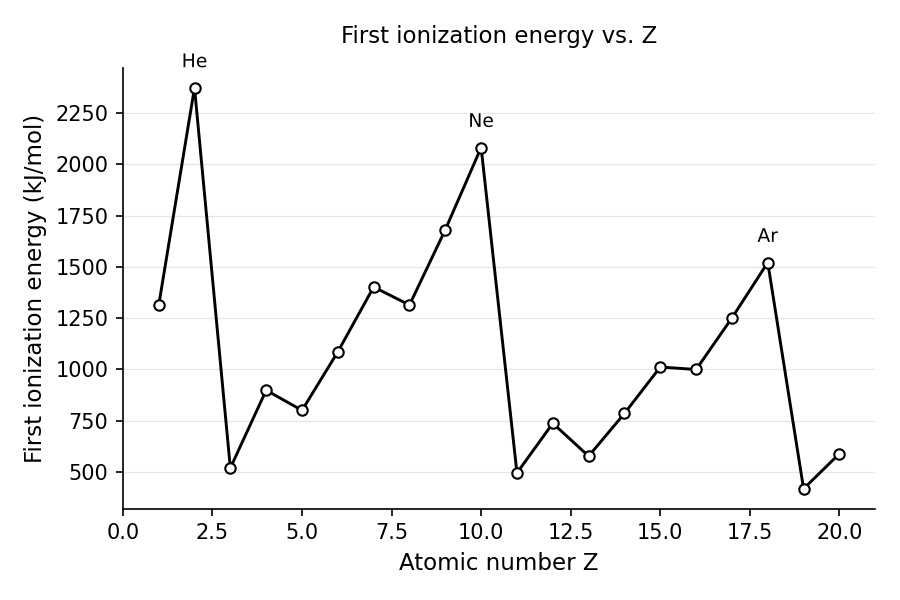
Know the logicThe across-a-period trend has two well-tested dips:
- Group 2 → 13 (Be → B, Mg → Al): the Group 13 element has a lower because its outermost electron is a electron — higher in energy and shielded by the filled subshell — so it's easier to remove.
- Group 15 → 16 (N → O, P → S): the Group 16 element has a lower . The Group 15 half-filled subshell is extra-stable (Hund's rule); the Group 16 element's fourth electron must pair up, adding repulsion that makes it easier to remove.
Period 2 pattern: . Plotting against atomic number gives a characteristic sawtooth.
The Dramatic Jump in Successive IEs
Must knowAs you remove successive electrons, IE climbs steadily — until you hit a core electron, where there's an enormous jump. The number of electrons removed before that jump = the number of valence electrons.
For example, Na () has kJ/mol (the lone electron) but kJ/mol (first core electron — nearly 10× harder). That jump tells you Na has 1 valence electron, which is why Na forms but essentially never .
Quick check: An unknown element has successive ionization energies (kJ/mol): IE₁ = 738, IE₂ = 1451, IE₃ = 7733. How many valence electrons, and what group?
Answer: The huge jump between IE₂ and IE₃ means the third electron is a core electron → 2 valence electrons → Group 2 (Mg fits).
Electron Affinity
Definition and Sign Convention
Must knowElectron affinity (EA) is the energy change when a gaseous, neutral atom gains an electron:
EA is reported as a positive number when the process is exothermic (energy released). Most nonmetals have positive EA; more positive = greater tendency to gain electrons. Halogens have the highest EAs (they "want" one electron to complete the octet); noble gases have near-zero or negative EA.
Variation with Group and Row
Must know- Across a period: EA generally becomes more positive (rising ) — same direction as IE, but a noisier trend.
- Down a group: EA generally decreases (added electron is farther out and shielded).
The Fluorine Anomaly (Classic MCAT Trap)
Know the logicYou'd expect F to have the highest EA, but Cl's EA is actually higher than F's. Fluorine's orbitals are so small that adding an electron causes significant electron–electron repulsion in the cramped shell; chlorine's larger orbitals accommodate it with less repulsion. The same half-filled- stability that lowers nitrogen's IE also gives N a lower EA than both C and O — adding an electron to N forces pairing.
Quick check: Would you expect or to have a higher first ionization energy? How does that compare to which has higher EA?
Answer: has the higher IE₁ (smaller, valence electron closer to nucleus), but has the higher EA. IE measures removing an electron from a neutral atom; EA measures adding one — and F's cramped orbitals penalize addition more than removal. A known exam trap.
Electronegativity
The Concept
Must knowElectronegativity () is the ability of an atom in a bond to attract electron density toward itself — a bonding concept, unlike EA (an isolated-atom property). On the Pauling scale, fluorine is the most electronegative element. You don't memorize Pauling numbers; you need the relative ordering:
The most electronegative atoms cluster in the upper right; metals at the lower left are least electronegative.
Trends
Must knowElectronegativity increases across a period (higher ) and decreases down a group (electrons farther out, more shielded).
Why Electronegativity Matters on the MCAT
Must know- Bond polarity: the difference between bonded atoms sets bond character — small → nonpolar covalent, intermediate → polar covalent, large () → ionic character (rough guidelines).
- Acid strength: in oxyacids, more electronegative atoms pull electron density off the O–H bond, releasing the proton more easily → stronger acid (e.g., ).
- Biomolecular context: high of O and N drives hydrogen bonding in water, DNA base pairing, and protein structure — directly relevant to biology passages.
Quick check: The bond is more polar than the bond. True or false? Explain.
Answer: True. F is more electronegative than Cl, so with carbon is larger for → greater bond dipole and ionic character → more polar.
Electron Shells and the Sizes of Atoms
Atomic Radius: Two Competing Forces
Must knowAtomic radius (often the covalent radius) reflects a tug-of-war: more shells push the cloud outward; higher pulls it inward.
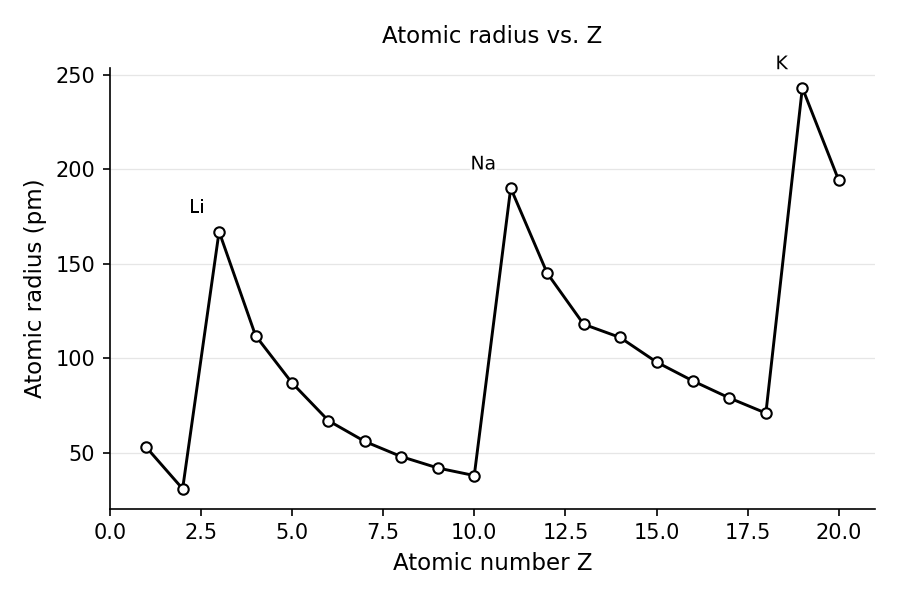
- Across a period: shell count is constant but rises → radius decreases.
- Down a group: each period adds a shell → radius increases (the shell effect dominates).
So the largest atoms sit at the lower-left (Cs, Fr) and the smallest at the upper-right (He, F). Plotted against atomic number, radius is the inverse of the IE plot.
The lanthanide contraction — filling diffuse / orbitals shields poorly, so 6th-period atoms are surprisingly similar in size to their 5th-period counterparts. Rarely a direct MCAT question; occasionally a passage hook.
Worked Example: Ranking Atomic Radii
Must knowProblem: Rank smallest to largest: , , , .
Same group: and (lower period = larger). Same period (3): (far left = larger). Combining: F < Cl < Na < K.
Quick check: As you move from to to to across Period 3, what happens to atomic radius?
Answer: Radius decreases steadily (Al > Si > P > S). Same shell count, but rises with each proton, contracting the cloud.
Electron Shells and the Sizes of Ions
Cations Are Smaller Than Their Parent Atoms
Must knowLosing electrons to form a cation reduces electron–electron repulsion and may remove an entire outer shell, so the remaining electrons are pulled in tightly by the unchanged nuclear charge → cations are smaller than their parent atoms. Example: (≈186 pm) → (≈102 pm), losing the whole shell.
Anions Are Larger Than Their Parent Atoms
Must knowGaining electrons to form an anion keeps nuclear charge fixed but adds electron–electron repulsion, expanding the cloud → anions are larger than their parent atoms. Example: (≈100 pm) → (≈181 pm).
Isoelectronic Series: The MCAT Favorite
Must knowAn isoelectronic series is a set of species with the same electron count but different . Within it, more protons → smaller radius. The classic 10-electron (Ne configuration) series, largest to smallest:
All ten electrons feel the same mutual repulsion, but more protons pull harder.
Quick check: Which is larger, or ? Both are isoelectronic (10 electrons each).
Answer: is larger. With the same electron count, F's extra proton ( vs ) pulls the cloud inward more tightly.
Common Confusions & Tricks
1. Electron affinity sign conventions. EA is reported as positive when energy is released (exothermic — the atom "wants" the electron). "EA = −50 kJ/mol" means the process is endothermic — the atom resists gaining an electron (noble gases, nitrogen).
2. F has the highest electronegativity but NOT the highest EA. Cl has the higher EA. Electronegativity is a bonding property; EA is an isolated-atom property — related but distinct.
3. N vs. O in IE and EA. Both show a dip at N for the same reason — N's half-filled is extra-stable (Hund's rule). So N's IE₁ > O's IE₁, and N's EA < O's EA. An anomalous dip at Group 15 → think "half-filled ."
4. Be vs. B. Be () has a higher IE₁ than B () because B loses a shielded electron. Don't let B's higher atomic number fool you.
5. Cation size vs. anion size direction. The most-reversed fact on the MCAT: cations are smaller, anions are larger than the neutral atom. Anchor with vs (loses a shell) and vs (more repulsion).
6. Isoelectronic series: more protons = smaller. Electron count is fixed within a series — only varies. More protons = more pull = smaller.
7. Atomic radius is opposite to IE and electronegativity. Across a period, radius decreases while IE and increase; down a group, radius increases while IE and decrease.
8. Huge jump in successive IEs → count before the jump. That count = number of valence electrons. Reliable for element-ID problems.
9. Transition metals lose before . Fe forms (loses ) or (loses + one ) — even though fills before .
Key Equations
| Equation / Relationship | Variables & When to Use |
|---|---|
| = atomic number, = shielding constant; conceptual foundation for all periodic trends | |
| First ionization energy; always endothermic (); predicts cation formation | |
| Second IE; always ; jump in successive IEs identifies valence-electron count | |
| Electron affinity; EA positive when exothermic; predicts anion-formation tendency | |
| Electronegativity order: | Relative ; use for bond polarity () and oxyacid acid strength |
| Isoelectronic size: more → smaller (same count) | Within a series, larger → smaller ionic radius |
| Atomic radius: increases down and left | Largest at lower-left (Cs), smallest at upper-right (F/He); ranks neutral-atom radii |
| Ionic size: ; | Cations shrink (lose electrons/shells); anions expand (gain electrons, same charge) |