Acid-base chemistry bridges general chemistry and biochemistry on the MCAT: oxygen delivery, enzyme catalysis, kidney function, and protein folding all depend on proton control. Recognize its fingerprints everywhere.
Priority labels: Must know = cold; Know the logic = mechanism not names; Passage-level = recognize, don't memorize; Optional = skippable.
Brønsted-Lowry Acids and Bases
Must knowThe MCAT uses the Brønsted-Lowry definition almost exclusively: an acid is a proton donor ( donor), a base is a proton acceptor. This is broader than the older Arrhenius model — water itself can act as either, depending on its reaction partner. Every acid-base reaction is a competition for a proton between two bases; the stronger base "wins."
Passage-levelThe Lewis definition: a Lewis acid is an electron-pair acceptor, a Lewis base an electron-pair donor. Every Brønsted base is a Lewis base, but the Lewis picture also covers reactions with no proton transfer (e.g., a metal cation accepting ligand lone pairs). Reach for it only when there is no proton to track.
Conjugate Acid-Base Pairs
Must knowWhen an acid donates a proton, what remains is its conjugate base; when a base accepts one, the result is its conjugate acid. The pair differs by exactly one .
A strong acid has a weak conjugate base, and a weak acid has a stronger conjugate base. This governs whether a salt makes a solution acidic or basic.
Quick check: In the reaction , identify the two conjugate pairs.
Answer: Pair 1: (base) / (conjugate acid). Pair 2: (acid) / (conjugate base).
A species that can act as either donor or acceptor — , , — is amphoteric (amphiprotic). These are the intermediate species between equivalence points in polyprotic titrations.
The Autoionization of Water and
Must knowWater molecules donate and accept protons from each other:
The equilibrium expression is the ion-product constant of water:
So pure water has equal M. rises with temperature (autoionization is endothermic), but for the MCAT assume .
The Complementary Relationship Between and
Must knowBecause is constant, knowing one ion gives the other:
Acidic: ; basic: ; neutral: equal. The product is always .
Quick check: If M, what is ?
Answer: M. The solution is acidic.
pH, pOH, and the p-Notation System
Must knowThe pH scale is a logarithmic compression of :
Taking the negative log of :
Pure water: (neutral). Acidic < 7; basic > 7. The "p" operator means , applying also to , , etc. Because of the negative sign, a smaller pKa means a stronger acid.
MCAT Log Estimation Trick
Must knowNo calculator on test day, so estimate logs: ; and for a leading coefficient, subtract , e.g. , . So pH .
Quick check: What is the pH of a solution with M?
Answer: pH . Basic, as expected since is below .
Strong Acids and Bases
Must knowStrong acids and bases dissociate essentially completely (>99%). There is no meaningful equilibrium — set (or ) equal to the formal concentration directly.
The strong acids: , , , , , and (first dissociation). is diprotic: the first proton is strong, the second is weak (); dilute is usually treated as giving 2 .
Strong bases: Group I hydroxides (NaOH, KOH, LiOH) and the heavy Group II hydroxides , , . ( is only sparingly soluble — not a strong base for MCAT purposes.)
Worked Example: pH of a Strong Acid
Must knowCalculate the pH of M . It dissociates completely, so M:
Each factor-of-10 change in concentration shifts pH by 1 unit (1 M → pH 0; 0.001 M → pH 3).
Weak Acids and Bases: , , p, p
Must knowMost acids and bases (acetic acid, carbonic acid, ammonia, amines) are weak — only partially dissociated, governed by and .
Acid Dissociation Constant
Must knowFor a weak acid :
A large (small p) means a stronger acid.
Know the logicWhat makes an acid strong: acid strength tracks conjugate-base stability. Anything that stabilizes favors dissociation: higher electronegativity ( across a period); larger atomic size / weaker bond down a group (); electron-withdrawing inductive effects (trichloroacetic ≫ acetic); and resonance delocalization (carboxylic acids ≫ alcohols).
Passage-levelTypical p values (provided on the exam; don't memorize the table): acetic acid ≈ 4.75, carbonic acid p ≈ 6.1, ≈ 7.2, ≈ 9.25, ≈ 10.3.
Base Dissociation Constant
Must knowFor a weak base :
Conjugate pair relationship:
Once you know of acetic acid, you know of acetate — the backbone of salt hydrolysis.
Calculating pH of a Weak Acid: The ICE Table
Must knowFor initial concentration and constant :
| I | |||
| C | |||
| E |
Simplifying assumption: when is small and not too dilute, , so and . Valid when of — always check.
Percent Ionization
Know the logic
Since , percent ionization , so it increases on dilution (Ostwald dilution law) — counterintuitive: the fraction ionized rises even as falls.
Worked Example: pH of a Weak Acid
Must knowFind the pH of 0.10 M acetic acid ().
Check: of ✓ (under 5%). Then — higher (less acidic) than a 0.1 M strong acid (pH 1), as expected.
Quick check: If you double a weak acid from 0.1 M to 0.2 M, does the pH halve?
Answer: No. Since , doubling raises by -fold, dropping pH only units. pH is logarithmic — doubling concentration ≠ halving pH.
Dissociation with Added Salt: The Common Ion Effect
Must knowDissolving a weak acid in a solution already containing its conjugate base shifts the equilibrium left, suppressing dissociation — the common ion effect, a direct application of Le Chatelier. Adding sodium acetate to acetic acid raises the pH. The ICE table still applies; you just start with non-zero . This is the chemistry behind buffers.
Quick check: You dissolve 0.1 mol acetic acid in 1 L of 0.5 M sodium acetate. Higher or lower pH than pure 0.1 M acetic acid?
Answer: Higher. Excess acetate suppresses dissociation via the common ion effect, so is lower.
Hydrolysis of Salts of Weak Acids and Bases
Must knowWhen a salt dissolves, its ions may react with water (hydrolysis) and shift pH. The ion from the weak partner hydrolyzes; the ion from the strong partner is a spectator:
- Strong acid + weak base (e.g., ): cation hydrolyzes, releases → acidic.
- Weak acid + strong base (e.g., ): anion hydrolyzes, grabs → basic.
- Strong acid + strong base (e.g., ): neither hydrolyzes → neutral, pH 7.
- Weak acid + weak base: both hydrolyze; pH depends on relative vs. .
Calculating pH of a Salt Solution
Must knowIdentify the hydrolyzing ion, find its (from or ), and run ICE.
Worked Example: pH of 0.10 M sodium acetate. Acetate is the conjugate base of acetic acid ():
pH > 7 for a basic salt solution ✓.
Quick check: Approximate pH of 0.1 M ? (p of = 9.25, so )
Answer: M; pH . Acidic, as expected for the salt of a weak base and strong acid.
Buffers
The Concept
Must knowA buffer resists pH change on adding small amounts of strong acid or base. It contains both a weak acid (to neutralize added base) and its conjugate base (to neutralize added acid), in significant concentrations. It acts as a proton reservoir: added is grabbed by the conjugate base; added is neutralized by the weak acid. The equilibrium shifts only slightly, so pH barely moves.
The Henderson-Hasselbalch Equation
Must know
where is the conjugate base and the weak acid. Key insights:
- When , , so pH = p (buffer midpoint).
- Valid when both species are significant (neither near zero).
- pH depends on the ratio, not absolute concentrations — diluting a buffer doesn't change pH (to first approximation).
Buffer Range and Capacity
Must knowA buffer works best within ±1 unit of the p (ratio between 0.1 and 10) — the effective buffer range. Buffer capacity (how much acid/base it absorbs before pH shifts) increases with total buffer concentration.
Physiologically Important Buffer Systems
Must knowBicarbonate (, p ≈ 6.1) is the dominant blood-plasma buffer; phosphate (, ≈ 7.2) matters intracellularly and in urine; proteins/hemoglobin also buffer blood.
The bicarbonate buffer: despite p 6.1 being far from blood pH 7.4, it is enormously effective because it is an open system — is volatile and continuously regulated by the lungs (ventilation), and by the kidneys, so the body shifts the equilibrium by changing breathing rate.
Worked Example: H-H Calculation
Must knowA buffer of 0.20 M acetic acid + 0.30 M sodium acetate (p = 4.75):
pH > p because there is more conjugate base than acid ✓.
Quick check: Adding a small amount of to this buffer — which component is consumed and which produced?
Answer: reacts with the weak acid: . Acid decreases, conjugate base increases, the ratio rises — pH rises modestly.
Titration Curves
Must knowA titration curve plots pH vs. volume of titrant. Knowing the shape and what each region means is essential.
Strong Acid–Strong Base Titration
Must know- Start: low pH (set by ).
- Near equivalence: pH rises steeply.
- Equivalence point: pH = 7.0 exactly (only water + neutral salt).
- After: pH > 7 from excess .
A large near-vertical jump at equivalence makes indicator choice easy.
Weak Acid–Strong Base Titration
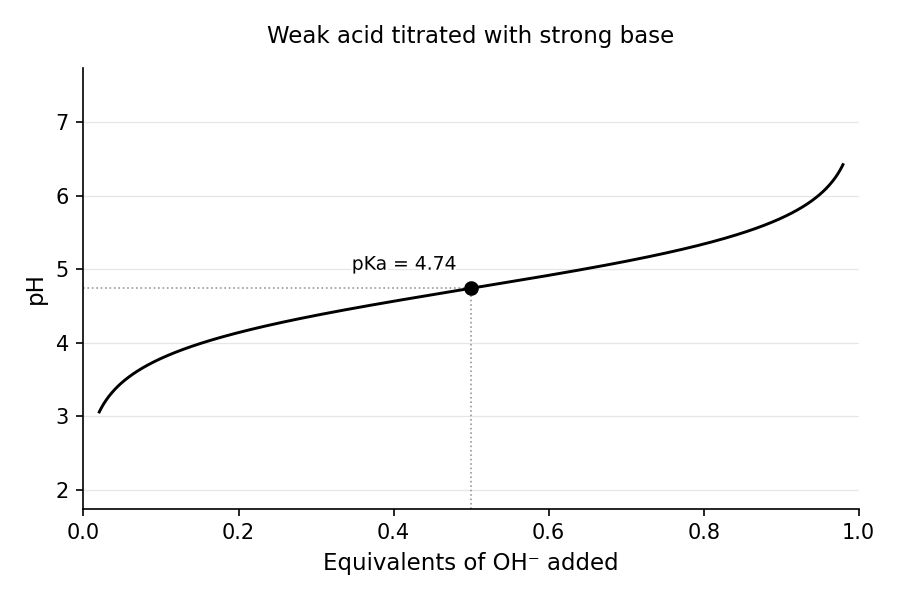
Must knowThe more MCAT-relevant case (e.g., acetic acid + NaOH). Key landmarks:
- Initial pH: higher than a strong acid of equal concentration (partial dissociation).
- Buffer region: both and present; the curve is relatively flat.
- Half-equivalence point: , so pH = p — read p directly off the curve here.
- Equivalence point: all acid → conjugate base, a basic salt solution (pH > 7, typically 8–10); solve by salt hydrolysis.
- After: excess NaOH; pH rises steeply.
The vertical jump is smaller than for a strong acid because the starting pH is already elevated.
Weak Base Titrated with Strong Acid
Must knowThe mirror image: starts at high pH, half-equivalence gives pH = p (of the conjugate acid), and the equivalence point is acidic (pH < 7).
Polyprotic Acid Titrations
Must knowPolyprotic acids (, ) show multiple equivalence points — one per dissociable proton — with a buffer region and half-equivalence point (pH = p) between each. Recognize the staircase shape and read p values from the half-equivalence points.
Indicators
Must knowAcid-base indicators are weak acids whose protonated and deprotonated forms differ in color; the change occurs near the indicator's p. Choose one whose p is near the equivalence-point pH:
- Strong/strong (pH 7): phenolphthalein or bromothymol blue (the jump spans pH 4–10).
- Weak acid/strong base (pH 8–10): phenolphthalein.
- Weak base/strong acid (pH 4–6): methyl orange or methyl red.
Quick check: Titrating ammonia (p of ) with HCl — pH at the half-equivalence point?
Answer: , so pH = p of = 9.25.
Common Confusions & Tricks
1. p and strength. Lower p = larger = more dissociation = stronger acid. Mnemonic: "lower pKa = louder acid."
2. Equivalence point ≠ pH 7 (unless strong/strong). Weak acid/strong base equivalence is above 7; weak base/strong acid is below 7. Only both-strong gives pH 7.
3. Half-equivalence point = p. Memorize cold. To read p off a curve: find the equivalence volume, halve it, read the pH.
4. The H-H ratio is conjugate base over acid. . Inverting it makes pH wrong by twice the log term.
5. Diluting a buffer doesn't change pH — but over-diluting destroys capacity. H-H depends on the ratio; very dilute buffers have negligible capacity and effects creep in.
6. only for a conjugate pair — an acid and its own conjugate base, not two unrelated species.
7. Salt of weak acid/strong base → basic; strong acid/weak base → acidic. The ion from the strong partner is inert; the ion from the weak partner hydrolyzes.
8. The "5% rule." If , the approximation fails — use the quadratic. Happens when is tiny or the solution very dilute.
9. Buffer range vs. capacity. Range (±1 pH unit of p) = which pH it holds; capacity = how much acid/base it absorbs before breaking.
Key Equations
| Equation | Variables & When to Use |
|---|---|
| Ion product of water (25°C); find one ion from the other | |
| Definition of pH | |
| Definition of pOH | |
| From at 25°C; links pH and pOH | |
| Acid dissociation constant; ICE for weak acid pH | |
| Base dissociation constant; ICE for weak base pH | |
| Conjugate pair; find from for hydrolysis | |
| Log form of above | |
| Weak acid approximation (valid when of ) | |
| Henderson-Hasselbalch; buffer pH, half-equivalence point | |
| at half-equivalence point | Special case when |