Why Ions Matter in Biology and on the MCAT
Almost every body fluid is an ionic solution. Blood, cytoplasm, and urine carry dissolved salts whose charged particles—ions—conduct electricity, set membrane potentials, and buffer pH. The MCAT tests how ions form, what they are called, and what happens physically when they dissolve in water.
Priority labels: Must know = cold; Know the logic = mechanism not names; Passage-level = recognize, don't memorize; Optional = skippable.
Cations, Anions, and the Ions You Must Know Cold
The Basic Distinction
Must knowLose electrons → positive cation; gain electrons → negative anion (memory anchor: anion = electrons added = negative). Cations are named from the parent element/group; monatomic anions take -ide, while polyatomic anions usually take -ate or -ite.
Monatomic Ions
Must knowCharges are predictable from group number — group 1 → +1, group 2 → +2, halogens → −1, chalcogens (O, S) → −2, plus /. Transition metals carry variable charge, written with Roman numerals: iron(II) vs. iron(III) .
The biologically high-yield ions: , , , , , , plus the redox-active metals and . The redox pair matters: hemoglobin binds only with iron in the reduced state; oxidation to gives non-functional methemoglobin.
OptionalReference: (enzyme active sites), (enamel), (thyroid hormone), (Fe–S clusters) — recognize, don't drill.
Polyatomic Ions
Must knowA polyatomic ion is a covalently bonded group with a net charge. Must know the AAMC set by name, formula, and charge:
| Ion | Formula | Charge |
|---|---|---|
| Ammonium | +1 | |
| Hydroxide | −1 | |
| Nitrate / Nitrite | / | −1 |
| Sulfate / Sulfite | / | −2 |
| Phosphate | −3 | |
| Carbonate / Bicarbonate | / | −2 / −1 |
| Acetate | −1 | |
| Cyanide | −1 |
Ammonium is the only common polyatomic cation. Bicarbonate is the dominant blood buffer; cyanide inhibits cytochrome c oxidase.
Passage-levelLab oxidizers — permanganate , dichromate , chromate , perchlorate — recognize if a passage gives them.
The -ate vs. -ite pattern: -ate has one more oxygen than -ite (same charge). Sulfate vs. sulfite ; nitrate vs. nitrite . For the four-member chlorine series, per- = most oxygens, hypo- = fewest.
The phosphate family is biologically central and exists in pH-dependent equilibrium:
At physiological pH (~7.4), and dominate, which is why phosphate buffers mimic physiological conditions.
Writing Neutral Ionic Formulas (Charge Balancing)
Must knowIonic compounds are neutral overall, so total positive charge cancels total negative. Use the criss-cross method: each ion's charge magnitude becomes the other ion's subscript, then reduce. Ammonium phosphate → ; aluminum sulfate → (check: ). Wrap polyatomic ions in parentheses before subscripting.
Quick check: What is the charge on ammonium, and how does it form from ammonia?
Answer: Ammonium () is +1. It forms when ammonia () acts as a Brønsted base and accepts a proton () on nitrogen's lone pair; the four N–H bonds become equivalent (tetrahedral).
Dissolution and the Formation of Ions in Solution
From Crystal to Solution
Must knowWhen an ionic solid like dissolves, polar water molecules surround surface ions and pull them free—dissolution:
(aq) means the ions are dissolved and surrounded by water. A strong electrolyte dissociates completely (, strong acids/bases); a weak electrolyte only partially ionizes (acetic acid, ammonia). Note is a strong electrolyte (fully dissociates) even though its solution is acidic — don't confuse weak-acid behavior with incomplete dissociation.
| Type | Example | Dissociation | Conductivity |
|---|---|---|---|
| Strong | , , | ~100% | High |
| Weak | , | Partial | Moderate |
| Nonelectrolyte | Glucose, ethanol | None | Negligible |
Ion concentration drives conductivity: a 0.1 M solution provides 0.2 M particles ( + ), while 0.1 M glucose stays 0.1 M. Strong electrolytes conduct far better than weak ones at the same formal concentration.
Worked Example: Concentration of Ions After Dissolution
Must knowProblem: Dissolve 0.050 mol to make 500 mL of solution. Find and .
So M and M. Charge balance checks: mol⁺/L equals mol⁻/L. ✓
Quick check: A 0.30 M solution (complete dissociation) — what is ?
Answer: , so .
Net Ionic Equations and Spectator Ions
Know the logicWhen strong-electrolyte solutions mix, the net ionic equation strips out spectator ions (unchanged on both sides). Procedure: write the molecular equation, split soluble strong electrolytes into ions, then cancel common ions. Mixing and :
- Molecular:
- Net ionic:
Here and are spectators. Solids, gases, and weak electrolytes stay in molecular form (not fully dissociated), so they never cancel.
Hydration: Why Water Is Such a Powerful Solvent
Ion–Dipole Interactions
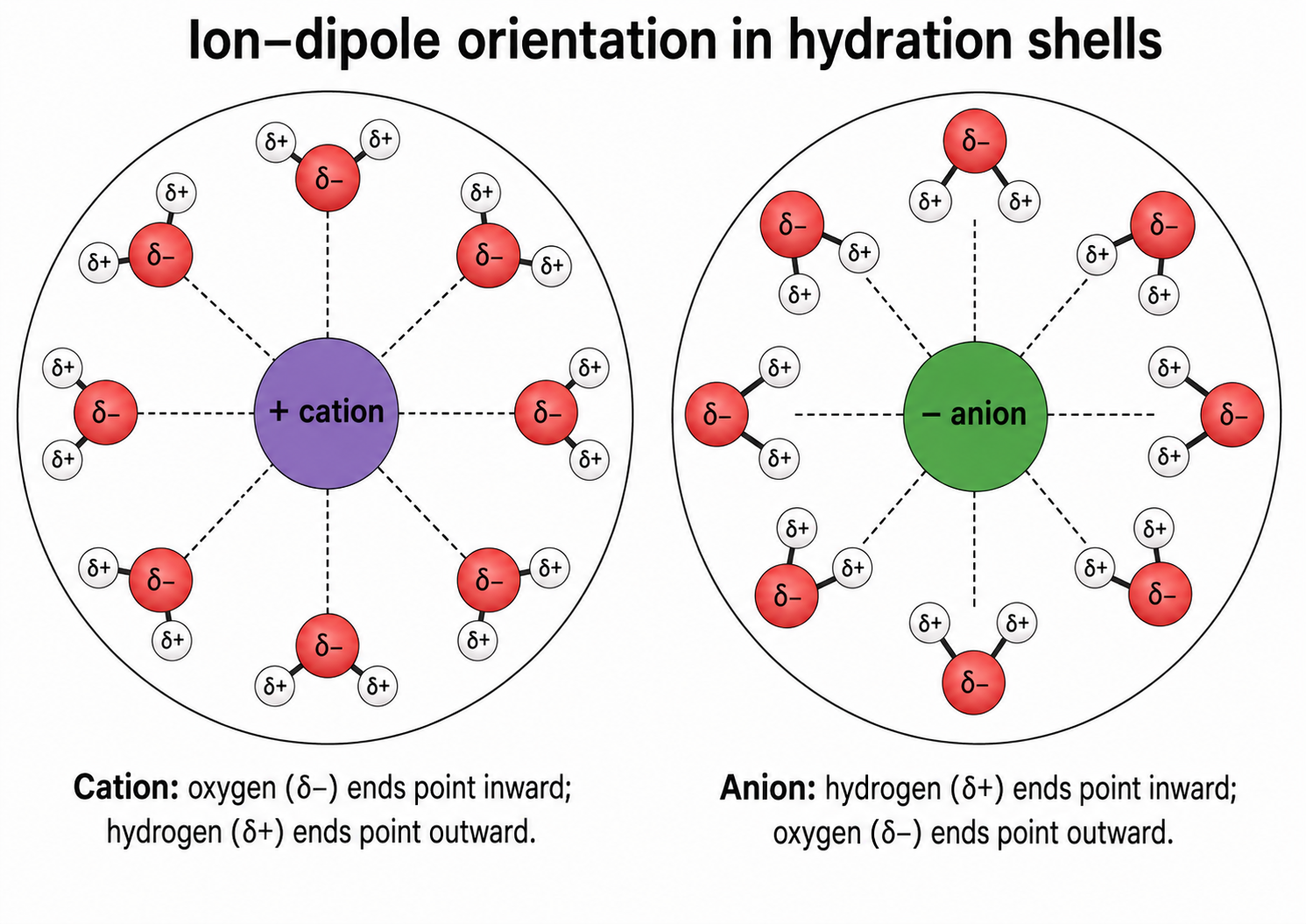
Must knowWater is polar: partially negative oxygen (), partially positive hydrogens (). When an ion enters water, the oppositely charged end of water is attracted to it—an ion–dipole interaction (stronger than dipole–dipole, weaker than an ionic bond).
- Around a cation, water oxygens point inward.
- Around an anion, water hydrogens point inward.
The shell of water surrounding an ion is the hydration shell (solvation shell), and the energy released is the hydration energy. Dissolution is favorable when hydration energy exceeds the lattice energy that holds the crystal together.
Charge Density and Hydration
Know the logicSmaller ions with higher charge have greater charge density and are hydrated more strongly — e.g., is far more tightly hydrated than . A strongly hydrated ion drags a larger effective "sphere" through solution, which matters for channel selectivity. High charge density also explains why high-lattice-energy salts (e.g., ) are sparingly soluble: hydration can't offset the lattice energy.
Quick check: Between and , which has a larger hydration energy, and why?
Answer: — higher charge (+3 vs. +1) and smaller size give far greater charge density, so its ion–dipole attractions with water are much stronger.
The Hydronium Ion
Why Is Not Really "Naked"
Must knowA free proton () has no electrons and is too reactive to exist alone in water; it instantly bonds to a water lone pair to form the hydronium ion, :
This is why the MCAT writes for the actual acidic species in water. It is a +1 cation with trigonal pyramidal geometry.
Know the logicGrotthuss mechanism: (and ) conduct charge anomalously fast because the proton "hops" along hydrogen-bonded waters—a bond breaks on one molecule as a new one forms on the next—rather than physically diffusing. Qualitative grasp is enough.
Connection to pH and Acid–Base Chemistry
Must knowHydronium concentration defines pH:
At 25°C, pure water autoionizes:
So M in neutral water (). A strong acid like fully donates its proton, raising :
Worked Example: pH of a Strong Acid
Must knowProblem: pH of 0.0010 M ? is a strong acid, so M and:
Below 7, as expected for an acid. ✓
Quick check: If M at 25°C, what is and the pH?
Answer: M, so pH (basic, since ).
Electrolytes in Biological Context
Electrolytes and Membrane Physiology
Must knowElectrolytes produce ions in solution and let it conduct electricity. The major biological electrolytes are sodium, potassium, calcium, chloride, bicarbonate, and phosphate; membrane pumps and channels hold their concentrations tightly, and derangements (hyponatremia, hyperkalemia) are high-yield clinical hooks.
Passage-levelThe Na⁺/K⁺-ATPase moves 3 out and 2 in per ATP, maintaining the gradients behind the resting potential; the unequal charge export contributes to the cell's negative interior.
Quick check: Why does dissolving produce a conducting solution while glucose does not?
Answer: dissociates into and —freely moving charge carriers. Glucose is a covalent nonelectrolyte that dissolves without forming ions, so conductivity is negligible.
Common Confusions & Tricks
1. Cation vs. anion — CATion is POSitive; anion gains an electron and is negative.
2. vs. — is acceptable shorthand, but if a passage names the "actual species" or shows the proton reacting with water, use . They are interchangeable in expressions.
3. The -ate / -ite charge trap — -ite does NOT mean more negative; the charge is identical for a pair (e.g., and are both −1). Only the oxygen count differs.
4. Per-/hypo- series — chlorine oxyanions: hypochlorite (1 O) → chlorite → chlorate → perchlorate (4 O); charge is −1 throughout.
5. Hydration ≠ hydrolysis — hydration is physical (ion–dipole surrounding); hydrolysis is a chemical bond-breaking reaction. An ion can be heavily hydrated without reacting with water.
6. More ions ≠ more acidic if spectators — / don't affect pH. But (weak acid) and (weak base) do. Ask: is the ion conjugate to a weak acid or base? If yes, it shifts pH.
7. and temperature — at 25°C, and neutral pH = 7. rises with temperature (autoionization is endothermic), so neutral pH < 7 when hot—still neutral, just .
8. Charge density and ion selectivity — the K⁺ channel selects over partly because is more strongly hydrated and costs more energy to dehydrate.
Key Equations
| Equation | Variables & When to Use |
|---|---|
| in mol/L → pH | |
| Analogous, for hydroxide | |
| At 25°C | |
| At 25°C; find one ion concentration from the other | |
| Autoionization of water | |
| = ion's stoichiometric coefficient; gives ion molarity after full dissociation | |
| Hydration energy | = charge, = radius; higher charge/radius → stronger hydration |