Titration is calculation- and curve-reading-rich, but once you know what is happening chemically at each stage, the curves and calculations become logical rather than memorized. This guide covers the high-yield corners: neutralization chemistry, curve interpretation, indicators, and redox titrations.
Priority labels: Must know = cold; Know the logic = mechanism not names; Passage-level = recognize, don't memorize; Optional = skippable.
Neutralization: The Chemical Foundation
Must knowNeutralization is the reaction of an acid and a base; in Brønsted-Lowry terms a proton transfers from acid to base. The general form:
What sets the equivalence-point pH is the salt's hydrolysis:
- Strong acid + strong base: . The salt (e.g. ) doesn't hydrolyze, so equivalence is pH = 7.00 (25 °C). No buffer region.
- Weak acid + strong base: . The product is the conjugate base; it hydrolyzes (), so equivalence is above pH 7 (basic).
- Strong acid + weak base: . The conjugate acid hydrolyzes, so equivalence is below pH 7 (acidic).
Stoichiometry of Neutralization
Must know
where is the number of acidic/basic protons per formula unit (: ; : ).
Worked example. Titrate 25.00 mL (unknown) with 0.100 M ; equivalence at 32.50 mL. Both monoprotic, so :
Quick check: You titrate 50.0 mL of with 0.200 M , requiring 60.0 mL to reach the equivalence point. What is ?
Answer: , . So .
Interpretation of the Titration Curves
Must knowYou add a titrant of known concentration from a buret into a fixed volume of analyte, tracking pH vs. volume of titrant. Know how to both read and sketch each curve type.
Strong Acid / Strong Base
Must knowThe baseline curve: low starting pH, a gradual rise, then a nearly vertical jump centered at pH 7.00, leveling off near pH 12–13 as excess dominates. Sigmoidal, with no buffer region (the salt forms no buffer).
Weak Acid / Strong Base
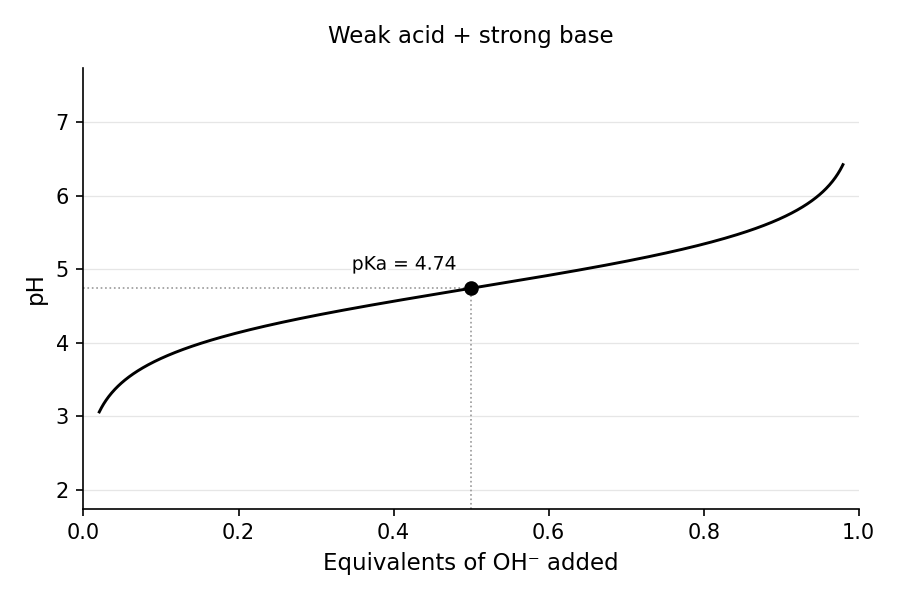
Must knowThe most information-dense curve. Five landmarks:
- Initial pH: higher than a strong acid at the same concentration (partial dissociation); estimate with .
- Buffer region: added base converts to , so both coexist — pH rises only gradually (the flat part).
- Half-equivalence point: half the is converted, so and Henderson-Hasselbalch gives pH = p. This is the single most tested relationship in titration.
- Equivalence point: all is now , which hydrolyzes → pH > 7. The inflection point of the steep rise is the equivalence point.
- After equivalence: excess strong base drives pH toward ~13.
Weak Base / Strong Acid
Must knowThe mirror image: high (basic) initial pH, a buffer region, and equivalence below pH 7. At half-equivalence , i.e. pH = p of the conjugate acid.
Polyprotic Acid Curves
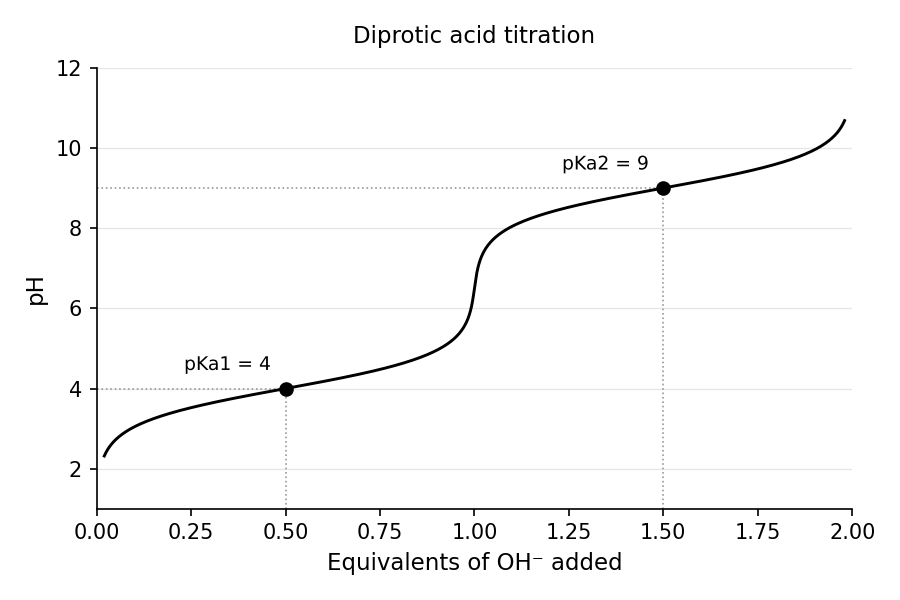
Must knowA polyprotic acid (, ) gives one equivalence point and one half-equivalence point (pH = p) per ionizable proton, producing a staircase curve. For a diprotic : first equivalence converts , second converts . The first equivalence-point pH is approximately:
Quick check: On the titration curve for a weak acid with , at what pH is the buffer region most effective, and at what pH does the steep equivalence point rise occur?
Answer: The buffer region is centered at pH = 5.2 (the half-equivalence point). The steep equivalence point rise occurs at a pH above 7, because the conjugate base formed at equivalence hydrolyzes to give a basic solution. The exact equivalence point pH depends on and the concentration, but you can expect something in the range of 8–9 for a typical weak acid.
Key Features to Read Off Any Titration Curve
Must know| Feature | How to locate it | What it tells you |
|---|---|---|
| Equivalence point | Midpoint of the steep vertical rise | Moles of acid = moles of base titrated |
| Half-equivalence point | Halfway on x-axis to equivalence point | pH = p (for weak acid) |
| Buffer region | Flat/gradual slope before equivalence | Both conjugate acid and base present |
| Initial pH | y-intercept | Identity/concentration of analyte |
| Post-equivalence plateau | High pH plateau | Excess titrant controls pH |
Indicators
Know the logicAn indicator is itself a weak acid whose two forms have different colors: . The ratio tracks pH (Henderson-Hasselbalch); the eye sees the change near pH ≈ p, over a range of about ±1 pH unit.
The endpoint (indicator color change) approximates the equivalence point (moles acid = moles base) when the indicator's transition range overlaps the steep jump. SA/SB jumps span ~pH 4–10, so almost any indicator works; weak titrations have a narrower, shifted jump, so the indicator must be matched.
Passage-levelThe high-yield pairing: phenolphthalein (colorless → pink, ~8.2–10.0) for weak acid / strong base (equivalence above 7); methyl orange/methyl red (~3–6) for strong acid / weak base (equivalence below 7). Bromothymol blue (~6–7.6) suits SA/SB. Exact pKa values are not worth memorizing.
Quick check: You are titrating a solution of (a weak base) with . The equivalence point pH will be around 5.1. Which indicator should you use — phenolphthalein or methyl red?
Answer: Methyl red (transition range 4.4–6.2) brackets the equivalence point at pH 5.1. Phenolphthalein changes color at pH 8.2–10.0, well above the equivalence point, so it would give a false endpoint too early in the addition.
Redox Titration
Must knowRedox titrations use an oxidizing or reducing agent as titrant; the endpoint reflects a change in oxidation state, not pH. Stoichiometry is set by conservation of electrons:
Permanganate () — the most tested. In acid, deep-purple is reduced to near-colorless , gaining 5 electrons (Mn +7 → +2):
It is self-indicating: the endpoint is the first persistent pink/purple from one excess drop of .
OptionalOther systems (recognize, don't memorize). Dichromate (orange) → (green), gaining 6 e⁻. Iodometric titrations generate and titrate it with thiosulfate () in a 1:2 ratio (); starch gives a blue-black complex, and the endpoint is the disappearance of blue.
Worked Example
Must knowA 25.00 mL sample of is titrated with 0.0200 M in acid; endpoint at 18.00 mL. Each takes 5 e⁻, each gives 1, so the ratio is 1:5:
Quick check: In a permanganate titration, the solution goes from deep purple to very pale pink. What does this signal, and why do you not need a separate indicator?
Answer: The color change signals the endpoint — all the reducing agent has been consumed and the first excess drop of is no longer reduced, so the intense purple color of persists. Permanganate is self-indicating because of its dramatic color contrast between (purple) and (nearly colorless).
Common Confusions & Tricks
1. Equivalence point ≠ endpoint. Equivalence is stoichiometric (moles acid = moles base); endpoint is the observed indicator color change. A poor indicator makes them diverge.
2. "pH = 7 at equivalence" is only true for strong/strong. It's > 7 for weak acid/strong base and < 7 for strong acid/weak base — set by salt hydrolysis.
3. Half-equivalence point. Half the original acid is now conjugate base, so and pH = p. (Same volume as "half the equivalence volume," but the concentration relationship is the conceptual anchor.)
4. Which indicator. Phenolphthalein → weak acid / strong base (equivalence basic). Methyl orange/red → strong acid / weak base (equivalence acidic).
5. Buffer region vs. post-equivalence plateau. The buffer region is always before the steep rise; the plateau is after it.
6. Permanganate n-factor is 5 in acid (not 1 or 7). Always write the half-reaction and count electrons.
7. Equivalence points = ionizable protons. → three, → two ( → two, first not easily visible).
8. Starch/iodine trap. The endpoint is the disappearance of the blue color, not its appearance.
9. Extracting p from a curve. Find the equivalence volume, take half of it, and read the pH — that pH = p.
Key Equations
| Equation | Variables & When to Use |
|---|---|
| = molarity, = volume, = moles of or per formula unit. Use at the equivalence point to find unknown concentrations. | |
| Henderson-Hasselbalch: use in the buffer region. At half-equivalence, , so . | |
| Valid at 25 °C. Use when you've calculated from base hydrolysis. | |
| Conjugate pair; at 25 °C. | |
| Initial pH of a weak acid solution; use before titration begins. Requires . | |
| pH at the first equivalence point of a diprotic acid. | |
| Permanganate half-reaction in acid; electrons. Essential for redox titration stoichiometry. |