Intermolecular forces (IMFs) are the attractions between molecules in condensed phases — weaker than covalent or ionic bonds, but they govern the physical properties the MCAT cares about: boiling/melting points, vapor pressure, viscosity, surface tension, solubility, and the shapes of DNA and proteins.
Priority labels: Must know = cold; Know the logic = mechanism not names; Passage-level = recognize, don't memorize; Optional = skippable.
The guiding intuition: stronger IMFs → molecules are harder to separate → higher boiling point, lower vapor pressure, higher surface tension, higher viscosity. Everything flows from that.
The IMF Hierarchy at a Glance
Must knowFrom strongest to weakest:
| Force | Relative Strength | Example |
|---|---|---|
| Ion–dipole | Strongest | dissolving in water |
| Hydrogen bond | Strong | water, DNA base pairs |
| Dipole–dipole | Moderate | acetone–acetone |
| Dipole–induced dipole | Weak | near |
| London dispersion (induced–induced) | Weakest (for comparable size) | , noble gases |
The MCAT tests this ranking qualitatively, not exact energies. Categories overlap in magnitude — a large nonpolar molecule can have stronger London forces than a small polar molecule has dipole–dipole forces. Molecular size matters, not just polarity.
Hydrogen Bonding
What It Is and Why It Exists
Must knowA hydrogen bond is a particularly strong electrostatic attraction (not electron sharing) between a hydrogen covalently bonded to a highly electronegative atom and a lone pair on another electronegative atom. H is unique: it's so small and its electron is so pulled away that the bare proton is exposed, creating an intense partial positive charge.
A hydrogen bond requires:
- A donor: H covalently bonded to N, O, or F.
- An acceptor: a lone pair on another N, O, or F atom (same or different molecule).
Canonical examples: , , , . Chlorine is electronegative but too large — is not a true hydrogen bond.
Strength and Biological Role
Know the logicH-bonds are directional (strongest near linear, 180°), which gives them structural specificity in biology. Passage-level in DNA, A–T pairs via 2 H-bonds and C–G via 3, so G–C-rich DNA has a higher melting temperature; in proteins, backbone (donor) to (acceptor) H-bonds stabilize -helices and -sheets.
Effect on Physical Properties
Must knowWater is the key example: (MW 18) boils at 100 °C, while (MW 34) boils at −60 °C — the heavier molecule can't hydrogen bond. Water's high boiling point, high heat of vaporization, high surface tension, and ice-floats-on-water (the H-bond network in ice is more open/less dense than liquid) all arise from hydrogen bonding. Compounds that H-bond with water are hydrophilic and water-soluble.
Worked Example — Boiling Point Ranking
Must knowProblem: Rank by increasing boiling point: butane (), 1-propanol (), acetone (). All have similar MW (~58–60), so compare dominant IMF.
- Butane: nonpolar → London only.
- Acetone: polar , no O–H → dipole–dipole + London (can accept but not donate H-bonds).
- 1-Propanol: has → hydrogen bonding on top of dipole–dipole + London.
Since MW (and thus London) is comparable, each step up the hierarchy raises BP:
Quick check: Water () has two O–H donors and two lone pairs for accepting H-bonds. Dimethyl ether () has two lone pairs on oxygen but no O–H. Which has a higher boiling point, and why?
Answer: Water (100 °C vs. −24 °C for dimethyl ether). Water can both donate and accept hydrogen bonds, forming an extensive network. Dimethyl ether can only accept hydrogen bonds from other molecules (it has no H on O), so it relies mainly on dipole–dipole and London forces for self-interactions.
Dipole Interactions
Permanent Dipole–Dipole Forces
Must knowA molecule with a permanent dipole moment interacts electrostatically with neighboring dipoles — positive end to negative end.
A molecule has a net dipole only if (1) bonds are polar AND (2) geometry is asymmetric so bond dipoles don't cancel. This is the key distinction:
- (linear) — polar bonds, but they point in exactly opposite directions → zero net dipole, no dipole–dipole forces.
- (bent) — polar bonds, geometry doesn't cancel → large net dipole.
- (tetrahedral) — polar bonds cancel by symmetry → no net dipole.
- (tetrahedral, but asymmetric) — net dipole, dipole–dipole forces present.
Dipole–dipole interactions are weaker than hydrogen bonds (no exposed proton nucleus), but they are still stronger than London forces for molecules of similar size.
Ion–Dipole Forces
Must knowIon–dipole interactions are the strongest non-covalent interaction. When an ionic compound dissolves in a polar solvent, ions attract solvent dipoles — this is why water dissolves salts: attracts the partial-negative O ends of water; attracts the partial-positive H ends. The released hydration energy offsets the lattice energy needed to separate the ions.
Quick check: is linear and nonpolar. is bent and polar. Which experiences dipole–dipole interactions in the liquid phase?
Answer: . Its bent geometry (due to a lone pair on S) gives it a net dipole moment ( 1.63 D). , being linear with symmetric bond dipoles, has no net dipole and relies only on London dispersion in the liquid phase.
Van der Waals Forces (London Dispersion Forces)
The Origin of an "Instantaneous Dipole"
Know the logicEven perfectly nonpolar molecules — noble gases, , , alkanes — attract one another. Electrons are constantly moving, so at any instant their distribution can be asymmetric, creating a fleeting instantaneous dipole. This distorts a neighbor's electron cloud, inducing a correlated dipole, and the two attract. This is the London dispersion force (induced dipole–induced dipole). Unlike H-bonding or dipole–dipole, it needs no permanent charge asymmetry — it works for all molecules.
Polarizability — The Key Variable
Must knowLondon strength depends on polarizability — how easily the electron cloud distorts. It increases with:
- More electrons (larger atoms, higher MW): larger, more diffuse cloud → easier to distort. Iodine (, solid at RT) has far stronger London forces than fluorine (, gas at RT), both nonpolar.
- Greater surface area: straight-chain alkanes boil higher than their branched isomers of the same MW because more surface contact = more London overlap. (E.g. n-pentane bp 36 °C vs. spherical neopentane bp 10 °C, both .)
London forces help stabilize hydrophobic clustering of nonpolar side chains in protein interiors and lipid-bilayer tails (though entropy — released ordered water — is the main driver).
Quick check: Arrange the following in order of increasing boiling point: , , .
Answer: (−246 °C) < (−186 °C) < (−108 °C). All are monoatomic noble gases with zero permanent dipole. The only IMF is London dispersion. Atomic number (and electron count) increases Ne → Ar → Xe, so polarizability increases, and boiling point increases accordingly.
Physical Properties Governed by IMFs
The link between IMF strength and bulk properties is tested repeatedly.
Boiling Point and Heat of Vaporization
Must knowBoiling overcomes IMFs to move molecules from liquid to gas. Stronger IMFs → higher boiling point and higher heat of vaporization (). Water's is anomalously high for such a small molecule because of its hydrogen bonding. The same network gives water its high specific heat (energy disrupts H-bonds instead of raising temperature), making it a biological temperature buffer.
The hydrogen-bonding effect shows up when boiling point is plotted against molar mass down a group of hydrides. Normally BP rises with molar mass (more electrons → stronger London). But , , and sit far above their heavier congeners because they are the only members of their groups that hydrogen bond.
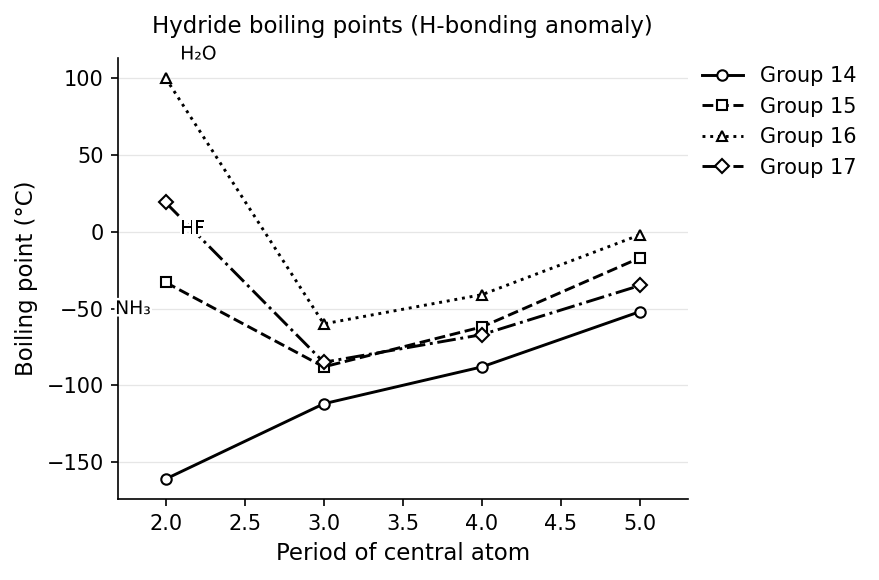
The boiling point is the temperature where a liquid's vapor pressure equals ambient pressure — which is why it's pressure-dependent: at high altitude water boils below 100 °C. The normal boiling point is defined at 1 atm.
Vapor Pressure
Must knowVapor pressure is the pressure of gas in equilibrium with its liquid. Stronger IMFs → fewer molecules escape → lower vapor pressure. Ethanol has a lower vapor pressure than diethyl ether because its O–H enables hydrogen bonding. Volatile = weak IMFs = high vapor pressure.
Know the logicVapor pressure rises with temperature; the Clausius–Clapeyron equation makes this quantitative:
A plot of vs is linear with slope , letting you extract from two (P, T) points or predict vapor pressure at a new temperature.
Surface Tension and Viscosity
Must knowSurface tension is the energy cost of new surface area — surface molecules have fewer neighbors/IMF stabilizations than interior ones. Stronger IMFs → higher surface tension (water's is unusually high). Viscosity (resistance to flow) also rises with IMF strength; glycerol is highly viscous because its three –OH groups allow extensive H-bonding.
Capillary Action
Must knowCapillary action (rise of liquid in a narrow tube) results from adhesion (liquid–wall IMFs, e.g. water H-bonding to glass) vs. cohesion (liquid–liquid IMFs). Adhesion > cohesion → liquid rises, concave meniscus (water in glass); cohesion > adhesion → depressed, convex meniscus (mercury).
Solubility: "Like Dissolves Like"
Must knowA solute dissolves when solute–solvent IMFs are comparable to solute–solute and solvent–solvent IMFs. Polar/ionic solutes dissolve in polar solvents (water); nonpolar in nonpolar (hexane). This underlies the hydrophobic effect and amphipathic molecules (fatty acids, phospholipids).
Quick check: Why does 1-butanol () mix less completely with water than 1-propanol ()?
Answer: As the nonpolar carbon chain grows longer, the molecule becomes more hydrocarbon-like overall. The polar O–H end can still H-bond with water, but the four-carbon chain disrupts water's H-bond network (hydrophobic effect) without providing compensating favorable interactions. The balance shifts away from mixing.
Common Confusions & Tricks
1. "Hydrogen bonding occurs whenever H is present."
Wrong. H must be bonded directly to N, O, or F. has zero H-bonding ability. If you see C–H, think London only.
2. "Dipole–dipole is always the second-strongest IMF."
Not always. A large nonpolar molecule can have stronger London forces than a small polar molecule's dipole–dipole. Compare (bp −85 °C, polar) vs. (bp 59 °C, nonpolar) — 's greater polarizability wins.
3. "Can accept" vs. "can donate" hydrogen bonds.
Acetone's O lone pair can accept H-bonds from water (so it's water-soluble), but it can't donate one (no N–H/O–H). Among itself it shows only dipole–dipole — which is why its bp (56 °C) is below 1-propanol's (97 °C) at similar MW.
4. Branched = lower boiling point (not higher).
Branching reduces surface area → weaker London → lower bp. More surface contact = more London overlap = higher bp.
5. London forces exist in ALL molecules.
Polar molecules have London in addition to dipole–dipole/H-bonding. Never subtract London from polar compounds.
6. "High vapor pressure" ≠ "strong IMFs."
High vapor pressure = weak IMFs (escape easily). They're inversely related.
7. The vs. trap.
linear → nonpolar → London only → gas. bent → polar → H-bonding → liquid. Shape determines polarity, not just the atoms.
8. Ion–dipole is strongest but often N/A in pure-substance rankings.
Key on dissolution/solubility questions; usually doesn't apply to pure-liquid boiling-point/vapor-pressure comparisons of molecular compounds.
Memory trick: "NOF" — N, O, F are the only atoms that can be an H-bond donor or acceptor. No NOF, no hydrogen bond.
Key Equations
| Equation / Relationship | Variables & When to Use |
|---|---|
| IMF strength ranking: ion–dipole > H-bond > dipole–dipole > dipole–induced dipole > London | Qualitative hierarchy; use to rank boiling points, vapor pressures, and solubilities |
| Higher IMF → higher boiling point; applies to all force types | |
| Higher IMF → lower vapor pressure (inverse relationship) | |
| Clausius–Clapeyron: relates vapor pressure to temperature; slope of vs gives . Boiling occurs when vapor pressure = ambient pressure. | |
| = dipole moment (Debye), = charge magnitude, = bond length; non-zero → dipole–dipole forces | |
| Polarizability electron count MW (for similar structures) | Larger/heavier molecules → stronger London forces → higher BP |
| H-bond donor: , , ; acceptor: lone pair on N, O, F | Use to identify whether a compound can self-associate via H-bonding (affects BP) or dissolve in water |
| "Like dissolves like": when | Predicts miscibility and solubility; basis of hydrophobic effect |