Priority labels: Must know = cold; Know the logic = mechanism not names; Passage-level = recognize, don't memorize; Optional = skippable.
Introduction: The Core Logic of Every Separation
Know the logicEvery technique here rests on one idea: exploit a difference in physical or chemical properties (polarity, size, volatility, charge, binding affinity) and use it to move molecules into different places. Reason from that principle and you can handle even unfamiliar separation scenarios.
Extraction
The Concept: Two Immiscible Solvents
Must knowWhen you shake a solute between water and a water-immiscible organic solvent (e.g., diethyl ether, ethyl acetate) in a separatory funnel, the solute partitions between the layers based on which it prefers — "like dissolves like."
The partition (distribution) coefficient quantifies this:
Large → prefers organic; small (<1) → prefers aqueous. Polar/ionic compounds favor the aqueous layer; nonpolar favor the organic.
Which layer is on top? The denser layer sits on the bottom. Dichloromethane (~1.33 g/mL) is below water; diethyl ether (~0.71 g/mL) is above. Knowing densities tells you which layer to drain.
Acid–Base Extraction
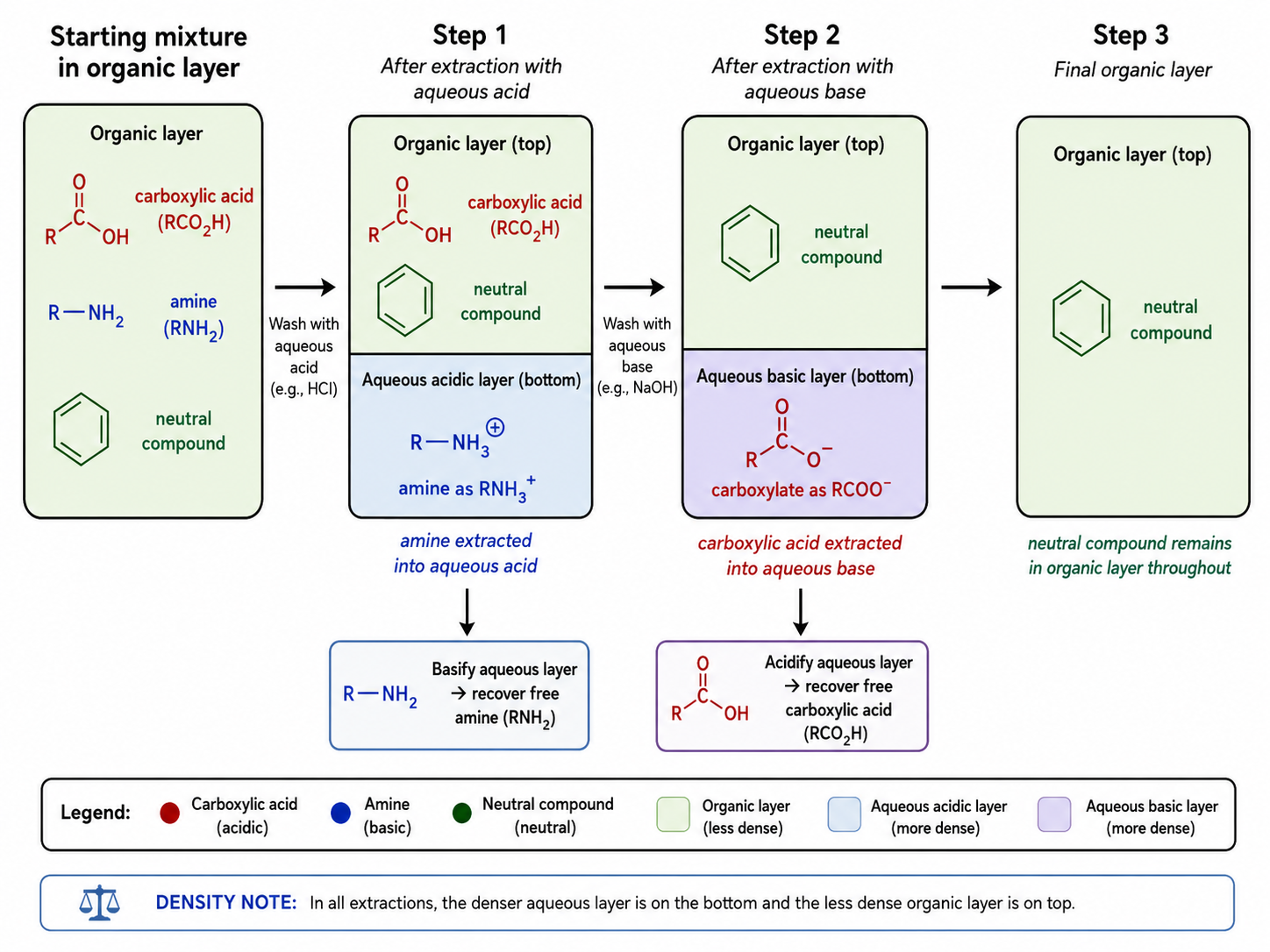
Must knowThis is the most-tested form. The key rule: ionized molecules are hydrophilic (aqueous); nonionized molecules are hydrophobic (organic). Change a molecule's ionization state with pH to move it between layers.
- Organic acid (e.g., carboxylic acid): neutral/organic-soluble in acid; ionized ()/aqueous-soluble in base.
- Organic amine (base): ionized ()/aqueous-soluble in acid; neutral/organic-soluble in base.
- Neutral compound (ketone, alkane): doesn't ionize, stays organic regardless of pH.
This lets you separate an acid + base + neutral by sequential pH adjustments — a classic MCAT scenario.
Multiple Extractions
Know the logicSeveral small-volume extractions remove more total solute than one extraction with the same total volume. More extractions = more efficient.
Quick check: A carboxylic acid and a neutral ketone are dissolved in diethyl ether. You add aqueous and shake. Which compound migrates to the aqueous layer, and why?
Answer: The carboxylic acid. Base deprotonates it to , which is ionic/hydrophilic and partitions into water. The ketone has no ionizable group and stays organic.
Distillation
The Concept: Separating by Volatility
Must knowDistillation separates liquids by vapor pressure / boiling point. The more volatile (lower-bp) component enriches the vapor, which is condensed and collected. Boiling point is set by intermolecular forces (H-bonding > dipole–dipole > London dispersion, which scales with MW): stronger forces → higher bp, lower volatility.
Simple vs. Fractional Distillation
Must know- Simple distillation: works when bp's differ by more than ~25°C, or to remove nonvolatile impurities (e.g., salts).
- Fractional distillation: for close bp's. A fractionating column provides many vaporization–condensation cycles (theoretical plates); more plates = better separation. (Petroleum refining is the canonical example.)
Raoult's Law and Ideal Mixtures
Must knowFor an ideal solution of two miscible volatile liquids:
where = mole fraction, = pure-component vapor pressure. The vapor is enriched in the more volatile component. Azeotropes (constant-boiling mixtures, e.g., 95.6% ethanol/water) cannot be separated further by ordinary distillation because vapor and liquid have identical compositions.
Special Distillation Techniques
Passage-levelSteam distillation isolates high-boiling, water-immiscible compounds below 100°C (both components add to total vapor pressure, so the mixture boils below either pure bp). Vacuum distillation lowers pressure so heat-sensitive compounds boil at a lower, safer temperature.
Quick check: Simple or fractional to separate ethanol (bp 78°C) from water (bp 100°C)? What about hexane (bp 69°C) from toluene (bp 111°C)?
Answer: Ethanol/water differ by only 22°C and near-azeotrope — fractional (and only reaches ~95.6% ethanol). Hexane/toluene differ by ~42°C — simple works.
Recrystallization, Filtration, and Purity Assessment
Recrystallization (Crystallization)
Know the logicRecrystallization purifies a solid via differential solubility across temperature: dissolve the impure solid in a minimum volume of hot solvent, then slowly cool. The target crystallizes into a pure lattice that excludes impurities, while impurities stay dissolved in the cold mother liquor. Slow cooling → larger, purer crystals.
Filtration: Gravity vs. Vacuum
Know the logic- Gravity filtration: keep the filtrate (liquid); e.g., removing solid impurities/drying agents. Often done hot to avoid premature crystallization.
- Vacuum (Büchner/suction) filtration: collect the solid quickly (e.g., harvesting recrystallized crystals).
Melting Point as a Purity/Identity Check
Must knowA pure compound melts over a sharp, narrow range (~1–2°C). An impure compound melts over a broad range and at a lower temperature (impurity = mp depressant). A mixed melting point confirms identity: mixing an unknown with an authentic sample keeps the mp sharp if they're the same compound, but depresses/broadens it if they differ.
Quick check: After recrystallizing, a student measures 121–134°C; the pure compound melts at 133–134°C. Is the product pure?
Answer: No. The broad, depressed range indicates residual impurity. Recrystallize again until a sharp range near 133–134°C is obtained.
Chromatography: Basic Principles
The Universal Framework
Must knowEvery chromatographic method has a stationary phase (doesn't move) and a mobile phase (carries the sample through). Separation depends on how strongly a compound interacts with the stationary phase vs. the mobile phase: stronger stationary affinity → slower migration.
Polarity Rules for Chromatography
Must know- Normal-phase: stationary phase polar (silica, alumina); mobile phase nonpolar. Polar compounds stick and travel slowly; less polar elute first.
- Reverse-phase (common in HPLC): stationary phase nonpolar (C-18); mobile phase polar. Nonpolar compounds stick and travel slowly; polar elute first — the opposite of normal phase.
Thin-Layer Chromatography (TLC)
How It Works
Must knowTLC uses polar silica gel on a plate (stationary phase); solvent rises by capillary action (mobile phase). It's the fastest, cheapest method, used to monitor reactions.
The retention factor ():
ranges 0–1. On silica (normal phase), a more polar compound has a lower (sticks to the polar phase); a more polar solvent raises all values. Visualize colorless compounds by UV (aromatic/conjugated systems absorb) or staining (e.g., ninhydrin for amino acids).
Worked Numerical Example
Must knowSolvent front travels 8.0 cm; Compound A migrates 6.0 cm; Compound B migrates 2.4 cm.
A is less polar (travels farther, interacts less with polar silica); B is more polar and retained more.
Quick check: Two compounds have the same . Does this prove they are identical?
Answer: No. Confirm with a different solvent system (identical compounds still co-migrate; coincidental co-migrants separate) or additional characterization (e.g., spectroscopy).
Paper Chromatography
How It Works
Must knowPaper chromatography is like TLC but uses cellulose paper; water adsorbed to the fibers is the true polar stationary phase. is calculated identically. More polar (water-soluble) compounds travel more slowly. Still used for amino acids and sugars; visualize with ninhydrin or other stains.
Quick check: In paper chromatography with a nonpolar mobile phase, which moves farther: a nonpolar amino acid (leucine) or a polar one (serine)?
Answer: Leucine — it has lower affinity for the aqueous polar stationary phase and greater affinity for the nonpolar mobile phase.
Column Chromatography
The Concept
Must knowColumn chromatography scales up TLC for preparative amounts: a column packed with stationary phase (usually silica), sample loaded on top, solvent flowed through (gravity or pressure), fractions collected as components elute. In normal phase, less polar compounds elute first; increase solvent polarity to push polar compounds off.
Quick check: You run a normal-phase silica column with hexane and want to elute a stubborn polar compound. What should you do to the mobile phase?
Answer: Increase its polarity (add ethyl acetate or methanol). A more polar eluent competes with the polar stationary phase and displaces the polar compound.
Gas-Liquid Chromatography (GLC / GC)
The Concept
Must knowIn GLC, the mobile phase is an inert carrier gas (He, N₂) and the stationary phase is a high-boiling liquid coated in the column. The sample must be volatile — it's vaporized at injection and carried through. Separation depends on (1) volatility (more volatile = faster) and (2) affinity for the liquid stationary phase. Output is a chromatogram (detector response vs. time); retention time () is characteristic of each compound.
Key facts:
- Only for volatile, thermally stable compounds (not proteins, salts, sugars).
- Quantitative: peak area ∝ amount.
Quick check: Can GLC easily separate two structural isomers with similar boiling points and polarities?
Answer: Difficult — separation depends on volatility and stationary-phase interaction, so similar bp's and polarities give similar retention times and overlapping peaks. A different stationary phase or temperature program might help.
High-Pressure Liquid Chromatography (HPLC)
The Concept
Must knowHPLC is column chromatography under very high pressure through a fine-particle column → much higher resolution and speed, and it handles nonvolatile compounds (unlike GC), including biomolecules. Most MCAT HPLC is reverse-phase (C-18 nonpolar phase, polar mobile phase): nonpolar compounds retained longest, polar elute first. Gradient elution (gradually increasing organic solvent) is common.
Applications: peptide/protein purification, pharmaceutical QC, quantitation in biological fluids.
Quick check: In reverse-phase HPLC, which elutes first: a hydrophobic peptide (Phe, Leu, Val) or a hydrophilic one (Ser, Arg, Asp)?
Answer: The hydrophilic peptide. The nonpolar stationary phase retains the hydrophobic peptide longer, so it elutes later.
Electrophoresis
The Concept
Must knowElectrophoresis separates charged molecules in an electric field; they migrate toward the opposite electrode. Rate depends on charge-to-mass (charge-to-size) ratio: higher ratio moves faster; larger molecules face more gel friction and move slower.
Gel Electrophoresis of DNA (Agarose Gel)
Know the logicDNA is always negatively charged (phosphate backbone) and migrates toward the anode. Separation is purely by size (gel acts as a sieve; smaller fragments travel farther). A DNA ladder estimates sizes; visualize with ethidium bromide under UV.
SDS-PAGE
Must know- SDS (anionic detergent) denatures proteins and coats them with uniform negative charge proportional to size.
- A reducing agent (β-mercaptoethanol or DTT) breaks disulfide bonds for full denaturation.
- Charge-to-mass differences are eliminated → migration depends entirely on size. Smaller proteins travel farther toward the anode.
- A MW ladder runs in a parallel lane; bands visualized with Coomassie Brilliant Blue.
SDS-PAGE reports the MW of denatured subunits: a disulfide-linked oligomer shows one band at the subunit size with reducing agent.
Native PAGE and Isoelectric Focusing
Must knowNative PAGE omits SDS; proteins keep native charge/shape (separation reflects size, shape, charge) and stay functional. Isoelectric focusing (IEF) separates by isoelectric point (pI): a protein migrates along a pH gradient until pH = pI, where its net charge is zero and it stops — very high resolution.
Western Blotting
Passage-levelNot a separation per se: SDS-PAGE → transfer to membrane → detect a target with antibodies.
Quick check: On SDS-PAGE, Protein A is higher (closer to the well) than Protein B. What does this say about their sizes?
Answer: Protein A is larger. Larger proteins migrate more slowly and stay closer to the well; smaller proteins travel farther toward the anode.
Size-Exclusion Chromatography
The Concept
Must knowSize-exclusion chromatography (SEC) — also gel filtration or gel permeation — separates by size using porous beads. The commonly reversed logic:
- Small molecules enter the pores → longer path → elute later.
- Large molecules are excluded → flow around the beads → shorter path → elute first.
Large molecules elute at the void volume (). SEC is used to estimate protein MW, desalt proteins, and remove small-molecule contaminants.
Quick check: Run myoglobin (17 kDa) and albumin (67 kDa) on SEC. Which elutes first?
Answer: Albumin — it's too large to enter the pores, travels around the beads, and exits first. Myoglobin enters the pores and elutes later.
Ion-Exchange Chromatography
The Concept
Must knowIon-exchange chromatography separates by charge using a resin with fixed charged groups that attract opposite charges.
- Cation-exchange resin: negative fixed charges → binds positive molecules (protein at pH < pI).
- Anion-exchange resin: positive fixed charges → binds negative molecules (protein at pH > pI).
Elute by increasing salt (ions compete for binding sites) or changing pH (alters the protein's net charge). To predict binding, ask: at the buffer pH, is the protein net positive (pH < pI → cation exchanger) or net negative (pH > pI → anion exchanger)?
Quick check: A protein has pI 9. You pass it through a cation-exchange column at pH 7. Does it bind? How would you elute it?
Answer: Yes. At pH 7 (below pI 9) the protein is net positive and binds the negative resin. Elute with increasing salt (e.g., an gradient).
Affinity Chromatography
The Concept
Must knowAffinity chromatography is the most selective method: it exploits specific, reversible biological interactions (enzyme–substrate, antibody–antigen, receptor–ligand). A ligand for the target is bound to the resin; the target binds and is retained while everything else flows through. Elute with a competing ligand, high salt, or pH change.
Canonical example: His-tag / Ni²⁺ purification. A recombinant protein carries a hexahistidine tag; the histidines coordinate on the resin. Only the tagged protein binds; elute with imidazole (which competes with histidine for the sites). The same logic applies to any specific ligand–target pair. Affinity is usually a late purification step because it achieves high purity in one step.
Quick check: To purify a His-tagged enzyme by nickel affinity, what step releases the enzyme, and why does it work?
Answer: Elute with imidazole. Its ring resembles the histidine side chain and competes with the His-tag for the sites, displacing the protein.
Separation and Purification of Peptides and Proteins (Integrated)
The Typical Purification Workflow
Know the logicProteins are purified in stages, from crude/bulk methods to highly selective ones:
- Cell lysis + clarification (centrifugation).
- Ammonium sulfate precipitation ("salting out"): high salt reduces solvation and precipitates proteins; different proteins drop out at different saturations. Fast first step.
- Dialysis: semipermeable membrane removes small molecules/salts while retaining large proteins (desalting).
- Column chromatography: ion-exchange, size-exclusion, and/or affinity.
- SDS-PAGE to assess purity.
Centrifugation
Know the logicCentrifugation separates particles by density and size via sedimentation; denser/larger particles move outward faster. Sedimentation rate is the sedimentation coefficient in Svedberg units (S) (e.g., the eukaryotic ribosome is 80S from 60S + 40S — note S values aren't additive).
- Differential centrifugation: progressively higher speeds pellet largest/densest components first; crude fractionation.
- Density-gradient centrifugation: sample layered over a density gradient (sucrose, CsCl); particles settle to the region matching their density — finer resolution.
Tracking purification: a purification table tracks specific activity (activity per mg protein), which rises with each step as contaminants are removed; fold purification and percent yield capture the purity–recovery trade-off.
Quick check: After affinity chromatography, the target enzyme has very high specific activity but low total yield. Is this expected, and is it a problem?
Answer: High specific activity is expected (affinity is highly selective). Low yield reflects protein loss — a common trade-off; whether it matters depends on whether enough protein remains for the intended use.
Racemic Mixtures and Separation of Enantiomers
The Challenge
Must knowEnantiomers have identical physical properties (mp, bp, solubility, ) in achiral environments, so ordinary distillation, recrystallization, and achiral chromatography cannot separate them. To resolve them, you must introduce chirality into the process.
Method 1: Diastereomeric Salt Formation
Must knowThe classic, most-tested approach:
- React the racemic mixture with a single pure enantiomer of a chiral resolving agent (e.g., a chiral amine to resolve acids; a chiral acid like tartaric acid to resolve amines).
- This gives two diastereomeric salts — e.g., and .
- Diastereomers have different physical properties, so they separate by fractional crystallization or ordinary (achiral) chromatography.
- Remove the resolving agent (e.g., acidify) to recover each pure enantiomer.
Method 2: Chiral Stationary Phase Chromatography
Know the logicChiral HPLC uses a chiral stationary phase; each enantiomer forms diastereomeric complexes of differing stability → different retention times. The dominant modern method.
Method 3: Enzymatic Resolution
Know the logicAn enzyme (a chiral catalyst) reacts with only one enantiomer of a racemic substrate; the reacted and unreacted forms are now structurally different and separable by ordinary methods.
Confirming Resolution
Know the logicA polarimeter measures optical rotation (): a racemate reads zero; a resolved pair reads and of equal magnitude.
Quick check: Can a student separate the enantiomers of a racemic amino acid on normal-phase silica TLC?
Answer: No. Silica is achiral, so enantiomers interact identically and have the same (one spot). A chiral stationary phase or chiral resolving agent is required.
Quantitative Analysis in Chromatography
Using Chromatography to Quantify
Know the logicIn GLC and HPLC, peak area ∝ amount of compound:
To get an absolute amount: external standard calibration (peak area vs. known concentration curve) or the internal standard method (a fixed amount of a reference added to every sample; the analyte/standard area ratio corrects for injection and detector variation).
Sample purity from relative peak areas:
(Assumes equal detector response factors, which the MCAT treats as true unless stated.)
Worked Example: HPLC Purity Calculation
Know the logicPeaks: Compound A = 9,200; Impurity 1 = 400; Impurity 2 = 200 units.
Quick check: In GC, you add an internal standard (10 mg/mL). The standard peak area is 800; the analyte peak area is 600. Equal concentrations give equal peak areas. What is the analyte concentration?
Answer: The ratio is , so analyte mg/mL.
Common Confusions & Tricks
1. Size-exclusion elution order is backwards.
Large molecules elute FIRST (excluded from pores, faster route around the beads); small molecules enter pores and elute later. "Big is fast in gel filtration."
2. SDS-PAGE separates by SIZE, not native charge.
SDS gives uniform negative charge proportional to size. All SDS-coated proteins migrate toward the anode; only size sets how far.
3. Normal vs. reverse phase are mirror images.
Normal (silica): polar sticks → slow → low . Reverse: nonpolar sticks → slow → long retention. In reverse phase, "polar elutes first."
4. Cation vs. anion exchange.
"Cation exchanger catches cations." pH < pI → protein positive → binds cation exchanger; pH > pI → negative → binds anion exchanger.
5. is reproducible only under identical conditions.
It depends on solvent, stationary phase, temperature, humidity. Don't compare across uncontrolled experiments.
6. Distillation vs. extraction for what's collected.
Distillation: the more volatile (lower bp) compound distills first. Extraction: pH controls which layer a compound enters — not about volatility.
7. Diastereomers CAN be separated by achiral methods; enantiomers CANNOT.
Diastereomers differ in physical properties. This is why you convert enantiomers to diastereomers (chiral resolving agent) before separating.
8. Affinity: the tagged protein comes off with imidazole (or competing ligand), NOT high salt.
High salt elutes ion-exchange; imidazole/competing ligand/pH change elutes affinity.
9. Steam distillation: the MIXTURE boils below either pure component.
Both components add to total vapor pressure (), so boiling occurs at a lower temperature.
10. On a TLC plate, "higher" means larger (less polar in normal phase).
Don't equate a higher spot with "more polar" — a higher spot traveled farther and is less polar on silica.
Key Equations
| Equation | Variables & Notes |
|---|---|
| Partition coefficient. favors organic layer. | |
| Retention factor. = distance from baseline; TLC/paper; always 0–1. | |
| Raoult's Law. = mole fraction; = pure vapor pressure. | |
| Chromatographic purity. = peak area; assumes equal response factors. | |
| Specific activity. Increases with each purification step. | |
| Henderson–Hasselbalch. Predicts ionization state (→ layer) for acid–base extraction. |