Carbohydrates are polyhydroxy aldehydes or ketones. For the MCAT you need to read Fischer and Haworth projections, assign D/L and identify anomers/epimers, explain mutarotation and tautomerism, and connect polysaccharide structure to function.
Priority labels: Must know = cold; Know the logic = mechanism not names; Passage-level = recognize, don't memorize; Optional = skippable.
Classification and Nomenclature of Monosaccharides
What a Monosaccharide Is
Must knowA monosaccharide is a single polyhydroxy aldehyde or ketone that cannot be hydrolyzed into smaller sugar units. All share the empirical formula , .
Two classification axes:
- By carbonyl: aldoses have an aldehyde () at C1; ketoses have a ketone, almost always at C2.
- By chain length: triose (3C), tetrose (4C), pentose (5C), hexose (6C).
Combine as prefixes: glucose is an aldohexose, fructose a ketohexose, ribose an aldopentose.
High-Yield Monosaccharides to Know by Name
Must knowKnow the names, roles, and how they differ structurally.
| Sugar | Type | Key Role |
|---|---|---|
| D-Glucose | aldohexose | primary fuel; blood sugar |
| D-Fructose | ketohexose | fruit sugar; in sucrose |
| D-Galactose | aldohexose | C4 epimer of glucose; in lactose |
| D-Mannose | aldohexose | C2 epimer of glucose |
| D-Ribose | aldopentose | RNA backbone |
| 2-Deoxy-D-ribose | aldopentose | DNA (C2 replaced by ) |
Quick check: Fructose is a ketose. Which carbon bears its carbonyl? — C2.
Absolute Configuration: D/L and R/S
The D/L System
Must knowThe reference molecule is glyceraldehyde. Assign D or L from the highest-numbered chiral carbon (closest to the tail) in a Fischer projection:
- on the right → D sugar
- on the left → L sugar
Nearly all biological sugars are D; enzymes are stereospecific, so L-sugars are not used as metabolic substrates.
Fischer Projections
Know the logicA Fischer projection is a 2D representation: carbon chain vertical with the carbonyl at the top; horizontal bonds point toward you, vertical bonds point away.
Counting stereoisomers: a sugar with chiral centers has at most stereoisomers. An aldohexose has 4 chiral centers (C2–C5) → stereoisomers (8 D + 8 L). You do not need to assign R/S at every center or memorize the full aldose family tree.
R/S at the Anomeric Carbon
Passage-levelThe anomeric carbon (C1 in aldoses, C2 in ketoses) is the new chiral center formed on cyclization. The key point: and are anomers (a type of diastereomer); you won't be asked to assign R/S here.
Quick check: D-Galactose has its at C5 projecting to the right in a Fischer projection. True or false? — True. All D-hexoses have on the right at C5; that's the definition of D.
Cyclic Structures and Conformations of Hexoses
Why Sugars Cyclize
Must knowOpen-chain sugars equilibrate with ring forms: the electrophilic carbonyl carbon is attacked intramolecularly by a distant hydroxyl oxygen, forming a hemiacetal (aldose) or hemiketal (ketose).
For glucose, the C5 attacks C1 to form a six-membered pyranose ring. Fructose forms either a pyranose or a five-membered furanose (C4 attacks C2).
| Ring | Name | Example |
|---|---|---|
| 5-membered | Furanose | Fructose (in sucrose), Ribose |
| 6-membered | Pyranose | Glucose, Galactose |
The Anomeric Carbon and /
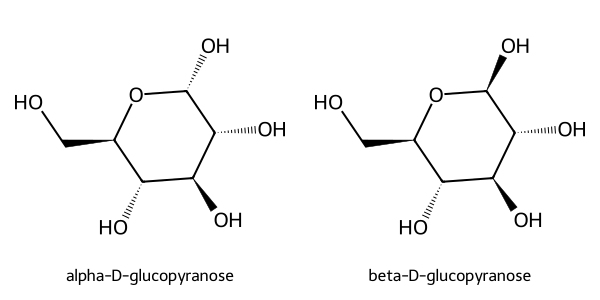
Must knowWhen the ring closes, the former carbonyl carbon becomes the new anomeric carbon, giving two anomers:
- anomer: anomeric axial in the chair; points down in a Haworth projection.
- anomer: anomeric equatorial; points up in a Haworth.
Haworth shortcut for D-hexoses: right in Fischer = down in Haworth; left = up. The (C6) goes up for D-sugars.
Chair Conformations and Stability
Must knowThe real shape of a pyranose is a chair, with substituents axial or equatorial; equatorial is favored (less steric strain). -D-glucose is the most stable sugar because all its substituents are equatorial — part of why glucose is the preferred fuel. -D-glucose has the anomeric axial, so it is slightly less stable; at equilibrium (mutarotation) the mix is roughly 64% , 36% .
Worked example: Pure -D-glucose dissolved in water reads , then drifts to . Why?
The ring opens and re-closes as or (). The equilibrium mixture () gives a weighted average:
This is mutarotation — interconversion of anomers via the open chain. The final value lies between the two pure-anomer values, as expected for a mixture.
Epimers and Anomers
Epimers
Must knowEpimers differ at exactly one chiral center (other than the anomeric carbon):
- C4 epimers: D-Glucose and D-Galactose (basis of galactosemia).
- C2 epimers: D-Glucose and D-Mannose.
"Epimer" always implies a specific center — glucose and galactose are C4 epimers.
Anomers
Must knowAnomers are the special case that differ only at the anomeric carbon. - and -D-glucose are anomers; they interconvert via the open chain (mutarotation).
Quick check: Are -D-glucose and -D-galactose anomers? — No. They differ at C4, so they are C4 epimers, not anomers.
Hydrolysis of the Glycoside Linkage
How Glycosidic Bonds Form
Must knowWhen the anomeric of one sugar reacts with the of another molecule, water is lost and an O-glycosidic bond forms. The anomeric carbon is now an acetal (from aldose) or ketal (from ketose) — stable, and unable to open. So once a glycoside forms, the sugar loses its free anomeric carbon and is no longer a reducing sugar.
A reducing sugar has a free anomeric that can open to the aldehyde/ketone and be oxidized. All monosaccharides, maltose, and lactose are reducing; sucrose is not.
Hydrolysis
Must knowHydrolysis reverses glycoside formation — water attacks the acetal carbon (acid- or enzyme-catalyzed):
Enzymes are specific: -glycosidases cleave links, -glycosidases (e.g., lactase) cleave links. Lactose intolerance = insufficient lactase for the bond.
Reducing Sugar Tests
Know the logicBoth detect a free (open-chain) reducing sugar:
- Benedict's: (blue) → (brick-red precipitate).
- Tollens': → (silver mirror).
Quick check: Benedict's test on sucrose — what do you observe? — No color change (stays blue). Sucrose is non-reducing: both anomeric carbons are in the glycosidic bond.
N-Glycosidic Bonds
Passage-levelThe anomeric carbon can bond to nitrogen instead of oxygen. Two examples: the sugar–base bond in every nucleoside/nucleotide, and sugars attached to asparagine in N-linked glycoproteins. Like O-glycosides, these lock the anomeric carbon (non-reducing).
Oxidation and Reduction Products
Know the logicNamed products:
- Aldonic acid — oxidation of the C1 aldehyde to (e.g., glucose → gluconic acid; what Tollens'/Benedict's do).
- Uronic acid — oxidation of the terminal C6 to (e.g., glucuronic acid).
- Alditol — reduction of the carbonyl to a polyol (e.g., glucose → sorbitol).
Phosphorylation of Sugar Hydroxyls
Passage-levelSugar groups are ordinary alcohols. Biologically the key reaction is phosphorylation by kinases, giving sugar phosphates (e.g., glucose-6-phosphate). The charged phosphate traps the sugar in the cell and activates it for metabolism.
Amino Sugars and Deoxy Sugars
Passage-levelAmino sugars replace a ring with an amino group, often N-acetylated — e.g., N-acetylglucosamine (GlcNAc) (building block of chitin). Deoxy sugars lack one — key example 2-deoxyribose in DNA.
Keto-Enol Tautomerism of Monosaccharides
The Concept
Know the logicTautomers interconvert by proton transfer. The relevant pair is the keto form () and the enol form ( on a ). Keto is usually favored, but the enol is briefly accessible.
Why It Matters
Know the logicAldoses and ketoses interconvert via an enediol intermediate. In glycolysis, phosphoglucose isomerase converts glucose-6-phosphate (aldose) to fructose-6-phosphate (ketose) through an enediol at C1–C2. The same enolization lets glucose, fructose, and mannose interconvert in base (no need to name the reaction). It also explains why ring-form reducing sugars can be oxidized — the equilibrium pulls rings open via the enolizable open chain.
Quick check: Phosphoglucose isomerase converts an aldose to a ketose without breaking the carbon skeleton. What intermediate does it proceed through? — An enediol intermediate at C1–C2.
Disaccharides
Formation and Naming
Must knowDisaccharides are two monosaccharides joined by an O-glycosidic bond, named (anomeric carbon) (carbon of second sugar) with /. Know all four:
| Disaccharide | Components | Linkage | Reducing? | Role |
|---|---|---|---|---|
| Maltose | Glc + Glc | Yes | starch digest product | |
| Lactose | Gal + Glc | Yes | milk sugar | |
| Sucrose | Glc + Fru | No | table sugar | |
| Trehalose | Glc + Glc | No | insect/fungal storage |
Sucrose is the most-tested non-reducing disaccharide: both anomeric carbons are locked, so neither can open. Hydrolysis by sucrase (invertase) gives an equimolar glucose + fructose invert sugar. Lactose and maltose each keep a free anomeric carbon → reducing.
Quick check: A patient lacks sucrase. After eating table sugar, what accumulates in the intestinal lumen? — Sucrose itself, causing osmotic diarrhea and bloating from bacterial fermentation.
Polysaccharides
Starch
Must knowStarch is the plant storage polysaccharide, with two parts:
- Amylose: linear glucose; the links coil it into a helix that binds iodine () → blue-black (starch test).
- Amylopectin: like amylose plus branch points (~every 24–30 units); branching gives more non-reducing ends for faster hydrolysis.
Digestion: salivary then pancreatic -amylase cleave ; a debranching enzyme handles .
Glycogen
Must knowGlycogen is the animal analog of amylopectin but more highly branched ( every 8–12 units), giving many non-reducing ends for rapid mobilization by glycogen phosphorylase. Stored in liver (blood glucose) and muscle (local energy).
OptionalEnzymes: glycogen synthase builds (from UDP-glucose); branching enzyme makes ; phosphorylase cleaves terminal by phosphorolysis; debranching enzyme cleaves .
Cellulose
Must knowCellulose is glucose. The links extend the chain into straight ribbons that hydrogen-bond into rigid, insoluble microfibrils (plant cell walls). Humans lack cellulase, so cellulose is indigestible fiber; ruminants digest it via gut microbiota.
Chitin
Passage-levelChitin is like cellulose but built from -linked N-acetylglucosamine; it forms arthropod exoskeletons and fungal cell walls.
Quick check: Why does in starch coil while in cellulose extends? — In , the anomeric is axial, tilting each unit → helix. In , it's equatorial; alternating flips give a flat, linear chain that H-bonds laterally for rigidity.
Common Confusions & Tricks
1. vs. . Haworth (D-sugars): = anomeric down. Chair: = axial. -D-glucose: axial → less stable → 36%; = equatorial → 64%.
2. Epimer ≠ Anomer. An anomer is a specific epimer (differs only at the anomeric carbon). C4 epimers (glucose/galactose) are NOT anomers.
3. Sucrose is the only common non-reducing disaccharide — and the one most likely tested. Both anomeric carbons are bonded ().
4. D-Fructose cyclizes at C2, not C1. As a ketose, its anomeric carbon is C2; / still applies there.
5. Glycogen is more branched than amylopectin — every 8–12 vs. 24–30 glucoses → faster mobilization.
6. Cellulose is , not . That single change makes a nutrient into indigestible fiber.
7. The iodine test is specific to amylose. Glycogen gives reddish-brown; cellulose, no color.
8. Fischer D/L: look only at the bottom-most (highest-numbered) chiral center. Right = D, Left = L.
9. Benedict's → reducing sugar → free anomeric carbon. Monosaccharides, maltose, lactose are reducing; sucrose and trehalose are not.
10. Mutarotation requires water and goes through the open chain. In dry conditions anomers can't interconvert; a freshly dissolved solution holds the anomer you dissolved until equilibrium.
Key Equations
| Expression | Variables & Use |
|---|---|
| Empirical formula of monosaccharides; number of carbons. | |
| Weighted-average optical rotation at equilibrium (mutarotation); = mole fraction. | |
| Hemiacetal formation; reversible ring-closure step. | |
| Glycoside (acetal) formation; removes free anomeric ; product non-reducing. | |
| Hydrolysis of O-glycosidic bond; regenerates free anomeric . | |
| Keto-enol tautomerism; basis of aldose-ketose interconversion via enediol. | |
| Benedict's test; (blue) → (red); positive = reducing sugar. |