Introduction: Why Phenols Matter in Biology
A phenol is just an on an aromatic ring, but the reversible oxidation of phenols to quinones is a central electron-transfer strategy in biochemistry. The electron transport chain depends on a phenol-derived molecule shuttling electrons between complexes — connecting organic chemistry to cell biology in a way the MCAT loves.
The central story: phenol → quinone is an oxidation; quinone → phenol is a reduction, and this interconversion carries electrons (and protons) with chemical control.
Priority labels: Must know = cold; Know the logic = mechanism not names; Passage-level = recognize, don't memorize; Optional = skippable.
Phenol Structure and Reactivity: A Quick Foundation
Must knowA phenol is an aromatic ring bearing at least one hydroxyl group directly on the ring (distinguish from aliphatic alcohols and from benzyl alcohol, , which is not a phenol). The is more acidic than an alcohol ( vs. ) because the phenoxide anion is resonance-stabilized — the negative charge delocalizes into the system (onto the ortho and para ring carbons, not just the oxygen).
The ring is electron-rich because donates density, making phenols good electron donors (reducing agents). Oxidizing a phenol gives a quinone (a cyclic diene-dione); reducing the quinone regenerates the phenol. This oxidation-state change is the foundation of everything that follows.
Acidity, Substituent Effects, and Ring Reactivity
Must knowSubstituents tune acidity through that same delocalization. Electron-withdrawing groups (especially at ortho/para) stabilize the phenoxide and lower the pKa (stronger acid); electron-donating groups (, , ) raise the pKa. p-Nitrophenol (pKa ≈ 7) and picric acid (2,4,6-trinitrophenol, pKa ≈ 0.4) are dramatic EWG examples. An ortho substituent that can hydrogen-bond intramolecularly to the (e.g., salicylaldehyde) perturbs acidity/volatility relative to the para isomer.
Acidity enables a separation. A phenol (pKa ≈ 10) is not deprotonated by but is deprotonated by ; a carboxylic acid (pKa ≈ 4–5) is deprotonated by both. This separates a carboxylic acid (into aqueous bicarbonate) from a phenol (only into aqueous hydroxide) from neutral organics in an acid–base extraction.
Know the logicBeing electron-rich, the is a strong activating, ortho/para-directing group in electrophilic aromatic substitution — phenol + Br₂ needs no catalyst and gives 2,4,6-tribromophenol. The phenoxide is also a good nucleophile: in a Williamson ether synthesis it displaces an alkyl halide () to give an aryl alkyl ether, and it attacks acyl groups to form aryl esters (acetylating salicylate's phenol makes aspirin).
The Hydroquinone / Quinone Redox Couple
Structure and Oxidation States
Must knowHydroquinone (1,4-benzenediol) has two groups at the 1 and 4 positions. Benzoquinone (para-benzoquinone) is its oxidized form, with two ketone () groups at 1 and 4. Note the aromatic ring is lost on oxidation — sacrificing aromaticity is why energy (from NADH) is needed to drive reduction.
The interconversion is:
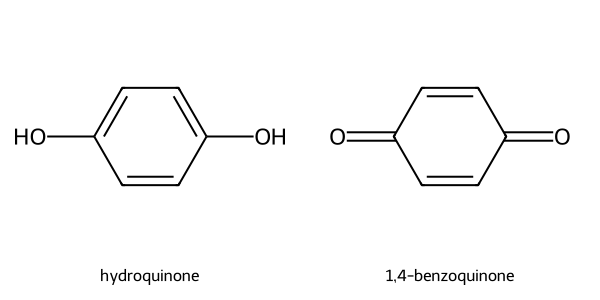
This is a 2-electron, 2-proton (2H/2e) redox couple. Catechol (1,2-dihydroxybenzene) likewise interconverts with an ortho-quinone.
The Three Oxidation States: Semiquinone
Know the logicThe 2e transfer can go stepwise. After transferring one electron, the intermediate is the semiquinone radical ( or ) — a species with an unpaired electron.
| Species | Name | Electrons removed | Radical? |
|---|---|---|---|
| Hydroquinone () | Fully reduced | 0 | No |
| Semiquinone () | Half-oxidized | 1 | Yes (radical) |
| Quinone () | Fully oxidized | 2 | No |
This is a key MCAT concept: because quinones have an accessible 1e intermediate, they are the biochemical bridge between 2e donors (NADH, FADH) and 1e carriers (Fe-S clusters, cytochromes). The quinone/hydroquinone couple sits at a moderate reduction potential — more easily reduced than NADH, less so than the cytochromes — which is exactly why ubiquinone accepts from the early ETC complexes and passes to Complex III. (You do not need to compute reduction-potential values.)
Quick check: Is the conversion of hydroquinone to benzoquinone an oxidation or reduction? What is oxidized?
Answer: An oxidation. The carbons bearing go from to (higher oxidation state). Hydroquinone loses 2 electrons (and 2 protons), so it is the reducing agent and gets oxidized.
Ubiquinone (Coenzyme Q): The Master Redox Shuttle
Structure
Must knowUbiquinone, or Coenzyme Q (CoQ), is a benzoquinone ring carrying methoxy and methyl substituents plus a long isoprenoid tail (CoQ in humans). The lipophilic tail anchors CoQ in the inner mitochondrial membrane, where it diffuses laterally to shuttle electrons between the large, immobile protein complexes. That mobility is its defining feature.
Ubiquinone in the Electron Transport Chain
Must knowCoQ operates between Complexes I/II and Complex III:
- Complex I (NADH dehydrogenase) oxidizes NADH and reduces → .
- Complex II (succinate dehydrogenase) oxidizes FADH and also reduces → .
- diffuses to Complex III (cytochrome ), which oxidizes it back to , passing electrons one at a time to cytochrome .
CoQ carries both electrons AND protons ( = ). Protons are released into the intermembrane space during oxidation at Complex III, feeding the proton gradient that drives ATP synthase — unlike cytochromes, which carry only electrons.
OptionalQ cycle: Complex III uses the semiquinone intermediate to split the 2e transfer into two sequential 1e steps, sending one electron forward to cytochrome and cycling the other back, pumping extra H.
Worked Example: Tracking Electrons Through CoQ
Know the logicProblem: NADH donates 2 electrons to Complex I. Trace them through CoQ to cytochrome .
Complex I: NADH is oxidized; its 2e pass through Fe-S clusters (1e transfers) to reduce → , transiently forming semiquinone after the first electron.
Diffusion: (reduced, neutral, lipophilic) diffuses to Complex III.
Complex III (Q cycle): is oxidized; the first electron goes to cytochrome (Fe → Fe), leaving a semiquinone radical, and the second electron returns to the quinone pool. 2 H are released into the intermembrane space.
Sanity check: CoQ is regenerated — a true catalytic electron carrier, not consumed.
Other Biologically Relevant Phenol/Quinone Systems
Vitamin K (Phylloquinone / Menaquinone)
Passage-levelVitamin K is a naphthoquinone (quinone core on naphthalene) that undergoes the same hydroquinone/quinone redox cycle. Its hydroquinone form is the cofactor for -carboxylation of glutamate in clotting factors; during the reaction it is oxidized to the epoxide and recycled by vitamin K epoxide reductase — the target of warfarin.
Vitamin E (Tocopherols)
Must knowVitamin E (-tocopherol) is a phenol that acts as a lipid-soluble antioxidant, donating an H atom (1H + 1e) to quench a chain-carrying lipid peroxyl radical. Phenols are good antioxidants because the weak O–H bond gives a resonance-stabilized phenoxyl radical that halts the radical chain (the tocopheryl radical is regenerated by Vitamin C). Synthetic phenols like BHT and natural polyphenols work the same way. This is phenols acting in a 1e (radical-trapping) mode.
Tyrosine and the Catecholamines
Know the logicThe amino acid tyrosine has a phenol side chain (pKa ≈ 10) and launches several pathways: hydroxylation to L-DOPA (a catechol) en route to dopamine → norepinephrine → epinephrine; iodination to make thyroid hormones (T₃, T₄); and phosphorylation of its by tyrosine kinases as a signaling switch.
The catechol motif is redox-active — catechols oxidize easily to ortho-quinones (the same phenol→quinone chemistry). This underlies melanin formation (via tyrosinase) and the enzymatic browning of cut apples and potatoes (polyphenol oxidase).
Plastoquinone
Passage-levelPlastoquinone is the plant analog of ubiquinone, functioning in the chloroplast thylakoid membrane between Photosystems II and I (it carries electrons and protons to the cytochrome complex, analogous to Complex III).
Quick check: Warfarin inhibits vitamin K epoxide reductase. Would it cause accumulation of the oxidized or reduced form of vitamin K?
Answer: Accumulation of the oxidized (epoxide) form, because the reductase that regenerates the active hydroquinone is blocked. Without the reduced form, -carboxylation of clotting factors fails — explaining warfarin's anticoagulant effect.
The 2e⁻ Redox Center: Why It Matters Mechanistically
Comparing Redox Carriers
Must knowThe MCAT may ask you to compare carriers:
| Carrier | Electrons | Protons carried? | Location |
|---|---|---|---|
| NADH / NADPH | 2e (as H) | Yes | Aqueous (soluble) |
| FADH | 2e | Yes | Protein-bound |
| CoQ () | 2e | Yes | Membrane (lipid) |
| Cytochrome | 1e | No | Aqueous (peripheral) |
| Fe-S clusters | 1e | No | Protein-bound |
CoQ is uniquely the only major mobile carrier in the membrane and the only one carrying both e and H, making it essential for the proton gradient. Because each successive carrier has higher affinity for electrons, electrons flow "downhill" from NADH through CoQ to the cytochromes to O, with energy released used to pump protons. (The quantitative treatment belongs to bioenergetics, not here.)
Common Confusions & Tricks
1. "Quinone is reduced, hydroquinone is oxidized" — students reverse this.
Hydroquinone has hydrogens added — it's the reduced form; quinone is oxidized (). "Hydro-" = added hydrogen = reduction. is fully reduced.
2. CoQ carries protons; cytochrome does not.
Only CoQ (and NADH/FADH) carry H. Cytochromes transfer electrons only via Fe/Fe; no proton transfer.
3. Semiquinone = radical, but not always bad.
In the ETC, semiquinone radicals are controlled intermediates. Uncontrolled release leads to superoxide () — making mitochondria a major ROS source.
4. Ubiquinone vs. ubiquinol:
= ubiquinone (oxidized, acceptor); = ubiquinol (reduced, donor). The "-ol" suffix = reduced form.
5. Warfarin and vitamin K — know which form is blocked.
Warfarin blocks the reductase (oxidized → reduced), so oxidized (epoxide) vitamin K accumulates → no active hydroquinone → no clotting factor carboxylation.
6. "Dihydroxybenzene → think redox potential."
Catechols (1,2-diol) and hydroquinones (1,4-diol) both have quinone forms. Two hydroxyls on a ring → consider a redox carrier.
7. FADH vs. CoQ — both 2e carriers, but FAD is protein-bound.
FADH never leaves its enzyme; CoQ is the mobile carrier. Not interchangeable.
Key Equations
| Relationship | What to know |
|---|---|
| Hydroquinone/quinone redox couple (2e⁻/2H⁺). = ubiquinol (reduced), = ubiquinone (oxidized). | |
| Semiquinone radical = the 1e⁻ intermediate; lets quinones bridge 2e⁻ and 1e⁻ carriers (and is a source of ROS if released). | |
| Phenol quinone | Phenol/hydroquinone (reduced) is oxidized to quinone; quinone is reduced back. The "hydro-"/"-ol" form is the reduced form. |
| Acidity comparison | Phenol pKa ≈ 10 (resonance-stabilized phenoxide) ≫ alcohol pKa ≈ 16; EWGs (–NO₂ o/p) lower pKa, EDGs raise it. |