Aromaticity: The Foundation You Cannot Skip
Must knowPriority labels: Must know = cold; Know the logic = mechanism not names; Passage-level = recognize, don't memorize; Optional = skippable.
Aromaticity is a special stability from full delocalization of π electrons around a closed loop. This extra stability (lower energy than isolated double bonds would predict) is called resonance stabilization energy.
Hückel's Rule is the formal test for aromaticity. A molecule is aromatic if it is:
- Cyclic,
- Planar (p-orbital overlap around the whole ring),
- Fully conjugated (every ring atom contributes a p orbital; sp² or sp), and
- Contains π electrons, where (i.e., 2, 6, 10, 14, …).
The most important case is → 6 π electrons (benzene and most biological heterocycles). A compound with π electrons (4, 8, 12 …) is antiaromatic — destabilized relative to a non-conjugated analog (explains why some rings avoid planarity).
Benzene is the prototype: 6 sp² carbons, 6 π electrons (), planar — far more stable than 1,3,5-cyclohexatriene would be, which is why benzene resists addition reactions that would destroy aromaticity.
Quick check: Cyclobutadiene has 4 π electrons. Is it aromatic, antiaromatic, or nonaromatic?
Answer: Antiaromatic (, ). It is extremely unstable and is not isolable under normal conditions — exactly the opposite of benzene.
Polycyclic Aromatic Hydrocarbons (Fused Rings)
Must knowPolycyclic aromatic hydrocarbons (PAHs) are all-carbon systems built from ortho-fused benzene rings that share an edge: naphthalene (2 rings, mothballs), anthracene (3 linear), phenanthrene (3 angular).
The π system is delocalized across the entire fused framework (count all π electrons together, not ring by ring), making PAHs flat, rigid, and stable. Because they are planar and hydrophobic, PAHs can intercalate between DNA base pairs — which is why many PAHs (from combustion/smoke) are mutagens and carcinogens: intercalation distorts the helix.
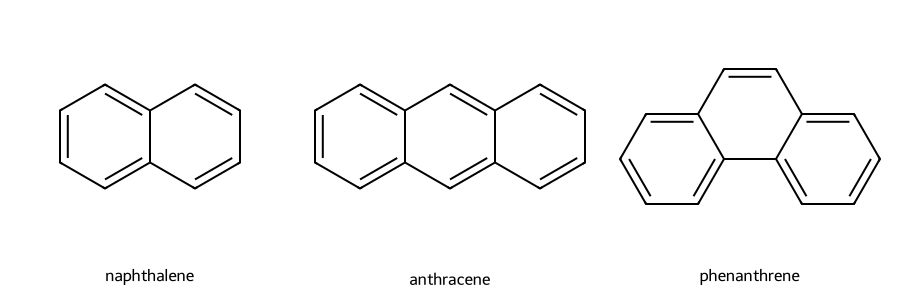
Two other fused-ring frameworks to recognize: the steroid nucleus (three 6-membered + one 5-membered ring; saturated, not aromatic) and the fused purine base (the key fused aromatic heterocycle, covered below).
Six-Membered Heterocycles: Pyridine and Pyrimidine
Pyridine
Must knowPyridine () is benzene with one —CH— swapped for nitrogen. The sp² nitrogen contributes one p-orbital electron to the π system (like each carbon), keeping 6 π electrons → aromatic.
Pyridine's nitrogen lone pair sits in the plane of the ring (in an sp² orbital, perpendicular to the p orbitals), not in the π system. It is therefore available for protonation, making pyridine a base — but a weaker one than aliphatic amines (sp² N is more electronegative; vs. ~10–11 for amines).
Pyridine's nitrogen also makes the ring electron-poor (withdraws density by induction and resonance), so EAS is slower than on benzene and occurs at the 3-position (C-2, C-4, C-6 are deactivated by the nitrogen).
Quick check: Pyridine reacts with a strong electrophile. At which position does EAS occur, and why not at C-2?
Answer: EAS occurs at C-3. At C-2 and C-4, resonance structures place positive charge directly on the electronegative nitrogen, making those transition states very high in energy. C-3 avoids this, so it is the kinetically preferred position.
Pyrimidine
Must knowPyrimidine is a six-membered ring with two nitrogens at positions 1 and 3 (1,3-diazine). Still 6 π electrons and aromatic, but even more electron-deficient than pyridine. It is the parent ring of three DNA/RNA bases: cytosine, thymine, and uracil.
Quick check: Does pyrimidine satisfy Hückel's rule?
Answer: Yes. The ring has 6 atoms (all sp²), is planar and cyclic, and contributes 6 π electrons (, ). Both nitrogens donate one p-orbital electron each to the π cloud; their lone pairs are in the plane.
Five-Membered Heterocycles: Pyrrole, Imidazole, Furan, and Thiophene
Pyrrole
Must knowFive-membered heterocycles donate the heteroatom's lone pair into the π system to reach 6 π electrons and be aromatic.
In pyrrole (), 4 carbons contribute 1 π electron each, plus the nitrogen contributes 2 (its lone pair): π electrons → aromatic.
Because the lone pair is locked into the π system, it is not available for protonation — so pyrrole is an extraordinarily weak base (); protonation would destroy aromaticity. (It is actually weakly acidic at N–H, since the pyrrolyl anion is aromatically stabilized.) The same electron-rich character makes pyrrole highly activated toward EAS, reacting at C-2 (alpha position).
Contrast with pyrrolidine (fully saturated, no π system, ): a normal secondary amine with a free lone pair. The huge basicity gap (11 vs. −3.8) is the whole point — pyrrole's lone pair is tied up in aromaticity.
Imidazole
Must knowImidazole is a five-membered ring with two nitrogens (positions 1 and 3); it is the side chain of histidine. The key feature: it has one pyrrole-like nitrogen (N-1, N–H, lone pair in the π system) and one pyridine-like nitrogen (N-3, lone pair in the plane, available for protonation). So imidazole is aromatic (6 π electrons) and a moderate base, .
That sits right at physiological pH (~7.4), so histidine's side chain is partly protonated and partly neutral — making it a superb proton shuttle. This is why histidine is the catalytic residue in serine-protease catalytic triads, carbonic anhydrase, and many other enzymes.
Quick check: In the catalytic triad of chymotrypsin (Asp–His–Ser), what role does histidine's imidazole play?
Answer: The imidazole nitrogen (pyridine-like N-3) accepts the proton from serine's hydroxyl during nucleophilic attack on the substrate's peptide bond, then donates it to the leaving amine group. Its near 7 makes it an ideal proton shuttle at physiological pH.
Furan and Thiophene
Know the logicFuran (, O) and thiophene (, S) follow the same logic as pyrrole: the heteroatom donates a lone pair, giving 6 π electrons → aromatic. Both are aromatic but somewhat less so than benzene (furan least, because electronegative oxygen is reluctant to donate; thiophene more aromatic). Optional thiophene appears in biotin (vitamin B7).
Quick check: Why is furan's oxygen lone pair donated to the π system rather than remaining in the plane?
Answer: Only by donating the lone pair can the ring achieve 6 π electrons and become aromatic — the thermodynamic gain from aromaticity is large enough to overcome oxygen's preference for keeping its electrons.
Polycyclic Aromatic Systems: Indole and Purine
Indole
Must knowIndole is benzene fused to pyrrole — the side chain of tryptophan, the largest and most UV-absorbing standard amino acid ( nm, the basis for measuring protein concentration). It has 10 π electrons (, ); the pyrrole-like nitrogen makes it electron-rich.
Purine
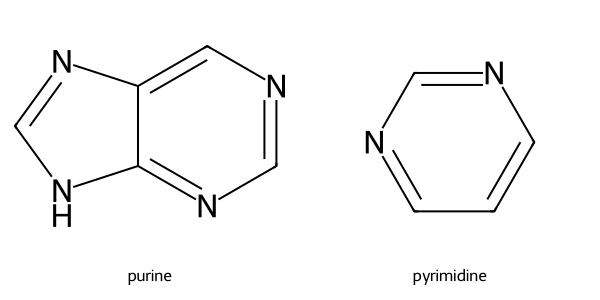
Must knowPurine is pyrimidine fused to imidazole, 10 π electrons, fully aromatic. It is the parent of the purine bases adenine (also in ATP, NAD⁺, FAD, CoA) and guanine (DNA/RNA). Passage-level other purine derivatives include uric acid (purine catabolism end product; gout) and caffeine.
OptionalThe glycosidic bond to (deoxy)ribose attaches at N-9.
Quick check: ATP contains how many aromatic rings, and what are they?
Answer: ATP contains adenine, which is a substituted purine — itself a bicyclic fused aromatic system (pyrimidine + imidazole). So ATP contains one bicyclic aromatic unit (the purine adenine), comprising two fused aromatic rings.
Biological Nucleobases: DNA and RNA
Must knowThe five nucleobases:
| Base | Ring type | Found in | Pair with |
|---|---|---|---|
| Adenine (A) | Purine | DNA + RNA | Thymine (DNA) / Uracil (RNA) |
| Guanine (G) | Purine | DNA + RNA | Cytosine |
| Cytosine (C) | Pyrimidine | DNA + RNA | Guanine |
| Thymine (T) | Pyrimidine (methylated uracil) | DNA only | Adenine |
| Uracil (U) | Pyrimidine | RNA only | Adenine |
Memory trick — Purines are larger (two rings), Pyrimidines are smaller (one ring): A purine always pairs with a pyrimidine. The geometry of the double helix requires this — if two purines paired, the helix would bulge; if two pyrimidines paired, it would pinch.
Watson-Crick base pairing is governed by complementary hydrogen bonding, not just size:
- A–T: 2 hydrogen bonds (A donates 1, T donates 1, accepts 1)
- G–C: 3 hydrogen bonds (stronger, higher melting temperature)
G–C-rich regions melt at higher temperatures than A–T-rich regions. This is why (melting temperature) of DNA increases with %G–C content — directly testable on the MCAT.
Keto–Enol Tautomerism in Nucleobases
Know the logicThe bases exist predominantly in keto form. The rare enol tautomers can cause mismatch base pairing — a molecular basis for spontaneous mutations. E.g., enol-guanine pairs with thymine instead of cytosine, giving a transition mutation after replication. The keto form is strongly favored, so this is rare but non-zero.
Quick check: A researcher measures the of two DNA fragments of equal length. Fragment X has 70% G–C content; Fragment Y has 30% G–C content. Which melts at a higher temperature, and why?
Answer: Fragment X melts at a higher temperature. G–C base pairs form 3 hydrogen bonds vs. 2 for A–T. More energy is required to denature G–C-rich DNA, so is higher.
Heterocycles in Amino Acids and Biological Cofactors
Aromatic Amino Acids
Must knowThree standard amino acids contain aromatic rings and are worth knowing in detail:
| Amino acid | Ring system | Key MCAT facts |
|---|---|---|
| Phenylalanine (Phe, F) | Benzene (phenyl group) | Hydrophobic, nonpolar; UV absorbs ~257 nm weakly |
| Tyrosine (Tyr, Y) | Phenol (hydroxybenzene) | Can be phosphorylated; UV absorbs ~274 nm; ionizable () |
| Tryptophan (Trp, W) | Indole (benzene + pyrrole) | Strongest UV absorber at 280 nm; rarest standard amino acid; precursor to serotonin |
| Histidine (His, H) | Imidazole | Catalytic residue; in isolated form, variable in proteins |
Note: histidine's side-chain is ~6 free but can shift (≈4–9) in protein environments — part of why it is so versatile catalytically.
Heme and Porphyrins
Must knowHeme is a porphyrin: four pyrrole rings linked by methine bridges, fully conjugated and aromatic, coordinating a central ferrous iron ().
- In hemoglobin/myoglobin, heme iron binds reversibly; in cytochromes it cycles between and during electron transport.
- CO binds heme far more tightly than , blocking oxygen binding (CO poisoning); cyanide inhibits Complex IV (cytochrome c oxidase) at its heme iron.
- Chlorophyll is a related porphyrin with magnesium instead of iron.
NAD⁺/NADH and FAD/FADH₂
Must know- NAD⁺ = an adenine (purine) nucleotide linked to a nicotinamide ring (a pyridine derivative). The electron-poor nicotinamide ring accepts a hydride () at C-4: NAD⁺ → NADH.
- FAD = an adenine nucleotide plus a riboflavin (isoalloxazine, fused tricyclic aromatic) unit; it accepts 2 electrons + 2 protons → FADH₂.
Quick check: Why is the nicotinamide ring in NAD⁺ a good hydride acceptor?
Answer: The nicotinamide ring is electron-deficient (pyridine-like, nitrogen withdraws electrons inductively and by resonance), so the positively charged ring in NAD⁺ readily accepts electrons. The reduction product NADH has a non-aromatic, sp³ carbon at C-4 — so NADH is actually less stable (less aromatic) but stores the reducing equivalents.
Reactivity of Heterocycles: EAS and Nucleophilic Aromatic Substitution
Know the logicThe single rule is whether the heteroatom donates or withdraws electron density:
- Electron-rich, donate a lone pair (pyrrole, furan, thiophene, indole) → faster than benzene at EAS, at C-2 (alpha).
- Electron-poor, withdraw (pyridine, pyrimidine) → slower than benzene at EAS, at the 3/5-position. Optional imidazole is intermediate.
Nucleophilic Aromatic Substitution (NAS)
Know the logicThe flip side: electron-poor heterocycles (pyridine, pyrimidine) instead favor nucleophilic aromatic substitution — a nucleophile attacks a carbon bearing a leaving group. Relevant to some drug mechanisms.
Quick check: A student wants to nitrate pyrrole. Should they use harsh conditions (concentrated + ) or mild conditions? Where will substitution occur?
Answer: Mild conditions — pyrrole is electron-rich and very reactive toward EAS. Harsh acidic conditions would also protonate pyrrole (even though it is a weak base), disrupting aromaticity and potentially destroying the ring. Nitration occurs at C-2 (the alpha carbon adjacent to nitrogen).
Common Confusions & Tricks
1. Pyridine-like N vs. pyrrole-like N — the most tested distinction:
- Pyridine-like N (in pyridine, imidazole N-3, purine N-1, N-3, N-7): lone pair is in the plane (sp² orbital), NOT in π system → available, moderate base.
- Pyrrole-like N (in pyrrole, imidazole N-1, indole N): lone pair IS in the π system → not available, essentially non-basic (destroying aromaticity costs too much).
2. Don't confuse purine and pyrimidine bases:
- "Pure As Gold" — Purines = Adenine and Guanine (bigger rings, two fused rings)
- Pyrimidines = Cytosine, Thymine, Uracil (smaller, one ring — C, T, U are in alphabetical order after the purines)
3. A–T has 2 H-bonds; G–C has 3:
Students reverse this. Remember: G–C is the "stronger" pair (more H-bonds, higher contribution) — G and C are both larger, more complex molecules with more H-bond donors and acceptors.
4. Thymine vs. Uracil:
Thymine = Uracil + a methyl group at C-5. Thymine is in DNA (T for DNA), Uracil is in RNA. The methyl group on thymine provides protection against spontaneous deamination (cytosine → uracil is a common mutation; if uracil were normally in DNA, this repair mechanism would fail).
5. Basicity order: aliphatic amine >> pyridine > aniline > pyrimidine >> pyrrole.
Students expect pyridine to be weakest because it "looks aromatic" — but its lone pair is NOT in the ring, it is free. Pyridine is basic; pyrrole (lone pair in the π system) is essentially non-basic.
6. Hückel's rule applies to the whole ring: For fused bicyclics like indole and purine, you count ALL π electrons across the entire conjugated system — not ring by ring. Indole has 10 π electrons total (), not two separate 6-electron systems.
7. CO poisoning and cyanide poisoning are different targets:
- CO → binds hemoglobin heme iron (prevents transport)
- Cyanide → inhibits cytochrome c oxidase (Complex IV) heme iron (prevents utilization)
Both involve heme, but at different points in the oxygen pathway.
8. Guanine's enol tautomer causes G–T mispairs, not G–A:
The enol form of guanine mimics adenine's hydrogen-bonding pattern and pairs with thymine, not with another purine. This causes transition mutations (purine–pyrimidine pair maintained, sequence changed).
Key Equations
This is a qualitative structure/reactivity topic — the only "equation" is Hückel's rule. Compact reference:
| Rule | When to use |
|---|---|
| (Hückel's Rule) | Total π electrons must equal this for aromaticity. Count one per sp² C or pyridine-type N; two from a pyrrole-type lone pair (N, O, S). |
| basicity | Pyridine-type N ; imidazole ; aliphatic amine –; pyrrole-type N . |
| Higher G–C → higher DNA melting temp (3 H-bonds vs. 2 for A–T). | |
| for proteins | Trp/Tyr/Phe absorb UV ~280 nm; used to estimate protein concentration. |