Enzymes are biological catalysts. They speed reactions up enormously — not by changing the thermodynamics (they do not), but by providing a lower-energy pathway. Everything the MCAT tests about enzymes flows from that one insight.
Priority labels: Must know = cold; Know the logic = mechanism not names; Passage-level = recognize, don't memorize; Optional = skippable.
Mechanism: How Enzymes Actually Work
The Thermodynamic Picture
Must knowAn enzyme does not change . The free-energy gap between substrates and products is fixed by chemistry. What an enzyme does is lower the activation energy () by stabilizing the transition state, making the reaction far faster at body temperature.
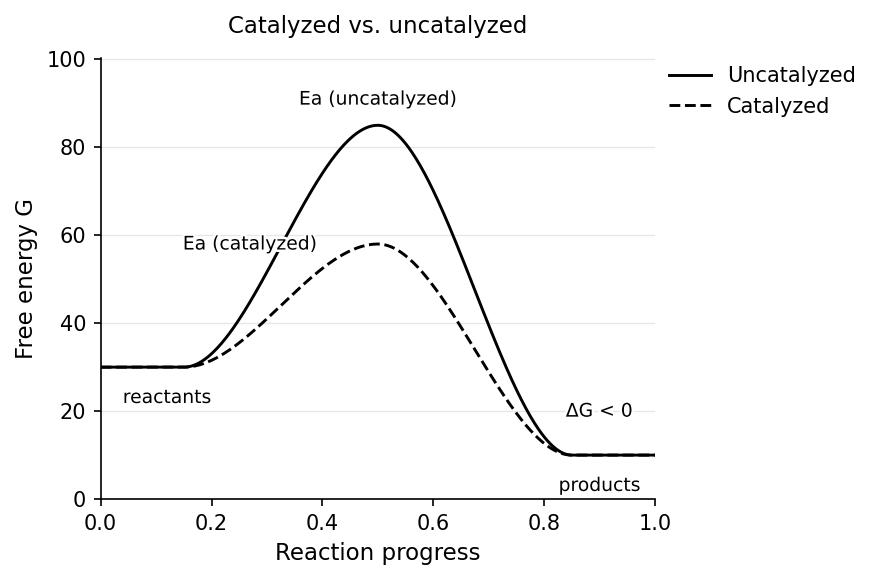
Because rate depends exponentially on , even a modest drop in gives a huge rate acceleration.
Molecular Strategies for Catalysis
Know the logicUnderstand these mechanisms; don't memorize every example enzyme.
- Proximity/orientation: holding substrates together in the right geometry.
- Transition-state stabilization: the active site is complementary to the transition state, not the ground-state substrate — a subtle but critical point.
- Covalent catalysis: an active-site nucleophile transiently bonds the substrate. Serine proteases (chymotrypsin, trypsin) are the canonical example, using a Ser–His–Asp catalytic triad as a charge relay.
- Acid–base catalysis: active-site residues donate/accept protons.
- Metal-ion catalysis: a metal (e.g., in carbonic anhydrase) acts as a Lewis acid.
Substrate Specificity and the Binding Models (Brief)
Know the logicTo frame catalysis: an enzyme acts on a specific substrate because the active site's shape, charge, and H-bonding are complementary to it. The lock-and-key model pictures a rigid, preformed pocket; the accepted induced-fit model has a flexible site that closes around the correct substrate to align catalytic residues. Either way, the site is ultimately complementary to the transition state, not the ground-state substrate — the basis for the transition-state stabilization above. (Enzyme classification, binding-model detail, and cofactors/coenzymes are covered in the 1A Enzyme Structure and Function guide.)
Quick check: Hexokinase undergoes a "clam-shell" closure around glucose on binding. Which model does this illustrate, and what's the advantage?
Answer: Induced-fit. The closure excludes water, preventing wasteful ATP hydrolysis — the conformational change creates the right environment for catalysis, not just binding.
Kinetics
General Concepts
Must knowTwo intuitions:
- An enzyme lowers for both directions equally — it speeds the approach to equilibrium but does not change .
- Enzyme catalysis is saturable: finite active sites mean that at high , all sites are full and adding substrate does nothing. This is what distinguishes enzyme kinetics from simple chemical kinetics.
Turnover number () = substrate molecules converted per enzyme per second at saturation. Catalytic efficiency is the best single measure of how good an enzyme is (fast and tight-binding); the most efficient enzymes approach the diffusion-controlled limit.
Michaelis-Menten Kinetics
Must knowThe model (single-substrate, steady-state assumption that stays roughly constant):
- = velocity; = max velocity; = substrate conc.
- = Michaelis constant = at which .
Low = high affinity (half-saturation reached at low ); high = low affinity. approximates of the ES complex when .
The vs. plot is a rectangular hyperbola: first-order at low , approaching zero-order () at high .
The Lineweaver-Burk Plot
Must knowTaking the reciprocal linearizes Michaelis-Menten:
- y-intercept = ; slope = ; x-intercept = .
Must know these intercepts cold — they're how you read off and and how you distinguish inhibition types.
Worked Example
Know the logicGiven data where as , and at mM:
- (the plateau).
- mM (the giving half ).
- Check at : ✓
- LB intercepts: y-int ; x-int ; slope .
(Cooperative, multi-subunit enzymes give a sigmoidal vs. curve rather than a hyperbola; cooperativity is covered with biological regulation in the 1A Control of Enzyme Activity guide.)
Effects of Local Conditions on Enzyme Activity
Must knowEach enzyme has an optimum for temperature and pH; extremes denature it.
- Temperature: rate rises with temperature until the optimum (~ for human enzymes), then drops sharply as the protein denatures — a bell-shaped curve.
- pH: activity depends on the protonation state of active-site residues; each enzyme has a pH optimum (e.g., pepsin ~2, most intracellular enzymes ~7.4).
- Passage-level Salt/substrate/product: high ionic strength can disrupt salt bridges; product accumulation slows the forward rate (product inhibition).
Quick check: A lab measures serum enzyme activity at 25°C instead of 37°C. How will measured activity compare to true physiological activity?
Answer: Lower — slower molecular motion and fewer collisions exceeding , so underestimates true activity.
Inhibition
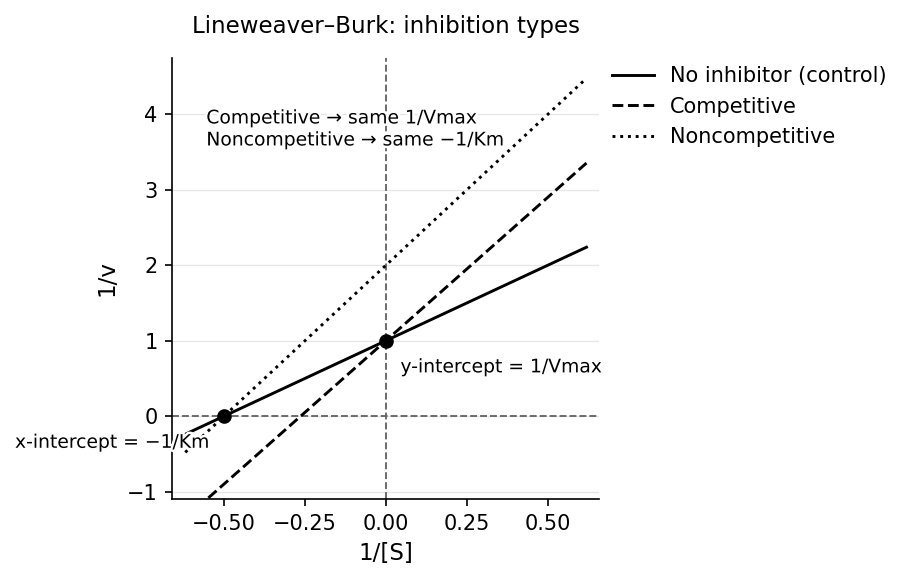
Must knowInhibition types and their effects on , , and the Lineweaver-Burk plot — heavily tested.
Competitive
Must knowInhibitor resembles substrate and binds the active site; the two compete.
- unchanged (high outcompetes inhibitor); increases.
- LB: same y-intercept, steeper slope, x-intercept shifts toward zero.
- Optional Examples: statins (HMG-CoA reductase), methotrexate (DHFR).
Uncompetitive
Must knowInhibitor binds only the ES complex.
- decreases; decreases (same factor) → slope unchanged.
- LB: parallel lines, higher y-intercept.
Mixed / Pure Noncompetitive
Must knowInhibitor binds both E and ES at a site other than the active site (allosteric).
- Pure noncompetitive (equal affinity for E and ES): decreases, unchanged.
- LB: lines intersect on the x-axis (x-intercept unchanged, higher y-intercept).
| Type | LB lines | ||
|---|---|---|---|
| Competitive | ↑ | — | same y-int, steeper |
| Uncompetitive | ↓ | ↓ | parallel |
| Pure noncompetitive | — | ↓ | cross on x-axis |
Irreversible
Know the logicSome inhibitors form covalent bonds, permanently inactivating the enzyme — not described by standard analysis. Optional Examples: aspirin (COX), organophosphates (acetylcholinesterase), penicillin (transpeptidase).
Quick check: With an inhibitor, the LB y-intercept is unchanged but the slope is steeper. What are and doing, and why is the y-intercept unchanged?
Answer: unchanged (same y-intercept ), increased (steeper slope) — a competitive inhibitor. The y-intercept holds because high still outcompetes the inhibitor to reach .
Common Confusions & Tricks
1. "Enzymes shift equilibrium" — WRONG. They speed the approach to equilibrium but don't change or . A passage claiming an enzyme makes a thermodynamically unfavorable reaction favorable is wrong.
2. Competitive ↑ ; uncompetitive decreases . Uncompetitive inhibitors bind ES preferentially, pulling equilibrium toward ES — you need less substrate for half-saturation. (Here decreased is a kinetic artifact, not increased affinity.)
3. LB x-intercept with competitive inhibition. ↑ → ↓ → the x-intercept moves toward zero (right). Remember you're plotting , so the sign flips the intuition.
4. ≠ affinity (always). only when . Safe rule: lower = half-saturation at lower .
5. Coenzyme vs. cofactor vs. prosthetic group. Cofactor = any non-protein helper. Coenzyme = organic, vitamin-derived. Prosthetic group = tightly/covalently bound (FAD, heme); if it floats away and returns it's a cosubstrate (NAD⁺, CoA).
6. Allosteric vs. active site. Allosteric effectors bind a separate site; competitive inhibitors bind the active site. Test: does high substrate overcome it? Yes → competitive; no → allosteric.
7. Irreversible inhibition is not kinetics. Standard analysis doesn't apply; adding substrate can't reverse a covalent inhibitor.
8. "ATCase = cooperative AND allosteric." Cooperativity (subunit communication) and allostery (regulation by a distinct effector) often coexist but are conceptually separate.
9. Zymogen activation is irreversible. Cleaving pepsinogen to pepsin can't be undone — unlike reversible allostery and phosphorylation.
10. Temperature bell curve. Activity rises with temperature to the optimum, then drops from denaturation. Don't confuse this with temperature's effect on (van't Hoff thermodynamics).
Key Equations
| Equation | Variables & When to Use |
|---|---|
| Michaelis-Menten: = initial velocity, = max velocity, = substrate conc., = at half-maximal velocity | |
| Lineweaver-Burk: linearizes Michaelis-Menten; y-intercept = , x-intercept = , slope = | |
| Relates to turnover number and total enzyme | |
| Overall measure of enzyme performance (speed × binding); diffusion-limited ceiling – | |
| Competitive inhibition: apparent increases; unchanged | |
| Uncompetitive/noncompetitive: apparent decreases | |
| Standard Michaelis-Menten reaction scheme |