Chemical kinetics and equilibrium sit at the heart of how reactions actually behave — not just whether they can happen, but how fast they go and where they end up. The MCAT tests both together because they are deeply linked: the ratio of forward and reverse rate constants is the equilibrium constant. That connection is the backbone of this guide.
Priority labels: Must know = cold; Know the logic = mechanism not names; Passage-level = recognize, don't memorize; Optional = skippable.
Reaction Rates and What Controls Them
The Concept of Reaction Rate
Must knowA reaction rate measures how quickly reactants are consumed or products formed — the "speed" of a reaction at a given moment. Rates are positive, expressed as change in concentration per unit time (units: ).
For a general reaction , you can monitor any participant, but stoichiometric coefficients matter (A disappears faster than C appears if ), so we normalize:
Negative signs on reactants keep the rate positive (their concentrations fall); the coefficients in the denominator give the same rate no matter which species you monitor.
Quick check: For , if increases at , what is the rate of disappearance of ?
Answer: Rate . Since , disappears at .
Rate Laws and the Rate Constant
Must knowRate depends on the concentrations of reactants (not products, not overall stoichiometry). The rate law is experimentally determined:
- is the rate constant — specific to a reaction at a given temperature; its units depend on overall order.
- and are the orders in A and B. These are not the stoichiometric coefficients — they must be determined from experiment.
- The overall order is .
Why not from stoichiometry? A balanced equation gives the net change, not the mechanism. The rate law reflects the slowest step. Only for an elementary step (a single-collision event) does stoichiometry equal kinetic order.
Reaction Orders
Must know| Order | Rate Law | Units of | vs. Time | Half-life behavior |
|---|---|---|---|---|
| Zero | Linear decrease | shortens as falls | ||
| First | Exponential decay | constant () | ||
| Second | Hyperbolic decay | lengthens as falls |
The first-order half-life: , independent of initial concentration. First-order kinetics is ubiquitous (radioactive decay, many drug-clearance processes). You don't need integrated rate laws or half-life formulas for other orders — just the qualitative trends above.
Recognizing order from a linear plot: know which plot is a straight line:
- Zero order: vs. (slope )
- First order: vs. (slope )
- Second order: vs. (slope )
Quick check: A researcher monitors a reaction and finds that decreases from to in 20 min, and then from to in the next 20 min. What is the order?
Answer: The half-life is constant at 20 min regardless of concentration — this is the hallmark of a first-order reaction. .
Determining Rate Laws from Experimental Data
Must knowMethod of initial rates. Vary one reactant concentration at a time and compare initial rates:
Worked example:
| Experiment | (M) | (M) | Initial rate (M/s) |
|---|---|---|---|
| 1 | 0.10 | 0.10 | |
| 2 | 0.20 | 0.10 | |
| 3 | 0.10 | 0.30 |
Step 1 — Find (order in A): Compare experiments 1 and 2 ( held constant):
Step 2 — Find (order in B): Compare experiments 1 and 3 ( held constant):
Step 3 — Rate law:
Step 4 — Solve for (exp. 1): — units s confirm first order. ✓
The Rate-Determining Step and Mechanisms
What the Rate-Determining Step Means
Must knowThe rate-determining step (RDS) is the slowest elementary step — the bottleneck that governs the overall rate. Because it is elementary, you can write its rate law directly from its stoichiometry.
Key consequence: if an intermediate (produced in one step, consumed in a later one) appears in the RDS, substitute it out using the equilibrium expression from the prior fast step. The final rate law must contain only reactants, never intermediates.
Quick check: A mechanism has two steps: (1) (fast equilibrium) and (2) (slow). What is the overall rate law?
Answer: Rate . From the fast equilibrium, . Substituting: rate . The observed rate constant is , and the reaction is first order in A, second order in B, third order overall.
Temperature, Activation Energy, and Transition States
Activation Energy and the Transition State
Must knowPicture a reaction as a ball rolling over a hill. To get from reactants to products, the system must climb to a peak — the transition state (activated complex): a fleeting, high-energy arrangement that is a maximum on the energy surface, not a stable intermediate.
The activation energy () is the energy gap from reactants up to the transition state — the minimum energy colliding molecules need to react.
Interpreting Energy Profiles
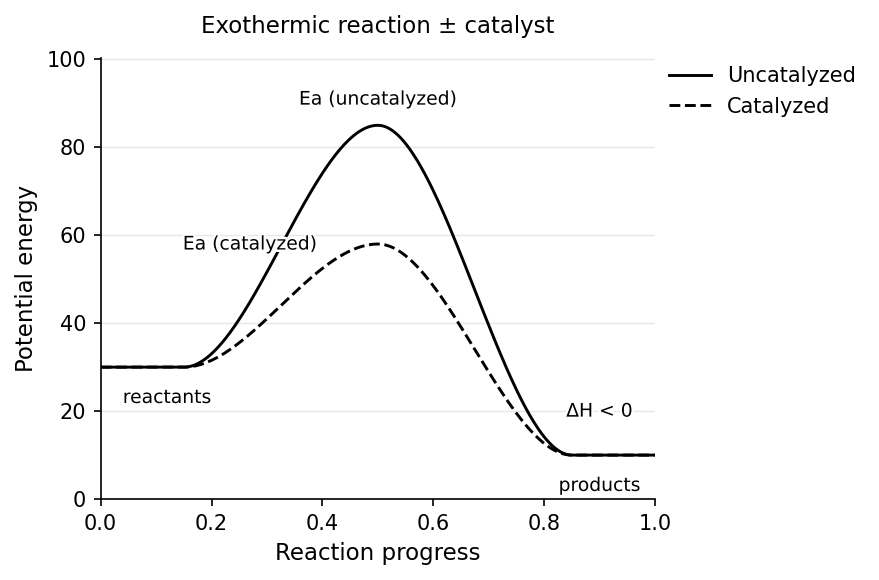
Must knowA reaction-coordinate (energy profile) diagram plots potential energy () vs. reaction progress (). Must know how to read it:
- Peak height above reactants = (forward reaction)
- Peak height above products = (reverse reaction)
- Difference between reactant and product energy =
- Reactants higher than products → exothermic ()
- Products higher than reactants → endothermic ()
- A catalyst lowers the peak (decreases ) without changing the energy of reactants or products — so is unaffected.
- A multi-step mechanism shows multiple peaks (one per elementary step) separated by valleys (intermediates, which are local minima).
Quick check: An energy profile shows reactants at 40 kJ/mol, a transition state peak at 100 kJ/mol, and products at 60 kJ/mol. What are (forward), (reverse), and ?
Answer: ; ; (endothermic).
The Arrhenius Equation
Must knowHigher temperature → faster molecules → more collisions with energy ≥ → faster rate. The Arrhenius equation quantifies this:
- = frequency factor (collision frequency + orientation)
- = activation energy; ; in Kelvin
Linearized, : a plot of vs. is a straight line with slope , the experimental route to .
The qualitative behavior: larger → smaller (slower); higher → larger . The dependence is exponential, not linear — doubling does not just double the rate. The MCAT tests this qualitatively, not via two-temperature calculations.
Quick check (Arrhenius): Two reactions are run at the same temperature. Reaction 1 has ; reaction 2 has . With identical frequency factors, which has the larger rate constant ?
Answer: Reaction 1. A smaller makes the exponent less negative, so is larger and is larger — the lower-barrier reaction is faster.
Kinetic vs. Thermodynamic Control
Must knowWhen a reaction can give two products, which one dominates depends on conditions:
- Kinetic control (low temperature, short time): the product that forms fastest — lower — the kinetic product.
- Thermodynamic control (high temperature, long time): the most stable product (lowest free energy) — the thermodynamic product.
At high there's enough energy to cross both barriers repeatedly, so the reaction becomes reversible and equilibrates to the most stable product; at low it's effectively trapped at the kinetic product. (Classic example: 1,2- vs. 1,4-addition to conjugated dienes — 1,2 is kinetic, 1,4 is thermodynamic.)
Quick check: Two products A and B can form from the same starting material. Product A has and . Product B has and . Which is the kinetic product? Which is the thermodynamic product?
Answer: A has the lower activation energy → A is the kinetic product. B has the more negative (more stable) → B is the thermodynamic product. Use low temperature/short time for A; high temperature/long time for B.
Catalysts
Must knowA catalyst speeds a reaction by providing an alternative pathway with lower . Key features:
- Not consumed — it is regenerated.
- Lowers for both forward and reverse by equal amounts.
- Therefore does not change , , or — only the rate at which equilibrium is reached, never its position.
Biological hook: enzymes are catalysts that lower by stabilizing the transition state in their active site.
Quick check: A catalyst is added to the reaction . Initially, and the forward rate the reverse rate. After adding the catalyst, does change?
Answer: No. remains 50. The catalyst speeds up both forward and reverse rates equally (both values decrease by the same amount), so the ratio of rate constants — and hence — is unchanged.
Chemical Equilibrium
Equilibrium in Reversible Reactions
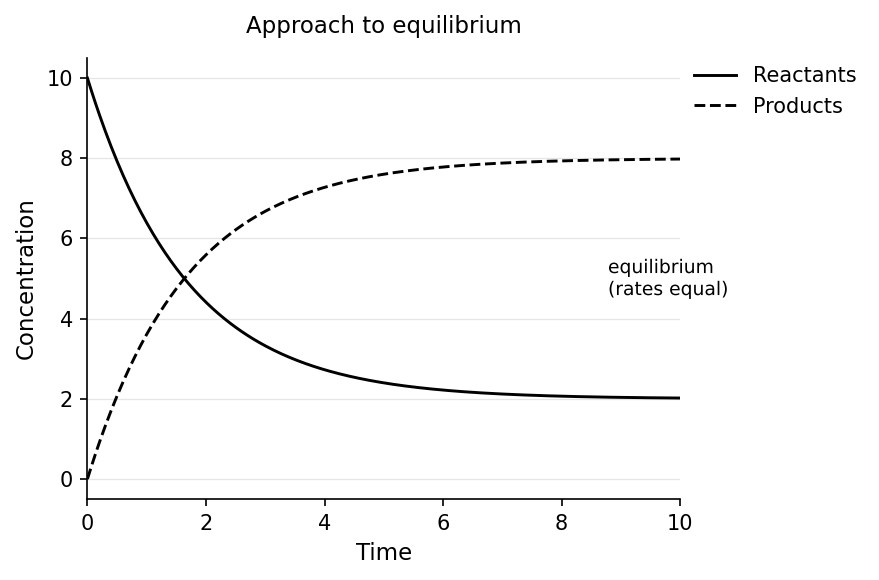
Must knowAs a reaction proceeds, reactants deplete and products build up — the forward rate slows, the reverse rate rises, until the forward rate equals the reverse rate. This is dynamic equilibrium: molecules keep reacting both ways, but macroscopic concentrations stay constant (like an airport where arrivals equal departures).
The Law of Mass Action and the Equilibrium Constant
Must knowFor the general reaction:
The Law of Mass Action states that at equilibrium, the following ratio is constant at a given temperature:
The conventions:
- Concentrations in M give ; partial pressures give (gas-phase).
- Pure solids and pure liquids are omitted (activity = 1) — critical for heterogeneous equilibria.
- is formally dimensionless; for the MCAT, just use the expression's apparent units.
vs. : , where = moles gaseous products − reactants; if , .
Magnitude: → products favored; → both significant; → reactants favored.
Passage-levelManipulating expressions: reverse → ; scale coefficients by → ; add reactions → .
Quick check: For , at 500°C. What is for ?
Answer: First reverse the reaction: . Then multiply all coefficients by : .
The Reaction Quotient Q
Must knowThe reaction quotient has the same form as but uses current (non-equilibrium) concentrations:
Comparing to tells you which way the reaction proceeds:
| Condition | Meaning | Direction of net reaction |
|---|---|---|
| Too many reactants (or too few products) relative to equilibrium | Forward (→) | |
| System is at equilibrium | No net change | |
| Too many products (or too few reactants) relative to equilibrium | Reverse (←) |
Memory trick: Think of as the "current ratio" and as the "target ratio." If your current ratio is too small, the reaction needs to produce more products to reach target.
Quick check: For a reaction with , you measure . Which direction does the reaction proceed?
Answer: , so the reaction proceeds forward (toward products) to reach equilibrium.
Le Châtelier's Principle
The Concept
Must knowLe Châtelier's Principle: a system at equilibrium under a stress shifts in the direction that partially counteracts that stress. "Partially" matters — it never fully reverses the disturbance. It predicts the direction of shift; most stresses don't change at all.
Types of Stresses
Must know1. Adding or removing a reactant or product:
- Add reactant → → shift forward (to consume added reactant)
- Remove reactant → → shift reverse
- Add product → → shift reverse (to consume added product)
- Remove product → → shift forward
Applied hook: exhaling removes from blood, driving the bicarbonate buffer forward: .
2. Pressure/volume (gas-phase only): increasing pressure (decreasing volume) shifts toward fewer moles of gas; decreasing pressure shifts toward more. For (4 → 2 mol gas), increasing pressure shifts forward. If , no effect. Adding inert gas at constant volume does not shift equilibrium (partial pressures unchanged).
3. Temperature — the only common stress that changes . Treat heat as a species:
- Exothermic (): heat is a product → raising shifts reverse → decreases.
- Endothermic (): heat is a reactant → raising shifts forward → increases.
4. Catalyst: no shift in position; only reaches equilibrium faster.
Worked example: , :
(a) Add → → forward. unchanged.
(b) Halve the volume (raise pressure) → left = 3 mol gas, right = 2 → forward. unchanged.
(c) Raise (exothermic) → reverse; falls. decreases.
(d) Add catalyst → no change in position or ; faster only.
Quick check: For , . Does adding more shift the equilibrium?
Answer: No. is a pure solid, so it does not appear in the equilibrium expression. Its addition does not change or shift equilibrium.
The Relationship Between and
Connecting Thermodynamics and Equilibrium
Must knowThe equilibrium constant is thermodynamically defined. At constant and :
( = standard free energy change; ; in K.) The equilibrium position is set by thermodynamics: large negative → (products favored); large positive → (reactants favored).
| Equilibrium favors | ||
|---|---|---|
| Products | ||
| Equal amounts | ||
| Reactants |
The Full Free Energy Equation
Must knowUnder non-standard conditions (almost always the case in biology):
At equilibrium and , recovering . Knowing current and tells you whether the reaction is spontaneous forward right now.
Connection to kinetics: for an elementary reaction — thermodynamics sets , kinetics sets the individual rate constants. A reaction can be thermodynamically favorable () yet kinetically slow (large ) — a frequent MCAT distinction.
Worked example: at 298 K, . Find .
With : . → strongly positive . ✓
Quick check: A reaction has . What is ?
Answer: . Equal amounts of reactants and products at equilibrium.
Common Confusions & Tricks
1. Rate law exponents ≠ stoichiometric coefficients (except for elementary steps). This is the most common error on the MCAT. You cannot write the rate law from the balanced overall equation. Orders must be experimentally determined.
2. vs. rate. A large says nothing about how fast the reaction goes (diamond → graphite has but is immeasurably slow). Always separate thermodynamic favorability from kinetic feasibility.
3. Pure solids and pure liquids in equilibrium expressions. Omit them. Water () is omitted when it is the solvent in aqueous reactions — a frequent trap. But if water is a gas-phase participant in a heterogeneous reaction, it is included.
4. vs. direction: Students often get the direction of shift backwards. Anchor on this: if , the numerator (products) needs to grow → forward reaction. If , the numerator needs to shrink → reverse reaction.
5. Temperature and Le Châtelier's: Temperature is the only common stress that changes . Pressure, concentration, and catalysts change the position of equilibrium but not itself.
6. vs. : uses standard conditions and relates to . is the actual free energy under current conditions and tells you spontaneity right now. The MCAT sometimes gives a passage with non-standard concentrations and expects you to use .
7. Catalyst and energy diagrams: A catalyst lowers both the forward and reverse by the same amount. It cannot make an endothermic reaction exothermic. On an energy profile, the reactant and product energy levels stay the same; only the peak moves down.
8. Half-life trick for first-order reactions: The half-life of a first-order reaction is constant and independent of concentration. This is unique to first order. For zero order, decreases as concentration decreases. For second order, increases as concentration decreases.
9. The sign of vs. the sign of : Since , a negative means means . A positive means . The negative sign is the source of many errors — internalize it.
10. Arrhenius: increasing or decreasing both increase . Catalysts decrease ; higher makes the exponent less negative. Either way rises — exponentially, not linearly.
Key Equations
| Equation | Variables & When to Use |
|---|---|
| Rate law: = rate constant; = orders determined experimentally | |
| Integrated 1st-order rate law; linear plot of vs. (recognize, don't derive) | |
| First-order half-life; independent of initial concentration | |
| Arrhenius equation: = frequency factor; = activation energy; | |
| Equilibrium constant expression; omit pure solids and liquids | |
| Relates and ; = change in moles of gas | |
| $Q = \dfrac{[\text{C}]^c[\text{D}]^d}{[\text{A}]^a[\text{B}]^b}\bigg | _{\text{now}}$ |
| Links standard free energy change to equilibrium constant; | |
| Free energy at non-standard conditions; at equilibrium and |