Bioenergetics is the study of how living systems capture, store, and spend energy. Before any pathway makes sense, you need the thermodynamic rules that govern whether reactions happen at all. This guide builds that foundation from Gibbs free energy to ATP and the electron-carrier machinery.
Priority labels: Must know = cold; Know the logic = mechanism not names; Passage-level = recognize, don't memorize; Optional = skippable.
Bioenergetics and Thermodynamics
The Central Question: Will a Reaction Go?
Must knowThe quantity that captures both drives a cell exploits — toward lower energy and higher disorder — is the Gibbs free energy, :
where is the enthalpy change, is absolute temperature (K), and is the entropy change.
The sign of tells you everything about spontaneity:
| Spontaneity | |
|---|---|
| Exergonic — spontaneous, releases usable energy | |
| Endergonic — non-spontaneous, requires energy input | |
| Equilibrium |
"Spontaneous" does not mean fast. A reaction can be thermodynamically favorable yet proceed imperceptibly slowly without a catalyst. Thermodynamics governs whether a reaction can occur; kinetics governs how fast.
Standard vs. Biochemical Standard Conditions
Must knowThe standard free energy change, , is defined at 298 K, 1 atm, all species at 1 M. Biochemists use , which adds pH = 7 (so M is "standard"). It does not change the equations — just the reference state.
Passage-levelWhy a reaction is spontaneous can be enthalpy-driven (, e.g. combustion) or entropy-driven (, e.g. the hydrophobic effect in protein folding); most biological reactions have both contributions.
Quick check: A reaction has and at 310 K. Is it spontaneous?
Answer: . Yes — entropy-driven and spontaneous even though endothermic.
Free Energy and the Equilibrium Constant
Connecting to
Must knowAt equilibrium , which gives the key link between thermodynamics and equilibrium:
where and is in Kelvin.
| Interpretation | ||
|---|---|---|
| Largely negative | Products favored | |
| Near zero | Roughly equal | |
| Largely positive | Reactants favored |
Under Non-Standard Conditions
Must knowIn a cell, concentrations are never 1 M and the system is held away from equilibrium. The actual free energy change is:
where is the reaction quotient (same form as but using current concentrations).
Even a reaction with unfavorable can be spontaneous () if the cell keeps products low and/or reactants high, making and .
Worked example: with at 310 K, , .
So — spontaneous, despite the unfavorable standard value. Because , the negative term pulls the reaction forward. This is how cells drive "uphill" reactions by controlling concentrations.
Quick check: If at 298 K, what is ?
Answer: , so . Products ~1000× more abundant at equilibrium.
Concentration Effects on
Le Chatelier and the Reaction Quotient
Must knowThe equation formalizes Le Chatelier's principle: when the reaction runs forward; when it runs in reverse.
In metabolism, cells keep far from by supplying reactants and removing products (downstream enzymes consume them immediately). This metabolic flux keeps negative through a pathway even when individual values are small or positive.
Coupled Reactions
Must knowCells exploit this through coupled reactions: an endergonic reaction is paired with an exergonic one. Because is a state function, the totals add:
If is sufficiently negative (e.g., ATP hydrolysis), it drives even when .
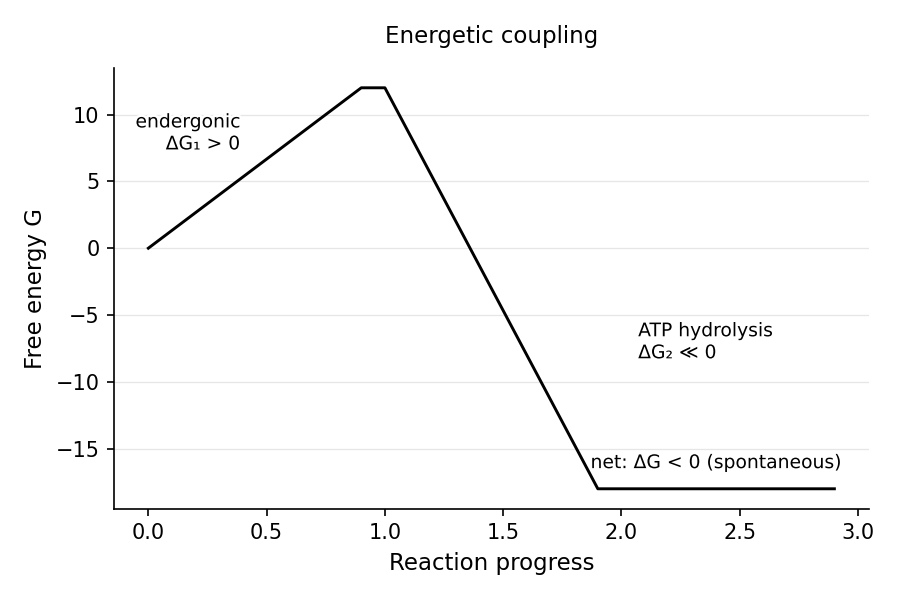
Quick check: Reaction X has , coupled to ATP hydrolysis (). Spontaneous?
Answer: . Yes.
Phosphorylation and ATP
Structure of ATP
Must knowAdenosine triphosphate (ATP) is adenine + ribose + three phosphates (, , ; is the terminal one). The – bond hydrolyzed in most reactions is a phosphoanhydride bond.
A second route releases pyrophosphate (), which pyrophosphatase then hydrolyzes:
That extra hydrolysis drives the reaction further forward, which is why biosynthetic reactions (DNA/RNA synthesis, fatty acid activation) use the AMP + route.
Why ATP Hydrolysis Is So Exergonic
Know the logic(closer to physiologically due to low cellular [ADP], []). Four reinforcing factors: charge repulsion relief in the triphosphate tail, greater resonance stabilization of free , better solvation of products, and an entropy gain (one molecule → two). "High-energy" describes the phosphoryl-group transfer potential, not energy mysteriously stored in the bond.
ATP Group Transfers
Know the logicATP is also a group-transfer reagent, not just an energy source. The three transfers are phosphoryl (, e.g. hexokinase phosphorylating glucose), pyrophosphoryl (), and adenylyl (AMP, e.g. fatty acid activation). In phosphoryl transfer a substrate nucleophile attacks the -phosphate, releasing ADP and leaving a phosphorylated substrate activated for a later step.
Quick check: Glucose-6-phosphate has a more negative of hydrolysis than glucose-1-phosphate. Which is "higher-energy"?
Answer: Glucose-6-phosphate — more energy released on hydrolysis means higher phosphoryl-transfer potential.
Phosphoryl-Transfer Potential Ranking
Must knowATP sits in the middle of the phosphoryl-transfer hierarchy. Compounds above ATP (more negative hydrolysis ) can phosphorylate ADP → ATP; compounds below are phosphorylated by ATP. Don't memorize numbers — know the ranking.
- Above ATP: phosphoenolpyruvate (PEP) and 1,3-bisphosphoglycerate (1,3-BPG) — they drive substrate-level phosphorylation in glycolysis. Creatine phosphate also sits above ATP and acts as an energy buffer regenerating ATP in early intense exercise (, creatine kinase).
- Below ATP: e.g. glucose-6-phosphate.
Substrate-Level vs. Oxidative Phosphorylation
Must knowThe MCAT contrasts these directly.
- Substrate-level phosphorylation: phosphate transferred directly from a high-energy substrate to ADP. Occurs in glycolysis (PEP and 1,3-BPG) and the TCA cycle (succinyl-CoA → succinate, making GTP ≈ ATP). Oxygen-independent.
- Oxidative phosphorylation: ATP synthase uses the proton-motive force to phosphorylate ADP. Oxygen-dependent; source of most cellular ATP.
GTP is interconvertible with ATP. Cellular regulation tracks energy charge — high charge inhibits catabolic enzymes (e.g. PFK-1), rising AMP activates them.
Biological Oxidation-Reduction
The Logic of Biological Redox
Must knowElectrons flow from reduced, high-energy molecules (fats, sugars) to lower-energy acceptors; the released free energy is captured to make ATP. Oxidation is loss of electrons (OIL), reduction is gain (RIG). Biological electron transfer usually occurs as hydride transfer (, two electrons) or hydrogen atom transfer (one electron + one proton).
Standard Reduction Potentials
Must knowEvery redox couple has a standard reduction potential, ( at pH 7), in volts vs. the standard hydrogen electrode. The more positive , the greater the tendency to be reduced.
where = electrons transferred and .
Electrons spontaneously flow from lower (electron donor) to higher (electron acceptor).
Key Biological Redox Couples
Passage-level| Redox Couple | (V) |
|---|---|
| (in flavoproteins) | |
| Coenzyme Q | |
| Cytochrome | |
The large spread from NADH ( V) to ( V) is the thermodynamic engine of oxidative phosphorylation.
Worked Numerical Example: ΔG from Redox Potentials
Know the logicFor NADH oxidation by : .
- Cathode: ,
- Anode: ,
Negative and large — consistent with NADH oxidation driving the ETC (~2.5 ATP per NADH).
Quick check: Would electrons flow spontaneously from FADH₂ to NAD⁺?
Answer: No. , negative → non-spontaneous. Electrons flow from NADH to FAD, not the reverse.
Half-Reactions
Writing and Balancing Biological Half-Reactions
Must knowA half-reaction isolates the oxidation or reduction component. You need to identify which species is oxidized vs. reduced, combine half-reactions, and use to assess spontaneity.
Balancing in acidic aqueous solution: balance non-H/O atoms → balance O with → balance H with → balance charge with .
Example: . Charge: left = right. ✓
Concentration Effects on Cell Potential
Know the logicSince , cell potential shifts with concentration opposite to . The MCAT expects only qualitative reasoning: raising a reactant (reduced species) concentration makes more positive; raising product concentration makes it less positive.
Quick check: For , if cellular rises relative to , does the reduction potential become more positive or more negative?
Answer: More negative. More product (NADH) lowers , making NADH a better electron donor.
Soluble Electron Carriers
The Logic of Carriers
Rather than coupling every oxidation directly to oxygen, cells use soluble electron carriers that pick up electrons from substrates and deliver them to the electron transport chain (ETC). This modular design lets the cell match ATP production to demand.
NAD⁺/NADH
Must knowNicotinamide adenine dinucleotide (NAD⁺) is the primary electron acceptor in catabolism (glycolysis, PDH, TCA). It accepts a hydride ion ( = 2 e⁻ + 1 H⁺) to form NADH:
NADH then carries those electrons to the ETC, where they flow down a potential gradient toward oxygen (complex-by-complex mechanics belong to the oxidative phosphorylation guide).
NADPH is the phosphorylated form — same redox chemistry, but used in anabolic/biosynthetic reactions and antioxidant defense, not the ETC. NADH = catabolism/energy; NADPH = anabolism/biosynthesis.
FADH₂
Must knowFlavin adenine dinucleotide (FAD) is tightly (often covalently) bound to its enzyme. It accepts 2 e⁻ and 2 H⁺:
Because FADH₂ has a less negative than NADH ( vs. V), less energy is released when its electrons reach oxygen — so each FADH₂ supports less ATP than each NADH.
Coenzyme Q (Ubiquinone) and Cytochrome c
Passage-levelTwo further mobile carriers. Coenzyme Q (ubiquinone) is a lipid-soluble carrier diffusing in the inner membrane (reduced form = ubiquinol). Cytochrome c is a small water-soluble heme protein carrying electrons one at a time via its cycle.
Conceptual Link to the Electron Transport Chain
Know the logicThe unifying idea: soluble carriers (NADH, FADH₂) deliver electrons to a membrane-bound chain, where they flow down a reduction-potential gradient from NADH ( V) to ( V). That large favorable drop is the engine the cell harnesses to make ATP.
Quick check: A cell is treated with an inhibitor that blocks NADH from donating electrons early in the ETC. Which carrier accumulates?
Answer: NADH — it can no longer pass electrons forward. With NAD⁺ not regenerated, upstream NAD⁺-dependent TCA dehydrogenases stall too.
Flavoproteins
Structure and Prosthetic Groups
Must knowFlavoproteins contain a flavin prosthetic group — FAD or FMN — both built on the isoalloxazine ring from riboflavin (vitamin B₂), the redox-active moiety.
Know the logicThe ring can accept 1 electron (semiquinone radical) or 2 electrons. This one-or-two electron flexibility lets flavoproteins interface two-electron donors (NADH, succinate) with one-electron carriers (Fe-S clusters, cytochromes).
Why Flavoproteins Matter for the MCAT
Must knowSuccinate dehydrogenase (Complex II) is both a TCA enzyme and an ETC complex — the only direct link between them; its FAD is covalently attached.
OptionalFlavoproteins require riboflavin (B₂), so deficiency impairs multiple oxidative pathways. (Other flavoprotein examples — NADH dehydrogenase/Complex I, fatty acyl-CoA dehydrogenase, glutathione reductase — are reference-level.)
Quick check: Malonate is a competitive inhibitor of succinate dehydrogenase. How does this affect the ETC?
Answer: It blocks Complex II, preventing FADH₂ production from succinate, so those electrons can't enter via Complex II. NADH can still donate via Complex I — the ETC is impaired but not fully blocked.
Common Confusions & Tricks
1. vs. . tells you the equilibrium position; tells you whether the reaction is spontaneous right now under actual concentrations. A reaction with can be spontaneous if .
2. "Spontaneous" ≠ "fast." Thermodynamics gives direction; kinetics gives rate. Diamond → graphite is spontaneous but essentially never happens at room conditions.
3. NADH vs. NADPH. NADH = catabolic (ETC-bound); NADPH = anabolic (biosynthesis/antioxidant). NADH = breaking down; NADPH = building up.
4. FADH₂ gives less ATP than NADH. FAD/FADH₂ has a less negative than NAD⁺/NADH, so its electrons fall through a smaller potential drop to O₂ — less energy, less ATP.
5. ATP hydrolysis vs. physiological . ; in a cell with low [ADP], [], is even more negative (around ).
6. Sign of and are opposite. : positive → negative → spontaneous.
7. FAD is enzyme-bound; NAD⁺ is freely diffusible. Two FAD enzymes can't "share" FADH₂ — it's stuck to the protein. NAD⁺/NADH shuttles freely.
8. is "two ATP equivalents." Cleaving ATP to AMP + pyrophosphate costs two equivalents (because hydrolysis is the second), used to drive biosynthesis hard.
9. Oxidation state vs. "oxidized/reduced." Carbon is oxidized from glucose () to (). Tracking oxidation state is faster than tracking electrons directly.
Key Equations
| Equation | Variables and Use |
|---|---|
| Gibbs free energy; = enthalpy, = temperature (K), = entropy; determines spontaneity | |
| Links standard free energy to equilibrium constant; | |
| Actual free energy at non-standard conditions; = reaction quotient | |
| Links standard free energy to cell potential; = electrons transferred, | |
| Net cell potential; positive means spontaneous | |
| Additivity of for coupled reactions | |
| , | ATP hydrolysis; physiological value |
| , | NAD⁺ reduction half-reaction |
| , | FAD reduction half-reaction; higher than NADH → less ATP |
| , | Oxygen reduction; terminal electron acceptor |