Thermodynamics connects chemistry, physics, and biology into one framework — the same principles that decide whether combustion releases heat also explain ATP production and why ice melts. Build the intuition and the equations follow.
Priority labels: Must know = cold; Know the logic = mechanism not names; Passage-level = recognize, don't memorize; Optional = skippable.
Thermodynamic Systems and State Functions
Must knowA thermodynamic system is the part of the universe you're studying (a flask, a gas in a piston, a cell); everything else is the surroundings, and universe = system + surroundings.
Systems are classified by what they can exchange:
| System Type | Energy | Matter |
|---|---|---|
| Open | Yes | Yes |
| Closed | Yes | No |
| Isolated | No | No |
A living cell is open (exchanges energy and matter); a thermos approximates isolated.
State Functions vs. Path Functions
Must knowA state function depends only on the current state, not the path taken — like altitude: if you're at 2000 m, it doesn't matter whether you hiked or flew. Key ones: internal energy , enthalpy , entropy , Gibbs free energy , , , .
Heat () and work () are path functions — they depend on the process. You can't speak of "the heat of the system," only the heat transferred during a particular process.
This matters: because , , and are state functions, you can add them across steps (Hess's Law) and get the same answer regardless of mechanism.
Quick check: Is the change in altitude between base camp and the summit a state function or path function? Answer: State function — it depends only on the two endpoints, not whether you took the north or south face.
The Zeroth Law and Temperature
Must knowThe Zeroth Law: if A is in thermal equilibrium with C, and B with C, then A and B are in equilibrium with each other. This defines what temperature means — the property that determines whether two objects in contact exchange heat. At equal temperature, no net heat flows (thermal equilibrium).
Always use Kelvin in thermodynamics equations. Never plug Celsius into .
Quick check: Two metal blocks at different temperatures are placed in contact in an insulated box. What happens to the total entropy of the system? Answer: It increases — heat flows spontaneously from hot to cold, and spontaneous processes increase entropy (Second Law preview).
The First Law: Conservation of Energy
Must knowThe First Law is energy conservation: energy is neither created nor destroyed, only transferred or converted.
= change in internal energy, = heat added to the system, = work done on the system.
Sign convention (MCAT/IUPAC): heat in, heat out; work done on system (compression), system does work (expansion). Some physics texts write with = work done by system — same physics, flipped sign on . Read the passage's convention.
The most common work for a gas is pressure-volume work:
Expansion () gives (system loses energy); compression () gives .
Special Process Types
Must knowThese come up constantly in PV diagram questions:
| Process | Constraint | Consequence |
|---|---|---|
| Isothermal | constant | for ideal gas; |
| Adiabatic | ||
| Isobaric | constant | ; |
| Isochoric (isovolumetric) | constant | ; |
Quick check: A gas expands adiabatically against a piston. Does the temperature of the gas increase, decrease, or stay the same? Answer: It decreases. Since , . The gas does work on the piston ( on the system), so — the internal energy drops, which means temperature drops.
PV Diagrams: Visualizing Work
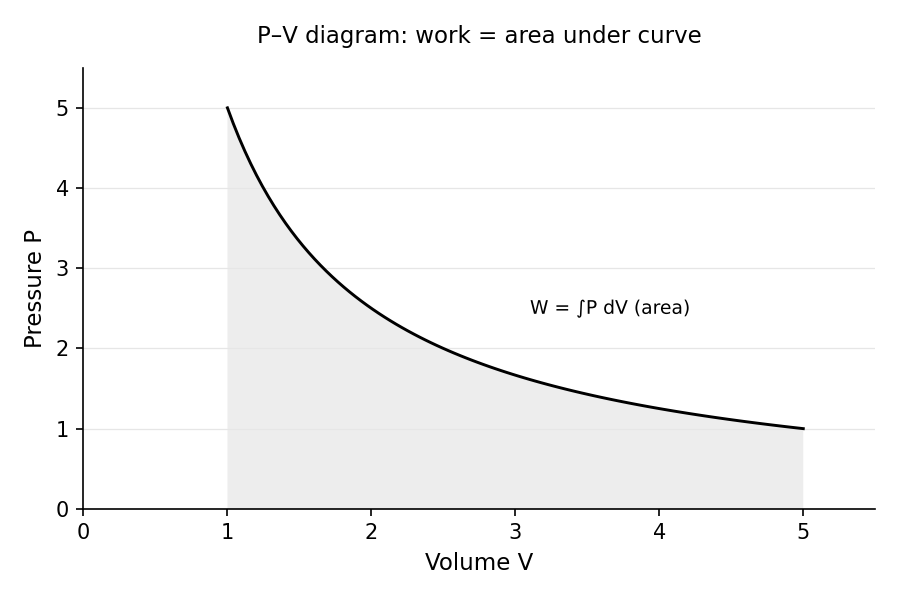
Must knowA PV diagram plots pressure (y) vs. volume (x). The key insight is geometric:
Work done by the system = area under the PV curve. For a cyclic process, net work = area enclosed by the cycle.
(Work done on the system is the negative of this.)
Reading PV Diagrams
Must know- Isobaric (horizontal): , a rectangle.
- Isochoric (vertical): , no work, zero area.
- Isothermal (hyperbola, ): area under the curve.
- Adiabatic: falls more steeply than the isothermal.
Clockwise cycle = system does net positive work (heat engine); counterclockwise = net work done on system (refrigerator/heat pump).
Passage-levelA heat engine absorbs heat from a hot reservoir, converts part to work, and rejects the rest to a cold reservoir. Heat flows spontaneously only hot→cold, so reversing it (a refrigerator) requires work input, and no engine is 100% efficient (heat must always be rejected). No efficiency formula needed.
Worked Example
Must knowA gas at constant pressure expands from to . How much work does the gas do on the surroundings?
Set-up:
Conversion:
Substitution:
Sanity check: The gas expanded (it pushed the piston outward), so it should do positive work on surroundings — J makes sense. In the convention, J.
The Second Law and Entropy
Must knowThe First Law says how much energy is conserved; the Second Law says which direction processes go.
The Second Law: for any spontaneous process, the entropy of the universe increases.
Equality holds only for (idealized) reversible processes; all real spontaneous processes increase .
What Is Entropy, Really?
Must knowEntropy () measures the number of microstates (energetically equivalent arrangements) available — more microstates, more disorder, higher entropy. The MCAT expects this qualitative picture, not the Boltzmann statistical formula.
The thermodynamic definition links entropy to reversible heat flow:
The same heat produces a larger entropy change at low than at high .
Entropy and States of Matter
Must knowEntropy increases as matter becomes less ordered and particles gain more freedom of motion:
Rules of thumb for predicting the sign of :
- Gas is produced from solids or liquids →
- More moles of gas on product side →
- Dissolving most solids →
- Condensation or freezing →
- Reactions that reduce the number of particles →
Quick check: Consider . Predict the sign of .
Answer: . You start with 4 moles of gas and end with 2 moles — fewer particles, fewer microstates, less entropy.
Standard Reaction Entropy
Must knowLike reaction enthalpy, compute reaction entropy as "products minus reactants," weighted by coefficients:
(The MCAT supplies any values; don't memorize tables.)
Calorimetry, Heat Capacity, and Specific Heat
Must knowCalorimetry measures heat flow. The key relationship:
= mass, = specific heat (heat to raise 1 g by 1 K), .
Memorize water's specific heat: . It's unusually high (hydrogen bonding), which buffers temperature changes in organisms.
Heat capacity raises the whole object by 1 K: .
A constant-pressure (coffee-cup) calorimeter gives ; a constant-volume (bomb) calorimeter has , so .
Worked Example: Coffee-Cup Calorimetry
Must know50.0 g of water at 22.0°C is mixed with 50.0 g of water at 38.0°C in an insulated container. What is the final temperature? (Assume for both.)
Set-up: Heat lost by warm water = heat gained by cool water (isolated system):
Substitution (same and cancel):
Sanity check: 30°C is exactly the midpoint between 22°C and 38°C — which makes sense when masses and specific heats are equal.
Quick check: A 100 g block of metal at 80°C is dropped into 100 g of water at 20°C. The final temperature is 24°C. Which has the higher specific heat, the metal or the water? Answer: Water. The water temperature rose only 4°C while the metal dropped 56°C — water absorbed most of the heat with little temperature change, indicating a higher specific heat.
Heat Transfer: Conduction, Convection, and Radiation
Must knowKnow the three mechanisms and which requires a medium.
Conduction — heat through direct molecular contact, no bulk motion. Metals conduct well (high ); air and tissue poorly. A metal bench feels colder than wood at the same temperature because it conducts heat from your skin faster. Rate:
( = conductivity, = area, = thickness.)
Convection — heat by bulk fluid movement (warm rises, cool sinks). Requires a medium. Examples: ocean currents, blood distributing heat.
Radiation — heat via electromagnetic (IR) waves; needs no medium, works through vacuum (the sun heats Earth). Optional quantitative form: Stefan–Boltzmann , with in Kelvin; the dependence makes radiation dominant at very high temperature.
Quick check: An astronaut on a spacewalk is in vacuum. Which heat transfer mechanisms are available to cool the astronaut's suit? Answer: Only radiation — conduction and convection both require a medium, which is absent in vacuum.
Endothermic and Exothermic Reactions
Must know- Exothermic: releases heat, ; products lower enthalpy than reactants. Combustion, neutralization, most bond formation.
- Endothermic: absorbs heat, ; products higher enthalpy. Melting ice, dissolving ammonium nitrate, photosynthesis.
MCAT trick: exothermic means the surroundings get warmer. If dissolving a salt makes the solution feel cold, the dissolution is endothermic.
Quick check: A hot pack used for muscle pain gets warm when activated. Is the chemical reaction inside endothermic or exothermic? Answer: Exothermic — heat is released to the surroundings (your muscle), raising the temperature.
Enthalpy, Standard Heats of Reaction, and Formation
Must knowEnthalpy . At constant pressure (most chemistry, all biochemistry), the enthalpy change equals heat exchanged:
This is why chemists measure — lab reactions occur at constant atmospheric pressure.
Standard Conditions and Notation
Must knowThe standard state is 1 atm, 1 M, and a specified temperature (usually 298 K). Standard quantities carry a superscript .
The standard enthalpy of formation () is the enthalpy to form 1 mole of a compound from its elements in their standard states. By definition for an element in its standard state (e.g., , ).
The standard enthalpy of reaction ("products minus reactants," weighted by coefficients):
Worked Example: Standard Enthalpy of Combustion
Must knowCalculate for the combustion of methane:
Given: , , , .
Set-up:
Calculation:
Sanity check: Combustion is exothermic, so — confirmed. The magnitude (~890 kJ/mol) is consistent with known combustion enthalpies for small alkanes.
Hess's Law of Heat Summation
Must knowHess's Law: because enthalpy is a state function, is the same in one step or many. Algebraically combine known reactions to reach a target.
Strategy: manipulate given reactions so intermediates cancel and the target remains, applying the same operations to — reverse → flip the sign; multiply coefficients by → multiply by — then sum.
Worked Example
Must knowFind for:
Given:
- Reaction 1: ,
- Reaction 2: ,
Strategy: We need CO on the product side. Reverse Reaction 2 to put CO on the product side, then add to Reaction 1:
- Reaction 1 (as written): ,
- Reaction 2 (reversed): ,
Add the reactions: and cancel:
Sanity check: CO formation from carbon is less exothermic than full combustion to , which makes intuitive sense — CO still has chemical energy left.
Quick check: If you double all the coefficients in a Hess's Law manipulation, what happens to ? Answer: It doubles. is an extensive property — it scales with the amount of material reacting.
Bond Dissociation Energies and Heats of Formation
Must knowBond dissociation energy (BDE) is the energy to break one mole of a bond in the gas phase. Breaking bonds costs energy (endothermic); forming bonds releases it (exothermic). Estimate:
Mnemonic: "BREAK − FORM."
This is approximate — tabulated BDEs are averages across molecules.
Worked Example: BDE Approach
Must knowEstimate for
Given: BDE() = 436 kJ/mol, BDE() = 243 kJ/mol, BDE() = 431 kJ/mol.
Bonds broken: 1 mol + 1 mol
Bonds formed: 2 mol
Sanity check: Negative — the reaction is exothermic, which is correct for HCl formation from elements.
Quick check: A reaction has very strong bonds in the products and weak bonds in the reactants. Is it likely to be exothermic or endothermic? Answer: Exothermic — more energy is released forming the strong product bonds than is required to break the weak reactant bonds.
Gibbs Free Energy and Spontaneity
Must knowEnthalpy and entropy alone can't predict spontaneity — a process can be enthalpically favorable but entropically unfavorable. Gibbs free energy () unifies both:
At constant and :
- : spontaneous (exergonic)
- : nonspontaneous (endergonic)
- : at equilibrium
also has a second meaning: equals the maximum non-PV work a process can deliver (e.g., to drive active transport or biosynthesis). Real processes extract less; the difference is lost as heat.
The Four Thermodynamic Scenarios
Must know| Spontaneity | |||
|---|---|---|---|
| (exo) | Always | Spontaneous at all temperatures | |
| (endo) | Always | Never spontaneous | |
| (exo) | at low | Spontaneous at low temperature | |
| (endo) | at high | Spontaneous at high temperature |
The temperature-dependent cases hinge on whether overcomes . The crossover temperature (, equilibrium) is:
Standard Free Energy and Equilibrium
Must knowStandard free energy links to the equilibrium constant:
- (products favored)
- (reactants favored)
Under non-standard conditions:
where is the reaction quotient. When , is more negative — the reaction runs forward. This is why a biochemical reaction with can still be spontaneous if reactant concentrations are high and products low.
Biological connection: ATP hydrolysis has , but under cellular conditions the actual is roughly — more favorable than standard.
Quick check: If a reaction has , can it ever be spontaneous under any conditions? Answer: Yes — if , then can still be negative. Spontaneity depends on actual concentrations, not just standard conditions.
Heat of Fusion and Heat of Vaporization
Must knowPhase transitions occur at constant temperature — energy goes into overcoming intermolecular forces, not raising . This is latent heat:
- Heat of fusion (): to melt. Water: .
- Heat of vaporization (): to vaporize. Water: .
always — vaporization breaks all intermolecular interactions, melting only some (for water, ~7×). This is why sweating cools effectively.
Phase transitions are reversible: condensation releases ; freezing releases .
Quick check: A 10 g ice cube at 0°C is placed in a warm drink. How much heat does it absorb as it melts (before any warming of liquid water)? Use .
The Heating Curve
Must knowThis canonical figure plots temperature (y) vs. heat added (x) through phase changes.
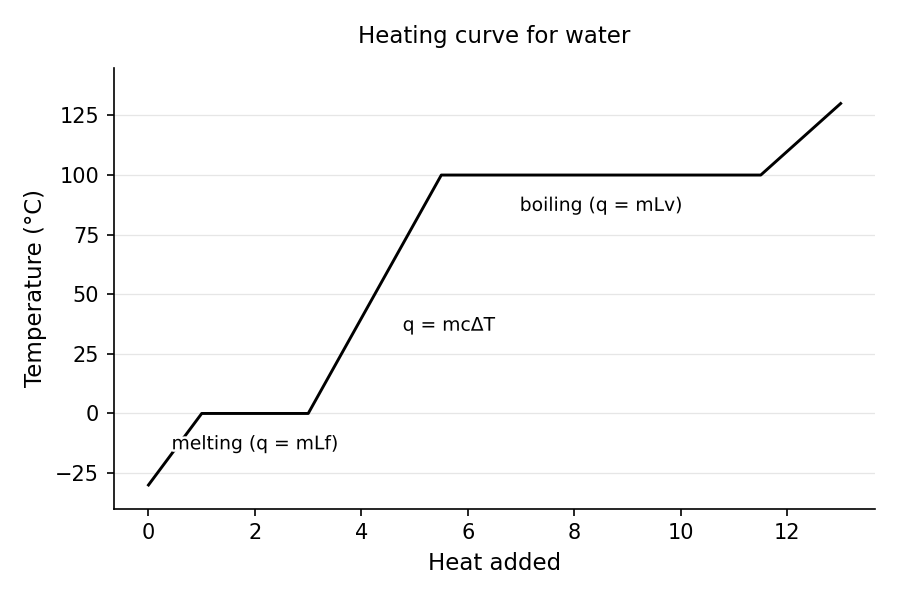
It alternates two segment types:
- Sloped (single phase, rising): . Steeper slope = lower .
- Flat plateaus (phase change, constant): . The vaporization plateau is longer than fusion because .
For a full problem (ice at steam at ), sum every segment: three terms and two terms.
Coefficient of Thermal Expansion
Must knowMost materials expand when heated (atoms vibrate harder, increasing interatomic distance).
Linear expansion (solids):
= linear coefficient (K), = original length.
Volumetric expansion (liquids, gases, 3D solids): , with for isotropic solids.
Exception — water: maximum density at 4°C and expands on freezing (ice's open hexagonal lattice is less dense than liquid). This is why ice floats, insulating aquatic life below.
Quick check: A steel bridge is 200 m long at 20°C. If , how much does it expand when the temperature rises to 50°C?
This is why bridges have expansion joints — to prevent structural damage from thermal expansion.
Phase Diagrams
Must knowA phase diagram maps the stable phase as a function of temperature (x) and pressure (y).
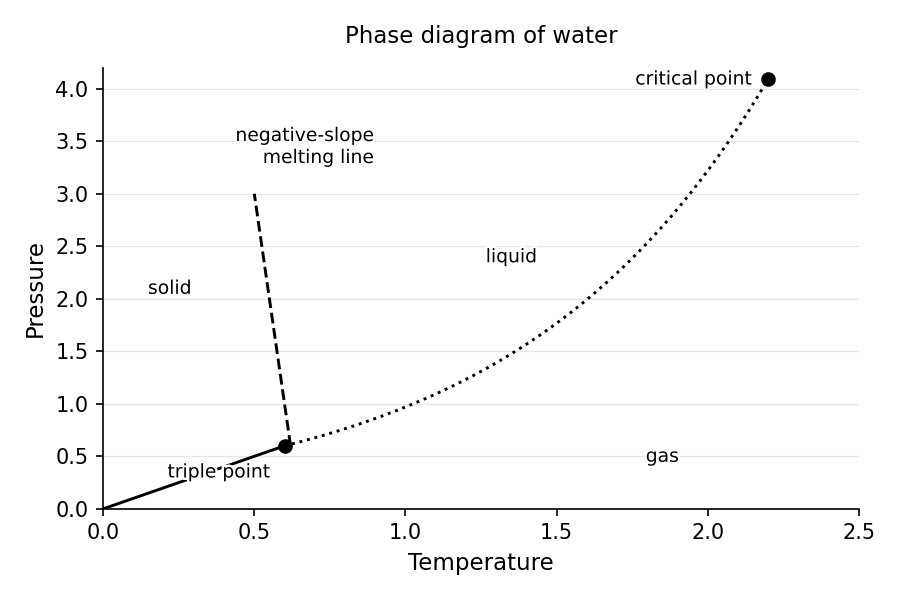
Three critical features:
- Phase boundaries (coexistence curves): two phases in equilibrium.
- Triple point: the unique where all three phases coexist.
- Critical point: above it, liquid/gas distinction vanishes — a supercritical fluid.
Reading a Phase Diagram
Must knowFind the coordinate and read the region. Moving horizontally (↑) is heating; vertically (↑) is pressurizing.
Key feature of water: the solid-liquid (melting) boundary has a negative slope — pressure near 0°C melts ice, because water's liquid is denser than its solid. Most substances have a positive-slope melting curve.
Sublimation (solid → gas, bypassing liquid) happens below the triple point. Dry ice () sublimes at 1 atm because 's triple point is at 5.1 atm.
Vapor pressure is where liquid and gas coexist; boiling occurs when vapor pressure equals external pressure. Lower (altitude) → boils below 100°C; higher (pressure cooker) → above 100°C.
Quick check: At the triple point, you add heat to the system at constant pressure. What happens first? Answer: The system cannot exist stably at the triple point if you move away from it — adding heat at constant pressure (which equals triple point pressure) will cause the solid to convert to liquid and then vapor as temperature rises; you'll observe all transitions in sequence as you heat across the phase boundaries.
Common Confusions & Tricks
1. means spontaneous, not fast. Students confuse thermodynamics with kinetics. Diamond spontaneously converts to graphite at room temperature (), but the rate is effectively zero. Spontaneity tells you the direction of the thermodynamic driving force, not the speed.
2. "Disorder" as the only entropy description gets you in trouble. Entropy is fundamentally about the number of microstates. A gas expanding into a vacuum increases entropy not because it "looks messier" but because there are vastly more spatial arrangements available. Use the microstate language on the exam.
3. The sign convention for work. If a passage uses physics notation (, where = work done BY system), the sign of is flipped relative to chemistry notation (, where = work done ON system). Read carefully — the physics convention is more common in MCAT physics passages.
4. for elements in standard state is zero — but not for all forms. but . Graphite is the standard state of carbon, so but .
5. Hess's Law — don't forget to flip signs when reversing reactions. The most common arithmetic error: students reverse a reaction to get a species on the correct side but forget to change the sign of from negative to positive.
6. "Products minus reactants" for both and calculations. Same formula, same logic: .
7. Phase transition temperatures on phase diagrams require pressure context. Water boils at 100°C only at 1 atm. The boiling point you're given is always at a specified pressure — check the phase diagram's pressure axis.
8. Heat of vaporization >> heat of fusion (for water, ~7× larger). If an exam question asks you to compare energy for melting vs. vaporizing, vaporization always requires far more energy per gram. This is why steam burns are so much more severe than boiling water burns — the skin must absorb from the condensing steam before any cooling begins.
9. and equilibrium vs. and spontaneity. tells you where equilibrium lies (direction of the reaction at standard state); tells you the spontaneity at actual concentrations. These are related by — don't mix them up.
10. BDE estimates give answers only. Bond dissociation energies are averages — use BDE calculations for estimation and trend questions, not when exact thermochemical data are provided.
Key Equations
| Equation | Variables & When to Use |
|---|---|
| First Law: = change in internal energy, = heat added to system, = work done on system | |
| Work for isobaric or constant external pressure; for compression | |
| Work done by gas = area under PV curve; use geometry for simple shapes | |
| Entropy change for reversible heat transfer; in Kelvin | |
| Sensible heat; = mass, = specific heat, = temperature change | |
| Latent heat during phase transition; = specific heat of fusion or vaporization | |
| Conductive heat flow rate; = thermal conductivity, = area, = thickness | |
| Radiative power (Stefan–Boltzmann); must be in Kelvin | |
| Standard enthalpy of reaction from formation enthalpies | |
| Estimate from bond dissociation energies; products − reactants is reversed | |
| Gibbs free energy; spontaneous when ; in Kelvin | |
| Links standard free energy to equilibrium constant; | |
| Free energy at non-standard conditions; = reaction quotient | |
| Temperature at which ; boundary between spontaneous/nonspontaneous | |
| Linear thermal expansion; = linear expansion coefficient (K) | |
| Volumetric thermal expansion; for isotropic solids |