Beyond vision and hearing, your nervous system runs several sensory channels the MCAT tests in specific ways. This guide builds each sense from its receptors up through central processing.
Priority labels: Must know = cold; Know the logic = mechanism not names; Passage-level = recognize, don't memorize; Optional = skippable.
Somatosensation
The Big Picture
Must knowSomatosensation is the body-wide collection of modalities: touch, pressure, vibration, temperature, proprioception, and pain. Its receptors are spread across skin and internal tissues rather than in one organ, and different stimuli are detected by specialized receptor types: mechanoreceptors (touch/pressure/vibration), thermoreceptors (temperature), nociceptors (pain), and proprioceptors (body position).
Mechanoreceptors of the Skin
Know the logicRapidly adapting receptors fire at stimulus onset/offset and signal change (Meissner's corpuscles → light touch/texture; Pacinian corpuscles → high-frequency vibration/deep pressure). Slowly adapting receptors fire continuously and signal ongoing pressure (Merkel's discs → fine spatial detail; Ruffini endings → skin stretch).
Free nerve endings are unencapsulated and detect temperature, crude touch, and pain (nociception).
Receptor density varies across the body and is measured by the two-point threshold — the smallest distance at which two touches feel separate. Densely innervated regions (fingertips, lips) have a tiny threshold; sparse regions (back) need wide separation. This same map appears in cortex as the homunculus, a distorted body map where high-acuity regions occupy disproportionately large areas.
Pain Perception and Gate Control Theory
Must knowTwo fiber types carry pain: Aδ fibers (myelinated, fast) carry sharp, well-localized "first pain"; C fibers (unmyelinated, slow) carry dull, burning "second pain."
Gate Control Theory (Melzack & Wall, 1965): a "gate" in the dorsal horn of the spinal cord regulates how much pain signal reaches the brain.
- Large-diameter Aβ touch/pressure fibers activate inhibitory interneurons that close the gate, reducing Aδ/C pain transmission — why rubbing an injury helps.
- Descending brain pathways (releasing endorphins/endogenous opioids, serotonin, norepinephrine) also close the gate — the basis of placebo and stress-induced analgesia. Pain is thus modulated by attention, expectation, and emotion.
Referred pain: visceral pain perceived at a somatic surface (e.g., cardiac ischemia felt as left arm/jaw pain) because visceral and somatic afferents converge on the same dorsal horn neurons.
Passage-levelDermatomes: skin regions innervated by a single spinal nerve root; relevant to spinal injury and herniated discs.
Quick check: A patient with a herniated L4–L5 disc complains of sharp, well-localized pain shooting down the leg, followed seconds later by a dull ache. Which fiber types carry each component?
Answer: The sharp, quick pain is carried by myelinated Aδ fibers; the dull, delayed ache by slow, unmyelinated C fibers.
Taste (Gustation)
Receptor Biology
Must knowTaste depends on chemoreceptors that respond to dissolved molecules. Taste buds are the sensory organs for taste, clustered on the tongue within bumps called papillae. Fungiform, circumvallate, and foliate papillae contain taste buds; filiform papillae (the most numerous) do NOT — they provide texture. Taste receptor cells are epithelial cells (not neurons) that synapse onto cranial nerve afferents.
The Five Basic Tastes
Must knowKnow the five primary taste qualities and their stimuli:
| Taste | Stimulus | Significance |
|---|---|---|
| Sweet | Sugars | Caloric energy |
| Salty | Na⁺ ions | Electrolyte intake |
| Sour | H⁺ ions (acids) | Spoilage/unripe warning |
| Bitter | Alkaloids, toxins | Aversion to toxins |
| Umami | Glutamate | Protein/amino acid content |
Salty and sour transduce through ion channels (direct ion influx); sweet, bitter, and umami through GPCRs with second-messenger cascades.
Cranial Nerve Pathways
Passage-levelTaste travels on CN VII (anterior 2/3 of tongue, via chorda tympani), CN IX (posterior 1/3), and CN X (epiglottis/pharynx). All converge on the nucleus of the solitary tract (medulla) → thalamus → gustatory cortex (insula).
Quick check: A patient suffers a lesion to the chorda tympani branch of CN VII after middle ear surgery. Which region of the tongue loses taste sensation?
Answer: The anterior two-thirds of the tongue on the affected side, because the chorda tympani carries taste from CN VII territory.
Smell (Olfaction)
Olfactory Receptor Cells
Must knowOlfaction is chemosensory like taste, but its central pathway is distinct and high-yield. Olfactory receptor neurons (ORNs) are bipolar neurons in the olfactory epithelium lining the roof of the nasal cavity. Their ciliated dendrites bear GPCR-type odorant receptors; when a dissolved odorant binds, a second-messenger cascade depolarizes the ORN. Their axons thread through the cribriform plate to the olfactory bulb. A given odor activates a combination of receptor types, letting a limited receptor set discriminate many smells.
CN I (Olfactory nerve) is made of these axons — the shortest cranial nerve, most vulnerable to shear injury in TBI (causing anosmia).
Olfactory Pathways in the Brain
Must knowOlfaction is the only sensory modality whose primary pathway does NOT relay through the thalamus before reaching cortex.
Pathway: ORN axons → olfactory bulb (mitral cells) → via the olfactory tract directly to primary olfactory (piriform) cortex, amygdala, and hippocampus. A secondary route does pass through the thalamus to the orbitofrontal cortex for conscious perception.
The direct limbic connection (amygdala = emotion, hippocampus = memory) explains why smells are powerfully tied to emotional memory.
Pheromones
Must knowPheromones are chemical signals released by one individual that affect the behavior or physiology of another of the same species. In many animals they are detected by the vomeronasal organ (VNO), feeding the accessory olfactory system. In humans the VNO is vestigial/non-functional and evidence for human pheromones is debated and not established — the exam will call for "limited/debated evidence."
Quick check: A patient sustains a traumatic brain injury with shearing of olfactory nerve axons at the cribriform plate. Aside from losing smell, why might this patient also notice that food tastes blander?
Answer: Much of flavor is retronasal olfaction — odorants from food reach the olfactory epithelium via the nasopharynx. Without olfaction, only the five basic tastes remain, reducing perceived flavor.
Kinesthetic Sense (Proprioception)
What It Is and Why It Matters
Must knowThe kinesthetic sense (proprioception) is your sense of the position and movement of your own body parts — "where is my hand?" without looking. It is essential for coordination, posture, and balance.
Three receptor types contribute: muscle spindles (in muscle; detect muscle length/stretch), Golgi tendon organs (at muscle–tendon junctions; detect tension/force), and joint receptors (joint angle).
Know the logic- Muscle spindles drive the stretch (myotatic) reflex — the knee-jerk: spindle stretch fires Ia afferents that monosynaptically excite alpha motor neurons → muscle contracts to resist stretch.
- Golgi tendon organs drive the inverse myotatic reflex (autogenic inhibition): high tension fires Ib afferents that inhibit the muscle via an interneuron → relaxation, protecting against tendon rupture.
Proprioceptive signals travel in the dorsal columns to the somatosensory cortex and also project to the cerebellum for unconscious movement fine-tuning.
Quick check: A patient with severe vitamin B₁₂ deficiency develops subacute combined degeneration, damaging dorsal column pathways. Would you expect this patient to have trouble knowing where their feet are with their eyes closed?
Answer: Yes. Dorsal column damage disrupts proprioceptive and fine touch signals from the feet, causing a positive Romberg sign — loss of balance with eyes closed when visual compensation is removed.
Vestibular Sense
The Sense of Balance and Spatial Orientation
Must knowThe vestibular system detects head position and movement, contributing to balance, spatial orientation, and eye–head coordination. It sits in the inner ear, alongside the cochlea.
Anatomy: Two Functional Divisions
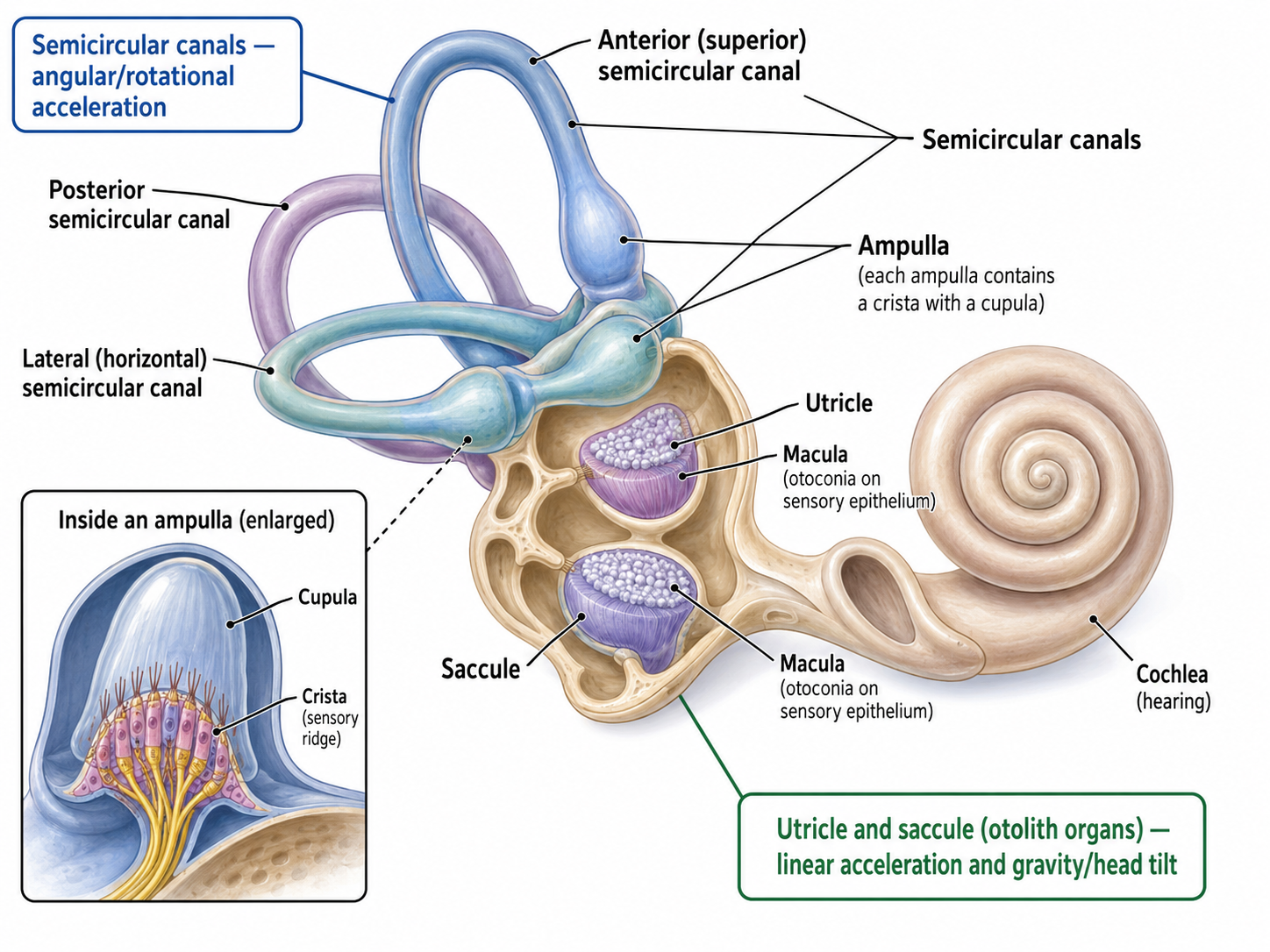
Must knowThe vestibular apparatus has two components, shown below: three semicircular canals (rotation) and two otolith organs (linear acceleration and gravity).
Know the distinction:
- Semicircular canals (three, in perpendicular planes) detect angular (rotational) acceleration. When the head rotates, endolymph lags and bends the cupula (in the ampulla's crista ampullaris), deflecting hair cell stereocilia.
- Otolith organs — utricle and saccule — detect linear acceleration and static head tilt (gravity). Calcium carbonate otoliths in a gelatinous membrane shift with gravity/acceleration, bending hair cell stereocilia. (Utricle ≈ horizontal, saccule ≈ vertical acceleration.)
Hair Cells
Must knowHair cells are the mechanoreceptors of both the vestibular system and the cochlea. Each has a bundle of stereocilia and one kinocilium. Deflection toward the kinocilium opens mechanically gated K⁺ channels → depolarization → transmitter release onto CN VIII afferents; deflection away hyperpolarizes.
Central Pathways
Must knowVestibular afferents travel on CN VIII → vestibular nuclei → three projections: cerebellum (balance), spinal cord (postural reflexes), and extraocular motor nuclei for the vestibulo-ocular reflex (VOR), which moves the eyes opposite to head rotation to stabilize gaze.
Know the logicBalance integrates three input streams — vestibular, proprioceptive, and visual. When they conflict, balance suffers (e.g., dorsal-column loss → fine with eyes open but sways with eyes closed; positive Romberg).
Motion sickness results from conflict between vestibular and visual signals (e.g., reading in a moving car), triggering nausea.
Quick check: A patient reports the room spinning (vertigo) and abnormal eye movements (nystagmus) after an upper respiratory infection. The physician suspects viral inflammation of the vestibular portion of CN VIII (vestibular neuritis). Which structures are NOT affected, allowing the patient to still hear normally?
Answer: The cochlea and cochlear division of CN VIII are intact. Vestibular neuritis selectively inflames the vestibular branch, so hearing is preserved — distinguishing it from labyrinthitis, which affects both divisions.
Common Confusions & Tricks
Olfaction bypasses the thalamus — every other sense doesn't. The single most-tested olfactory fact. Vision, hearing, taste, and touch all relay through the thalamus before cortex; smell reaches limbic cortex directly.
Taste vs. flavor. Taste = the five basic qualities from taste buds. Flavor = taste + retronasal olfaction + texture + temperature. Anosmia kills flavor but leaves basic taste intact.
Semicircular canals vs. otolith organs. Canals = rotation (angular acceleration). Utricle/saccule = linear acceleration and gravity (static tilt). Trap: feeling tilted while stationary = otolith organs, not canals.
Muscle spindles vs. Golgi tendon organs. Spindles detect stretch (length) → contraction; GTOs detect tension (force) → relaxation (protective autogenic inhibition).
Aδ vs. C fibers. Aδ = fast, sharp, first pain; C = slow, dull/burning, second pain (C = Chronic-like).
Gate Control = rubbing works. Mechanistic, not psychological: Aβ touch fibers activate inhibitory interneurons that close the gate on Aδ/C transmission.
Referred pain is not malingering. Visceral and somatic afferents converge on shared dorsal horn neurons. Left arm pain in a heart attack = textbook example.
CN I (olfactory) vs. CN II (optic). Both are CNS tracts (no Schwann cells). CN I is most vulnerable to shearing at the cribriform plate; CN II is damaged by increased intracranial pressure.
Pheromones = VNO in animals; debated in humans. Don't claim humans definitively use pheromones.
Fungiform ≠ filiform. Filiform papillae are most numerous but have NO taste buds.
Key Theories & Terms
| Term / Researcher | What It Means / Who |
|---|---|
| Somatosensation | Body-wide system for touch, pressure, temperature, pain, and proprioception |
| Rapidly vs. slowly adapting receptors | RA (Meissner's, Pacinian) signal change/vibration; SA (Merkel's, Ruffini) signal sustained pressure/stretch |
| Two-point threshold | Smallest distance at which two touches feel separate; smaller where receptor density is high |
| Aδ fibers | Myelinated, fast pain fibers; sharp, localized first pain |
| C fibers | Unmyelinated, slow pain fibers; dull, burning second pain |
| Gate Control Theory | Melzack & Wall (1965): large touch fibers and descending signals inhibit pain transmission in the dorsal horn |
| Endorphins | Endogenous opioids; descending pain modulation, placebo effect |
| Referred pain | Visceral pain felt at a somatic site due to convergence of afferents |
| Taste bud | Sensory organ of taste receptor cells (chemoreceptors) in lingual papillae |
| Five basic tastes | Sweet, salty, sour, bitter, umami |
| CN VII, IX, X | Taste cranial nerves: facial (ant. 2/3), glossopharyngeal (post. 1/3), vagus (epiglottis/pharynx) |
| Olfactory receptor neurons (ORNs) | Bipolar neurons in olfactory epithelium with GPCR-type odorant receptors |
| Thalamic bypass | Olfaction is the only sense reaching limbic cortex without first relaying through the thalamus |
| Pheromones / VNO | Chemical signals between conspecifics; detected via vomeronasal organ in animals, vestigial in humans |
| Proprioception / Kinesthetic sense | Sense of body position/movement via muscle spindles, GTOs, and joint receptors |
| Muscle spindle | Detects muscle length/stretch; basis of the stretch reflex |
| Golgi tendon organ (GTO) | Detects tension; mediates autogenic inhibition to protect against over-tension |
| Semicircular canals | Detect angular (rotational) acceleration via hair cells in the crista ampullaris |
| Utricle & Saccule | Otolith organs detecting linear acceleration and static head tilt (gravity) |
| Hair cells | Mechanoreceptors of vestibular system and cochlea; stereocilia deflection opens K⁺ channels |
| CN VIII (Vestibulocochlear) | Carries auditory and vestibular signals from the inner ear |
| Vestibulo-ocular reflex (VOR) | Moves eyes opposite to head rotation to stabilize gaze |
| Motion sickness | Nausea from conflict between vestibular and visual signals |