Sensation tells you that light of a certain wavelength hit your retina. Perception tells you that you are looking at your friend's face. That leap — from raw sensory data to meaningful experience — is what this topic is about, and the MCAT tests it repeatedly because perception sits at the intersection of biology and psychology.
Priority labels: Must know = cold; Know the logic = mechanism not names; Passage-level = recognize, don't memorize; Optional = skippable.
Bottom-Up and Top-Down Processing
The Core Distinction
Must knowBottom-up processing (data-driven) starts with the raw sensory signal and builds upward toward meaning. Top-down processing (conceptually driven) starts with existing knowledge, expectations, and context and uses them to interpret the incoming signal. Real perception blends both.
Passage-levelGibson championed bottom-up/ecological perception (the environment provides enough information to perceive directly); Gregory emphasized top-down processing (perception is a hypothesis the brain constructs), using illusions as evidence.
How Each Type Works
Must knowIn bottom-up processing, feature detectors in the visual cortex (discovered by Hubel and Wiesel) respond to simple properties like orientation, edges, and motion; these assemble progressively into object recognition. Decoding an unfamiliar script feature by feature is the prototype example.
In top-down processing, context, prior experience, schemas, and expectations fill in gaps or resolve ambiguity — e.g., reading your own name through background noise (cocktail party effect), or the ambiguous "THE CAT" figure where context dictates how an identical middle letter is read.
Perceptual set is the top-down readiness to perceive a stimulus a particular way, shaped by expectation, emotion, motivation, and culture (a radiologist expecting a tumor is likelier to "find" one).
Quick check: A person fluent in a language reads a dense page quickly without noticing a few misspellings. Bottom-up or top-down? Answer: Top-down — their linguistic schema and expectation of correct words override bottom-up detection of letter anomalies.
Perceptual Organization
The brain assembles scattered inputs into coherent wholes. The MCAT tests four domains: depth, form, motion, and constancy.
Depth Perception
Must knowYour retina is 2D, yet you perceive 3D. Depth perception combines monocular cues (one eye) and binocular cues (both eyes).
Know the logicMonocular (pictorial) cues — they work in paintings/photos. You should recognize each, but the logic (each implies distance) matters more than the wording:
| Cue | Description |
|---|---|
| Linear perspective | Parallel lines converge with distance |
| Interposition (overlap) | An object blocking another is seen as closer |
| Relative size | The smaller-appearing of two same-size objects looks farther |
| Texture gradient | Texture looks finer/less detailed with distance |
| Motion parallax | Nearby objects shift fast across the visual field, distant ones slowly, as you move (absent in still images) |
| Aerial perspective | Distant objects look hazier/bluer |
| Accommodation | Lens curvature change for near focus gives proprioceptive distance feedback |
Binocular cues require both eyes:
- Retinal (binocular) disparity: the two eyes receive slightly different images; the brain fuses them, and the degree of disparity encodes depth (greater disparity = closer). The resulting vivid depth is stereopsis (exploited by 3D movies).
- Convergence: the eyes rotate inward for near objects; muscular tension signals distance. Works only within a few meters.
Quick check: A person loses vision in one eye. Which depth cues remain? Answer: All monocular cues remain; they lose retinal disparity and convergence.
Visual cliff (Gibson & Walk): crawling-age infants and young animals refuse to cross the "deep" side of a glass-covered apparent drop-off, indicating depth perception emerges very early and is largely innate.
Form Perception
Must knowForm perception recognizes objects as distinct shapes, beginning with feature detection in V1. Outputs feed two pathways: the ventral "what" stream (temporal lobe, object identity) and the dorsal "where/how" stream (parietal lobe, spatial location and action).
The core challenge is figure-ground segregation — deciding which part of the scene is object (figure) vs. background (ground) — discussed further under Gestalt below.
OptionalPattern-recognition theories match incoming features against stored templates; prototype theory compares stimuli to an idealized category average (why you recognize a letter across fonts).
Quick check: A temporal-lobe patient can't recognize faces despite normal acuity; a parietal-lobe patient recognizes objects but can't reach for them accurately. Which stream is damaged in each? Answer: Temporal = ventral "what" stream (recognition); parietal = dorsal "where/how" stream (spatial action).
Motion Perception
Must knowReal motion is detected by direction- and speed-selective neurons responding to movement across the retina.
Apparent motion is perceived when stationary stimuli flash in rapid sequence. The classic case is the phi phenomenon (Wertheimer): alternating lights appear as one moving light. Stroboscopic motion is the closely related percept of motion from a rapid sequence of still images — the basis of film and animation.
Know the logicMotion aftereffect (waterfall illusion): after staring at downward motion, a stationary scene appears to drift upward — downward detectors fatigue, so upward detectors dominate (detector adaptation). Induced motion: a stationary object surrounded by moving context appears to move (your still train "moving backward" as the next train pulls forward).
Quick check: A film looks continuous though the projector shows 24 still frames per second. Which phenomenon? Answer: Stroboscopic motion (related to the phi phenomenon).
Perceptual Constancy
Must knowPerceptual constancy is perceiving objects as unchanged despite variation in the sensory information reaching your receptors.
- Size constancy: a person walking away looks the same height though the retinal image shrinks; the brain combines retinal size with distance. Removing distance cues (Ames room) breaks it.
- Shape constancy: a door looks rectangular even when its angled projection is a trapezoid.
- Color/brightness constancy: the brain computes color/brightness relative to surrounding illumination, not in absolute terms, so a white shirt stays "white" in dim light. (Lightness constancy is the same idea: coal in sun still looks black, paper in shadow still white.)
Illusions as constancy failures:
- Moon illusion: the horizon moon looks larger than the zenith moon (identical retinal image) because terrain depth cues make it seem farther, so size constancy enlarges it.
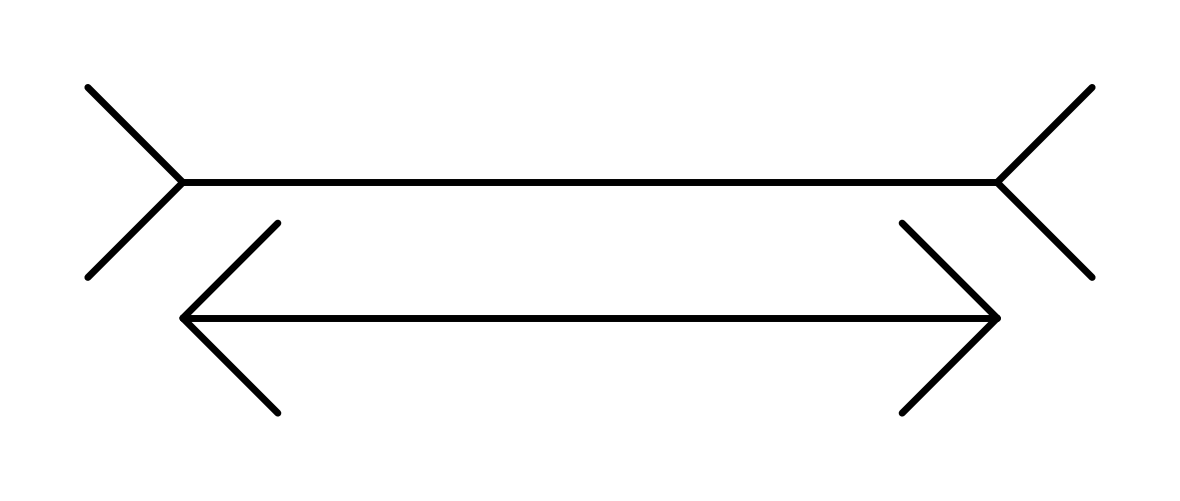
- Müller-Lyer illusion: equal lines with inward vs. outward fins look unequal; Gregory's account is that the fins trigger inside/outside-corner depth assumptions, misapplying size constancy.
- Ponzo illusion: identical bars over converging (railroad-track) lines look unequal; the "farther" upper bar looks larger via misapplied linear-perspective depth.
Quick check: A passage describes a room built so one corner is far but the floor rises, making a person there appear gigantic. What constancy is exploited, and why does it fail? Answer: The Ames room exploits size constancy. By eliminating normal distance cues, the brain treats both people as equidistant and "corrects" their retinal sizes accordingly, so the smaller-image person looks tiny rather than far away.
Gestalt Principles
The Core Idea
Must knowEarly-20th-century German psychologists (Wertheimer, Koffka, Köhler) showed perception is not a simple sum of parts: "the whole is other than the sum of its parts." The brain organizes input into coherent wholes by predictable rules — largely bottom-up, but modifiable by experience.
The Named Gestalt Principles
Must knowRecognize and apply each by name:
- Figure-Ground: the scene splits into a focal figure (has shape, "in front") and receding ground. Ambiguous figures (Rubin vase) show the two are mutually exclusive.
- Proximity: elements physically close together are grouped.
- Similarity: elements sharing features (color, shape, size) are grouped.
- Continuity (good continuation): smooth continuous paths are preferred over abrupt direction changes (crossing lines seen as two continuous lines).
- Closure: gaps in incomplete figures are filled in (a gapped circle is still a circle).
- Common fate: elements moving in the same direction/speed are grouped (a flock as a unit) — the principle for moving stimuli.
- Prägnanz (law of good form / simplicity): the master principle — the brain chooses the simplest, most stable interpretation; the others partly derive from it.
- Optional — Symmetry / Connectedness: symmetric or physically linked elements tend to be grouped.
Why Gestalt Principles Matter for the MCAT
Know the logicThe MCAT presents a scenario and asks which principle is operating, so identify the principle from a description, not just the definition. These are default bottom-up tendencies that top-down processing can override.
Quick check: A designer places all blue buttons in a row and all red buttons in a column, and users see them as two groups. Which principle? Answer: Similarity — grouped by shared color, not proximity.
Common Confusions & Tricks
Bottom-up vs. top-down in a passage: if perception is driven by the physical stimulus alone, it's bottom-up; if context, schema, or expectation shapes it, it's top-down. Ambiguous images (Necker cube flipping between interpretations) are top-down — the brain chooses between competing hypotheses.
Monocular vs. binocular cues: only retinal disparity and convergence require two eyes. Everything else — including motion parallax and accommodation — works with one eye.
Retinal disparity vs. convergence: disparity is the difference in images (photoreceptor-level, effective up to ~30 ft); convergence is muscle tension (proprioceptive, only for close objects).
Phi phenomenon vs. motion aftereffect: phi = stationary stimuli appearing to move (no real motion). Motion aftereffect = stationary stimuli appearing to move opposite a previously viewed motion, due to detector fatigue.
Gestalt proximity vs. similarity: proximity = spatial distance; similarity = shared features.
Closure vs. continuity: closure fills gaps to complete a shape; continuity prefers smooth paths over angles at intersections.
Prägnanz is the umbrella, not just one of the laws: it's the superordinate principle; the others are specific expressions of it.
Perceptual constancy ≠ sensory adaptation: adaptation is a receptor-level drop in responsiveness to constant input (you stop smelling your perfume); constancy is a central/cortical process maintaining stable perception despite changing input. Opposite directions.
Ames room, Müller-Lyer, and moon illusion all involve constancy failures: ask "what cue is being manipulated, and what constancy is breaking down?"
Key Theories & Terms
| Term / Researcher | What It Means / Who |
|---|---|
| Bottom-up processing | Perception built from stimulus features up to meaning |
| Top-down processing | Perception driven by expectations, context, and prior knowledge |
| Gibson / Gregory | Bottom-up/ecological (Gibson) vs. top-down hypothesis-testing (Gregory) views |
| Perceptual set | Readiness to perceive a particular way, shaped by expectation, motivation, culture |
| Hubel and Wiesel | Discovered feature-detector neurons in visual cortex |
| Ventral / dorsal streams | "What" (temporal, identity) vs. "where/how" (parietal, location/action) |
| Retinal disparity / convergence | Binocular depth cues: image difference (basis of stereopsis) vs. inward eye rotation |
| Phi phenomenon | Apparent motion from sequential stationary stimuli (Wertheimer); basis of film |
| Motion aftereffect (waterfall illusion) | Opposite illusory motion after prolonged unidirectional motion (detector fatigue) |
| Size / shape / color-brightness constancy | Stable perception of size, shape, and color despite changing retinal input |
| Moon / Müller-Lyer / Ponzo illusions | Constancy/depth-cue failures producing misjudged size |
| Gibson & Walk / visual cliff | Infants/young animals avoid an apparent drop-off; depth perception emerges early |
| Ames room | Distorted room removing distance cues, causing dramatic size misperception |
| Gestalt psychology | Wertheimer, Koffka, Köhler — perception organized into coherent wholes |
| Gestalt principles | Figure-ground, proximity, similarity, continuity, closure, common fate, prägnanz (umbrella) |
| Prototype theory | Form recognition by comparison to an idealized category average |