What Is Attention, and Why Does It Matter?
Priority labels: Must know = cold; Know the logic = mechanism not names; Passage-level = recognize, don't memorize; Optional = skippable.
Attention is the cognitive system that decides what limited sensory information reaches awareness, gets encoded into memory, and guides behavior — a spotlight that can be directed deliberately or captured involuntarily. The MCAT tests it two ways: how you select one stream from competing ones (selective attention) and how you split limited resources across multiple tasks (divided attention).
Selective Attention
The Core Idea: Filtering the World
Must knowSelective attention is the ability to focus on one stimulus or stream while filtering out others. The landmark debate cognitive psychologists wrestled with: at what stage does the filtering happen — early, late, or in between? That debate produced three models you need cold.
Cherry's Cocktail Party Phenomenon
Must knowE. Colin Cherry's cocktail party phenomenon: you can follow one conversation amid noise, yet your own name "breaks through" from an unattended channel. Cherry studied this with dichotic listening (different audio streams played to each ear) and shadowing (repeating one ear's message aloud in real time). People shadowed the attended ear well but recalled almost nothing from the unattended ear — except their name and gross physical changes (e.g., a tone replacing speech). Takeaway: the unattended channel isn't fully blocked; personally significant or physically distinctive signals still get through.
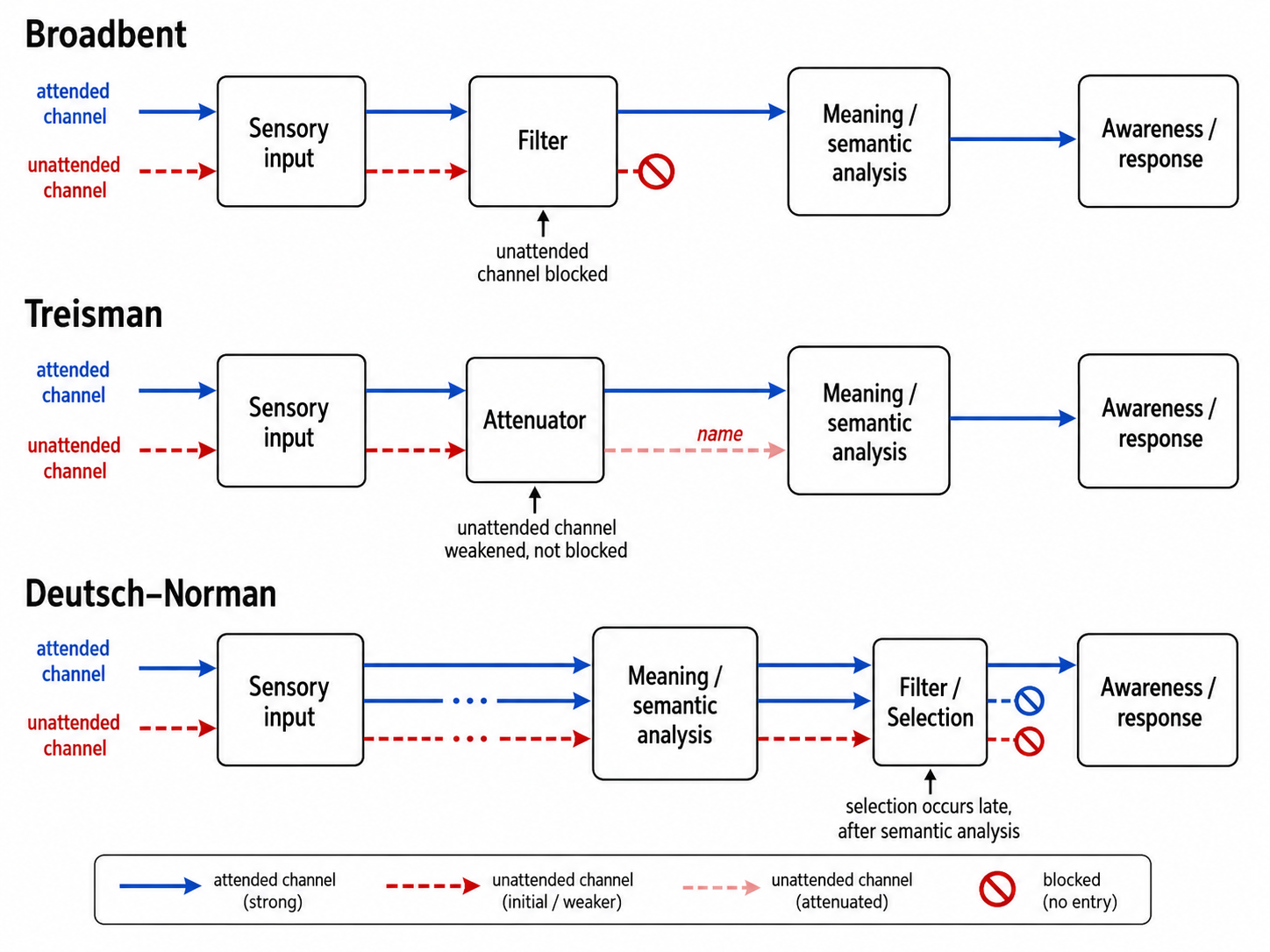
Broadbent's Early-Selection (Filter) Model
Must knowBroadbent's filter model is an early-selection model: a filter blocks all but one channel before meaning is analyzed, acting on physical characteristics (pitch, location, voice). It predicts you should never detect an unattended message's meaning — yet Cherry's name effect already showed otherwise.
Quick check: According to Broadbent, why would you not be able to notice your own name in the unattended ear? And what does the fact that you can notice it tell you about his model?
Answer: Broadbent predicts that the unattended channel is filtered before meaning is extracted, so names — which require semantic processing to recognize — should be invisible. The fact that your name breaks through suggests the model is too strict; some meaning must be processed even for unattended messages, which the model cannot explain. This was the central critique that motivated later models.
Treisman's Attenuation Model
Must knowAnne Treisman's attenuation model: instead of a hard filter, an attenuator turns down the volume of the unattended channel rather than silencing it. Words are then checked against a threshold dictionary — most need a strong signal, but personally significant words (your name, "fire") have permanently lowered thresholds, so they break through even an attenuated signal. This still counts as an early-selection model, just more graded than Broadbent's all-or-nothing filter.
Quick check (scenario): A participant in a dichotic listening experiment is shadowing a passage in the right ear. In the left (unattended) ear, a sentence begins in the left ear and then the meaning of that sentence continues in the right ear. Does the participant notice this meaning-based switch, or do they follow the physical location of the voice?
Answer: Participants do follow meaning across ears — they don't even notice that the sentence jumped ears. This was one of Treisman's own findings and a major problem for Broadbent's purely physical-filter model, because it shows that meaning (not just physical properties) guides what we track.
Deutsch-Norman Late-Selection Model
Must knowThe Deutsch-Norman late-selection model is the opposite extreme: all channels are fully processed for meaning, and the filter comes late — at response/awareness selection. This explains the name effect (everything is analyzed; the unattended just isn't selected unless flagged). Passage-level the modern consensus is that the level of selection is flexible, depending on task demands. For the MCAT, what matters is the contrast — early filter (Broadbent), early attenuation (Treisman), late selection (Deutsch-Norman). The diagram lines up all three.
Inattentional Blindness
Must knowInattentional blindness is the failure to notice a clearly visible but unexpected stimulus when attention is focused elsewhere — demonstrated by Simons & Chabris's "invisible gorilla" (counting basketball passes, ~half miss a person in a gorilla suit). The point: conscious perception requires attentional resources; you don't simply "see" everything in your visual field (a driver failing to see a cyclist).
Change Blindness
Must knowChange blindness is the failure to detect a change in a scene, particularly across a brief interruption (a cut, blink, or distraction) — even large changes go unnoticed if attention isn't on the changed element. Together with inattentional blindness, it shows our sense of a rich, complete visual world is largely illusory.
Quick check (scenario): A film editor cuts between two shots of the same scene, and viewers don't notice that the actor's tie color changed between shots. What phenomenon is this?
Answer: Change blindness. The cut provides the interruption needed; because viewers' attention wasn't focused on the tie specifically, the change goes undetected despite being obvious in retrospect.
Feature Integration Theory
Know the logicTreisman's feature integration theory explains visual search: basic features (color, orientation, size) are registered in parallel, automatically, in a pre-attentive stage; combining features into a conjunction requires serial, focused attention. Practical upshot — a pop-out search (red circle among blue circles) is fast and parallel (single feature); a conjunction search (red circle among blue circles and red squares) is slow and serial because it requires feature binding.
Quick check (scenario): Why does a lone orange among a pile of apples seem to "pop out" immediately, while finding a specific face in a crowd of faces takes deliberate effort?
Answer: The orange is distinguishable by a single feature (color) processed pre-attentively and in parallel — a classic pop-out. Faces are identified by complex conjunctions of features requiring serial, attentive processing.
Divided Attention
The Core Idea: Sharing a Limited Resource
Must knowDivided attention is processing two or more tasks at once (driving while talking, taking notes while listening). The central insight: attentional resources are a limited pool, so when tasks compete for the same resources, performance suffers.
Automatic vs. Controlled Processing
Must knowThe key framework, from Shiffrin & Schneider, is automatic vs. controlled (effortful) processing:
- Controlled: slow, deliberate, serial, capacity-limited, flexible (good for novel tasks), easily disrupted.
- Automatic: fast, effortless, parallel, not capacity-limited, inflexible/hard to suppress, built through extensive practice.
Once a skill is automatic, it no longer competes for resources, freeing capacity for other tasks. A new driver consciously controls steering and mirrors (controlled, competing); an experienced driver does them automatically, freeing attention for conversation. Passage-level fatigue or brain injury can force a return to effortful controlled processing for once-automatic tasks, raising cognitive load.
Quick check (scenario): An expert pianist is asked to play a well-practiced piece while carrying on a conversation. A beginner is asked to do the same. Who performs better on both tasks simultaneously, and why?
Answer: The expert performs far better. For the expert, playing the piece has become largely automatic — it draws minimal attentional resources, leaving capacity for conversation. For the beginner, playing requires fully controlled processing, leaving no capacity for conversation, so both tasks degrade.
The Stroop Effect
Must knowIn the Stroop effect (Stroop, 1935), naming the ink color of an incongruent color word (e.g., "RED" printed in blue) is slowed because reading is automatic and overlearned, interfering with the controlled task of color-naming. It shows the asymmetry of the two processes: you can't easily suppress the automatic one (reading) even when it conflicts with the goal.
Quick check: In a Stroop task, why does naming the color of the word "BLUE" written in red ink take longer than naming the color of a red patch with no word?
Answer: Reading "BLUE" is automatic and activates the response "blue" without effort. This conflicts with the correct response "red" (the ink color), requiring extra controlled processing to resolve the conflict. The color patch has no competing automatic process, so it is faster.
Bottleneck Theory and Resource Models
Know the logicTwo frameworks explain divided-attention limits:
- Bottleneck (structural) theory: at some stage, information must pass through a single channel, forcing one task to wait.
- Resource (capacity) theory (Kahneman): a flexible pool of mental effort is allocated across tasks; exceeding the pool degrades performance. Crucially, tasks using different resources (verbal vs. spatial) interfere less than tasks using the same resource.
The testable prediction: two similar tasks (same modality/type) interfere more than two dissimilar ones.
Quick check (scenario): A person is asked to simultaneously solve a math problem in their head and navigate a maze on paper. Compared to solving the math problem while listening to a news story, which dual task is easier, and why?
Answer: The key principle: tasks using the same type of resource (same modality/processing type) interfere more than tasks using different resources. Pairing two tasks that draw on distinct systems (e.g., one verbal, one spatial) generally interferes less than pairing two that load the same system.
Multitasking and Its Real Limits
Must knowHumans are poor at true simultaneous multitasking when both tasks require controlled attention. What people call "multitasking" is really rapid task-switching, which carries a switch cost (lost time and accuracy per switch). True parallel processing only works when at least one task is fully automatic. This is why distracted driving is dangerous — driving retains controlled components (especially in novel situations) that compete with conversation or phone use.
How Attention Is Directed and Sustained
Bottom-Up vs. Top-Down Attention
Must knowTop-down (endogenous) attention is goal-directed — you deliberately direct focus based on intentions or task (scanning a crowd for a friend). Bottom-up (exogenous) attention is stimulus-driven — a salient feature captures attention automatically (a sudden flash, loud bang, peripheral motion). Pop-out search is bottom-up; conjunction search is top-down.
Sustained Attention (Vigilance)
Passage-levelSustained attention (vigilance) is maintaining focus over time. It shows a vigilance decrement — accuracy and speed decline the longer the watch (e.g., air-traffic monitoring), and it worsens with fatigue.
Common Confusions & Tricks
1. Broadbent vs. Treisman vs. Deutsch-Norman — getting the order right. All three models involve a filter, but the location differs. A helpful mnemonic: Broadbent = Before meaning (early, physical filter), Treisman = Attenuated (early but graded), Deutsch-Norman = Delayed until after meaning (late). If a question says the unattended message is fully semantically processed, that points to late-selection (Deutsch-Norman).
2. Inattentional blindness ≠ change blindness. Inattentional blindness is failing to see something unexpected that is present while you're focused elsewhere (the gorilla is there the whole time). Change blindness is failing to notice a change that occurs, typically across a brief interruption. Both result from limits of selective attention, but the experimental setup is different. On the MCAT, the word "unexpected object" or "didn't notice it was there" = inattentional blindness; "didn't notice the difference between two scenes" = change blindness.
3. Automatic ≠ innate. Automatic processing is developed through extensive practice — it is not the same as a reflex or an innate response. Don't confuse automaticity with genetic hardwiring.
4. The Stroop effect shows automatic interference with controlled processing — not the reverse. The automatic process (reading) interferes with the controlled one (color naming) — not the other way around. If asked which process is disrupted, it's the controlled task being slowed by the automatic one.
5. Dichotic listening = different messages to each ear. Students sometimes confuse this with binaural (same message to both ears) tasks. Dichotic = two different streams; the shadowing paradigm = repeating one stream aloud in real time.
6. Feature integration theory: pop-out = pre-attentive, parallel; conjunction = attentive, serial. If you see a question about visual search getting slower as the number of distractors increases, that's a conjunction (serial) search. If search time is flat regardless of how many distractors are present, that's a pop-out (parallel, pre-attentive) search.
7. Treisman appears in two different contexts — the attenuation model (selective attention / dichotic listening) AND feature integration theory (visual search / attention). Both are hers; don't attribute feature integration to Broadbent or vice versa.
Key Theories & Terms
| Term / Name | One-Sentence Summary |
|---|---|
| Selective attention | The ability to focus on one stimulus or stream while filtering out competing inputs. |
| Divided attention | The ability (often limited) to process two or more tasks or stimuli simultaneously. |
| E. Colin Cherry | Identified the cocktail party phenomenon using dichotic listening and shadowing (1953). |
| Cocktail party phenomenon | The ability to follow one conversation amid noise; your name still "breaks through" from the unattended channel. |
| Dichotic listening | Experimental paradigm where different audio streams are delivered to each ear simultaneously. |
| Shadowing | Repeating aloud, in real time, the message in one ear — the standard dichotic listening task. |
| Broadbent's filter model | Early-selection model: a physical filter blocks the unattended channel before any semantic processing occurs. |
| Anne Treisman | Proposed the attenuation model (graded early filter) and feature integration theory. |
| Attenuation model | Early-selection model: the unattended channel is weakened (attenuated) rather than blocked; low-threshold words (e.g., your name) can still break through. |
| Threshold dictionary | In Treisman's model, each word/concept has an activation threshold; personally significant words have permanently low thresholds. |
| Deutsch-Norman model | Late-selection model: all channels are fully processed semantically before attention selects which reaches consciousness. |
| Inattentional blindness | Failure to consciously perceive an unexpected but visible stimulus when attention is directed elsewhere. |
| Simons & Chabris | Demonstrated inattentional blindness with the "invisible gorilla" experiment (1999). |
| Change blindness | Failure to detect changes in a visual scene, particularly across brief interruptions or cuts. |
| Feature integration theory | Treisman's model: single features are processed pre-attentively and in parallel; feature conjunctions require serial, focused attention. |
| Pre-attentive processing | Fast, parallel processing of basic visual features (color, orientation) that occurs without focused attention. |
| Pop-out search | Visual search based on a single distinguishing feature; search time is independent of distractor number (parallel/pre-attentive). |
| Conjunction search | Visual search requiring binding of multiple features; search time increases with distractors (serial, attentive). |
| Controlled processing | Slow, deliberate, capacity-limited cognitive processing requiring attentional resources; used for novel tasks. |
| Automatic processing | Fast, effortless, capacity-independent processing developed through extensive practice; difficult to suppress. |
| Shiffrin & Schneider | Proposed the distinction between automatic and controlled processing (1977). |
| Stroop effect | Interference when an automatic process (reading a color word) conflicts with a controlled task (naming the ink color); named after J. Ridley Stroop (1935). |
| Bottleneck theory | Structural view that a single-channel processing stage creates a bottleneck, limiting simultaneous task performance. |
| Resource (capacity) theory | Kahneman's model: a flexible pool of mental resources is allocated across tasks; exceeding capacity degrades performance. |
| Task-switching cost | The time and accuracy penalty incurred when shifting attention between tasks; what people call "multitasking" is largely rapid task-switching. |