Cognition is the umbrella term for the mental processes of acquiring, processing, storing, and using information. The MCAT tests it at the intersection of psychology and neuroscience — the theories plus why the brain works this way and how aging, lesions, and disease disrupt it.
Priority labels: Must know = cold; Know the logic = mechanism not names; Passage-level = recognize, don't memorize; Optional = skippable.
The Information-Processing Model
Must knowThe information-processing model treats the mind like a computer: input arrives, gets processed in stages, and is stored or acted upon. Attention is the gateway that decides what advances; capacity is limited at each stage.
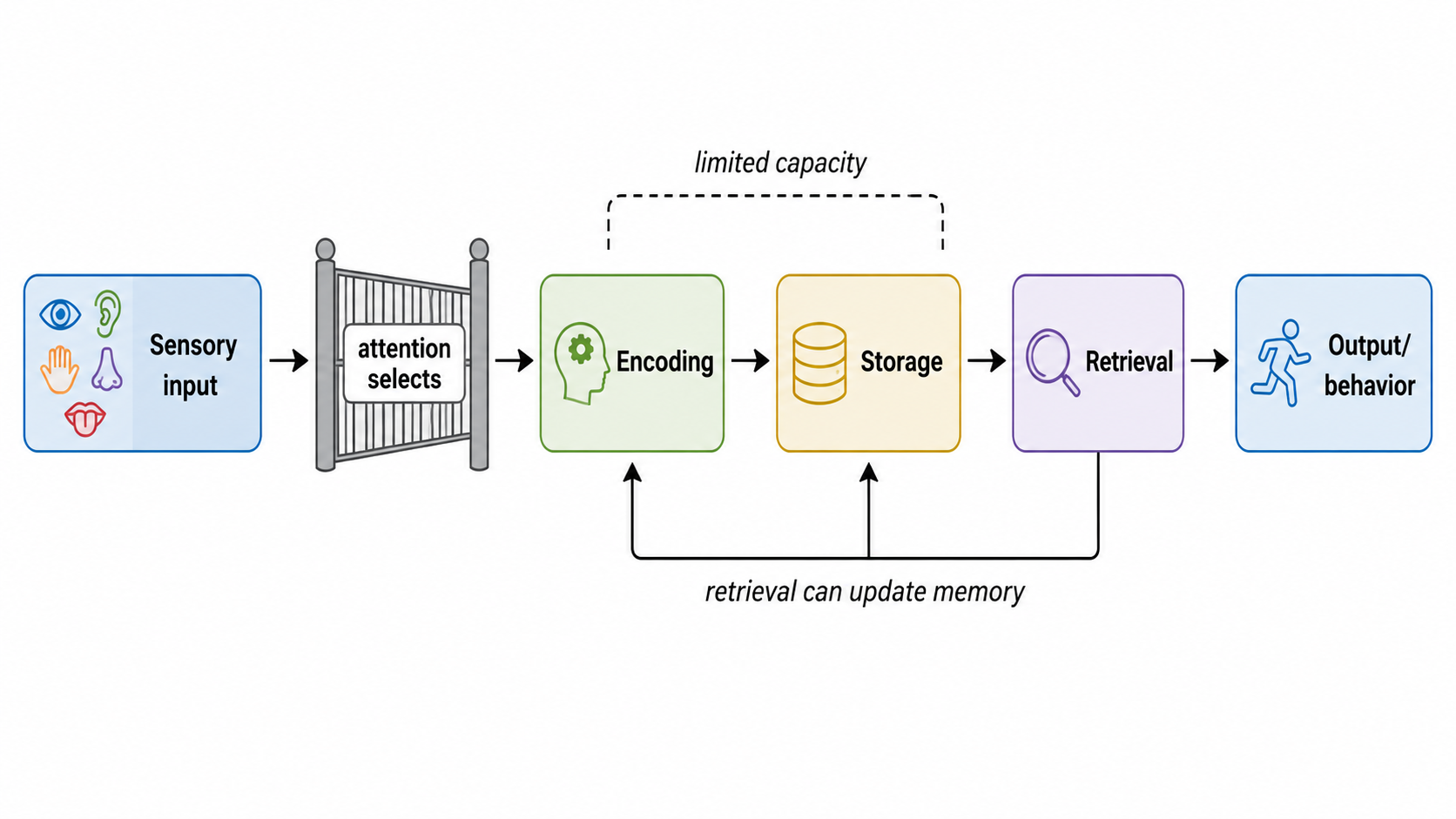
Stages of Memory Within the Model
Must knowThe Atkinson-Shiffrin (multi-store) model describes three sequential stores:
- Sensory memory — fleeting, high-capacity raw impression. Visual = iconic (~250 ms), auditory = echoic (~3–4 s). Decays unless attention is directed to it.
- Working memory (≈ short-term) — the active mental workspace. Capacity ~7 ± 2 items (Miller's Law); decays in ~15–30 s without rehearsal. Chunking (grouping items into meaningful units) expands effective capacity.
- Long-term memory — vast, essentially unlimited, relatively permanent. Consolidated via elaborative rehearsal (connecting new info to existing knowledge), not mere repetition.
The serial position effect shows these stores are distinct: in list recall, items at the start (primacy → entered LTM via rehearsal) and end (recency → still in working memory) are recalled best. A delay or distractor task abolishes recency (working-memory items decay) but spares primacy — evidence for separate stores.
Encoding, Storage, and Retrieval
Must knowAny memory failure localizes to one of three processes:
- Encoding — converting input into a storable representation. Deeper (semantic, meaning-based) processing makes stronger traces than shallow processing.
- Storage — maintaining it over time. The hippocampus consolidates new declarative memories into long-term storage; hippocampal damage (patient H.M.) causes anterograde amnesia (can't form new long-term memories).
- Retrieval — accessing it, aided by retrieval cues. Hence context-dependent (same environment) and state-dependent (same internal state) memory.
Types of Long-Term Memory
Must knowKnow the explicit/implicit split and that procedural memory is spared in amnesia.
| Type | Subcategory | What it holds | Key Brain Region |
|---|---|---|---|
| Declarative (explicit) | Episodic | Personal events | Hippocampus, PFC |
| Declarative (explicit) | Semantic | Facts, concepts, language | Hippocampus, temporal lobe |
| Nondeclarative (implicit) | Procedural | Motor skills, habits | Basal ganglia, cerebellum |
| Nondeclarative (implicit) | Priming / Conditioning | Enhanced recognition; conditioned responses | Neocortex; amygdala/cerebellum |
The explicit/implicit dissociation is a classic scenario: a patient with hippocampal damage can still learn to ride a bike, but won't remember learning it.
Quick check: A patient with severe hippocampal damage can still improve at a mirror-drawing task day after day, even though she has no recollection of ever doing it. Which memory system is intact?
Answer: Procedural (nondeclarative/implicit) memory, stored via the basal ganglia and cerebellum. The hippocampus is needed for new episodic/declarative memories, not procedural learning.
Cognitive Development
Piaget's Stages of Cognitive Development
Must knowJean Piaget held that children actively construct knowledge through two processes:
- Assimilation — fitting new experiences into existing schemas (a child calls a cat "dog").
- Accommodation — modifying or creating schemas to fit new info (forms a new "cat" schema).
Equilibration — the drive to resolve the mismatch (disequilibrium) between schemas and experience — is the engine that moves a child from one stage to the next. Stages are defined by the type of thinking available, not just age:
| Stage (approx. age) | Hallmark thinking |
|---|---|
| Sensorimotor (0–2 yr) | World via sensory/motor action; milestone = object permanence (~8–12 mo) |
| Preoperational (2–7 yr) | Symbolic thought, but no logic; egocentrism, animism, lack of conservation, centration, irreversibility |
| Concrete operational (7–11 yr) | Logic about concrete things; masters conservation, seriation, classification; egocentrism declines |
| Formal operational (12+ yr) | Abstract/hypothetical reasoning, metacognition, hypothetico-deductive reasoning |
Two canonical demos: egocentrism = the three-mountain task (preoperational child assumes others see their view); lack of conservation = the water-pouring task (insists a tall thin glass holds more than a short wide one). Not all adults reach full formal operational thinking in all domains.
Quick check: A 6-year-old watches you roll a ball of clay into a long snake shape and insists you now have "more clay." Which Piagetian concept explains this, and which stage is she in?
Answer: Lack of conservation (with centration on length). She is in the preoperational stage.
Vygotsky and Sociocultural Theory
Must knowWhere Piaget saw a solo scientist, Lev Vygotsky argued cognitive development is fundamentally social and cultural:
- Zone of Proximal Development (ZPD) — the gap between what a child can do alone vs. with skilled guidance.
- Scaffolding — tailored support within the ZPD, gradually withdrawn as competence grows.
- Private speech — self-directed talk that internalizes into thought (Vygotsky saw it as functional; Piaget dismissed it as "egocentric speech").
- Cultural tools — language, writing, number systems that shape cognition.
Quick check: A parent helps a child sound out words while reading, offering hints but letting the child do most of the work, and gradually reduces help as the child improves. This is an example of which Vygotskian concept?
Answer: Scaffolding within the ZPD.
Role of Culture in Cognitive Development
Passage-levelCulture shapes cognition: language influences categorization (the Sapir-Whorf hypothesis — language influences thought); cultural practices determine which skills are taught; some Piagetian milestones (e.g., conservation) appear at different ages across cultures depending on schooling. Vygotsky's whole framework makes culture central.
Cognitive Changes in Late Adulthood
Must knowKnow the dissociation: aging is selective decline, not uniform.
- Decline: processing speed (earliest, most robust), working memory, fluid intelligence, episodic and prospective memory.
- Preserved: crystallized intelligence (knowledge, vocabulary) and semantic/procedural memory; crystallized may even rise into the 60s–70s.
- Neurocognitive disorders (dementia): Alzheimer's is most common — amyloid plaques (extracellular) and neurofibrillary tangles (intracellular tau), hitting the hippocampus first; presents with episodic memory loss.
Quick check: An 80-year-old professor still gives brilliant lectures drawing on decades of knowledge, but struggles to remember where she left her keys this morning. How would you characterize these changes in terms of cognitive aging?
Answer: Preserved crystallized intelligence with declining episodic memory and likely processing speed — the classic healthy aging profile.
Influence of Heredity and Environment on Cognitive Development
Must knowBoth nature and nurture interact continuously.
Behavioral genetics. Twin studies are the main tool: MZ (identical) twins share ~100% of genes, DZ (fraternal) ~50%. MZ twins (even raised apart) show higher concordance for cognitive traits than DZ twins, indicating heritability — but heritability describes variance within a population, not how much of one person's IQ is genetically fixed. Adoption studies show children adopted into enriched environments exceed their biological parents' predicted scores — strong environmental effects.
Know the logicEnvironmental factors: prenatal teratogens (alcohol → fetal alcohol syndrome), maternal nutrition, malnutrition (esp. first 1,000 days), lead exposure, and socioeconomic status (one of the most powerful predictors, acting via nutrition, stress, education, and healthcare).
Quick check: Researchers find that MZ twins raised apart have much more similar IQs than DZ twins raised together. What does this suggest about the relative contributions of heredity and shared environment?
Answer: A strong hereditary contribution — even separated, identical twins resemble each other more than DZ twins sharing a home. But MZ twins raised apart aren't perfectly concordant, so environment matters too.
Biological Factors That Affect Cognition
Key Brain Regions
Must knowKnow which region supports which function:
- Prefrontal cortex (PFC) — executive function, working memory, planning, impulse control (damage: Phineas Gage — personality change, disinhibition).
- Hippocampus — consolidating new declarative memories (damaged in Alzheimer's, Korsakoff's).
- Amygdala — emotional memory, fear conditioning; enhances encoding of emotional events.
- Broca's area (left frontal) — speech production; damage → Broca's aphasia (nonfluent, comprehension intact).
- Wernicke's area (left temporal) — comprehension; damage → Wernicke's aphasia (fluent but nonsensical, poor comprehension).
- Cerebellum / basal ganglia — motor learning and procedural memory/habits.
Neurotransmitters and Cognition
Know the logicKey associations:
- Acetylcholine — memory/learning; cholinergic degeneration is characteristic of Alzheimer's.
- Dopamine — reward, motivation, working memory; the PFC needs an optimal level (too little OR too much impairs working memory); excess linked to schizophrenia.
- Glutamate — main excitatory transmitter; NMDA receptors drive long-term potentiation (LTP).
- Norepinephrine — attention/arousal; serotonin — mood (deficiency → depression-related cognitive impairment).
Long-Term Potentiation (LTP)
Know the logicLTP is the synaptic correlate of learning: repeated high-frequency stimulation strengthens a synapse ("neurons that fire together, wire together," Hebb's rule). The NMDA receptor is a coincidence detector — it opens only when the presynaptic neuron fires and the postsynaptic membrane is already depolarized, letting Ca²⁺ in to strengthen the synapse (e.g., inserting more AMPA receptors).
Quick check: A patient with early Alzheimer's disease is prescribed a drug that inhibits acetylcholinesterase (the enzyme that breaks down ACh). What is the rationale?
Answer: Inhibiting ACh breakdown raises available acetylcholine at synapses, compensating for lost cholinergic neurons and temporarily improving memory and cognition.
Problem-Solving and Decision-Making
Concept Formation
Passage-levelWe organize knowledge into concepts (mental categories). Prototype theory says we judge membership against an idealized average (a robin fits the "bird" prototype better than a penguin); exemplar theory says we compare to specific remembered instances. Concepts also form hierarchies (animal → bird → robin).
Dual-Process Theory of Decision-Making
Must knowAssociated with Kahneman: System 1 is fast, automatic, emotional (snap judgments, the source of most heuristics); System 2 is slow, deliberate, logical (can override System 1). Most biases below are System 1 shortcuts that System 2 fails to catch. Intuition is System 1 "knowing" without analysis; Damasio's somatic markers are bodily gut-feelings that tag options as good or bad.
Types of Problem-Solving Approaches
Must knowKnow the algorithm/heuristic/insight distinctions:
- Algorithms — step-by-step procedures guaranteed correct; thorough but slow.
- Heuristics — fast "rules of thumb," usually good enough but can introduce systematic biases.
- Trial and error — testing solutions until one works.
- Insight — the sudden "aha!" restructuring of the problem (Gestalt psychologists; Köhler's chimps).
Means-end analysis (reduce the biggest gap to the goal), working backward (from a well-defined goal), and analogical reasoning (reuse a past solution).
Barriers to Effective Problem-Solving
Must knowThese are the cognitive traps the MCAT tests directly:
- Mental set — defaulting to past strategies even when inappropriate.
- Functional fixedness — seeing objects only in their usual function (Duncker's candle problem); a subset of mental set.
- Confirmation bias — seeking/interpreting info to confirm existing beliefs.
- Representativeness heuristic — judging by resemblance to a prototype, ignoring base rates (assuming "librarian" over "salesperson").
- Availability heuristic — judging frequency by ease of recall (overestimating plane-crash risk after vivid coverage).
- Base-rate neglect — ignoring underlying frequencies for specific but less diagnostic info (drives representativeness).
- Conjunction fallacy — rating a combination ("bank teller AND feminist") as more probable than a constituent ("bank teller"); logically impossible.
- Gambler's fallacy — believing past independent outcomes change future ones.
- Anchoring bias — over-relying on the first piece of information.
- Overconfidence bias — overestimating the accuracy of one's own judgments.
- Belief perseverance — keeping a belief after its evidence is refuted.
- Framing effect — deciding differently based on presentation ("90% survival" vs. "10% mortality").
- Hindsight bias — "I knew it all along" after the outcome is known.
Quick check: A surgeon insists on a particular diagnosis despite three new lab results pointing to a different one, because her initial impression was so strong. Which barrier to effective problem-solving does this illustrate?
Answer: Belief perseverance (possibly with confirmation bias) — maintaining the original belief despite contradictory evidence.
Intellectual Functioning
Measuring Intelligence: IQ
Must knowModern IQ tests use a deviation IQ: mean 100, SD 15. So ~68% score 85–115 (±1 SD) and ~95% score 70–130 (±2 SD), in an approximately normal (bell) curve. Know reliability (consistency), validity (measures what it claims), and standardization (normed on a representative sample).
Theories of Intelligence
Must knowThe MCAT asks you to distinguish these:
- Spearman's g — factor analysis shows cognitive tests correlate positively; one general intelligence (g) underlies all tasks.
- Cattell-Horn fluid vs. crystallized — fluid (Gf) = reasoning on novel problems (relies on processing speed/working memory; peaks early, declines with age); crystallized (Gc) = accumulated knowledge/vocabulary (stable or rising with age).
- Gardner's multiple intelligences — eight relatively independent intelligences (linguistic, logical-mathematical, spatial, musical, bodily-kinesthetic, interpersonal, intrapersonal, naturalistic); argues IQ tests are too narrow.
- Sternberg's triarchic theory — analytical (IQ-test type), creative (novel ideas), and practical ("street smarts") intelligence.
Thurstone countered g with seven primary mental abilities; Emotional intelligence (EQ) (Salovey & Mayer) = perceiving/managing/reasoning about emotions — widely discussed but not psychometrically settled.
Influence of Heredity and Environment on Intelligence
Know the logicHeritability of IQ runs ~50–80% in adults (in Western samples) — but this is variance explained within a population, not a fixed ceiling. The Flynn effect (James Flynn) — average IQ rose ~3 points/decade across the 20th century — is too fast for genetics, so it shows powerful environmental influence. Genes and environment also interact (some profiles are more sensitive to enrichment/deprivation). Stereotype threat (Claude Steele): performance drops when a negative group stereotype is made salient.
Variations in Intellectual Ability
Must knowKnow the intellectual-disability definition:
- Significant deficit in intellectual functioning (IQ ~below 70, >2 SD below mean),
- Significant deficit in adaptive behavior, and
- Onset before age 18.
Reference (don't memorize all): common causes include Down syndrome (trisomy 21, most common chromosomal), fragile X (most common inherited), and fetal alcohol syndrome (most common preventable). Giftedness ≈ IQ above ~130 (+2 SD). Learning disabilities (e.g., dyslexia) are circumscribed deficits with otherwise normal intelligence — distinct from intellectual disability.
Quick check: A researcher reports that the heritability of IQ in her sample is 0.75. A critic points out that this doesn't mean 75% of any individual's IQ is "caused" by genes. What does heritability actually mean?
Answer: It's a population-level statistic — the proportion of IQ variance within that population and environment attributable to genetic differences. It says nothing about one individual's IQ and can change if the environment changes.
Common Confusions & Tricks
Piaget's stages — the most tested pitfalls:
- Conservation is concrete operational, NOT formal operational (students push it up a stage).
- Object permanence is sensorimotor. An infant searching for a hidden toy → sensorimotor.
- Egocentrism is about perspective-taking, not selfishness (three-mountain task).
- Piaget vs. Vygotsky: Piaget = solo scientist, universal maturational stages; Vygotsky = social/cultural, ZPD, scaffolding. Tutor/peer/scaffolding → Vygotsky; child "discovering" alone or universal milestones → Piaget.
Fluid vs. crystallized intelligence — students reverse these:
- Fluid = flowing through novel problems, no prior knowledge, peaks young, declines.
- Crystallized = set like a crystal, accumulated, stays or grows.
- Mnemonic: Fluid is Fresh, Crystallized is Collected.
Heuristics vs. biases: heuristics (availability, representativeness, anchoring) are the shortcuts; biases are the errors they produce — not the same thing.
- Availability → overestimating vivid/recent events. Representativeness → ignoring base rates, matching a prototype. Anchoring → over-relying on initial info.
Belief perseverance vs. confirmation bias: confirmation bias = actively seeking confirming evidence; belief perseverance = refusing to update even when disconfirming evidence is presented.
Broca's vs. Wernicke's aphasia: Broca's = broken (nonfluent) production, comprehension okay. Wernicke's = wrong words (fluent "word salad"), poor comprehension.
IQ score interpretation: SD 15, mean 100. Intellectual disability ~70 (−2 SD), giftedness ~130 (+2 SD). Know these cold.
Functional fixedness vs. mental set: functional fixedness is specifically about objects and their uses; mental set is the broader habitual-strategy trap. Functional fixedness is a subset of mental set.
Spearman vs. Gardner: Spearman = ONE g, everything correlates. Gardner = MANY independent intelligences, IQ too narrow. A brilliant musician who struggles with math fits Gardner, not Spearman's g.
Key Theories & Terms
| Term / Theorist | What it means / Who |
|---|---|
| Atkinson-Shiffrin model | Multi-store memory: sensory → short-term (working) → long-term |
| Miller's Law | Working memory holds ~7 ± 2 items; chunking extends capacity |
| Iconic / Echoic memory | Visual and auditory sensory memory, respectively |
| Elaborative rehearsal | Linking new info to existing knowledge → deeper, durable memory |
| LTP | Synaptic strengthening from repeated activation; NMDA-dependent; cellular basis of learning |
| Jean Piaget | Four stages: sensorimotor, preoperational, concrete operational, formal operational |
| Schemas / Assimilation / Accommodation | Mental frameworks; fitting new info in vs. modifying them |
| Equilibration | Disequilibrium from new info drives progression to the next stage |
| Object permanence | Objects persist when unseen; sensorimotor (~8–12 mo) |
| Conservation | Quantity unchanged despite appearance; concrete operational |
| Egocentrism (Piagetian) | Can't take another's perspective; preoperational hallmark |
| Lev Vygotsky | Sociocultural theory; learning is socially/culturally mediated |
| Zone of Proximal Development / Scaffolding | Gap between solo vs. guided ability; tailored support within it |
| Sapir-Whorf hypothesis | Language shapes thought |
| Flynn effect | James Flynn; IQ rose ~3 pts/decade — environmental influence |
| Phineas Gage | PFC's role in personality, planning, impulse control |
| H.M. (Henry Molaison) | Bilateral hippocampal loss → anterograde amnesia |
| Fluid (Gf) / Crystallized (Gc) | Cattell-Horn; novel-problem reasoning (declines) vs. accumulated knowledge (preserved) |
| Spearman's g | General factor underlying all cognition (factor analysis) |
| Gardner's multiple intelligences | Eight distinct intelligences; IQ tests too narrow |
| Sternberg's triarchic theory | Analytical, creative, practical intelligence |
| Emotional intelligence (EQ) | Salovey & Mayer; perceiving/managing/reasoning about emotions |
| Algorithm / Heuristic | Guaranteed-but-slow procedure vs. fast-but-fallible shortcut |
| Functional fixedness / Mental set | Objects-only-as-used vs. broader habitual-strategy trap |
| Availability / Representativeness heuristic | Ease of recall vs. prototype resemblance (ignores base rates) |
| Serial position effect | Primacy (→ LTM) and recency (→ working memory) beat the middle |
| Dual-process theory | Kahneman; System 1 (fast/intuitive) vs. System 2 (slow/deliberate) |
| Prototype / exemplar theories | Categorize by idealized average vs. specific remembered instances |
| Base-rate neglect | Ignoring underlying frequencies for specific details |
| Conjunction fallacy | Combination judged more probable than a constituent alone |
| Gambler's fallacy | Past independent outcomes alter future probability (false) |
| Anchoring bias | Over-relying on the first information when estimating |
| Belief perseverance / Confirmation bias | Refusing to update vs. actively seeking confirming evidence |
| Framing effect | Different decisions from equivalent presentations |
| Hindsight bias | Overestimating predictability after the outcome is known |
| Stereotype threat | Claude Steele; impairment when a negative stereotype is salient |
| Intellectual disability | IQ ~below 70 + adaptive deficits + onset before 18 |
| Down syndrome / Fragile X / FAS | Most common chromosomal / inherited / preventable causes |
| Alzheimer's disease | Amyloid plaques and tau tangles; earliest symptom episodic memory loss |
| Procedural memory | Implicit motor/habit memory; basal ganglia/cerebellum; spared in amnesia |
| Broca's / Wernicke's aphasia | Nonfluent production / fluent nonsensical speech with poor comprehension |