Consciousness is one of those topics that feels abstract until you realize it has concrete, testable biology underneath it. The MCAT cares about two lenses at once: the psychological framework (how we classify states of mind) and the biological machinery that creates them (brain regions, neurotransmitters, EEG patterns). Keep both active as you read.
Priority labels: Must know = cold; Know the logic = mechanism not names; Passage-level = recognize, don't memorize; Optional = skippable.
What Is Consciousness?
Must knowConsciousness is moment-to-moment awareness of ourselves and our environment — William James called it a "stream of consciousness," emphasizing that awareness is continuous and always changing. The key MCAT insight is that consciousness exists on a spectrum, not as an on/off switch: you move along it daily from alert wakefulness to drowsiness to slow-wave sleep to dreaming and back.
Selective attention is a companion idea: even when fully conscious, we are aware of only a small fraction of the sensory information our nervous system processes. The level of arousal shapes what we can even process.
States of Consciousness
Waking States and Alertness
Must knowAlertness is graded and biologically regulated, not simply "awake." The reticular activating system (RAS) — a diffuse network in the brainstem reticular formation — sends ascending projections to the thalamus and cortex, turning cortical arousal up or down. Damage to the RAS can produce coma.
The electroencephalogram (EEG) is the main window into brain state.
The four EEG waves (descending frequency = less mental activity):
| EEG Wave | Frequency | Associated State |
|---|---|---|
| Beta | >13 Hz | Alert, active thinking |
| Alpha | 8–12 Hz | Relaxed wakefulness, eyes closed |
| Theta | 4–7 Hz | Light sleep (Stage 1), drowsy |
| Delta | <4 Hz | Deep slow-wave sleep (Stage 3) |
Quick check: A participant sits quietly with eyes closed, not thinking about anything in particular. Which EEG wave predominates?
Answer: Alpha — the hallmark of relaxed, eyes-closed wakefulness. Beta would appear if they opened their eyes or began problem-solving.
Sleep
Stages of Sleep
Must knowSleep is an actively generated, organized state with two fundamentally different modes that alternate through the night.
NREM sleep has three stages:
- Stage 1 (N1): Transition from wake to sleep; theta waves; brief; hypnic jerks can occur. Easy to wake from.
- Stage 2 (N2): Light sleep; theta with sleep spindles (linked to memory consolidation) and K-complexes. Heart rate and temperature drop.
- Stage 3 (N3): Slow-wave sleep (SWS), dominated by delta waves. Hardest to wake from (waking causes groggy sleep inertia). Growth hormone is released here. Sleepwalking (somnambulism) and night terrors occur in this stage.
REM sleep is the stage of vivid dreaming. Its EEG looks nearly like waking beta — hence paradoxical sleep. The brain is active but REM atonia paralyzes skeletal muscles, preventing you from acting out dreams.
Optional REM atonia is driven by brainstem inhibition (glycine/GABA on motor neurons); penile/clitoral tumescence reliably occurs in REM and is used to distinguish psychogenic from organic erectile dysfunction.
Quick check: A patient is woken during a stage where their EEG looks like waking, their eyes are moving rapidly, and their limb muscles show no tone. What stage is this, and what mental content would you predict?
Answer: REM sleep — expect vivid, narrative dream content.
Why Do We Sleep? Theories of Sleep Function
Know the logicPassages ask which theory a finding supports. Know these (non-exclusive) accounts:
- Restorative (repair): Sleep repairs the body/brain — clears metabolic waste (glymphatic system most active in sleep), releases growth hormone in SWS.
- Evolutionary (adaptive): Sleep keeps animals inactive and hidden when activity would be dangerous, conserving energy and reducing predation risk.
- Information-consolidation (memory): Sleep consolidates memories; SWS aids declarative memory, REM aids procedural/emotional memory.
- Brain plasticity: Sleep reorganizes neural connections — why sleep need is highest in infancy.
Sleep Deprivation
Know the logicSleep deprivation impairs attention, working memory, mood, and reaction time, and can cause microsleeps (brief involuntary lapses into sleep). After deprivation, people show REM rebound — disproportionate REM on later nights — evidence that REM serves a needed function.
Sleep Cycles and Changes to Sleep Cycles
Must knowA sleep cycle lasts ~90 minutes (Stages 1→2→3, back toward lighter sleep, then REM); adults complete ~4–6 per night. The composition shifts across the night:
- Early night: more Stage 3 (slow-wave) — physical restoration and GH peak.
- Later night: Stage 3 nearly drops out; REM episodes lengthen — why vivid dreaming clusters before waking.
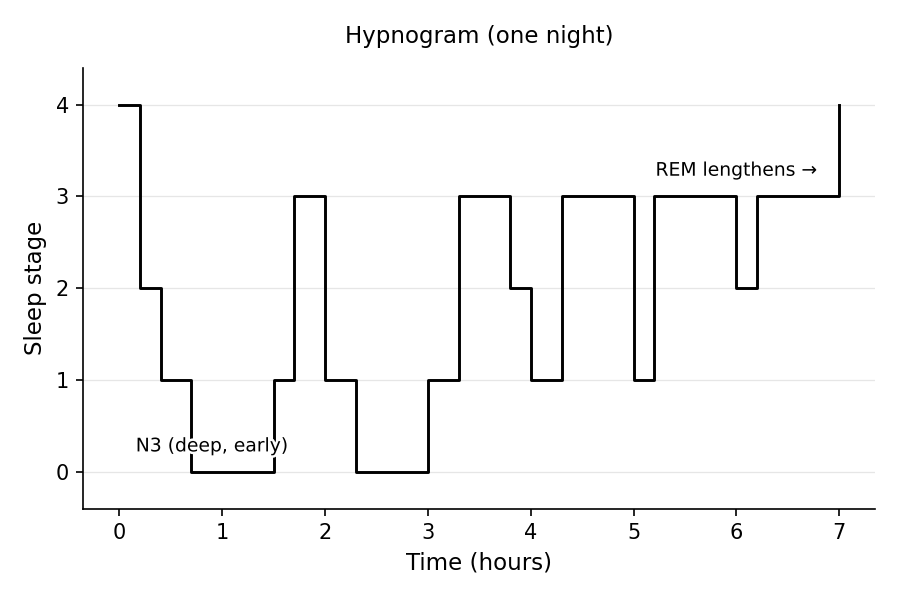
The MCAT implication: if sleep is cut short (or alcohol suppresses REM), you disproportionately lose REM.
Passage-levelLifespan changes: neonates spend ~50% of sleep in REM (supports neural development) with shorter cycles; total sleep need decreases with age (newborns ~16 h → adults ~7–8 h); slow-wave sleep decreases markedly with age; sleep fragments and nighttime awakenings increase in the elderly.
Quick check: An 80-year-old wakes several times a night and feels they never get deep sleep. Pathological or expected?
Answer: Normal age-related change — slow-wave sleep and sleep continuity decline with aging. Pathological only if it causes significant daytime impairment or meets disorder criteria.
Sleep and Circadian Rhythms
Must knowYour circadian rhythm is an internal ~24-hour clock regulating sleep timing plus body temperature, hormone secretion, and metabolism. The master pacemaker is the suprachiasmatic nucleus (SCN) of the hypothalamus, which receives direct light input (via the retinohypothalamic tract) to stay entrained.
The key hormone is melatonin, from the pineal gland: it rises in darkness and is suppressed by light (especially blue light). Melatonin signals "it is night" rather than forcing sleep — which is why screen light before bed delays its rise.
Circadian misalignment (jet lag, shift work, delayed sleep phase) impairs cognition, metabolism, and immune function.
Quick check: A nurse on a midnight–8 AM shift sleeps during the day but still feels tired during her shift. Why can't she simply "adjust" her clock?
Answer: The SCN is entrained mainly by light. Even sleeping by day, her clock receives daytime light that anchors it to a daytime phase. Without light manipulation (blackout curtains, timed light therapy), realignment is slow and often incomplete — the basis of shift-work disorder.
Dreaming and States of Consciousness
Must knowDreams are most vivid and narrative in REM; NREM dreams are more thought-like and fragmented.
Must know the two frameworks the MCAT tests most:
1. Freud's psychoanalytic theory — dreams express unconscious wishes/fears:
- Manifest content: the literal remembered storyline.
- Latent content: the hidden, symbolically disguised meaning.
Empirically weak, but the terms are tested because you must apply them.
2. Activation-synthesis hypothesis (Hobson & McCarley) — the dominant neuroscientific account: during REM the pons fires random impulses that activate sensory/motor cortex; the cortex synthesizes them into a narrative. Dreams are interpretation of noise, not disguised wishes.
Know the logicTwo more accounts:
- Information-processing (memory consolidation): dreaming reflects sorting/consolidating the day's experiences into long-term memory.
- Cognitive (problem-solving): dreams are a low-stakes arena to work through real concerns.
Optional threat simulation theory (Revonsuo) — dreaming as rehearsal for threats; rarely tested.
Quick check: You wake from a dream of being chased through a forest. According to activation-synthesis, what does it reflect?
Answer: The cortex interpreting random brainstem signals — not a repressed wish. The "chase" is the brain's construction to make sense of random activation.
Sleep-Wake Disorders
Must knowKnow these by name and distinguishing feature:
Insomnia: Difficulty initiating/maintaining sleep with daytime impairment; most common sleep disorder.
Narcolepsy: Excessive daytime sleepiness with sudden sleep attacks. Hallmark cataplexy — sudden bilateral muscle weakness triggered by strong emotion. Caused by loss of hypocretin (orexin) neurons in the lateral hypothalamus. May also feature sleep paralysis and hypnagogic/hypnopompic hallucinations. Essentially REM features intruding into wakefulness.
Sleep apnea: Repeated airway obstruction (OSA) or loss of central respiratory drive during sleep; each episode ends in a brief arousal, causing non-restorative sleep and daytime sleepiness. Treated with CPAP.
Somnambulism (sleepwalking): Arises from Stage 3 slow-wave sleep; common in children; no memory.
Night terrors: Also Stage 3 NREM; child sits up screaming, inconsolable, no morning memory. Distinct from REM-based nightmares, which are remembered.
REM sleep behavior disorder (RBD): Loss of REM atonia → physically acting out dreams; associated with neurodegenerative disease (Parkinson's, Lewy body).
Optional Restless leg syndrome — urge to move legs, worse at rest/evening, relieved by movement; disrupts sleep onset.
Quick check: A 7-year-old "screams and thrashes every few nights, seems terrified, won't respond — then has no memory in the morning." Nightmare or night terror, and which stage?
Answer: Night terror, in Stage 3 (NREM slow-wave) sleep. No memory because Stage 3 is the deepest, most amnestic sleep. Nightmares occur in REM and are usually remembered.
Hypnosis and Meditation
Hypnosis
Must knowHypnosis is an altered state of heightened suggestibility, focused attention, and reduced peripheral awareness. Susceptibility (hypnotizability) is a stable individual trait. Two theories:
1. Neodissociation theory (Hilgard): Hypnosis genuinely splits consciousness; a hidden observer remains aware of reality. In his ice-water experiment, participants given a no-pain suggestion reported no pain consciously, but a "hidden" part signaled high pain — so hypnosis dissociates awareness rather than eliminating experience.
2. Social cognitive (socio-cognitive) theory (Barber, Spanos): Hypnosis is not a special state — motivated, imaginative people role-play the hypnotic subject in response to social expectation. Many hypnotic effects can be produced without formal induction.
Know both theories and Hilgard's hidden observer by name. Clinically, hypnosis is used for pain, anxiety, and habit change.
Meditation
Know the logicMeditation is intentional direction of attention for calm or heightened awareness. Two types: focused attention (single object, e.g. breath) and open monitoring (non-reactive awareness of whatever arises).
Passage-levelRegular meditation is associated with more alpha/theta EEG, reduced amygdala reactivity, parasympathetic activation, and lower cortisol.
Quick check: A researcher discredits Hilgard by showing hypnotized participants simply report what they think the experimenter expects. Which theory does this support?
Answer: The social cognitive (socio-cognitive) theory — hypnosis as social role-playing, not a genuine altered state.
Consciousness-Altering Drugs
Know the logicPsychoactive drugs alter consciousness by changing neurotransmitter activity. For each class, know the main neurotransmitter/receptor and the behavioral effect — not detailed pharmacology.
Depressants
Know the logicDepressants decrease CNS activity, mainly by enhancing inhibitory GABA (alcohol also inhibits excitatory glutamate).
- Alcohol: Enhances GABA, inhibits glutamate → disinhibition, sedation, impaired coordination, respiratory depression at high doses. Chronic use drives opposite compensatory changes, so abrupt withdrawal causes dangerous hyperexcitability (seizures, delirium tremens).
- Benzodiazepines and barbiturates: Enhance GABA; used for anxiety/seizures. Withdrawal can be life-threatening; barbiturates have a narrower safety margin.
Stimulants
Know the logicStimulants increase CNS activity, mainly by raising dopamine and norepinephrine.
- Cocaine: Blocks reuptake of dopamine, NE, and serotonin → euphoria.
- Amphetamines: Increase dopamine/NE (release + reuptake block); longer-lasting than cocaine.
- Caffeine: Blocks adenosine receptors (adenosine promotes sleepiness) → alertness.
- Nicotine: Acts on acetylcholine receptors and triggers dopamine release in reward pathways.
Opioids
Know the logicOpioids (morphine, heroin, fentanyl) bind opioid receptors → analgesia, euphoria, sedation, respiratory depression (cause of overdose death), and constipation. Endogenous opioids (endorphins, enkephalins) act on the same receptors.
Hallucinogens
Know the logicHallucinogens distort perception without normal sensory input.
- LSD, psilocybin: Act on serotonin receptors → visual hallucinations, altered time, ego dissolution. Low addiction potential.
- PCP, ketamine: Act on the glutamate system → dissociative, out-of-body effects. (Ketamine is now used for treatment-resistant depression.)
Cannabis
Know the logicTHC acts on the brain's cannabinoid receptor system (natural ligands: endocannabinoids) → euphoria, altered time perception, increased appetite, impaired working memory.
MDMA
Know the logicMDMA causes a large release of serotonin (plus some dopamine/NE) → euphoria and emotional closeness; the "comedown" reflects serotonin depletion.
Quick check: A patient overdoses — unconscious, breathing 4 times per minute, with pinpoint (miotic) pupils. Which drug class?
Answer: Opioids. The triad of coma, respiratory depression, and miosis is the classic opioid toxidrome. Treatment is naloxone.
Drug Addiction and the Reward Pathway
The Mesolimbic Dopamine System
Must knowThe core of addiction is the mesolimbic dopamine pathway (reward pathway): ventral tegmental area (VTA) → nucleus accumbens (and prefrontal cortex, amygdala, hippocampus). Nearly every drug of abuse, by different mechanisms, ultimately raises dopamine in the nucleus accumbens, producing reward and reinforcing drug-seeking. Prefrontal projections underlie craving and the impaired decision-making of addiction.
Tolerance, Dependence, and Withdrawal
Must know- Tolerance: Reduced response after repeated use (receptor downregulation); more drug needed for the same effect.
- Physical dependence: The nervous system now requires the drug for normal function; removal causes a withdrawal syndrome — typically the opposite of the drug's effects (e.g., opioid withdrawal → hyperalgesia, anxiety, diarrhea).
- Addiction (substance use disorder): Compulsive drug-seeking despite harm; driven by neuroplastic changes — reward pathway sensitized to cues while prefrontal impulse control weakens.
Positive vs. Negative Reinforcement
Know the logicEarly use is positive reinforcement (the drug produces pleasure); after tolerance, use shifts to negative reinforcement (relieving withdrawal dysphoria). This shift from "chasing the high" to "avoiding the low" is central to addiction progression.
Quick check: Someone who has used heroin daily for years no longer gets "high" from their usual dose and uses just to "feel normal." Which concept explains the reduced euphoria, and which reinforcement now maintains use?
Answer: Tolerance explains the lost euphoria (opioid receptor downregulation). Use is now maintained by negative reinforcement — heroin reverses the aversive withdrawal state.
Common Confusions & Tricks
Night terrors vs. nightmares: The most common mix-up. Night terrors: Stage 3 NREM, no memory, inconsolable, not really "awake." Nightmares: REM, fully remembered. "Terrifying dream remembered vividly in the morning" = nightmare in REM.
Somnambulism and night terrors share a stage: Both arise from Stage 3 NREM. Sleepwalking is NOT in REM — REM atonia prevents physical acting-out.
RBD vs. narcolepsy: In narcolepsy, REM features intrude into wakefulness (cataplexy, sleep paralysis, hypnagogic hallucinations). In RBD, REM atonia fails and the person acts out dreams. Don't confuse them.
Hypocretin/orexin is lost in narcolepsy: Orexin promotes wakefulness; its loss → REM intrusions. Link orexin deficiency → narcolepsy firmly.
Alcohol withdrawal is dangerous: Alcohol enhances GABA and inhibits glutamate, so chronic use drives opposite changes. Withdrawal = GABA deficit + glutamate excess = seizures, which is why it can be fatal.
Caffeine's mechanism is adenosine blockade, not dopamine: Not all stimulants work primarily on dopamine — caffeine antagonizes adenosine receptors.
Manifest vs. latent content (Freud): Manifest = what you remember (the story). Latent = the hidden meaning. Surface vs. deep.
EEG waves memory trick: "BAT Delta" for descending frequency: Beta (alert) → Alpha (relaxed) → Theta (Stage 1) → Delta (Stage 3). REM is the exception — beta-like despite being asleep.
Neodissociation is Hilgard; social cognitive is Barber/Spanos: Hilgard = real altered state with hidden observer; social cognitive = role-playing and expectation. Know which name goes with which.
Key Theories & Terms
| Term / Researcher | What It Means |
|---|---|
| Consciousness | Moment-to-moment awareness of self and environment; exists on a spectrum. |
| William James | Coined "stream of consciousness"; emphasized its continuous nature. |
| Reticular Activating System (RAS) | Brainstem network controlling arousal and sleep/wake transitions. |
| EEG (electroencephalogram) | Tool measuring brain electrical activity; identifies sleep stages by wave type. |
| Beta waves | >13 Hz; alert, active waking cognition. |
| Alpha waves | 8–12 Hz; relaxed, eyes-closed wakefulness. |
| Theta waves | 4–7 Hz; Stage 1 NREM and drowsy transitions. |
| Delta waves | <4 Hz; Stage 3 NREM (slow-wave/deep sleep). |
| Sleep spindles | Bursts of 12–15 Hz in Stage 2 NREM; linked to memory consolidation. |
| K-complexes | Large sharp EEG waves in Stage 2 NREM; may protect sleep. |
| REM atonia | Brainstem-mediated muscle paralysis during REM; prevents acting out dreams. |
| Paradoxical sleep | Alternate name for REM, reflecting its beta-like EEG despite being asleep. |
| Suprachiasmatic nucleus (SCN) | Master circadian pacemaker in the hypothalamus; entrained by light. |
| Melatonin | Hormone from the pineal gland; rises in darkness; signals nighttime to the SCN. |
| Circadian rhythm | ~24-hour cycle regulating sleep timing, hormones, temperature, metabolism. |
| Manifest content (Freud) | The literal, remembered storyline of a dream. |
| Latent content (Freud) | The hidden, unconscious meaning symbolically encoded in the dream. |
| Activation-synthesis hypothesis | Hobson & McCarley; dreams = cortex interpreting random brainstem signals during REM. |
| Narcolepsy | Disorder from loss of hypocretin/orexin neurons; cataplexy, sleep attacks, sleep paralysis. |
| Hypocretin (orexin) | Neuropeptide from lateral hypothalamus promoting wakefulness; deficient in narcolepsy. |
| Cataplexy | Sudden muscle weakness triggered by strong emotion; hallmark of narcolepsy. |
| Somnambulism (sleepwalking) | Stage 3 NREM parasomnia; motor activity during sleep with no memory. |
| Night terrors | Stage 3 NREM arousal disorder; intense fear, no recall; distinct from REM nightmares. |
| REM sleep behavior disorder (RBD) | Loss of REM atonia → acting out dreams; associated with Parkinson's. |
| Neodissociation theory | Hilgard; hypnosis splits consciousness; shown by hidden observer experiments. |
| Hidden observer | Hilgard's part of the mind that stays aware of reality under hypnosis. |
| Social cognitive theory of hypnosis | Barber & Spanos; hypnosis = motivated role-playing, not a special state. |
| Mesolimbic dopamine pathway | VTA → nucleus accumbens; core reward pathway activated by drugs of abuse. |
| Nucleus accumbens | Reward center in ventral striatum; dopamine here mediates pleasure and reinforcement. |
| Ventral tegmental area (VTA) | Origin of the mesolimbic pathway; dopaminergic neurons firing to rewards/cues. |
| Tolerance | Diminished drug effect with repeated use; receptor downregulation. |
| Physical dependence | Adaptation requiring drug for normal function; removal causes withdrawal. |
| Negative reinforcement (addiction) | Late-stage addiction maintained by relief from withdrawal, not pursuit of pleasure. |
| Endocannabinoids | Natural ligands for cannabinoid receptors; mimicked by THC. |
| Endorphins/enkephalins | Endogenous opioid peptides; pain modulation and natural reward. |