Language is a uniquely human ability, and the MCAT tests it from three angles: how we acquire it, how it shapes thinking, and which brain structures make it possible. These connect — brain structures motivate the nativist claim that language is innate, and Sapir-Whorf explains how the language you acquire shapes how you reason.
Priority labels: Must know = cold; Know the logic = mechanism not names; Passage-level = recognize, don't memorize; Optional = skippable.
Properties and Milestones of Language
Must knowLanguage is a system of symbols and rules for communication. Defining properties that distinguish it from mere communication:
- Productivity (generativity): finite words/rules generate infinitely many novel sentences.
- Displacement: reference to things not present in time or space (past, future, hypotheticals).
- Arbitrariness: the link between symbol and meaning is conventional, not inherent.
- Cultural transmission: passed across generations through learning.
The Five Components of Language
Must knowThese named levels are high-yield vocabulary:
- Phonology — the sound system; smallest unit is the phoneme, the smallest unit of sound that distinguishes meaning (/b/ vs. /p/ in "bat" vs. "pat").
- Morphology — how sounds combine into meaning; smallest unit is the morpheme, the smallest unit of meaning (a whole word "dog," or the plural "-s"/past-tense "-ed"; "dogs" = two morphemes).
- Semantics — meaning of words and sentences.
- Syntax — grammar rules governing word order and combination.
- Pragmatics — practical social use in context (knowing "Can you pass the salt?" is a request, not a question about ability).
Keep the two smallest units straight: phoneme = sound, morpheme = meaning.
Developmental Milestones
Must knowHumans follow a consistent sequence across cultures — a fact nativists emphasize:
| Age (approximate) | Stage |
|---|---|
| 0–2 months | Cooing (vowel-like sounds) |
| 4–6 months | Babbling (consonant–vowel: "ba-ba-ba") |
| ~10–12 months | First words; holophrases (one word = a whole sentence, "milk!" = "I want milk") |
| ~18–24 months | Two-word stage / telegraphic speech ("want milk," "daddy go") |
| 2–5 years | Vocabulary explosion; rules applied, including overregularization ("I goed," "mouses") |
| ~5–7 years | Near-adult grammar |
Overregularization matters most: a child who said "went" correctly switches to "goed." This is not regression — it shows the child has internalized a rule (add -ed for past tense) and overapplies it, which is evidence for rule learning over imitation.
Quick check: A 3-year-old who used to say "went" now says "goed." Regression or progress? Answer: Progress — the child has abstracted the past-tense rule and applies it systematically, a more sophisticated operation than imitation.
Theories of Language Development
The central debate is nature vs. nurture: is language learned, wired in, or both?
Learning (Behaviorist) Theory
Must knowB.F. Skinner argued language is acquired like any learned behavior, through operant conditioning (caregivers reinforce correct utterances, correct or ignore errors) plus imitation.
Know the logicThe weaknesses are what get tested:
- Children produce sentences they've never heard (productivity).
- Parents rarely correct grammar — they correct facts, not form.
- Grammar is learned faster than reinforcement could explain.
- Overregularization ("goed") can't come from imitation — adults don't say it.
Quick check: A child says "I breaked the cup." The parent says "No, the cup is fine!" (correcting the fact, not the grammar). What grammar feedback is the child getting? Answer: None — exactly the weakness Chomsky exploited: if caregivers don't correct grammar, reinforcement alone can't explain grammatical acquisition.
Nativist Theory
Must knowNoam Chomsky argued language is too complex, rapid, and universal to be learned alone. The gap between impoverished input and rich grammar acquired is the poverty of the stimulus argument. Key claims:
- An innate Language Acquisition Device (LAD) — a species-specific mental faculty for language (a theoretical construct, not a literal brain region).
- All languages share a Universal Grammar (UG); exposure merely "sets the parameters."
- A critical period (roughly birth to puberty) after which native-level acquisition becomes extremely difficult.
Supporting evidence: a universal developmental sequence across cultures; all human societies have language while no animal develops human-like syntax; isolated deaf children spontaneously invent gestural systems (e.g., Nicaraguan Sign Language gaining grammar within a generation). The case of Genie (deprived of language until 13, never acquired normal grammar) is the classic critical-period example.
Quick check: Nicaraguan deaf children with no formal sign language invented one with consistent grammar in a single generation. Which theory does this support, and why? Answer: Nativist — they weren't imitating or being reinforced; they spontaneously generated grammar, consistent with an innate language capacity.
Interactionist Theory
Must knowMost researchers favor an interactionist view: biology sets up the capacity, but social interaction and cognition actualize it.
Lev Vygotsky is central:
- Language begins as a social tool and becomes internalized as inner speech (self-directed thought).
- The Zone of Proximal Development (ZPD) is the gap between what a child can do alone vs. with guidance; learning is optimal when caregivers provide scaffolding — support just beyond current ability, withdrawn as competence grows.
- Child-directed speech ("motherese") — simplified, high-pitched, repetitive — gives structured, comprehensible input; its cross-cultural universality suggests it's not arbitrary.
The view also draws on Jean Piaget: language is tied to general cognitive development. Piaget saw language as expressing pre-existing thought; Vygotsky saw language as constitutive of thought.
Quick check: A father simplifies his sentences, slows down, and repeats words while reading to his 18-month-old. Which theory best uses this as evidence, and why? Answer: Interactionist — child-directed speech is the environmental scaffolding interactionists argue is needed to actualize biological language potential.
Influence of Language on Cognition
Language doesn't just express thought — it may shape it.
The Sapir-Whorf Hypothesis (Linguistic Relativity)
Must knowEdward Sapir and Benjamin Lee Whorf proposed that the language you speak influences how you think. It spans a spectrum:
- Strong — Linguistic Determinism: language determines thought; you can't think about concepts your language lacks. Largely rejected.
- Weak — Linguistic Relativity: language influences thought, making some concepts more accessible. Empirically supported.
Classic evidence (recognize the pattern, don't memorize the languages): speakers whose language draws a lexical distinction perceive that boundary more readily. Russian has separate basic terms for light vs. dark blue (goluboy/siniy) and Russian speakers discriminate those shades faster; languages using absolute cardinal directions correlate with strong spatial navigation; the Pirahã, lacking exact number words, struggle with exact large-number tasks. The takeaway: language scaffolds perception and cognition (weak Whorf).
The key MCAT distinction: linguistic determinism is the rejected strong form; linguistic relativity is the accepted weak form.
Language and Memory
Know the logic- Verbal labeling improves memory for categories — having a word aids encoding and retrieval.
- The misinformation effect (Elizabeth Loftus): question wording alters memory. "Smashed" vs. "contacted" changes speed estimates and whether participants later "remember" broken glass — language at encoding/retrieval shapes memory.
- Inner speech and working memory: verbal rehearsal in Baddeley's phonological loop maintains information; the word-length effect (short words remembered better than long) reflects time-limited subvocal rehearsal.
Language and Problem-Solving
Know the logic- Functional fixedness / mental set can be linguistically reinforced — an object's conventional label makes novel uses harder to see.
- Framing effects: "90% survival" vs. "10% mortality" are equivalent but produce different choices.
Quick check: A bilingual English-Russian speaker sees two blue swatches that would be goluboy vs. siniy in Russian. Would her discrimination be faster than a monolingual English speaker's? Which theory does this test? Answer: Yes, likely faster — this tests Sapir-Whorf (linguistic relativity, weak form); the Russian lexical distinction makes the boundary more salient.
Brain Areas That Control Language and Speech
Aphasia syndromes are heavily tested. Know each area's function, lesion effect, and location.
Lateralization of Language
Must knowLanguage is lateralized to the left hemisphere in ~95% of right-handers (and ~70% of left-handers) — one of the most consistent findings in neuropsychology.
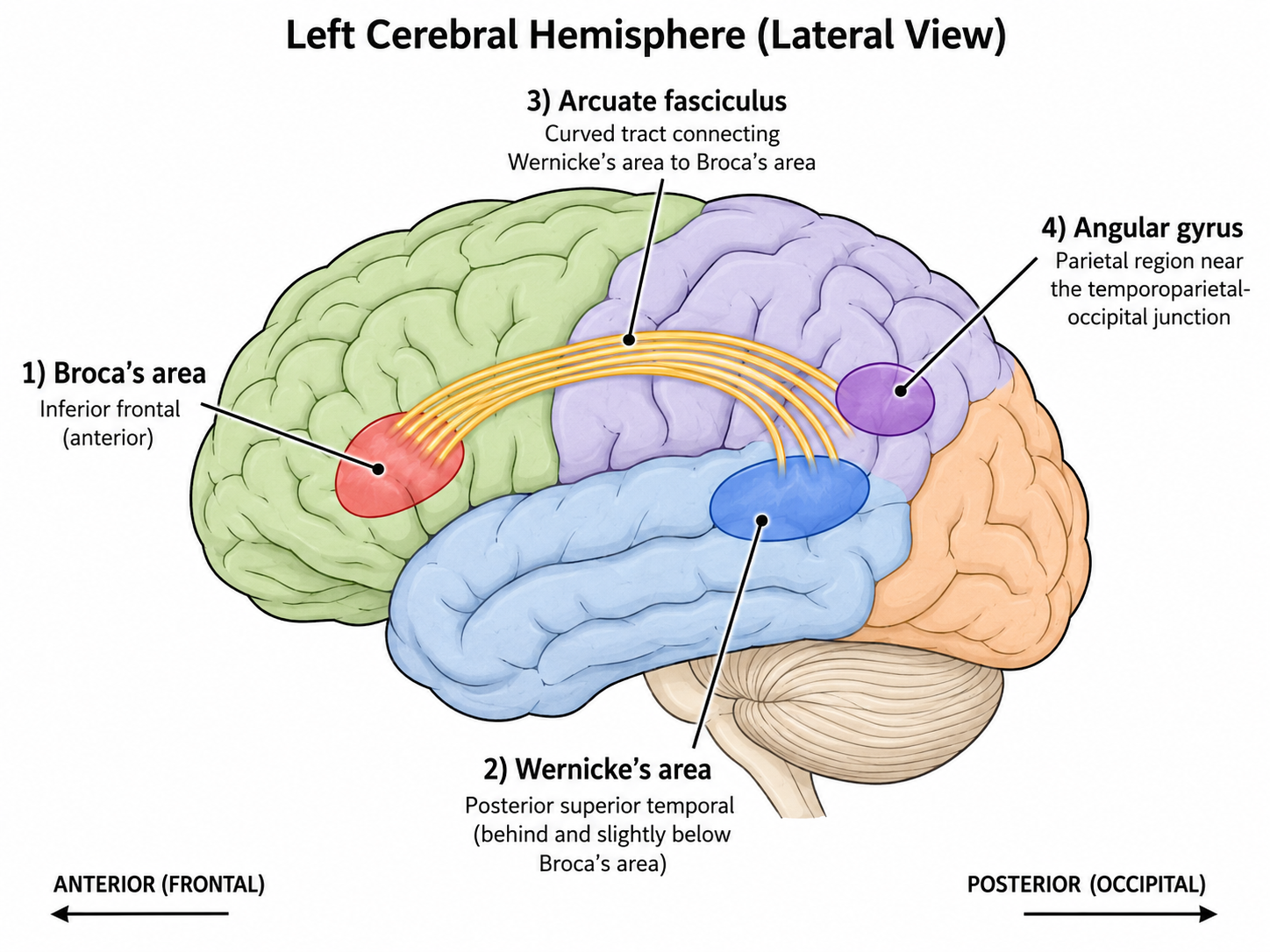
The classic Wernicke-Geschwind model describes a circuit connecting these regions, with the arcuate fasciculus linking comprehension to production.
Broca's Area
Must knowBroca's area sits in the left inferior frontal gyrus. Function: speech production — motor programming of articulation and grammatical processing (syntax).
Broca's aphasia (expressive):
- Speech is non-fluent — halting, effortful, telegraphic.
- Comprehension is largely intact.
- The patient knows what they want to say but can't fluently produce it (and is aware/frustrated).
Wernicke's Area
Must knowWernicke's area sits in the left posterior superior temporal gyrus. Function: language comprehension — decoding meaning.
Wernicke's aphasia (receptive):
- Speech is fluent but meaningless — "word salad" with paraphasias (wrong-word substitutions), neologisms, and jargon.
- Comprehension is severely impaired.
- The patient is often unaware their speech is incomprehensible (unlike Broca's patients).
The Arcuate Fasciculus and Conduction Aphasia
Must knowThe arcuate fasciculus is a white-matter tract connecting Wernicke's to Broca's area. Damage (both areas intact) → conduction aphasia: comprehension and spontaneous fluent speech are preserved, but the patient cannot repeat words/phrases. The hallmark is impaired repetition.
Global Aphasia
Passage-levelGlobal aphasia results from extensive damage to both Broca's and Wernicke's areas (often a large left-hemisphere stroke): non-fluent speech AND impaired comprehension — the most severe aphasia, combining both deficits.
The Angular Gyrus
Must knowThe angular gyrus (left parietal lobe, near the temporal-parietal-occipital junction) is a multimodal area linking visual word forms to meaning, critical for reading and writing. Damage → alexia (impaired reading) and agraphia (impaired writing), while spoken language can remain intact.
Summary Table: Key Language Areas
| Structure | Location | Function | Damage causes |
|---|---|---|---|
| Broca's area | Left inferior frontal gyrus | Speech production, syntax | Broca's aphasia (non-fluent, comprehension intact) |
| Wernicke's area | Left posterior superior temporal gyrus | Language comprehension | Wernicke's aphasia (fluent, comprehension impaired) |
| Arcuate fasciculus | Tract connecting the two | Connects production ↔ comprehension | Conduction aphasia (repetition impaired) |
| Angular gyrus | Left parietal (TPO junction) | Reading, writing, multimodal integration | Alexia and agraphia |
Quick check: A patient speaks in long, fluent, grammatical-sounding sentences full of made-up words and wrong substitutions, unaware she's unintelligible. Lesion location? Answer: Wernicke's area (left posterior superior temporal gyrus) — classic Wernicke's (receptive) aphasia: fluent jargon, impaired comprehension, lack of awareness.
Common Confusions & Tricks
Broca's vs. Wernicke's — the most common reversal on the MCAT:
- Broca = Broken speech (production broken, comprehension fine). Wernicke = Word salad (fluent but meaningless, comprehension wrecked).
- Location trick: Broca is frontal (front = production); Wernicke is temporal (you hear with ears by the temporal lobe = comprehension).
Linguistic relativity ≠ linguistic determinism:
- Determinism (strong Whorf) = language determines thought → rejected.
- Relativity (weak Whorf) = language influences perception/cognition → supported.
- A passage showing speakers of different languages perceive categories differently (color, space, time) = Sapir-Whorf, weak (relativist) form.
Vygotsky vs. Piaget on language and thought:
- Piaget: thought first; language expresses existing cognitive structures.
- Vygotsky: language and thought merge; language drives cognitive development; inner speech is internalized social speech.
Chomsky is nativist, not interactionist: both criticized behaviorism, but Chomsky argues for innate hardwired structures; Vygotsky for social scaffolding of a biological capacity.
Critical period ≠ sensitive period: critical implies a hard cutoff; sensitive implies a window with gradual decline. The MCAT commonly uses critical period — treat them as effectively synonymous here.
Conduction aphasia's hallmark is repetition: "cannot repeat but speaks fluently and comprehends" = arcuate fasciculus damage.
Overregularization is evidence against pure imitation: "goed"/"mouses" are errors children never heard adults use — directly challenging Skinner.
The angular gyrus is reading/writing, not speaking/understanding: damage spares spoken language but impairs reading and writing.
Key Theories & Terms
| Term / Name | One-sentence summary |
|---|---|
| B.F. Skinner | Behaviorist/learning theory: language acquired through operant conditioning, imitation, and reinforcement. |
| Noam Chomsky | Nativist theory; innate Language Acquisition Device and a Universal Grammar shared by all languages. |
| Language Acquisition Device (LAD) | Chomsky's construct for the innate faculty enabling rapid grammar acquisition. |
| Universal Grammar (UG) | Chomsky's claim that all languages share pre-wired deep structural principles. |
| Poverty of the Stimulus | Chomsky's argument that input is too impoverished to account for the grammar acquired, implying innate knowledge. |
| Critical Period | Window (roughly birth to puberty) during which language acquisition proceeds most readily. |
| Lev Vygotsky | Interactionist; social origins of language; Zone of Proximal Development and scaffolding. |
| Zone of Proximal Development (ZPD) | Gap between what a child can do alone vs. with guidance; optimal learning zone. |
| Scaffolding | Temporary support calibrated to the ZPD, withdrawn as competence develops. |
| Jean Piaget | Cognitive developmentalist; thought precedes and determines language. |
| Overregularization | Systematic misapplication of a grammatical rule to an irregular form ("goed"); evidence of rule internalization. |
| Telegraphic speech | Two-word utterances keeping content words, omitting function words ("daddy go"); ~18–24 months. |
| Holophrase | A single word conveying a whole sentence's meaning (~12 months). |
| Sapir & Whorf | Sapir-Whorf hypothesis: language influences (relativity) or determines (determinism) thought. |
| Linguistic relativity (weak Whorf) | Supported claim that language influences cognition and perceptual categories. |
| Linguistic determinism (strong Whorf) | Rejected claim that language wholly determines thought. |
| Broca's area / aphasia | Left inferior frontal gyrus; speech production; damage → non-fluent speech, intact comprehension. |
| Wernicke's area / aphasia | Left posterior superior temporal gyrus; comprehension; damage → fluent meaningless speech, impaired comprehension. |
| Conduction aphasia | Arcuate fasciculus damage; intact comprehension and fluent speech but impaired repetition. |
| Global aphasia | Damage to both Broca's and Wernicke's areas; non-fluent speech and impaired comprehension (most severe). |
| Phoneme / Morpheme | Smallest unit of sound / smallest unit of meaning. |
| Five components of language | Phonology, morphology, semantics, syntax, pragmatics. |
| Arcuate fasciculus | Tract connecting Broca's and Wernicke's areas; damage → conduction aphasia. |
| Angular gyrus | Left parietal multimodal area; damage → alexia and agraphia. |
| Wernicke-Geschwind model | Classic circuit model linking Broca's area, Wernicke's area, and the arcuate fasciculus. |
| Lateralization | Left-hemisphere localization of language (~95% of right-handers). |
| Misinformation effect | Loftus: post-event question wording alters memory — language shapes encoding/retrieval. |