Memory is heavily tested in Psych/Soc, connecting molecular neuroscience (synaptic plasticity) to clinical disorders (Alzheimer's) and social phenomena (eyewitness testimony). Treat memory as a system of processes: encoding, storage, retrieval, and forgetting/distortion. Each stage is a question target.
Priority labels: Must know = cold; Know the logic = mechanism not names; Passage-level = recognize, don't memorize; Optional = skippable.
Encoding
What Encoding Is
Must knowEncoding converts a sensory experience into a neural representation the brain can store — the "save" step. Encoding happens along three dimensions:
- Acoustic — the sound of information
- Visual — the appearance of information
- Semantic — the meaning of information
Semantic encoding produces the most durable memories — the central claim of levels of processing theory (Craik & Lockhart). Shallow processing (font, sound) yields weak traces; deep processing (meaning, connections) yields strong, lasting ones.
Processes That Aid Encoding
Must know- Maintenance (rote) rehearsal: simple repetition; shallow. Keeps info in working memory briefly but does not transfer to LTM efficiently.
- Elaborative rehearsal: connecting new info to existing knowledge; deep and far superior for long-term retention.
- Chunking: grouping items into meaningful units. Miller described working memory capacity as chunks (e.g., 800 | 555 | 1234).
- Mnemonics: patterns, acronyms, imagery that create richer encoding and more retrieval routes. The method of loci ("memory palace") places items along a familiar mental route.
- Dual coding: encoding verbally and visually creates two retrieval routes.
- Self-reference effect: info related to yourself is remembered better.
- Spacing effect (distributed practice): spaced study beats massed cramming for long-term retention.
- Serial position effect: items at the beginning (primacy → rehearsed into LTM) and end (recency → still in short-term store) of a list are recalled best. Delaying recall abolishes recency but spares primacy — evidence for separate stores.
Quick check: A student reads a word list and for each word is asked either "Does this word rhyme with 'cat'?" or "Could this word describe a person's personality?" Which group will remember more words on a later test, and why?
Answer: The second group. Personality meaning engages semantic, deep processing (levels of processing theory), producing a stronger trace than the shallow acoustic processing of judging rhyme.
Storage
The Atkinson-Shiffrin Modal Model
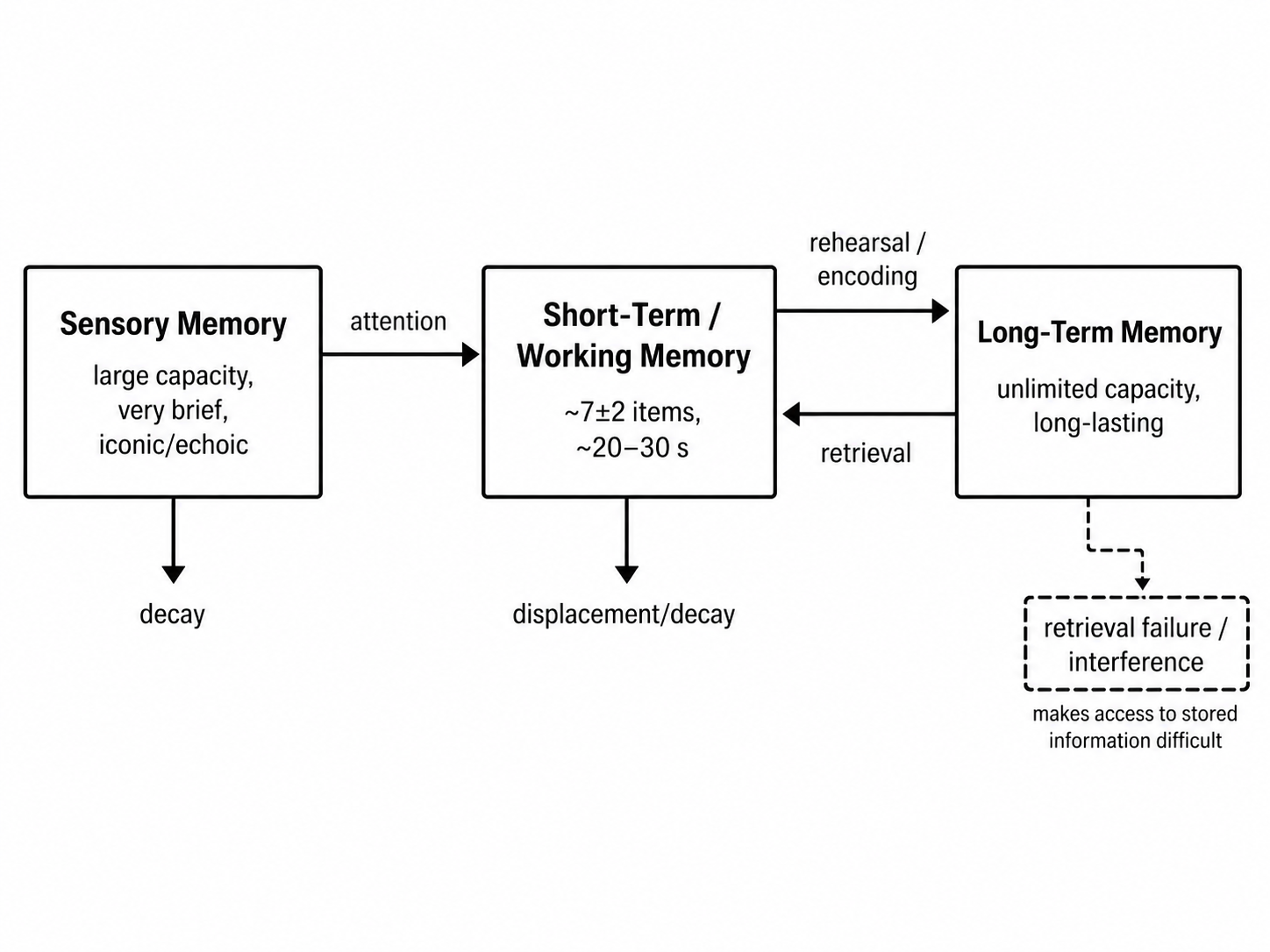
Must knowThe Atkinson-Shiffrin model (the modal model) describes three sequential stores:
- Sensory memory → 2. Short-term memory (STM) → 3. Long-term memory (LTM)
Information enters sensory memory; if attended to, it moves to STM; rehearsal transfers it to LTM.
Sensory Memory
Must knowSensory memory is the pre-conscious buffer holding raw input briefly; large capacity, very short duration, and modality-specific:
- Iconic (visual): ~0.5 s. Passage-level Sperling's partial-report experiments showed we briefly hold ~12 items but can report only ~4 before the trace fades.
- Echoic (auditory): ~3–4 s (you can "replay" the last few words you heard).
Unattended sensory memory simply decays.
Short-Term Memory and Working Memory
Must knowSTM holds attended info in awareness with limited capacity (~ chunks) and limited duration (~20–30 s without rehearsal).
The modern replacement is the working memory model (Baddeley & Hitch) — an active workspace, not a passive bin, with four components:
| Component | Role |
|---|---|
| Central executive | Directs attention, coordinates the other components |
| Phonological loop | Holds/rehearses verbal-acoustic info (inner voice) |
| Visuospatial sketchpad | Holds/manipulates visual and spatial info |
| Episodic buffer | Integrates the loops with LTM into unified episodes |
Long-Term Memory
Must knowLTM has effectively unlimited capacity and can last a lifetime. It is organized into subsystems:
Explicit (declarative) — consciously recalled:
- Episodic: personal, time-stamped experiences (autobiographical).
- Semantic: general world facts ("Paris is the capital of France").
Implicit (non-declarative) — influences behavior without conscious recollection:
- Procedural: motor skills and habits (riding a bike); automatic, hard to verbalize.
- Priming: a stimulus speeds processing of a related one without awareness.
- Classical conditioning: learned stimulus associations.
Patient H.M. (Henry Molaison): bilateral hippocampus removal caused anterograde amnesia for new explicit memories but spared implicit memory (he learned new motor skills, showed priming) — the double dissociation between explicit and implicit systems.
Semantic Networks and Spreading Activation
Must knowIn semantic network theory (Collins & Loftus), concepts are nodes linked by associations, with related concepts linked more closely. Spreading activation: thinking of one concept radiates activation to neighbors, making them more accessible — which is why "doctor" primes "nurse," and which also explains priming.
Quick check (scenario): A student is reading about "fire" and immediately finds it slightly easier to recognize the word "hot" on a screen even though no one told her the words were related. What phenomenon explains this?
Answer: Spreading activation through semantic networks. "Fire" activates related nodes like "hot," temporarily lowering the threshold to recognize them.
Retrieval
Recall, Recognition, and Relearning
Must knowThree retrieval types:
- Recall: retrieving without cues (hardest); cued recall provides a hint and is easier.
- Recognition: identifying previously learned info when presented (multiple choice); easier than recall because the answer is its own cue.
- Relearning (savings method): even unrecallable material is relearned faster than first learned; the savings score reveals a residual trace (Ebbinghaus).
Retrieval Cues
Must knowA retrieval cue is any stimulus that activates a stored memory. The encoding specificity principle (Tulving): retrieval is best when retrieval cues match encoding cues. This underlies:
- Context-dependent memory: better recall when the physical environment matches encoding (Godden & Baddeley: scuba divers recalled best in the environment they learned in).
- State-dependent memory: better recall when your internal physiological/emotional state matches encoding.
The Role of Emotion in Retrieving Memories
Must knowThe amygdala modulates the hippocampus during consolidation of emotional events, strengthening those memories.
- Flashbulb memories: vivid, confident memories of highly emotional/surprising events. They are not more accurate than ordinary memories — just held with more confidence — and remain subject to distortion.
- Mood-congruent memory: current mood biases retrieval (sad mood → sad memories). Clinically, depressed individuals preferentially retrieve negative memories, reinforcing depressive thinking.
Quick check (scenario): A patient with a phobia of dogs experiences intense anxiety whenever she smells a particular cologne that a dog trainer was wearing during a traumatic dog encounter years ago. Even though she can't consciously remember the trainer, the smell triggers anxiety. What type of memory is involved, and what biological structure is most relevant?
Answer: Implicit memory (a conditioned emotional/fear response). The amygdala is the key structure — it encodes emotional associations independently of hippocampal-dependent explicit memory, so fear responses can survive even when explicit memories are disrupted.
Processes That Aid Retrieval
Must know- Hierarchical organization of material aids retrieval over random lists.
- Retrieval practice (testing effect): quizzing yourself strengthens the trace more than re-reading.
- Distributed practice / spaced retrieval improves long-term access.
- Tip-of-the-tongue (TOT): partial retrieval failure — you know that you know but can't access it; shows metacognition can outrun retrieval.
Quick check (scenario): A student who studied biochemistry in a coffee shop decides to take the MCAT at a testing center with a different smell, sound environment, and temperature. According to memory research, should this concern her?
Answer: Mildly, yes — context-dependent memory and the encoding specificity principle predict some reduction in retrieval efficiency when context shifts. Studying in varied environments and practicing retrieval in test-like conditions helps.
Forgetting
Ebbinghaus and the Forgetting Curve
Must knowEbbinghaus (using himself, memorizing nonsense syllables) found the forgetting curve: loss is rapid right after learning, then slows. His work also established spaced practice and savings (relearning).
Decay Theory
Must knowDecay theory: memories fade through disuse — the trace (engram) weakens if not activated. It plausibly covers sensory/short-term memory but is inadequate alone for long-term forgetting (some unrehearsed memories last a lifetime).
Interference
Must knowInterference = disruption of one memory by another:
- Proactive (PI): old learning disrupts new (learning Spanish first intrudes on learning Italian).
- Retroactive (RI): new learning disrupts old (learning Italian disrupts recalling old Spanish).
Mnemonic: PRO = Old intrudes on New; RETRO = New intrudes on Old.
Motivated Forgetting
Must knowMotivated forgetting (Freud's repression): unconsciously pushing threatening memories out of awareness. Modern support is limited, but the MCAT may cite it in a Freudian context. Suppression is the conscious version.
Aging and Memory
Must knowNormal aging hits memory systems unevenly:
- Working memory and episodic memory decline.
- Prospective memory (remembering to do future tasks) declines.
- Semantic memory is relatively preserved (vocabulary stays strong).
- Implicit/procedural memory is largely preserved.
Clinically: loss of semantic or implicit memory is pathological, not normal aging.
Memory Dysfunctions
Must knowAlzheimer's disease — most common dementia. Know the logic progressive loss of acetylcholine (ACh) neurons, with amyloid-beta plaques and tau neurofibrillary tangles; memory loss begins with episodic memory and is irreversible.
Korsakoff's syndrome — thiamine (B₁) deficiency, usually from chronic alcohol abuse. Severe anterograde amnesia (± retrograde) plus confabulation (unconsciously fabricating memories to fill gaps, without awareness); damages the mammillary bodies and thalamus. Partially treatable with early thiamine replacement.
- Anterograde amnesia: can't form new memories after the damage.
- Retrograde amnesia: lost existing memories from before the damage.
The hippocampus is the critical structure for forming new explicit memories.
Quick check (scenario): A 58-year-old chronic alcoholic is hospitalized and found to be disoriented, with severe memory loss. When asked what he did yesterday, he gives an elaborate but impossible story with great confidence. What syndrome is this, what is the cause, and what is the name for the behavior of fabricating memories?
Answer: Korsakoff's syndrome, caused by thiamine (vitamin B₁) deficiency. Unconsciously filling gaps with fabricated stories is confabulation.
Memory Construction and Source Monitoring
Memory Is Reconstructive
Must knowRetrieval is not playback — it is active reconstruction from stored fragments, schemas, and general knowledge, so memories are vulnerable to distortion. Schemas (mental frameworks) shape encoding and retrieval, filling gaps with schema-consistent details that may never have occurred.
The Misinformation Effect
Must knowMisinformation effect (Loftus): misleading post-event information alters memory of the original event. In her classic study, witnesses asked how fast cars were going when they smashed (vs. hit) estimated higher speeds and were likelier to "remember" nonexistent broken glass. This drives the unreliability of eyewitness testimony, which the MCAT links to social/legal psychology.
Source Monitoring
Must knowSource monitoring = attributing a memory to its correct origin. Source monitoring errors: you remember what happened but misattribute where you learned it.
- Cryptomnesia: recalling an idea but forgetting its source, so you believe it's your own (unintentional plagiarism).
- Imagination inflation: imagining an event raises confidence that you experienced it.
Quick check (scenario): A juror remembers hearing during a trial that the defendant was wearing a red jacket. But the juror actually read this detail in a newspaper account of the crime before the trial, and it was never mentioned as evidence. The juror genuinely believes they heard it in court. What type of error is this?
Answer: A source monitoring error. The juror correctly remembers the detail but misattributes its source (courtroom testimony vs. pre-trial news). The misinformation effect could also contribute.
Changes in Synaptic Connections Underlie Memory and Learning
Neural Plasticity
Must knowNeural plasticity is the brain's ability to change structure and function with experience — the biological substrate of memory. Neurons form, strengthen, weaken, or eliminate connections, and some regions (hippocampus) show neurogenesis. Plasticity ranges from short-term (seconds–minutes) to long-term (days–lifetime) changes.
Hebbian learning: "Neurons that fire together, wire together" — repeated co-activation strengthens the synapse; the cellular basis of associative learning.
Long-Term Potentiation (LTP)
Must knowLTP is the best-studied cellular mechanism of long-term memory: high-frequency stimulation lastingly strengthens a synapse. First shown in the hippocampus; uses glutamate.
Know the logicLTP is the cellular face of Hebbian learning — strengthening occurs specifically when pre- and postsynaptic neurons are active together. The NMDA receptor acts as a "coincidence detector," contributing to strengthening only with simultaneous presynaptic input and postsynaptic depolarization. LTD (long-term depression) weakens synapses with low-frequency activity, allowing refinement.
Memory and Learning at the Biological Level
Must know- Hippocampus: new explicit (declarative) and spatial memory.
- Amygdala: emotional memory and fear conditioning.
- Cerebellum / basal ganglia: procedural memory and habits.
Biological sequence:
- Encoding: initial synaptic change (LTP induction).
- Consolidation: stabilization over time — initially hippocampus-dependent, then systems consolidation transfers some memories to the neocortex; sleep aids this.
- Reconsolidation: retrieval temporarily destabilizes a memory, opening a window in which it can be updated or distorted.
Quick check (scenario): A researcher blocks NMDA receptors in the hippocampus of a rat with a drug. She then tries to train the rat in a spatial maze. What outcome would you predict, and why?
Answer: Severely impaired spatial learning. NMDA receptors are essential for inducing hippocampal LTP; without LTP the synaptic strengthening needed to encode the spatial map cannot occur. The rat can navigate but cannot form a long-term memory of the maze.
Common Confusions & Tricks
Proactive vs. retroactive interference: The most commonly reversed pair. Direction goes from the interfering memory to the victim. Proactive = old disrupts new (old reaches forward); retroactive = new disrupts old (new reaches back). Learning Spanish before Italian → Spanish proactively interferes with Italian.
Anterograde vs. retrograde amnesia: Anterograde = can't form new memories going forward (H.M.). Retrograde = lose old memories ("retro" = looking back).
Explicit vs. implicit in amnesia: Hippocampal damage loses explicit but RETAINS implicit memory. Someone who can't recall a skill but can still perform it = implicit/procedural.
Korsakoff's confabulation vs. lying: Confabulation is NOT lying — patients genuinely believe their fabricated stories.
Maintenance vs. elaborative rehearsal: Maintenance keeps things in STM temporarily; only elaborative (meaning) efficiently encodes into LTM.
Flashbulb memories are NOT more accurate: more vivid and confident, but equally subject to distortion.
Misinformation effect = Loftus. Post-event suggestion altering memory → Loftus.
Semantic vs. episodic: Semantic = general facts (preserved in aging); episodic = personal, time-stamped (declines with aging).
Alzheimer's neurotransmitter = acetylcholine (ACh). Treated with ACh-esterase inhibitors (donepezil). Not Parkinson's (dopamine) or Huntington's.
State-dependent vs. mood-congruent memory: State-dependent = retrieval better when physiological/emotional state matches encoding. Mood-congruent = current mood biases which memories you retrieve.
LTP/NMDA = the biological face of Hebbian learning: synapse strengthens only with co-activation. A synapse strengthening after repeated co-activation → LTP.
Key Theories & Terms
| Term / Theory / Researcher | What It Means |
|---|---|
| Atkinson-Shiffrin model | Modal model: sensory → short-term → long-term memory in sequence |
| Levels of processing (Craik & Lockhart) | Deeper semantic processing yields stronger memories than shallow processing |
| Working memory model (Baddeley & Hitch) | Four components: central executive, phonological loop, visuospatial sketchpad, episodic buffer |
| Iconic memory | Visual sensory memory ~0.5 s (Sperling's partial-report) |
| Echoic memory | Auditory sensory memory ~3–4 s |
| George Miller | chunks as short-term capacity; introduced chunking |
| Explicit (declarative) memory | Conscious memory: episodic (experiences) + semantic (facts) |
| Implicit (non-declarative) memory | Unconscious: procedural, priming, conditioned responses; spared in hippocampal amnesia |
| Episodic memory | Personal, time-stamped experiences |
| Semantic memory | General world facts, not tied to personal experience |
| Procedural memory | Motor skills and habits (cerebellum, basal ganglia) |
| Priming | A stimulus facilitates later processing of a related one, without awareness |
| Semantic network theory (Collins & Loftus) | Concepts as nodes connected by associative links |
| Spreading activation | Thinking of one concept activates neighboring concepts |
| Hermann Ebbinghaus | Forgetting curve and savings/relearning; rapid early forgetting |
| Forgetting curve | Most forgetting is rapid then slows; supports spaced practice |
| Encoding specificity principle (Tulving) | Retrieval best when retrieval cues match encoding cues |
| Context-dependent memory | Better recall when physical environment matches encoding (Godden & Baddeley) |
| State-dependent memory | Better recall when internal state matches encoding |
| Mood-congruent memory | Current mood biases which memories are retrieved |
| Flashbulb memories | Vivid, confident memories of emotional events; not necessarily more accurate |
| Proactive interference | Old memories interfere with new ones |
| Retroactive interference | New memories interfere with old ones |
| Decay theory | Memories fade over time through disuse |
| Motivated forgetting / Repression (Freud) | Unconscious pushing of threatening material out of awareness |
| Anterograde amnesia | Can't form new explicit memories after injury |
| Retrograde amnesia | Loss of memories formed before injury |
| Patient H.M. (Henry Molaison) | Bilateral hippocampectomy; anterograde amnesia showed hippocampus is essential for explicit but not implicit memory |
| Alzheimer's disease | Progressive dementia: ACh neuron loss, amyloid-beta plaques, tau tangles; begins with episodic memory loss |
| Korsakoff's syndrome | Thiamine deficiency (alcoholism); anterograde amnesia + confabulation; damages mammillary bodies and thalamus |
| Confabulation | Unconsciously fabricating memories to fill gaps, no intent to deceive; hallmark of Korsakoff's |
| Misinformation effect (Loftus) | Post-event misleading information alters memory |
| Source monitoring | Attributing memories to their correct origin; errors misattribute source |
| Reconstructive memory | Memory is rebuilt during retrieval; vulnerable to distortion and schemas |
| Schemas | Mental frameworks guiding encoding/retrieval, filling gaps with expected info |
| Neural plasticity | The brain's capacity to change structure/function with experience |
| Hebbian learning | "Neurons that fire together, wire together" |
| Long-term potentiation (LTP) | Sustained synaptic strengthening after high-frequency stimulation; primary cellular memory mechanism |
| NMDA receptor | Glutamate "coincidence detector"; contributes to LTP only with simultaneous pre-input and post-depolarization |
| Hippocampus | Encoding new explicit memories and spatial navigation |
| Amygdala | Emotional memory, fear conditioning, modulating consolidation of emotional events |
| Consolidation | Stabilizing a newly encoded memory; hippocampus-dependent; aided by sleep |
| Reconsolidation | Restabilization after retrieval; window for updating/distortion |
| Tip-of-the-tongue phenomenon | Partial retrieval failure; you know you know but can't access it |
| Self-reference effect | Info encoded in relation to oneself is remembered better |
| Method of loci | Mnemonic placing items along a familiar mental route ("memory palace") |
| Dual coding | Encoding verbally and visually, creating two retrieval routes |
| Spacing effect | Distributed practice beats massed cramming for long-term retention |
| Serial position effect | Better recall for start (primacy → LTM) and end (recency → STM) than middle |