Emotion is one of those topics where everyday intuition can mislead you on the MCAT. You feel something, then you think about it — right? Several competing theories disagree with that sequence entirely. This guide covers what an emotion is, what it does, and how the brain and body produce it.
Priority labels: Must know = cold; Know the logic = mechanism not names; Passage-level = recognize, don't memorize; Optional = skippable.
The Three Components of Emotion
Must knowFirst, three baseline terms the MCAT sometimes hinges on. An emotion is a brief, intense reaction directed at a specific object (fear of a snake). A mood is a diffuse, longer-lasting state with no clear object. Affect is the outward, observable display of emotion.
Psychologists decompose emotion into three components:
- Cognitive: the subjective experience — the "what it feels like," plus how you appraise the situation ("this is threatening"). Can be rapid and automatic, not just slow reasoning.
- Physiological: the bodily changes — heart rate, respiration, hormones, skin conductance — orchestrated by the autonomic nervous system and endocrine system, and measurable.
- Behavioral: observable expression and action — facial expression, posture, vocal tone, fleeing or freezing.
The key insight: these three usually co-occur but can be dissociated — which is exactly what the major theories argue about. The theories differ in which component comes first and which causes which.
Quick check: A student learns she passed a critical exam. She smiles broadly, her heart races, and she feels elated. Match each observation to the correct component.
Answer: Smiling (behavioral), racing heart (physiological), feeling elated (cognitive/subjective). All three present simultaneously.
Universal Emotions
Must knowCertain basic emotions are biologically hardwired and cross-culturally universal. The key researcher is Paul Ekman, who studied isolated cultures (famously the Fore people of Papua New Guinea) and found the same core facial expressions produced and recognized across dramatically different cultures — a landmark argument against a purely cultural view of emotion.
The universal emotions: fear, anger, happiness, surprise, disgust, sadness — plus joy, which the AAMC lists separately. Recognize all seven; don't overthink the joy/happiness distinction.
Know the logicFacial feedback hypothesis: the act of making a facial expression can itself amplify the corresponding emotion (the classic pen-in-teeth-forces-a-smile study made cartoons seem funnier). This feeds theories about the body influencing the feeling.
Quick check: Researchers show photographs of facial expressions to subjects in Japan, Brazil, and the United States and find near-identical identification rates. Which researcher's work does this replicate, and what does it support?
Answer: Paul Ekman's work. It supports the universality of basic emotions and a biological (not purely cultural) basis for some emotional expressions.
Adaptive Role of Emotion
Must knowEmotions are adaptive mechanisms that enhance survival and reproduction:
- Motivational: direct behavior toward biologically relevant goals (fear → escape, disgust → avoid pathogens).
- Communication: signal internal states to others, enabling social coordination — why expressions are universal.
- Decision-making: Antonio Damasio's somatic marker hypothesis — emotional "gut feelings" tag options as good or bad. Patients with ventromedial prefrontal damage lose this tagging and make worse real-life decisions despite intact logic, showing emotion is essential to good decisions.
- Preparation: physiological arousal (adrenaline, increased heart rate) readies the body for fight or flight before conscious deliberation.
Quick check: A patient with ventromedial prefrontal cortex damage performs normally on logic puzzles but repeatedly makes disastrous financial decisions. Which hypothesis explains this?
Answer: Damasio's somatic marker hypothesis — he can reason logically but lacks the emotional "gut feeling" tags that normally guide real-world decisions.
Theories of Emotion
Must knowKnow the sequence each theory proposes and distinguish them rapidly. The core debate: does the body or the mind come first?
James-Lange Theory
Must knowWilliam James and Carl Lange independently proposed the same idea.
The claim: you perceive the bear, your body immediately responds, and the emotion is your perception of those bodily changes. The body leads; the feeling follows.
Sequence: stimulus → physiological response → subjective emotion. ("We are afraid because we tremble.")
Implication: different emotions require different physiological signatures.
Criticism (Cannon, 1920s): visceral responses are too slow to cause near-instant emotion, are non-specific, and severing visceral nerves did not eliminate emotional behavior in animals.
Quick check: Per James-Lange, if you could suppress all physiological arousal after a threatening stimulus, what happens to your emotion?
Answer: You feel no emotion (or greatly diminished), because the feeling is the perception of the bodily response.
Cannon-Bard Theory
Must knowWalter Cannon and Philip Bard proposed this in direct response to James-Lange.
The claim: the stimulus is processed by the brain (the thalamus in the original model), which simultaneously signals (1) the cortex → subjective experience and (2) the body → arousal. The two are simultaneous and independent — neither causes the other.
Sequence: stimulus → thalamus → (simultaneously) cortex (feeling) AND body (arousal).
OptionalModern models center the amygdala/limbic structures rather than the thalamus alone.
Quick check: A researcher injects epinephrine to induce rapid heart rate and sweating. Per Cannon-Bard, will subjects necessarily feel a specific emotion like fear?
Answer: No. Cannon-Bard holds arousal and subjective experience are independent parallel processes; arousing the body doesn't dictate which emotion is felt.
Schachter-Singer Theory (Two-Factor Theory)
Must knowStanley Schachter and Jerome Singer (1962) — the most nuanced of the three; needs two inputs.
The claim: Emotion = physiological arousal + cognitive label. You look to your environment to label undifferentiated arousal — the same arousal can become fear, anger, or euphoria depending on context.
Sequence: stimulus → arousal + cognitive label → specific emotion.
Know the logicClassic experiment: subjects injected with epinephrine and placed with a euphoric or angry confederate. Those given no explanation for their arousal adopted the confederate's emotion; those told the drug caused arousal did not shift (they already had an explanation).
Misattribution of arousal: when you can't identify the source of arousal, you attribute it to the most salient thing around you. Dutton & Aron's suspension bridge study — men who met an attractive experimenter on a scary high bridge (fear arousal) rated her as more attractive — is the classic demonstration.
Vs. James-Lange: both need arousal, but James-Lange says specific bodily patterns produce specific emotions directly; Schachter-Singer says arousal is undifferentiated and the mind labels it.
Quick check: A woman runs on a treadmill (high arousal), then immediately watches a sad film and rates it as more moving than a sedentary viewer. Which concept explains this?
Answer: Misattribution of arousal (excitation transfer) — residual arousal from exercise is misattributed to the film, amplifying the emotion.
Lazarus Cognitive Appraisal Theory
Must knowRichard Lazarus: cognitive appraisal — evaluating whether a stimulus is relevant to your goals and whether you can cope — is the necessary first step before any emotion.
This contrasts with Robert Zajonc, who argued affective reactions can be faster than cognition (you can feel before consciously processing). The Lazarus-Zajonc debate: does cognition always precede emotion? Lazarus said yes; Zajonc said sometimes no.
Quick check: A soldier dives for cover at a loud bang, heart pounding before he consciously registers the sound. Which theorist does this support?
Answer: Zajonc's position — an emotional/bodily response can occur before conscious appraisal, challenging Lazarus.
Biological Processes in Perceiving Emotion
Brain Regions Involved in Emotion
Must knowAmygdala: almond-shaped structure in the medial temporal lobe; the brain's threat detector and emotional memory center. Critical for:
- Fear conditioning — associating neutral stimuli with aversive outcomes. Bilateral amygdala damage produces a striking absence of fear.
- Emotional salience tagging — flagging stimuli as significant, which enhances memory (why emotional events are remembered better).
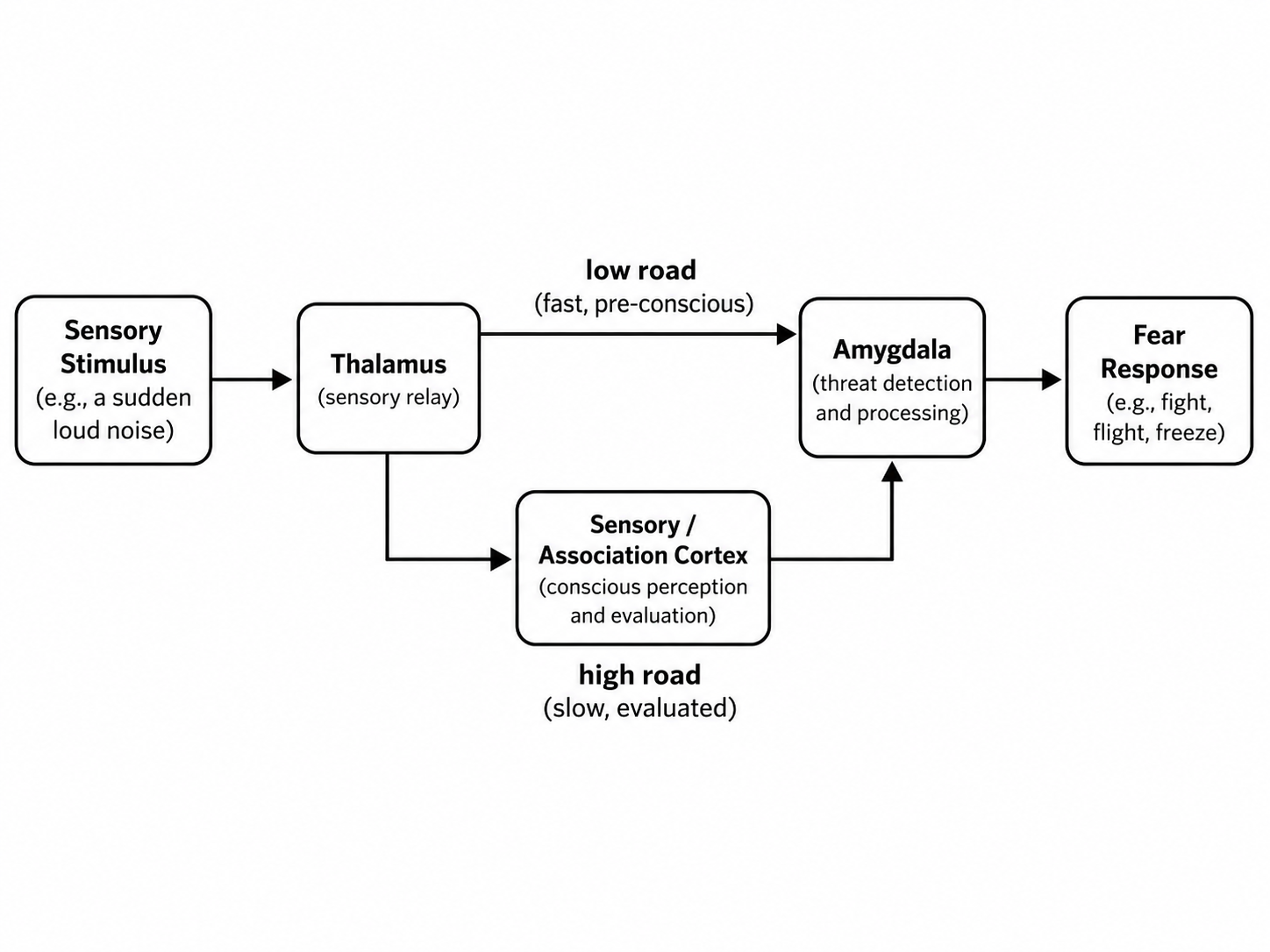
- Rapid pre-cognitive threat processing — receives fast direct input from the thalamus (the "low road") before cortical processing (the "high road"); Joseph LeDoux's dual-pathway model.
Prefrontal cortex: especially ventromedial PFC and orbitofrontal cortex — emotion regulation (dampening amygdala responses), appraisal, and decision-making (Damasio's somatic markers; the Phineas Gage case altered personality after frontal-lobe damage).
Insula: disgust and interoception (perception of bodily states), relevant to the James-Lange view.
OptionalAnterior cingulate cortex — emotion regulation, conflict monitoring. Hippocampus — works with the amygdala on emotional memory, encoding the context (where/when) while the amygdala flags that an event mattered.
Quick check: A patient with bilateral amygdala damage approaches a snake without fear but still knows snakes are dangerous. What does this demonstrate?
Answer: The amygdala is required for the emotional fear response, not factual knowledge of danger — a classic demonstration of its role in fear.
The Role of the Limbic System in Emotion
Must knowThe limbic system is a set of interconnected structures regulating emotion, motivation, and memory.
Core structures:
| Structure | Key role |
|---|---|
| Amygdala | Fear, threat detection, emotional salience |
| Hippocampus | Emotional memory, spatial/contextual memory |
| Hypothalamus | Drives ANS responses and hormone release (links emotion to body) |
| Thalamus | Sensory relay; fast-track to amygdala ("low road") |
Passage-level the cingulate cortex (emotion regulation) and olfactory bulb (smell's direct limbic access) are also limbic. Optional the term "limbic system" was formalized by Paul MacLean, building on the Papez circuit.
The hypothalamus controls the pituitary and the HPA axis (hypothalamic-pituitary-adrenal): under stress, hypothalamus → pituitary → ACTH → adrenal cortex → cortisol (the primary stress hormone). This is the major link between emotion, biology, and long-term health.
Quick check: Why might a specific perfume trigger a vivid emotional memory more reliably than a photograph from the same event?
Answer: The olfactory system projects more directly into limbic structures (amygdala, hippocampus) than other senses, which relay through the thalamus first — giving smell privileged access to emotional memory.
Emotion and the Autonomic Nervous System
Must knowThe ANS produces the physiological component of emotion through two divisions:
Sympathetic ("fight or flight"): activated by threat or excitement; mediated by norepinephrine at organs and epinephrine from the adrenal medulla. Effects: increased heart rate, bronchodilation, pupil dilation, inhibited digestion, sweating, glucose release.
Parasympathetic ("rest and digest"): counteracts sympathetic activation; mediated by acetylcholine; slows heart rate, promotes digestion, constricts pupils.
Emotional arousal (as in Schachter-Singer) reflects sympathetic activation; its intensity roughly tracks emotional intensity, though which emotion depends on cognitive labeling (Schachter-Singer) or the bodily pattern (James-Lange).
Quick check: A patient on a beta-blocker (which blunts sympathetic cardiovascular responses) reports less stage fright. Which theory best predicts that reducing physiological arousal reduces emotional intensity?
Answer: James-Lange — the emotion is the perception of physiological changes, so reducing arousal reduces emotion. Cannon-Bard predicts the emotion occurs independently of the body.
Physiological Markers of Emotion (Signatures of Emotion)
Must knowResearchers document measurable bodily correlates of emotion — physiological signatures:
- Galvanic skin response (GSR): sweating raises skin conductance with arousal; the basis of the polygraph, which measures arousal, not deception directly (why it's unreliable).
- Heart rate: rises with sympathetic activation. (Some research finds fear raises HR more than anger, hinting at partial bodily differentiation — mild support for James-Lange.)
- Cortisol: elevated in stress; chronic elevation is linked to hippocampal atrophy, immune suppression, and cardiovascular disease — a key psychology-to-health connection.
- Passage-level Facial EMG / Duchenne smile: a genuine ("Duchenne") smile engages the orbicularis oculi (eye) plus the zygomaticus major, while a fake smile uses only the zygomaticus. Ekman's FACS codes these facial action units.
Respiration speeds and shallows in anxiety; neuroimaging may link greater left prefrontal activity to positive/approach emotion and right to negative/withdrawal (Davidson).
Quick check: A study measures subjects' skin conductance, heart rate, and respiration while they watch emotional videos, with no self-report. Which component of emotion is being measured, and which theory argued this component is the source of subjective feeling?
Answer: The physiological component. James-Lange argued the subjective feeling is the perception of these bodily changes.
Common Confusions & Tricks
James-Lange vs. Schachter-Singer: the most common mix-up. Both require arousal, but James-Lange says specific bodily states produce specific emotions automatically; Schachter-Singer says arousal is undifferentiated and the emotion comes from cognitive labeling. (James-Lange: "racing heart = fear." Schachter-Singer: "racing heart + [bear] = fear; + [cute person] = attraction.")
Cannon-Bard sequence: it's simultaneous — the thalamus signals the cortex and body at the same time. Neither causes the other.
Amygdala ≠ the only limbic structure: the MCAT can ask about the hippocampus (contextual emotional memory), hypothalamus (HPA axis, ANS), or insula (interoception, disgust).
Sympathetic = arousal in ALL emotions: excitement, joy, and sexual arousal also involve sympathetic activation. The same epinephrine injection produced euphoria or anger in Schachter-Singer, depending on context.
LeDoux's "high road" vs "low road": low road (thalamus → amygdala) is fast and pre-conscious; high road (thalamus → cortex → amygdala) is slower but nuanced. Flinching before consciously seeing a threat = low road.
Ekman's universals vs. cultural display rules: Ekman found universal recognition of expressions but also cultural display rules — norms governing when emotions are shown (e.g., masking disgust before an authority figure). Don't confuse universal emotions with universal expression in all contexts.
Polygraph = arousal detector, not lie detector: it measures GSR, HR, and respiration — arousal, not truth. Anxiety about being falsely accused also raises arousal.
Damasio's somatic markers ≠ James-Lange: related (both emphasize bodily signals), but Damasio addresses how gut feelings guide decision-making, while James-Lange is about the origin of subjective experience.
Key Theories & Terms
| Name / Term | Who / What |
|---|---|
| Paul Ekman | Identified universal basic emotions through cross-cultural research (incl. the Fore of Papua New Guinea); developed FACS. |
| James-Lange Theory | James & Lange; emotion is the perception of physiological changes: stimulus → body response → feeling. |
| Cannon-Bard Theory | Cannon & Bard; body response and feeling occur simultaneously and independently, both triggered by the thalamus. |
| Schachter-Singer (Two-Factor) Theory | Schachter & Singer; emotion requires arousal plus cognitive labeling of that arousal based on context. |
| Misattribution of Arousal | Attributing arousal from one source (exercise, a scary bridge) to another (a person, a film); Dutton & Aron's bridge study. |
| Lazarus Cognitive Appraisal Theory | Lazarus; cognitive appraisal is the necessary first trigger of any emotion. |
| Zajonc | Argued affective reactions can precede and occur without conscious appraisal; challenged Lazarus. |
| Joseph LeDoux | Described the "high road" (slow, cortical) and "low road" (fast, thalamus→amygdala) fear pathways. |
| Antonio Damasio | Somatic marker hypothesis — emotional "gut feelings" guide real-world decision-making. |
| Somatic Marker Hypothesis | Damasio; emotion-based body signals tag options as good/bad; ventromedial PFC damage → poor decisions. |
| Facial Feedback Hypothesis | Making a facial expression can amplify the corresponding emotional experience. |
| Amygdala | Critical for fear conditioning, emotional salience, and rapid threat detection; the "low road" processor. |
| Hypothalamus | Links emotion to bodily response; controls the HPA axis (→ cortisol) and autonomic outputs. |
| HPA Axis | Hypothalamic-Pituitary-Adrenal axis; emotional stress → cortisol; chronic activation linked to hippocampal damage and health problems. |
| Galvanic Skin Response (GSR) | Skin conductance from sweat; a primary marker of emotional arousal; used in polygraphs. |
| Duchenne Smile | A genuine smile using both zygomaticus major and orbicularis oculi (eye crinkle); marker of authentic happiness. |
| Universal Emotions | Fear, anger, happiness, surprise, disgust, sadness (and joy); consistent cross-cultural expression, per Ekman. |
| Cultural Display Rules | Learned norms governing when and how emotions are expressed, even when the underlying emotion is universal. |