Stress is one of the most integrative topics on the MCAT because it bridges psychology, sociology, and biology at once: how the mind interprets threat, how the body mobilizes, and what happens when the response never switches off.
Priority labels: Must know = cold; Know the logic = mechanism not names; Passage-level = recognize, don't memorize; Optional = skippable.
The Nature of Stress
What Stress Actually Is
Must knowStress is the process by which we perceive and respond to environmental events (stressors) appraised as threatening or challenging and requiring effort to manage. Note the two ingredients: the external event and how you interpret it.
Hans Selye distinguished eustress (positive, motivating) from distress (negative, harmful). The point: the stress response is not inherently bad — duration and intensity determine harm.
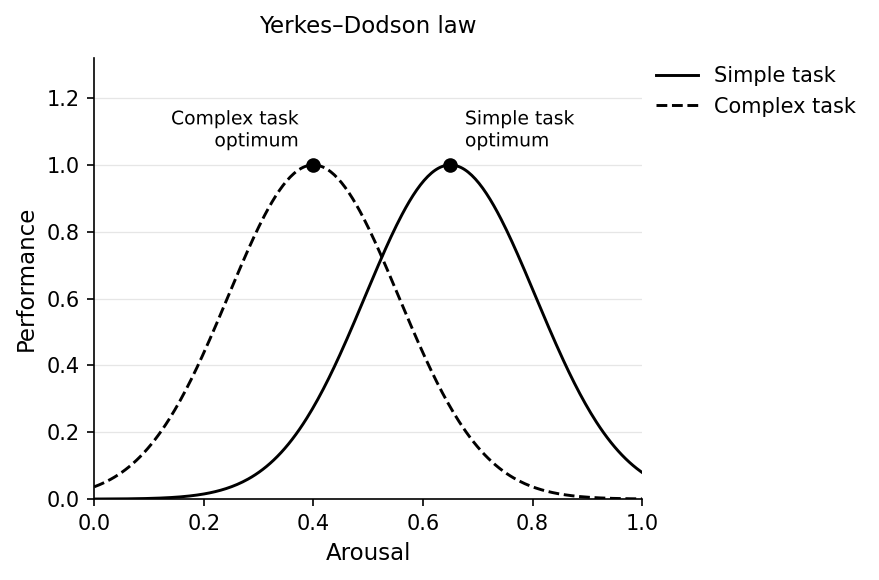
Yerkes-Dodson law — performance rises with arousal up to an optimal point, then declines (an inverted-U). The optimum is lower for complex/unfamiliar tasks and higher for simple/well-practiced ones.
General Adaptation Syndrome (GAS)
Must knowSelye's GAS is a three-stage model of the body's response to any prolonged stressor:
| Stage | Name | What Happens |
|---|---|---|
| 1 | Alarm | Threat detected; fight-or-flight activates; adrenaline and cortisol surge. |
| 2 | Resistance | Body sustains the response and adapts; cortisol stays elevated; resources consumed. |
| 3 | Exhaustion | Resources depleted; immune function collapses; disease risk rises; burnout/collapse. |
Key insight: chronic stress keeps you stuck between resistance and exhaustion. The body was built for brief alarm, not months of activation.
Quick check: A student preparing for finals is irritable, getting sick repeatedly, and cannot concentrate — despite the semester having started fine. Which GAS stage are they most likely in, and why?
Answer: Exhaustion. Prolonged stress has depleted reserves, and immune suppression (a hallmark of exhaustion) explains the repeated illness.
Appraisal
Lazarus's Cognitive Appraisal Theory
Must knowRichard Lazarus argued stress arises from the transaction between person and environment, mediated by appraisal — your subjective evaluation. Two sequential steps:
Primary appraisal — "Is this relevant to my well-being, and is it a threat, harm, or challenge?" Challenge tends to produce eustress; threat and harm/loss tend to produce distress.
Secondary appraisal — "Can I cope?" You weigh resources (skills, social support, time, energy) against demands. When perceived demands exceed perceived resources, distress results.
This explains why a job interview stresses an unprepared applicant but excites a prepared one — same event, different appraisal.
Locus of control (Rotter): an internal locus (outcomes flow from your actions) supports more favorable secondary appraisals and lower stress; an external locus (luck/fate/others) is linked to greater helplessness under uncontrollable stressors.
Reappraisal
Know the logicReappraisal is ongoing reevaluation as a situation unfolds — deliberately shifting appraisal from threat to challenge. It is the cognitive mechanism behind many stress-management techniques (CBT relies on it).
Quick check: A nurse who just transferred to an ED says, "This is terrifying — I might make a fatal mistake." A colleague thinks, "This is a chance to grow." Both appraise the situation as demanding. What explains the difference in their stress reactions?
Answer: Primary appraisal framing — threat vs. challenge — produces different outcomes even when the demand is real. The colleague's challenge appraisal also reflects a higher secondary appraisal of competence.
Types of Stressors
A Taxonomy of What Stresses Us
Must know- Cataclysmic events — sudden, powerful stressors affecting many people at once (earthquakes, wars, pandemics). Shared, so they bring communal social support, but can overwhelm resources and produce mass trauma, including PTSD.
- Personal stressors — significant life events affecting an individual (divorce, bereavement, job loss, illness). Often more isolating than cataclysmic events.
- Background stressors — daily hassles (minor repetitive irritants: traffic, deadlines) and ambient stressors (chronic low-grade conditions: noise, pollution, crowding). Know the logic accumulated daily hassles may predict health outcomes better than major life events because they are relentless and rarely allow full recovery (Lazarus, Kanner).
Holmes and Rahe — The Social Readjustment Rating Scale (SRRS)
Must knowHolmes and Rahe developed the SRRS, assigning Life Change Units (LCUs) to events (death of a spouse highest). Even positive events (marriage, retirement) count because any change demands adaptation. Higher cumulative LCUs over a year correlate with increased illness risk.
Approach-Avoidance Conflicts as Stressors
Know the logicKurt Lewin described three conflict types:
- Approach-approach: two desirable options (low stress).
- Avoidance-avoidance: two undesirable options (high stress).
- Approach-avoidance: one goal with both desirable and undesirable features (particularly stressful — sustained ambivalence).
Quick check: A person must choose between a high-paying job they hate and a low-paying job they love. Which conflict type is this, and why is it more stressful than choosing between two good job offers?
Answer: Avoidance-avoidance conflict. Both options have significant negative features. Approach-approach is resolved quickly because any choice satisfies; avoidance-avoidance maintains tension because you lose either way.
Effects of Stress on Psychological Functions
Cognitive Effects
Know the logicChronic stress impairs:
- Memory/learning: the hippocampus is rich in cortisol receptors; prolonged cortisol damages hippocampal neurons, impairing explicit (declarative) memory — the basis of "brain fog."
- Attention: narrows focus (tunnel vision on the threat) but impairs flexible problem-solving.
- Decision-making: shifts from prefrontal (deliberative) toward amygdala-driven automatic responses.
Emotional Effects
Must knowStress reliably generates anxiety, irritability, low mood, and in chronic cases depression (prolonged HPA/cortisol exposure is associated with reduced serotonin and dopamine signaling).
Learned helplessness (Seligman) links uncontrollable stress to depression: dogs given inescapable shocks later failed to escape when escape became possible — they had learned their actions didn't matter. In humans, uncontrollable stressors similarly produce passivity and hopelessness. It is the flip side of secondary appraisal: perceive no control, and coping collapses.
PTSD follows trauma and is characterized by four symptom clusters: intrusive re-experiencing (flashbacks, nightmares), hyperarousal (startle, insomnia), avoidance, and negative cognitions/mood.
Burnout — emotional exhaustion, depersonalization, and reduced sense of accomplishment — is tied to occupational/caregiving contexts.
Quick check: A paramedic begins avoiding shifts after a mass casualty event. At home, he is jumpy at loud sounds and cannot stop replaying the scene. What stress outcome is described, and which symptom clusters are present?
Answer: PTSD — avoidance, hyperarousal (startle), and re-experiencing (intrusive replay).
Stress Outcomes and Response to Stressors
Physiological Responses
The SAM Axis — The Fast Response
Must knowOn threat, the hypothalamus activates the sympathetic nervous system, which signals the adrenal medulla to release epinephrine and norepinephrine — Cannon's fight-or-flight response within seconds: heart rate and blood pressure up, bronchodilation, glucose mobilized from the liver, blood shunted from gut/skin toward skeletal muscle and brain, pupils dilate, sweating.
Passage-levelCannon/Shelley Taylor also described tend-and-befriend — seeking and providing social support instead of fighting or fleeing, especially under social threat.
The HPA Axis — The Slow, Sustained Response
Must knowFor persistent stressors, the HPA axis runs a hormonal cascade:
- Hypothalamus → CRH
- → anterior pituitary → ACTH
- → adrenal cortex → cortisol (a glucocorticoid)
Cortisol raises blood glucose (gluconeogenesis), is anti-inflammatory short-term but suppresses immune function with prolonged exposure, mobilizes fat, and increases alertness. The HPA axis is the key link from chronic psychological stress to disease — cortisol suppresses immune surveillance, raises cardiovascular risk, and damages the hippocampus.
Allostasis and Allostatic Load
Know the logicAllostasis (McEwen) is maintaining stability through change. Allostatic load is the cumulative "wear and tear" from repeated/prolonged stress, associated with cardiovascular disease, metabolic disorders, immune dysfunction, and accelerated aging.
Psychoneuroimmunology
Know the logicPsychoneuroimmunology (PNI) studies how psychological states influence immune function via neural/hormonal pathways. Chronic stress reduces NK-cell activity, slows wound healing, lowers vaccine effectiveness, and reactivates latent viruses — a favorite MCAT passage theme because it integrates all three sciences.
Type A / Type B Personality and Cardiovascular Disease
Passage-levelThe Type A pattern (Friedman & Rosenman: competitive, time-urgent, especially hostile) shows heightened cardiovascular reactivity and increased coronary heart disease risk; Type B (relaxed) carries lower risk. The MCAT frames this as chronic stress reactivity translating into physical disease.
Quick check: A researcher finds medical students show reduced immune responses to hepatitis B vaccination during exams versus summer. Which axis is responsible, and what hormone is the primary mediator?
Answer: The HPA axis; cortisol. Chronically elevated cortisol during exam stress suppresses immune function, reducing the antibody response.
Emotional Responses
Passage-levelStress-related emotion follows a pattern of initial anxiety/alarm that may resolve or escalate to sustained negative affect. Positive states (humor, gratitude, social connection) buffer stress by dampening HPA reactivity.
Behavioral Responses
Know the logic- Adaptive: social support, problem-solving, exercise, sleep.
- Maladaptive: substance use, over/undereating, withdrawal, aggression, procrastination.
The problem-focused vs. emotion-focused coping distinction (next section) maps onto whether behavior targets the stressor or the emotional response.
Quick check: After a poor grade, one student spends the weekend drinking heavily and avoids studying; another emails the professor and creates a revised study schedule. Classify each.
Answer: The first is maladaptive, emotion-focused (numbing without addressing the problem). The second is adaptive, problem-focused (targeting the source).
Managing Stress
Coping Strategies — Lazarus and Folkman
Must knowLazarus and Folkman defined coping as conscious efforts to manage taxing demands, with two strategies:
Problem-focused coping addresses the stressor directly (plan, act, seek instrumental support) — best when the stressor is controllable.
Emotion-focused coping manages the distress (emotional support, reappraisal, meditation) — best when the stressor is uncontrollable (grief, terminal diagnosis). Neither is universally superior; fit to controllability is what matters.
Hardiness — Kobasa
Passage-levelSuzanne Kobasa's hardiness buffers stress via three "C" traits: Commitment (meaning), Control (belief in influence), Challenge (change as opportunity). Essentially a chronic disposition toward challenge appraisal plus high secondary appraisal.
Social Support
Know the logicOne of the best-validated buffers. Mechanisms: direct buffering (suppresses cortisol, raises oxytocin), informational, emotional, and tangible support. Socially isolated individuals fare worse under equivalent stressors — a biological as well as psychological effect.
Exercise
Passage-levelReduces HPA reactivity (lowers baseline cortisol), promotes hippocampal neurogenesis (counteracting cortisol damage), releases endorphins, and improves sleep — plus a physiological outlet for sympathetic arousal.
Relaxation Techniques
Passage-levelDeep breathing, progressive muscle relaxation, meditation, and biofeedback engage the parasympathetic nervous system, lowering heart rate, blood pressure, and cortisol. MBSR (Kabat-Zinn) is a formalized mindfulness program. Biofeedback uses real-time physiological feedback to train voluntary control of stress responses.
Spirituality and Meaning-Making
Passage-levelReligious/spiritual practice correlates with better stress outcomes via community/social support, meaning-making that facilitates challenge appraisal and acceptance, structured relaxation, and health-protective behaviors.
Quick check: A physician caring for a dying patient cannot change the prognosis but is extremely distressed. What coping type is most adaptive, and name one concrete technique?
Answer: Emotion-focused coping, because the stressor is uncontrollable. Options: mindfulness meditation, seeking emotional support, or a meaning-making practice like spirituality.
Common Confusions & Tricks
GAS Stage Mix-up — Alarm vs. Exhaustion: Alarm has the dramatic acute response but the person quickly recovers; exhaustion looks like someone "sick and falling apart" because chronic cortisol has suppressed immunity. Repeated illness + depletion = exhaustion, not alarm.
SAM vs. HPA — Speed and Hormone: SAM is fast (seconds) via autonomic nervous system → adrenal medulla → epinephrine/norepinephrine. HPA is slow (minutes to hours) → adrenal cortex → cortisol. Don't mix up medulla (catecholamines) and cortex (glucocorticoids).
Primary vs. Secondary Appraisal: Primary appraises the Problem ("Is this a problem?"); Secondary appraises the Solution capacity ("Can I handle it?").
Problem- vs. Emotion-focused Coping — Not Good/Bad: Emotion-focused coping is the correct adaptive choice when the stressor is uncontrollable. Don't reflexively mark it maladaptive — the key word is controllability.
Eustress Is Still Stress: Eustress engages the same physiological pathways. An athlete before competition with elevated cortisol and heart rate is experiencing eustress — but the biology is identical to distress.
Holmes & Rahe — Positive Events Count: Marriage, pregnancy, and promotions have LCU scores too. Any life change demands adaptation.
Cortisol Immunosuppression Paradox: Short-term, cortisol is anti-inflammatory and protective; chronic elevation causes immune suppression and disease. Short-term anti-inflammatory benefit is not a contradiction.
Tend-and-Befriend Is Not Fight-or-Flight: Especially under social threat, the response of seeking/nurturing social bonds is a distinct pattern, not a subtype of fight-or-flight (Shelley Taylor).
Key Theories & Terms
| Term / Researcher | What It Means / Who |
|---|---|
| Hans Selye | Described GAS and coined eustress/distress |
| General Adaptation Syndrome (GAS) | Three-stage stress response: alarm → resistance → exhaustion |
| Eustress / Distress | Positive (motivating) vs. negative (harmful) stress (Selye) |
| Yerkes-Dodson Law | Inverted-U of arousal and performance; optimum lower for complex tasks |
| Learned Helplessness | Passivity/depression after uncontrollable stressors (Seligman) |
| Locus of Control | Internal (self) vs. external (luck/fate); internal buffers stress (Rotter) |
| Type A / Type B Personality | Type A (hostile, time-urgent) linked to coronary heart disease; Type B lower-risk (Friedman & Rosenman) |
| Walter Cannon | Described fight-or-flight and homeostasis |
| Fight-or-Flight Response | Rapid sympathetic/SAM activation preparing for action (Cannon) |
| Tend-and-Befriend | Social affiliation response to stress, esp. under social threat (Taylor) |
| Richard Lazarus | Developed Cognitive Appraisal Theory and problem/emotion-focused coping |
| Cognitive Appraisal Theory | Stress from the person-environment transaction, mediated by appraisal (Lazarus) |
| Primary Appraisal | Evaluating whether a situation is threatening, harmful, or challenging |
| Secondary Appraisal | Evaluating whether one's resources are sufficient to cope |
| Reappraisal | Ongoing re-evaluation; mechanism of cognitive coping |
| Susan Folkman | Co-developed problem- vs. emotion-focused coping (with Lazarus) |
| Problem-Focused Coping | Directly addresses the stressor; best when controllable |
| Emotion-Focused Coping | Manages distress; best when uncontrollable |
| Holmes & Rahe | Developed the SRRS (life-change units) |
| SRRS / Life Change Units (LCUs) | Quantifies life-event stress, including positive events; higher LCUs = greater illness risk |
| Kurt Lewin | Approach-approach, avoidance-avoidance, approach-avoidance conflicts |
| Cataclysmic Stressors | Sudden, large-scale events affecting many people at once |
| Daily Hassles | Minor recurring stressors whose accumulation predicts health outcomes (Lazarus, Kanner) |
| SAM Axis | Sympathetic-Adrenal-Medullary; fast response; epinephrine/norepinephrine |
| HPA Axis | Hypothalamic-Pituitary-Adrenal; slow, sustained response; cortisol |
| Cortisol | Glucocorticoid from adrenal cortex; immunosuppressant with chronic exposure |
| Allostasis / Allostatic Load | Stability through change / cumulative wear-and-tear (McEwen) |
| Psychoneuroimmunology (PNI) | How psychological states affect immune function via neural/hormonal pathways |
| PTSD | Post-trauma disorder: re-experiencing, hyperarousal, avoidance, negative mood |
| Burnout | Occupational outcome: emotional exhaustion, depersonalization, reduced accomplishment |
| Suzanne Kobasa | Identified hardiness (commitment, control, challenge) as a stress buffer |
| Hardiness | Stress-buffering traits: commitment, control, challenge (Kobasa) |
| MBSR | Structured mindfulness meditation program (Kabat-Zinn) |
| Biofeedback | Real-time physiological data to train voluntary control of stress responses |