Every thought, emotion, reflex, and personality trait has a biological substrate. The MCAT tests your ability to connect the nervous system, endocrine system, and genetics to observable behavior. This guide builds that connection from the single neuron up to the developing human organism.
Priority labels: Must know = cold; Know the logic = mechanism not names; Passage-level = recognize, don't memorize; Optional = skippable.
The Neuron: The Basic Unit of Behavior
Structure and Function
Must knowA neuron processes and transmits information through electrical and chemical signals. The cell body (soma) holds the nucleus; dendrites receive incoming signals (the "listening" end); the axon carries the electrical signal away toward the next cell; axon terminals release chemical messengers. Many axons are wrapped in myelin, an insulating sheath made by Schwann cells (PNS) and oligodendrocytes (CNS). Myelin speeds conduction via saltatory conduction — the signal jumps between gaps called nodes of Ranvier.
Neurons are classified by function: sensory (afferent) carry signals toward the CNS; motor (efferent) carry signals away toward muscles/glands; interneurons integrate within the CNS. Mnemonic: SAME — Sensory = Afferent, Motor = Efferent.
Passage-levelGlia support neurons. Beyond myelin-producing Schwann cells and oligodendrocytes, know astrocytes (most abundant; support the blood-brain barrier and recycle neurotransmitters), microglia (the CNS immune cells), and ependymal cells (produce cerebrospinal fluid).
The Action Potential
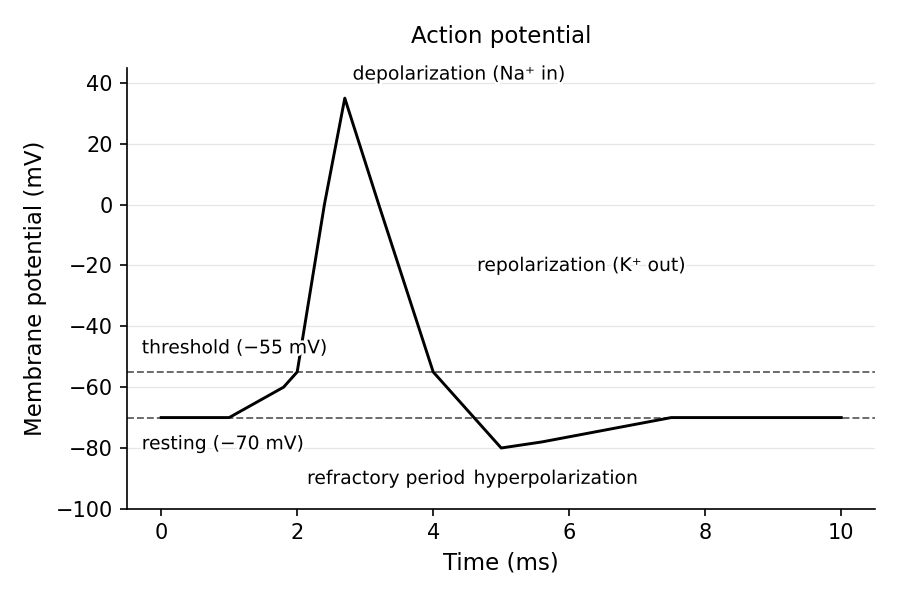
Know the logicThe action potential is an all-or-nothing wave of depolarization down the axon. At rest the inside is more negative than the outside (resting potential, ~−70 mV), maintained by the sodium-potassium pump (3 Na⁺ out, 2 K⁺ in).
When a stimulus reaches threshold (~−55 mV), voltage-gated Na⁺ channels open, Na⁺ rushes in, and the cell depolarizes; this triggers adjacent channels, propagating the signal. Then K⁺ channels open, K⁺ exits, and the cell repolarizes, briefly hyperpolarizing below rest. This is the refractory period — the neuron cannot fire again, which keeps signals one-directional and caps firing rate.
Quick check: A toxin blocks voltage-gated sodium channels. What happens to action potential generation?
Answer: Action potentials cannot be initiated or propagated — the cell can't depolarize past threshold. This is the mechanism of local anesthetics like lidocaine.
The Reflex Arc
Must knowA reflex arc is the simplest neural circuit. Touch a hot stove and you pull back before feeling pain. The circuit: sensory receptor → afferent neuron → interneuron in the spinal cord → efferent neuron → effector (muscle). The key point: processing happens at the spinal cord, not the brain, allowing faster responses. The patellar (knee-jerk) reflex is monosynaptic — one synapse, no interneuron.
Quick check: A patient has a severed spinal cord at a high cervical level. Will his patellar reflex still be present?
Answer: Yes. The patellar reflex completes within the lumbar spinal cord and doesn't require the brain. The lesion above eliminates voluntary movement but not reflexes below it — which may even become hyperactive from loss of descending inhibition.
Neurotransmitters and Their Influence on Behavior
The Synapse
Must knowNeurons don't touch; signals cross the synapse. An action potential at the terminal opens voltage-gated calcium channels; Ca²⁺ entry triggers synaptic vesicles to release neurotransmitters into the cleft. These bind postsynaptic receptors, producing an excitatory postsynaptic potential (EPSP) (depolarization toward threshold) or an inhibitory postsynaptic potential (IPSP) (hyperpolarization away from threshold). Firing depends on summation of EPSPs/IPSPs — across locations (spatial) or in rapid succession (temporal). Afterward, neurotransmitters are cleared by reuptake, enzymatic degradation (e.g., acetylcholine by acetylcholinesterase), or diffusion.
Know the logicIonotropic receptors are ligand-gated ion channels — binding directly opens a pore for a fast, brief response (e.g., nicotinic ACh, GABA-A, glutamate receptors). Metabotropic receptors are G-protein-coupled — binding triggers a second-messenger cascade for a slower, longer-lasting, modulatory effect (e.g., muscarinic ACh, most dopamine/serotonin/adrenergic receptors). One neurotransmitter can use both: ACh acts at nicotinic (ionotropic) and muscarinic (metabotropic) receptors, which is why drugs can target one selectively.
Major Neurotransmitters
Must knowKnow each neurotransmitter's role, behavioral relevance, and key clinical link.
| Neurotransmitter | Primary Role | Key Clinical Connection |
|---|---|---|
| Acetylcholine (ACh) | Muscle contraction; memory, attention, arousal | Alzheimer's (ACh loss); myasthenia gravis (anti-ACh receptor antibodies) |
| Dopamine (DA) | Reward/motivation; motor control | Schizophrenia (excess mesolimbic DA); Parkinson's (DA loss, substantia nigra) |
| Serotonin (5-HT) | Mood, sleep, appetite | Depression/OCD (low 5-HT); SSRIs raise synaptic 5-HT |
| Norepinephrine (NE) | Arousal, alertness, fight-or-flight | Depression (low NE); SNRIs target NE and 5-HT |
| GABA | Primary inhibitory NT in CNS | Anxiety (low GABA); benzodiazepines and alcohol enhance GABA |
| Glutamate | Primary excitatory NT in CNS; LTP | Excess → excitotoxicity (stroke, ALS) |
| Endorphins | Endogenous opioids; pain modulation | Runner's high; opioid drugs mimic them |
| Substance P | Pain signal transmission | Reduced by capsaicin |
A key distinction: GABA is the main inhibitory NT in the brain; glycine plays that role in the spinal cord. Glutamate drives long-term potentiation (LTP) — synaptic strengthening with repeated use, the leading cellular model of learning and memory.
Quick check: A patient on a benzodiazepine (which enhances GABA at GABA-A receptors) overdoses. Predict what happens.
Answer: Excess inhibitory signaling → sedation, respiratory depression, coma — why CNS depressants are dangerous in overdose. Alcohol (also a GABA enhancer) works the same way.
Structure and Function of the Peripheral Nervous System
Must knowThe peripheral nervous system (PNS) is all nervous tissue outside the brain and spinal cord, divided into two functional divisions.
Somatic nervous system (SNS): Controls voluntary skeletal muscle and carries sensory information to the CNS. Uses acetylcholine at the neuromuscular junction (NMJ); under conscious control.
Autonomic nervous system (ANS): Controls involuntary functions (heart rate, digestion, glands, smooth muscle):
- Sympathetic ("fight or flight"): Increases heart rate, dilates pupils, inhibits digestion, dilates bronchioles, mobilizes glucose. Pre-ganglionic neurons use ACh; post-ganglionic use norepinephrine (except sweat glands, which use ACh — a classic trap). Originates thoracolumbar.
- Parasympathetic ("rest and digest"): Lowers heart rate, stimulates digestion, constricts pupils. Both pre- and post-ganglionic use ACh. Originates craniosacral (especially vagus, CN X); ganglia sit near/within target organs.
- Optional Enteric ("second brain"): GI-wall network controlling digestion semi-independently.
Quick check: A person encounters a bear. Describe expected changes in heart rate, digestion, and pupil size, and the responsible ANS division.
Answer: Heart rate up, digestion inhibited, pupils dilated — all sympathetic effects mediated by norepinephrine on adrenergic receptors.
Structure and Function of the Central Nervous System
The Spinal Cord
Must knowThe spinal cord has central gray matter (cell bodies, butterfly-shaped) surrounded by white matter (myelinated tracts) — the opposite of the brain. The dorsal horn receives sensory input; the ventral horn holds motor neurons — captured by DAVE: Dorsal = Afferent, Ventral = Efferent.
Know the logicAscending tracts carry sensory info up, descending tracts carry motor info down. The high-yield point is where each crosses:
- Spinothalamic tract: pain/temperature; crosses at the spinal cord level.
- Dorsal columns: fine touch, vibration, proprioception; crosses at the medulla.
- Corticospinal tract: voluntary motor; crosses at the medulla.
Because they cross at different levels, a spinal hemisection (Brown-Séquard) gives ipsilateral motor and fine-touch loss but contralateral pain/temperature loss below the lesion.
Quick check: A patient has a lesion in the left dorsal column at T4. On which side is fine touch impaired below the lesion?
Answer: Left (ipsilateral) — dorsal column fibers travel ipsilaterally until they cross at the medulla, and the lesion interrupts them before they decussate.
The Brain
Hindbrain
Must knowThe oldest part of the brain; controls life-sustaining functions.
- Medulla oblongata: breathing, heart rate, blood pressure, swallowing; damage is rapidly fatal.
- Pons: relay between cerebrum and cerebellum; sleep and arousal.
- Cerebellum: coordinates movement, balance, fine motor control (refines, doesn't initiate); damage causes ataxia and intention tremor. Processes ipsilaterally (unlike cortex).
- Reticular formation / reticular activating system (RAS): regulates arousal and the sleep-wake cycle; suppressed by general anesthetics.
Quick check: A patient with chronic alcoholism develops cerebellar degeneration. What would the neurological exam show?
Answer: Wide-based unsteady gait, intention tremor, impaired rapid alternating movements, slurred speech — impaired coordination, not weakness.
Midbrain
Must knowA small relay center.
- Tectum: superior colliculi (visual reflexes), inferior colliculi (auditory reflexes).
- Tegmentum: the substantia nigra (dopamine for smooth movement; degeneration causes Parkinson's) and the ventral tegmental area (VTA), origin of the mesolimbic dopamine pathway (the reward circuit, projecting to the nucleus accumbens; central to motivation and addiction).
Quick check: A drug selectively destroys VTA neurons. Predict the behavioral effect.
Answer: Anhedonia, loss of motivation, and impaired reward learning — the VTA is the origin of the mesolimbic reward pathway, mirroring severe depression and dopamine-blocking antipsychotics.
Forebrain
Diencephalon
Must know- Thalamus: the brain's relay station — nearly all sensory info (except smell) passes through it before the cortex.
- Hypothalamus: master of homeostasis — hunger, thirst, temperature, circadian rhythms, sex. Controls the pituitary, linking nervous and endocrine systems. The "4 F's": Fighting, Fleeing, Feeding, mating.
Limbic System
Must knowEmotion, memory, and motivation:
- Amygdala: fear and emotional memory (fear conditioning).
- Hippocampus: forms new declarative (explicit) memories. H.M. (bilateral hippocampal removal) had anterograde amnesia but intact remote and procedural memory, establishing distinct memory systems.
- Optional Cingulate cortex: emotional processing, attention, decision-making.
Basal Ganglia
Must knowSubcortical nuclei regulating initiation/inhibition of voluntary movement, habit, and procedural learning. Huntington's (striatum degeneration) and Parkinson's (dopamine loss) both involve basal ganglia dysfunction.
Cerebral Cortex
Must knowThe outermost layer; four lobes:
- Frontal: executive function — planning, impulse control, working memory, personality, voluntary motor (primary motor cortex in the precentral gyrus). Phineas Gage's frontal injury altered personality while sparing intellect.
- Parietal: somatosensory processing (primary somatosensory cortex, postcentral gyrus), spatial awareness; lesions can cause neglect.
- Temporal: auditory processing, language comprehension (Wernicke's area), memory; contains hippocampus and amygdala.
- Occipital: visual processing (primary visual cortex, V1); right visual field maps to left occipital lobe.
Quick check: A stroke destroys the right postcentral gyrus. What does the patient experience?
Answer: Loss of somatosensation from the left body — the postcentral gyrus is primary somatosensory cortex, and sensory input is processed contralaterally.
Lateralization of Cortical Functions
Must knowCertain abilities are lateralized. In most people, language is left-lateralized.
- Broca's area (left inferior frontal gyrus): speech production. Damage → Broca's (expressive) aphasia — effortful, non-fluent speech with relatively preserved comprehension.
- Wernicke's area (left posterior superior temporal gyrus): language comprehension. Damage → Wernicke's (receptive) aphasia — fluent but nonsensical speech ("word salad") with impaired comprehension.
- The arcuate fasciculus connects them; damage causes conduction aphasia (intact comprehension and speech, but cannot repeat).
Left hemisphere tends toward analytic/logical reasoning, language, and math; right toward holistic/spatial reasoning, facial recognition, and prosody.
Split-brain research (Roger Sperry, Nobel 1981; Michael Gazzaniga): severing the corpus callosum prevents transfer between hemispheres. An object in the left hand (right hemisphere) couldn't be verbally named (language is left) but could be picked out by the left hand — proving each hemisphere can process independently.
Quick check: In a split-brain patient, a picture of a key is flashed to the left visual field only. The patient says they saw nothing. Can they identify the object?
Answer: Yes — the left visual field projects to the right hemisphere, which recognizes objects. They can't verbally name the key (verbal output needs the left hemisphere) but can pick it out with the left hand (right hemisphere).
Methods Used in Studying the Brain
Must knowKnow the major techniques and what each measures.
| Method | What It Measures | Key Feature |
|---|---|---|
| EEG | Electrical activity of neural populations | Excellent temporal, poor spatial resolution; non-invasive |
| fMRI | Blood oxygenation (BOLD) as proxy for activity | Excellent spatial resolution; localizes function |
| PET | Metabolic activity via radioactive tracers | Can image neurotransmitter systems; uses radiation |
| CT | Structure via X-ray | Fast; good for bleeds/large lesions |
| MRI (structural) | Anatomy via magnetic fields | Excellent detail; no radiation |
| TMS | Disrupts/activates cortical areas | Creates a transient "virtual lesion" for causal tests |
| Lesion studies | Behavioral effects of brain damage | Establish causal necessity |
| Single-unit recording | Action potentials of single neurons | Highly specific; invasive |
Key distinction: fMRI/PET measure function; structural MRI/CT measure anatomy. EEG has the best temporal resolution (ideal for sleep stages and seizures).
Quick check: Which neuroimaging method best identifies the region active when recognizing a familiar face, and why?
Answer: fMRI — excellent spatial resolution to localize activity, non-invasive, no radiation. PET works too but involves radiation.
The Endocrine System and Behavior
Must knowThe endocrine system signals slowly but body-wide via hormones — messengers secreted into the blood that bind distant target cells.
Know the logicThe hypothalamus makes releasing hormones (CRH, TRH, GnRH) that drive the anterior pituitary to release tropic hormones (ACTH, TSH, LH/FSH, GH, prolactin) acting on peripheral glands. The posterior pituitary stores and releases hypothalamic ADH and oxytocin — it's a release site, not a true secretory gland.
Major glands and behavioral relevance:
- Adrenal cortex: cortisol (stress, via the HPA axis), aldosterone, sex steroids. Chronic cortisol impairs memory (hippocampal damage) and raises depression/anxiety risk.
- Adrenal medulla: an extension of the sympathetic system; releases epinephrine and norepinephrine in acute stress.
- Thyroid (T3/T4): regulates metabolism, growth, neural development. Hypothyroidism → fatigue, cognitive slowing, depression; hyperthyroidism → anxiety, irritability. Passage-level fetal deficiency causes cretinism (irreversible intellectual disability).
- Gonads: testosterone, estrogen, progesterone influence sexual behavior, aggression, mood. Organizational effects (prenatal) shape brain structure permanently; activational effects (later) trigger behaviors when hormone levels change.
- Pancreas: insulin/glucagon; severe hypoglycemia impairs cognition (neurons depend on glucose).
- Pineal: melatonin in darkness, regulating circadian rhythms.
- Oxytocin: social bonding, trust, maternal attachment, labor contractions.
Quick check: A patient under chronic stress has chronically elevated cortisol. Beyond metabolic effects, what cognitive/behavioral consequences would you predict?
Answer: Hippocampal atrophy (cortisol is neurotoxic at high levels) → impaired memory; raised anxiety/depression risk; impaired executive function — the biological link between chronic stress and mental health disorders.
Behavioral Genetics
Genes, Temperament, and Heredity
Must knowBehavioral genetics studies how genetic variation contributes to individual differences in behavior; both genes and environment matter, and the challenge is disentangling them.
Temperament — stable, biologically based differences in reactivity and emotionality present from infancy — has a genetic basis shown by newborn temperamental differences, higher MZ-than-DZ twin concordance, and adoptees resembling biological over adoptive parents.
Twin and Adoption Studies
Must knowTwin studies compare monozygotic (MZ) twins (~100% shared DNA) to dizygotic (DZ) (~50%). Higher MZ concordance suggests genetic contribution; MZ concordance below 100% shows environment also matters.
Heritability is the proportion of population variance in a trait due to genetic differences — a population statistic, not a statement about individuals, and it can change across environments. Heritability of 0.8 for IQ means 80% of the variation in a population is genetic, not that 80% of any one person's IQ is genetic.
Adoption studies separate genes from environment: children of biological parents with schizophrenia raised by unaffected adoptive parents still show elevated rates. Family (pedigree) studies track how concordance rises with relatedness, but close relatives also share environments — which is why twin and adoption designs are needed. Together these reframe nature vs. nurture as how genes and environment interact.
Gene-Environment Interaction
Must knowGenes and environment constantly interact:
- Gene-environment interaction (G×E): a genotype's effect depends on the environment. Classic example: the MAOA gene — low activity plus childhood maltreatment greatly raises antisocial-behavior risk, while neither alone does.
- Epigenetics: environment alters gene expression (via DNA methylation, histone modification) without changing DNA sequence; can be heritable. Early adversity can epigenetically alter stress systems.
- Gene-environment correlation: genes shape the environments people experience — passive (parents provide genes and environment), evocative (a child's traits elicit reactions), active (people select fitting environments).
Regulatory Genes and Behavior
Know the logicRegulatory genes control expression of other genes via transcription factors or regulatory RNA. The classic examples are Hox genes, which pattern the body plan in development (mutations cause homeotic transformations, e.g., legs where antennae belong in Drosophila). By governing the timing of gene expression — including when neural circuits mature — regulatory genes influence behavior without changing structural proteins.
Adaptive Value of Traits and Behaviors
Must knowEvolutionary psychology examines how natural selection shapes behavior: traits that raised reproductive fitness ancestrally were selected. Examples:
- Preparedness (Seligman): fears of ancient threats (snakes, heights) condition more easily than modern ones (cars).
- Inclusive fitness / kin selection (Hamilton): altruism toward relatives evolves when benefit × relatedness exceeds cost.
- Reciprocal altruism: cooperation with non-relatives when mutual benefit is expected.
Prairie voles (monogamous) vs. meadow voles (promiscuous) differ in vasopressin receptor density — genetically determined neural differences driving social behavior. The Drosophila forager gene shows single-gene influence on behavior. Human personality traits show moderate heritability (~40–60%).
Quick check: MZ twins show 45% concordance for major depression, DZ twins 20%. What can you conclude about genetics and environment?
Answer: Higher MZ concordance indicates a genetic contribution; MZ concordance well below 100% means environment is also essential — consistent with a gene-environment interaction model.
Human Physiological Development
Prenatal Development
Must knowThree prenatal stages:
- Germinal (weeks 0–2): fertilization through implantation; the zygote divides into a blastocyst that implants.
- Embryonic (weeks 3–8): organogenesis — the period of greatest teratogen vulnerability. The nervous system forms from the neural plate, which folds into the neural tube by week 4; failed closure causes anencephaly or spina bifida (folate reduces risk). Neural crest cells migrate from the tube's edge to form most of the PNS, the adrenal medulla, and melanocytes — an MCAT favorite for its diverse derivatives.
- Fetal (week 9–birth): rapid growth; neuronal migration, synaptogenesis, and myelination continue into early adulthood (prefrontal myelination into the mid-20s).
Critical periods: windows when the nervous system is especially sensitive to experience. The classic example is ocular dominance columns — monocular deprivation during the critical period permanently impairs cortical responsiveness to that eye (Hubel and Wiesel, Nobel 1981). In humans, untreated congenital cataracts in infancy cause permanent amblyopia.
Motor Development
Must knowTwo principles: cephalocaudal (head-to-toe — head before trunk before legs) and proximodistal (center-to-periphery — trunk before arms before fingers).
Passage-levelThe exact ages are low-yield; know the trend (head lift → roll → sit → stand → walk over the first ~12–18 months). Fine motor progresses from palmar grasp to pincer grasp (~9 months). Motor development requires practice and opportunity, not maturation alone.
Reflexes present at birth normally disappear as the cortex matures; persistence signals pathology. Know the Babinski reflex (toe extension on stroking the sole) — normal in infants but a sign of an upper motor neuron lesion in adults. Others (Moro/startle, rooting, sucking, palmar grasp) fade in the first months.
Developmental Changes in Adolescence
Must knowAdolescence centers on puberty: the hypothalamus increases GnRH, driving the anterior pituitary to release LH and FSH, which stimulate the gonads to make sex steroids.
- Females: estrogen drives breast development, the menstrual cycle, and an earlier growth spurt (~10–12); menarche ~12–13.
- Males: testosterone drives testicular enlargement (first sign), hair, voice deepening, and a later growth spurt (~12–14); spermarche ~13–14.
A maturation mismatch — the limbic system (emotion, reward) matures earlier while the prefrontal cortex (impulse control, planning) matures into the mid-20s. This explains adolescent risk-taking and peer susceptibility. The key events are prefrontal myelination and synaptic pruning ("use it or lose it").
Quick check: Why are adolescents more likely than adults to take impulsive risks even when they understand the risks?
Answer: The limbic reward/emotional systems are fully active and responsive to peers and immediate rewards, but the prefrontal cortex that would regulate impulses is still maturing — "all accelerator and not enough brake."
Common Confusions & Tricks
Broca's vs. Wernicke's aphasia: Broca = production problem (B for "Broken speech"); Wernicke = comprehension problem ("What did you say?"). Broca's patients understand but can't speak; Wernicke's speak fluently but nonsensically.
Afferent vs. Efferent: Afferent = toward (Arrivals); Efferent = away (Exits). SAME/DAVE: Sensory = Afferent, Motor = Efferent; Dorsal = Afferent, Ventral = Efferent.
Sympathetic sweat glands: The ONE exception to "post-ganglionic sympathetic neurons use norepinephrine" — sweat glands use acetylcholine.
Cerebellum processes ipsilaterally; cerebral cortex processes contralaterally. Right cortex stroke → left-sided weakness; cerebellar damage → ipsilateral ataxia.
Gray vs. white matter location: In the spinal cord gray matter is central (butterfly); in the brain gray matter is on the outside (cortex) — opposite arrangements.
Heritability is a population statistic, not an individual one. "Heritability 0.8" = 80% of population variance is genetic — it says nothing about how much a specific person's trait is "caused by" genes.
H.M. and the hippocampus: Could NOT form new declarative memories (anterograde amnesia) but COULD form new procedural memories — dissociating explicit from implicit memory.
Organizational vs. activational hormone effects: Organizational (prenatal) = permanent structural changes; activational = reversible responses to current hormone levels. Removing/restoring testosterone in an adult changes behavior reversibly (activational); neonatal castration permanently alters structure (organizational).
Dopamine pathways: (1) Nigrostriatal (substantia nigra → striatum): movement; loss → Parkinson's. (2) Mesolimbic (VTA → nucleus accumbens): reward; addiction and schizophrenia positive symptoms. (3) Mesocortical (VTA → prefrontal cortex): cognition; linked to schizophrenia negative symptoms.
Critical period ≠ sensitive period: A critical period is an absolute window (outside it, little effect). A sensitive period is heightened sensitivity, but effects can still occur outside it. Language has a sensitive period.
Key Theories & Terms
| Term / Researcher | One-Sentence Summary |
|---|---|
| Action potential | An all-or-nothing electrical signal propagated along the axon via sequential voltage-gated ion channels. |
| Saltatory conduction | Rapid conduction by jumping between nodes of Ranvier in myelinated axons. |
| Reflex arc | A circuit producing an automatic response at the spinal cord level, bypassing the brain. |
| SAME / DAVE rule | Sensory = Afferent, Motor = Efferent; Dorsal = Afferent, Ventral = Efferent. |
| Reticular activating system (RAS) | Brainstem network controlling arousal and the sleep-wake cycle; suppressed by anesthetics. |
| Phineas Gage | Frontal lobe injury changed his personality, establishing the frontal lobe's role in social behavior. |
| H.M. (Henry Molaison) | Bilateral hippocampal removal produced anterograde amnesia, showing the hippocampus is needed for new declarative memory. |
| Paul Broca | Identified Broca's area (left inferior frontal gyrus) as essential for speech production. |
| Carl Wernicke | Identified Wernicke's area (left superior temporal gyrus) as essential for language comprehension. |
| Sperry / Gazzaniga | Split-brain research establishing specialized, independent hemispheric functions. |
| HPA axis | Hypothalamus–Pituitary–Adrenal axis; the primary stress-response pathway releasing cortisol. |
| Oxytocin | Posterior pituitary hormone promoting bonding, trust, maternal behavior, and uterine contraction. |
| Long-term potentiation (LTP) | Persistent synaptic strengthening after repeated activation; glutamate-dependent model of learning. |
| Organizational vs. activational effects | Organizational: permanent early-life hormonal effects on brain structure; activational: reversible effects of current hormone levels. |
| Heritability | Proportion of population variance attributable to genetic differences; a population statistic. |
| Gene-environment interaction (G×E) | A genotype's effect depends on the environment and vice versa; neither acts alone. |
| Epigenetics | Long-lasting changes in gene expression (methylation, histone modification) without changing DNA sequence. |
| Hox genes | Master regulatory genes patterning the body plan; mutations cause homeotic transformations. |
| Cephalocaudal / proximodistal | Motor development proceeds head-to-toe and center-to-periphery. |
| Critical period | A window during which a specific experience is necessary for normal development. |
| Hubel and Wiesel | Established visual critical periods via monocular deprivation experiments. |
| Preparedness theory | Seligman: organisms acquire fears to evolutionarily relevant threats more readily. |
| Inclusive fitness / kin selection | Hamilton: altruism toward relatives evolves when benefit × relatedness exceeds cost. |